Languages prevalent in India have been broadly classified into groups like Indo-Aryan, Dravidian and Austro-Asiatic. The classifications somehow make us feel that language groups are water tight compartments.
However, like human beings,their gene structures, behaviour, skin colour and attitudes, languages have also evolved with passage of time. Tulu is one of the ancient world languages that has evolved in several stages in different parts of the globe in tune with the human evolution and migration patterns.
Formation of words
1.In Dravidian languages like Tulu, words appear to have been formed by the agglutination of smaller short words. Some examples have been enlisted here below to
show the features of agglutination. Earlier we have discussed some of these features especially in post No.141. Village Name Suffixes.
2.Some of the smaller words or their basic components have also been absorbed or adopted by Dravida and Sanskrit languages alike during the course of evolution. New independent words were formed from the basic word components. It appears that some of these short- basic-words borrowed by Dravida and Sanskrit languages may be older in origin than both.
3.Some of these small words evolved into prefixes and suffixes in some languages while some languages like Tulu have unknowingly discontinued the usage of prefixes, possibly because of absence of systematic or classified grammar during the course of its evolutionary history.
In other words, Tulu had prefix like short words in the earlier stages. This could be a feature absorbed from one of its precursor languages. However, some of these prefix structures were abandoned during the course of later evolution of Tulu language.
4. Analysis of ancient prefixes that prevailed (now buried in ancient words) in Tulu language is important and these prefixes can be resurrected to create new words to suit the demands of current usages.
Tulu/Dravida prefixes
Consider an ancient word like 'mudara'.
Mudara was a commonly used proper name of Tulu people in ancient days. There is a place called Mudarangadi near Padubidri. The word Mudara means fertile land or soil according to Tulu Nighantu.
Thus the word 'Mudara' can be analysed as mu+dara =fertile land. [mu =fertile, wet; dara=land].
Note that 'mu' has been used as an ancient short word or prefix in the construction of several other similar Tulu/ Dravida words, but its independent identity as short word or prefix has been lost with passage of time. That is to say that now we do not use (or are not aware of ) the usage of 'mu' as a prefix in present Tulu.
Word components
The other component word in Mudara, the 'dara' or 'tara', means land or earth.(Compare the Tulu words like: kanDada dara kaDpuni, dare laaguini, etc). The ancient word 'dara' has been absorbed by several Dravidian as well as Sanskrit during the course of evolution. Dara / tara (land) > 'da-re' (Tulu) earthen wall; 'dhare' (Sanskrit, =Earth). Uttara (Sanskrit, =north) is based on (ut + tara) the elevated land. Ettara ( Dravida word, =elevation) (et + tara ) originally meant elevated land/ place > (later simplified to) 'the elevation'.Note that the words 'ettara' and 'uttara' mean the same origin-wise but now they have different meanings. In the Gangetic plains of north India, the northern region (consisting of Himalaya and Siwalik ranges) were distinctly elevated compared to southern regions. Therefore in those areas where Sanskrit was the preferred language, the word 'uttara' meant north!
Note also some of the words derived from the base of 'tara' or 'dara' like 'taru'(= those grown on land; trees) 'tarakāri' (=grown on land,or plant products), 'darakās' (=own land, private land), 'darkār'(=right or authority over land), 'terige'(=tax on land), 'tiruve'(=tax/cess on land) etc.
Prefix mu
Consider some of the other Tulu words having a prefix of mu: mugal, mudel, etc.
Mugal. mu+gal/kal fertile sky > modified to rainy dark clouds. Kal was a variant of kār or gār. Mungar is a variant of mugal r>l transition and obliteration of m sound (anuswāra). kal/gal became kāl, the time. Ancient people used to study/watch sky ( and position of sun in the sky and resultant shadow) to ascertain time.
Kar and kār /kāl further also meant dark blue or black. Kariya, kargi, karmoda etc Dravida words were evolved. Note that Krishna, the Sanskrit word (k.r+sh+Na=dark skinned person ) was also evolved from 'kar'>k.r, the dark.
Mudel, Mudal mu + tal/dal.: 'mudal' or 'mudel' refers to bottom or initial part of a plant.[mu=good; tal /dal=bottom (tal >tala, bottom,lower part)]
The related word 'mudal' refers to the first or initial aspect . The mudal (=first) is derived from 'mudel' (= initial growing part of a plant).
Mudale(=crocodile).(mu+tale=pronounced head characteristic of crocodile).
Above illustrations suggest that mu was a short word or prefix in Tulu and Dravida languages in earlier days. Apparently the usage of prefix/short word 'mu' has been abandoned in present state of Tulu language.
Other Tulu prefixes
Mu is not the only prefix word in ancient Tulu We can find that there are many such lost prefixes. The expression 'lost' is used solely to suggest our present difficulty to trace the exact original meaning of some of these prefixes. Some of the 'lost' prefixes recognizable in Tulu include: Ku, Ko,Ti, Na, Pa , Ma, Mi etc.
Na
Naravi (na=our? ravi/rayi=stoney area)
Navur (na=our? oor=village)
Nakre (Na=?
Ku
Kuvettu,[ku=fertile? ku+bettu]
Note an ancient Queens of Sri Lanka was named: 'Kuveni'.
Kumara, [ku=young youthful?, Māra=god ; related to 'Marava' cult].
The prefix Ku as in Sanskrit later became suggestive of negative or bad character.
Ko
Koila< Kovil? [ko=divine? illu=house, kovila, koila=shrine]
Ma
Ma=elevated area? As in manja, manji
Mi
Mi= enclosed, inner part?
Examples: Miyar,( mi+ār= enclosed/inner field?); Mijar( mi+jār=interior sloping land?); Midal(<.mi+tal=inner part/organs of head); Miraj etc.
Ti
Ti =wet land?
Examples:Timār(= a wet paddy field, ti+mār), Timare(=an aromatic herb growing in wet fields,'Brāhmi'; herb grown in timār).etc.
Pā
Pā=water? Primitive form of ' paani'?
Examples: Pāngala, Pāndi etc.
I have jotted down some of the above thoughts I derived while analysing the Tulu words. Later, these may be refined further. In the meanwhile readers may offer their opinions on these and other primitive Tulu/ Dravida word forms.
®

A heritage blog by: Ravindra Mundkur & Hosabettu Vishwanatha
Saturday, November 29, 2008


Sunday, November 9, 2008
161. Antiquity of Shira
Tracing roots of some of the common words and place names surprisingly leads us to locations beyond the shores our country from where our ancestors apparently set out on journeys several hundreds or thousands of years ago. Digging at the roots also reveal the evolutionary nature of many of the ancient words that might with passage of time have been modified to acquire newer shades of meaning in the true sense of growth and evolution.
Shirva
The fascinating place-name is as mysterious as inscrutable it is. Shirva and Manchakal are twin urban villages to the south of the temple town of Udupi. The simple analysis Shir+va does not leads us anywhere as to it origin or meaning at the first attempt.
However,comparison with some similar place names throws some light on this word. Some of the village names that can be compared with Shirwa are: Shirthadi, Shiriyara, Shirur,Shiradi and Shira. The common thread in these names is Shira or Sira.
Infact, the name 'Shiriyara' (or Siriyara) prompts us to link these villages with the famous name of Siri, a legend in the Karavali.
Siri
Antiquity of the legendary name of Siri has been discussed in older posts. The roots of word Siri can be traced to some of the African heritages. Ethiopia has several places that contain the word Siri. Even the roots of the game Chenne ( Manquala games) popular since Siri days can be traced to African lands. Siri has been a popular word for Goddess of luck in Buddhism and Jainism and later it was adopted into Sanskrit as Shri who is equivalent of Goddess Lakshmi. The common title 'Shri' bestowed on our men to denote respectability originally came from the name of symbolic Goddess of luck, prosperity and wealth.
Some of the place names like Siriyara, Siribeedu, Siribagilu, Shirlalu etc appear to have been directly related to the legend of Siri in Tulunadu. (In these names s- or sh- sounds have been used interchangeably by different users).
Sira
However, the word Shira or Sira in our place names is not modification of Siri, but is an original word, though the words Siri and Sira appear to be interrelated in origin and evolution.
There are several distinct places known as Shira. The popular well known town Shira in Tumkur district, Karnataka is not the only example. There is a 'Shira' in Uttar Kashi district of Uttaranchal State in the northern India.. Besides there are several Shirur ( spelt variously as Shiroor, Sirur or Siroor etc) all over India.
However the word Sira, Siri and Siria can be traced in Africa and Europe. Syria is the name of a State in Africa. There are many hills and villages known as 'Siri' or 'Sire' in and around Ethiopia (Africa), Norway and Sweden (Europe). Sira is also the name of river in Norway. Old west Norse priest had a title called Sira. And in Nigeria a Siri (and dialect Sirawa) language is spoken.
These roots leads us to the conclusion that Tulu ancestors who immigrated to India from African Ethiopian roots in antiquity brought with them basic outlines of the legends connected with the 'Siri' of Tulu Siri paDdana.
These data suggest that the word Sira or Siri is not a word restricted to our region alone but rather transcontinental in nature that can be attributed to dispersal of the ancient word in tune with the human migration patterns.
Roots of the term Sira
In Indian languages the term Sira (or Shira) refers to head or peak (summit) in general. And possibly the Indian word Shila (rock) is derived from the original word Shira (r >l conversion). In Phoenician languages the word 'tsur' means rock and the term 'Syria' is considered to have been derived from or related to the cited word 'tsur'. The rocks especially meteorites that fall into the earth were reverently worshipped in the ancient days as we see the importance attached to the rock at Kaaba.
In Persian languages the word 'Siria' means sunny bright glowing light etc, apparently refers indirectly to Sun or the 'Surya ' of Indian languages. Thus Siri, Sari, Sara, Siria, Siraj etc male/female personal names popular in different parts of Africa Europe and India have been derived from the word Siri or Sira. Siri is a name popular in Norway and Sweden as is in India. The Indian title for respectable males, 'Shri' is derived from the word 'Siri'.
We can trace the origin of the word to ancient Sumerian language (6000-4000 BCE) where we encounter the phrase such as “E-gish-shir-gal “(=house of the great light). The Sumerian word 'Shir' or 'sher ' means to shine brightly.
The book of Ecclesiasticus of Old Testament is also known as the “Book of Sirach”. or “Ben Sira”. The book in Greek manuscripts is known as Sophia Iesou uiou Seirach, which means "the Wisdom of Jesus, the son of Sirach". It is also known as Sophia Seirach (=the Wisdom of Sirach). The Hebrew fragments of Ecclesiasticus describes: "Wisdom of Simeon, the son of Yeshua, the son of Eleazar, the son of Sira".
Thus since the days of Sumerian civilization (6000-4000 BCE) and even during the beginning of Common Era the word 'Sira' meant divine light or God which suggests a connotation to the major source of light, the Sun. Further,the word Sira appears recurrently in Islamic tradition (600 CE onwards) too. Biographies of Prophet Muhammad are known as 'Sirah Rasul Allah'.The male Arabic name 'Siraj' means guiding light.
An overall analysis of the word suggests that Sira originally meant bright day light derived from the Sun. The light was considered heavenly and divine since it spread from the vast sky: auspicious and lucky because of its contrast with dark night. Similarly the meteorites that fell on the Earth from the sky were also called Sira, possibly because ancient people thought that it came from heaven. Because of this feelings, the meteorite fragment that survived while falling through the Earth's atmospheric shield were considered divine tokens, as perceived by the historical reverence attached to a specific basaltic rock at Kaaba. Thus Sira represented sky or that is above our head. This meaning was extended to represent top or summit portion of human body or peak of any hill.
Indian context
Migration of people from the African-Mediterranean region to India during several periods in the early human history obviously carried with them their cultural strains as well as their words. Their language was modified as a consequence of admixing with the places they settled but the basic words were absorbed into the new languages they adapted to. Thus five basic meanings were attributed or retained to the word Sira/Siri in the Indian context as follows:
Sira =the peak, the head, the top portion or summit. Sira> Shira
Sira =the rock, Sira>Sila
Sira =column, length or vein . Sire> Sele (=water bearing joint in the rock). Compare 'sele' (rock joint or water spring) with 'shile', the rock.
Sira =the divine light (Sun). Siria>Surya.
Siri =luck. 1.Heroine of an ancient Tulu paDdana (Siri), possibly Tulu equivalent of tamil Sangham literature. 2.Goddess of luck, prosperity and wealth in Buddhist and Jain traditions. 3.Also absorbed into Hindu pantheon of Gods as Shree or Lakshmi. 4.Siri.> Shri (=respectful Indian title of a prosperous man)
Our relevant village names
The usually accepted Indian meaning of Shira(=head or peak )is not applicable in the case of many our village names that contain the word Shira or Sira.
The village name Shirā possibly means divine and/ or rocky. Similarly Siriyara (= Siria+ara) and Shirthadi (Shiratta +aDi) might have been designated after the Siri, the Goddess of luck or the rocks. Note the word 'Siria' is similar to the Siria or Syria place/State name of the African continent. Shirlal is Shirila+ āl or the river-side village of the Siris', the plural term Siris being applied to a group of legendary ladies associated with the paDdana story of the Siri. The Shirahatti may be a divine village. However, in some of the villages known as 'Shiroor's along the coast, there are no trace of rocky outcrops or peaks worth describing. Hence, these Shiroors might have been named after Siri or the divine Sira.
Shirva (Shir+va) possibly means a village with rocky outcrops. Incidentally, an African dialect in Nigeria is also known as Sirawa. The suffix '-va' as village indicator is less common in Tulunadu, the only other example that comes to mind is 'Urva' (Uru+va) in Mangalore. The '-va' suffix may be a variant of '-ya' suffix as in Suria, Neri(y)a, Uliya etc.
It is no longer a mystery that vestiges of human evolution and migration have been preserved even in the evolution of words that have been handed out to us through generations.
®
Tuesday, October 28, 2008
160 . The Pāndi culture

The Alupa/Pandya emblem of twin fishes (copper ) and (2) conch figure on an Alupa gold coin.
The word Pāndi (pronounced pānDi) designating an ancient wooden large boat employed to transport cargo deserves some more probe. Sediyapu Krishna Bhat's suggestion that Pāndya were the owners of the Pāndi cargo boats appears to be reasonable in the historical context. The Tamil Pandya Kings had also adopted the emblem of twin fishes. According to historians Alupa Kings adopted the emblem of twin fishes probably after 7 th Century CE, specifically after a war between Chalukyas and Pandyas at Mangalapura (Mangalore).
Alupas
The Alupa clan appear to have originated and founded at Alupe village, near Mangalore to begin with. In other words Alupa dynasty derived its clan name from the Alupe village, located on the banks of River Netravathi with direct access to the Arabian Sea. The word 'Alupe' (Al + upe) represents a village on the bank of a river. The attributed Alupa.> Aluva word derivation was circumstantial and relatively later in origin. There has been several drastic geographic/geological changes in the drainage courses of Rivers Netravathi and Phalguni (Gurupur) especially during the time span of historical past.
It may be that Alupa Kings adopted the title Pandya after they came into contact with Tamil Pandyas, possibly who tried to befriend with Alupas on account of common 'Pandia' origin while fighting a war with Chalukyas. History tells us that Alupas were chieftains under Badami Chalukyas and therefore they sided with Chalukyas. Apparently the Tamil Pandya lost the Mangalapura war as result of hegemony between Alupas and Chalukyas.
Besides the emblem of twin fishes Alupa many of their coins also carried a symbol of conch (Shanka, a gastropod) another marine being which was held sacred. Lord Krishna in the epics was invariably depicted with a conch. These symbols corroborate that the Pandia/Pandya merchants were ardent navigators who worshiped marine symbols like fishes and conch.
Pandya Dhananjaya
The Alupa coins carry the title of 'Shri Pandya Dhananjaya'. The name 'Dhanajaya' generally refers to the middle Pandava brother of the Mahabharata epic, the Arjuna. However the word 'Dhananjaya' literally can also mean one who amassed (won) wealth or simply an affluent merchant! Therefore it appears that the title 'Shri Pandya Dhanajaya' was adapted by the Alupa Pandya Kings to represent Pandia the affluent merchants who became the rulers of the land. The gold coins minted by the Alupas imply and corroborate the 'Dhanajaya' status. The gold obviously had to be imported from upland Karnataka since gold deposits were not available in the Karavali.
Pāndi : word structure
The word pāndi can be analysed as pa+anDi
The prefix pa- or pa(n)- appears to be a short word representing water or to float in water (as in pani (=drop of water), pāni (=water) , pāmb (=to float in water) etc).There are several such ancient 'short words' used as prefixes in Tulu. Read also post 141 Village name prefixes.
The word 'anDi' has several meanings such as: (1a) egg (1b) seed (1c) oval structure(1d) head or brain (1e) buttocks and (2) wild wood.[The meaning (2) is obvious in usages such as anDe-Koraga, anD-bedir and anD-punar etc.]
There is one more clue to suggest that the 'anDi' means a wooden structure. Ancient boats have a pair of balancing wooden poles on a side known as 'Ayilandi' and 'Oyilandi'.(Inputs from: Hosabettu Viswanath) .Since the prefixes 'ayil' and 'oyil' refer to the opposing wave/current flows in the water, the suffix 'anDi' stands for the wooden structure.
Thus the word 'pāndi' is a combination of (1c) and (2) meanings cited above representing an oval wooden structure that floats on water.
Low lying watery fields on the river banks used especially to store pānDi boats during the off-season were also designated as PānDi or Pāndimār. Ancient ports were known as 'Pandela'.The Tulu original equivalent of the place-name Pandeswara was 'Pāndetha' again suggestive of connection with PānDi, the boats and Pandela, the ports.
Pandava link
There is one more interesting twist in the story of Pandyas, the affluent boat-owners/ merchants who resorted to ruling people of the land.
The Tamil Pandya were traditionally considered to have been derived from the Pandava clan of north India.(Also read Manjunat.) Besides the the name of their ancient capital, Madhurai is a phonetic replication of Mathura, the celebrated north Indian city cited in Mahabharata. Therefore the influence of the epic on Tamil Pandya Kings cannot be ruled out.
One of the aspects of regal history of India is that the Kings demanded glorified eulogies to constantly cheer up themselves or as psychological morale boosters. They depended on dedicated servants and poets who spun larger than life praises in favour of the King. Such eulogizers, found since the days of Sangam literature, proclaimed that the King descended from great and noble lineages and attributed superhuman attributes to the King.
At the outset, the Pandava link of the Pandya kings appears to the product of such eulogies. If you explore a little further there are some interesting backdrop to this Pandava link. The Mahabharata has been considered by recent analysts to be a blown up version of the battle of ten kings cited in Vedas. However this does not belittles the merits of the epic Mahabharata which is an unparalleled classic in the world literature. The original author of Mahabharata epic Vyasa was born of a sage (Parashara) and a fisher-woman (Matsyaganadha).Therefore, it was natural that the celebrated poet Vyasa had intimate knowledge about boats.
Padavu
It can be deduced that the name 'PānDav' in the epic was chosen by the poet Vyasa based on his childhood influences of boat culture. The word PanDav appears to be a regional variant of the word pānDi. PānDav also means large size even in Tulu. The word 'paDavu' is a Tulu variant of the word panDavu, the large boat or ship, like pānDi.
The Tulu/Dravida word panDavu/ paDavu has undergone further evolution as follows: panDavu.> paDavu.> haDavu.> haDagu. The word 'haDagu' in modern Kannada represents a ship.
**
Footnote on the role ofAyilandi in fishing( by Hosabettu Viswanath):
The Ayilandi (two thick paralleled poles fastened to Padavu and fixed to boat-shaped wooden plump ) is on right-hand side. While jettisoning out large net in the sea - from one point of shore to other point of it - padavu takes a curved course, encircling targeted shoal of fish, when ayilandi is on inner side, thus balancing padavu. 'Maand' (Tulu Noghantu, p.2552) is a piece of thick rope (made of coir) with a light-weight wooden float tied to centre-most portion of the assemblage of nets (made of several nets of members, joined by special thread of specific thickness). Width of nets on 'maandu' section is large, considering depth of sea to be ventured so as to cover entire shoals of fish sighted by 'kontalas' (small boats) manned by experts with keen eyes. Eyes of the net are also small in maand section. Considering depth and length of sea to be covered, additional pieces of 'aalad' (TN.p.269) (Thread of coir ropes entwined to gain thickness and strength) are enjoined on both ends of assembled-nets.)
Padavau returns to centre, lifts the maand and ties it to Padavu (on its higher side).The cast net is towed up to shore by a number of pairs of members on both ends.
®
References:
Govindraya Prabhu, S & Nithyananda Pai, M (2006) The Alupas: Coinage and History.200p.
Sediyapu Krishna Bhat (2008) 'Shabdartha Shodha.' Edited by Dr.Padekallu Vishnu Bhat. Rastrakavi Govinda Pai Research Centre, Udupi. 361p.
Saturday, October 25, 2008
159. Airodi
The present delimitation of Tulu speaking areas along the Karavali especially to the south of Udupi appears to be a feature imposed on the region after the Vijayanagar administration (ca 14 century CE and thereafter) centered on Barakur that fostered administrative support for the growth of Kannada in the region around and north of Barakur. Before Vijayanagar era in the Karavali, Kadamba rule centered on Banavasi ca. 4th century CE laid the foundation for growth of (old) Kannada in the northern Karavali.
A few words still prevail in the northern Karavali in support of the above claim. And Airodi is one such place name.
Airodi
Airodi (pronounced AayiroDi) is a village close to the northern banks of River Seetha near Hangarkatta in Udupi taluk. Hangarkatta was a traditional boat building centre in the Karavali.
Ayere in Tulu stands for river bank. Possibly the word originated as aa+ere meaning the other edge of river.(Compare 'ayere' with Attavara, Aamai etc words that refer to the place on the other side of the river.)
Therefore the place name Airodi literally represents an Odi (village) on the Ayere (the river bank).
Airoli
A similar sounding village Airoli exists in coastal Maharastra. The Oli (pronounced OLi) is a Prakrit/ Marati word generally representing a village or habitation and the word is also found in Tulu.(Note the Tulu village names like Kudroli, Maroli, Budoli etc). The existence of names like Airoli in Maharastra suggests that the word 'ayere' was more widespread in the earlier days along the west coast.
It is possible that the Tulu word -Odi is an variant of the word -OLi or vice versa.
Written with: Hosabettu Viswanath
®
Wednesday, October 22, 2008
158. Pandyas & cargo boats

A wooden nagaa under construction at Ullal. A white arrow inserted shows the size of a man for comparison
Panemangalore and Pandimar, the place names, hold key to the ancient boat based trade culture of the Karavali. The word 'Pandi' (= a large cargo boat) appears to have been connected with ancient rulers of the south known as Pandyas. Apart from the Pandya Kings that ruled parts of Tamilandu during historical period, several Alupa Kings of Tulunadu have adorned the title of Pandya. The 'Pandya' surname appears to have been derived from the word 'Pāndi'. The capital of Pandyas, the original Madhurai, as well as those of Alupas were coastal port towns. It is logical to presume that ancient rulers of the coastal lands were affluent traders who employed large boats to ferry their merchandise to various destinations. Thus the ancient Tulu -Dravida coastal people were proficient in building huge boats to transport food-grains and other items on sea-route and coastal fluvial courses . Large tree trunks woods were cut down in the dense forests of Western Ghats and were transported downstream to coastal boat making centres through the major rivers like Nethravati.
Oda
The common 'Oda'(d as in dog) is a narrow linear wooden boat employed to traverse through rivers as well as used for fishing in the sea. On the analogy of morphology (shape) of Oda, the Tulu village name /suffix 'Odi' (as in Odipu, Posodi, Niddodi etc) can be described as a lane like habitation with houses arranged in a linear fashion.Odi can have several other shades of meaning like sloping land:it also may be an equivalent of the word 'Oli'(Compare village names 'Airoli' with 'Airodi'). As suggested by Hosabettu Viswanath the 'Oda' apparently evolved later into 'Ota', the run.
Besides 'Oda ', there are a number of words that describe large sized cargo boats in Tulu. Words like Pāndi, Koti, Nagā, Manji, Padavu and Kappāl were in usage to refer to large cargo boats implying that the ancient Tulu people were proficient in marine trade and navigation. Note that most of these words also reflect a large size or a huge number.
Pāndi , Pandya
Pandi is large boat used to carry merchandise and the boat-owner was usually known as Pandia or Pāndya. The legend of Bhutala Pandya highlights the life and times of a Pāndi owner or Pāndya. There is a suggestion that some of these Pandia were rich fishermen who were also experts in sea-faring and sailing cargo boats.
Pāndyas of Tamilnadu as well as Tulunadu (Alupa Kings)adopted the insignia of twin fishes. Adoption of this insignia might have been conncted to their heritage of fisherfolk /sailor culture or it may have been derived from the roots of fish worship cult of Sindhu- Saraswathi (Indus valley) civilization.
Sediyapu Krishna Bhat suggested that the surname Pandya or Pandia was originally applied to the owner of the large boat known as Pandi. Pandya were one of the the earliest dynasties that ruled ancient Tamilnadu. He has also proved that the word Pandi was once a Dravida word widespread in southern India. The place names Pondicherry and Pondi Bazar in Tamil areas are obviously the relics of the ancient Dravida word Pāndi.
Pandi probably was known in Gujarat coast also as pointed out by Sediyapu. The 'Pānde' surname popular in northern India might have been an offshoot of the word 'Pāndi'.
Bandi
Another interesting point is that the word 'Pandi' is related to or evolved to 'Bandi' (p>b transition) which now literally represents a wheeled vehicle, but originally the word banDa meant goods or merchandise and therefore 'banDi' meant a goods transport vehicle. Note the word 'banDasāle' (d pronounced as in 'dog') in Tulu represents a store-house.
Koti
Koti (t pronounced as in tea) is a large boat like Pandi. The funny expression 'KoTi or PānDi' is used by Tulu people usually as a pun. A Koti also represents a store-house or large number ( a crore or one hundred lakhs). However the personal name of 'Koti' (of Koti- Chennya fame)is said to have been derived from the name of deity Kotilingeswara.
Nagā
Nagāa also means a hill. The word was applied to (1) a hill-like large boat (2) a boat carrying valuable goods that brought cash to the owner of the boat upon trade transactions. The word nagā also evolved later to represent valuables like gold and jewelry ( as in 'naga nattu' ) or currency (as in 'naga nānya'), The Dravida word for cash 'nagad' is also derived from the word 'nagā'.
Manji
The words 'manjā' or 'manji' in Tulu meant a raised structure or elevated land and it was also applied to large sized boats. So the original word coined by the Nātha monks at Kadire (Mangalore) for the deity Manjinatha (later refined to 'Manjunatha') actually referred to the God of the heights, the heights possible connoted either the Mount Kailas ( the Himalayas) and/or the 'manja' or 'manji' (elevated plateau of the Kadire hills.
Of course there are words apparently of different origin but sounding similar to 'manji' with dissimilar meanings like (1) 'manj' or 'manji', the dew or fog and (2) 'mānji' a flat fish, known also as pamphret.
®
Friday, October 10, 2008
157. Panemangalur
A small town on the bank of Netravathi River in Bantval Taluk is known by the name of Pānemangalur. Sediyapu Krishna Bhat has discussed the origin of this place name in a work cited at the bottom of this post..
Pāner
Pānemangalur is called Pāner in Tulu. Fishermen call this place as Pāndimār. Sediyapu suggested that the name 'Pāner' is derived from Pāndimār. Padekallu Vishnu Bhat cites that Dr.G. R. Rai proposed that Pāner is a modified form of 'Pāndiyer'. The 'yer' suffix denotes that Pāndi boats were lifted on the river-bank field to be parked in the the raised field.
On the other hand,since the 'ār' suffix in Tulu (and other Dravidian languages) represents a field,the Pāner may have simply been derived -colloquially- from Pān(d)yār < 'Pāndi+ār', the parking field of pāndi boats.
Pāndimār
'Pāndi' is a large cargo boat used to transport merchandise since early history in various ports of southern India. 'Mār' is an expansive agricultural field. The Pāndimār therefore implies a large field used for anchoring or parking large cargo boats known as Pāndi. During the earlier history River Netravathi was extensively used for navigation and transportation of goods. Goods were transported on Pāndi boats from Panemangalore to Mangalore along the river Netravathi. During the off-seasons the Pāndi boats from Mangalur (Mangalore) were parked at Pāndimār. Thus the village was called Pandimangalur which was later shortened to Panemangalur.
Mār
Sediyapu has a special explanation for the word mār, the agricultural field. He suggests that mār is a abbreviated form of 'timar' the field. In my opinion mār is an independent Tulu word representing expansive fileds, Bākimār, Pālemār, Mālemār etc. The 'timār' possibly means wet field as indicated by 'timare' the aromatic herb that rampantly grows in wet fields.
Mala, Yermal
The r > l conversion of phonemes in Tulu during medieval history is well known. The 'mār' became 'māl' with passage of time as exemplified by the village name 'Māla' ( pronounced māLa) and Erumala (Yermal) and the words 'gomāla' (=pasture reserved for cattle grazing) etc.
*
Hosabettu Viswanath adds :
"A bit of information about 'Pandimar'. Keel is an important part of a boat. Hence strong and sturdy wood is used. This is made of fully grown and large tree trunks, which were available aplenty in forests of Ghat sections. Such crudely carved tree trunks were rowed through Netravathi River and sea and brought to coastal destinations. I have seen such tree trunks brought to Hosabettu for building country boats. I have heard elderly people sitting in sea-shore shelters, i.e. 'dompas/chappars' made of coconut leaves, and telling anecdotes about their trips and cutting jokes about Goudas and their admirable hospitality."
®
Thursday, October 9, 2008
156. Bondantila
An village in Mangalore Taluk is known as Bondantila.
In Proto-Kolami-Gadba langauges the word 'bonD'- referred to toddy palm or the palmyra. Therefore the place name Bondantila stands for a village with many palm trees.
In Tulu the word 'bonDa' refers almost exclusively to the tender fruit of coconut palm.Apparently th word 'bōnDa' was extended further to represent a round shaped oil-fried dish popular in south Indian restaurants.
®
Subscribe to:
Posts (Atom)
A Coastal estuary
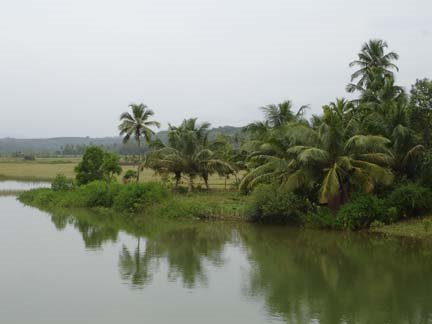
Holegadde near Honavar,Uttara Kannada dist, Karnataka
Copy? Right - but kindly remember to acknowledge!

" tulu-research.blogspot." ತುಳು ರಿಸರ್ಚ್. ಬ್ಲಾಗ್ಸ್ಪಾಟ್. ಇನ್

Have a nice day !