Village names like 'Kotrupadi'(pron:koTrupādi) open up windows into forgotten early chapters of the human evolution in the Tulunad. The Kotrupadi is a hamlet within Kallamundkur village, located on the Mulki-Mudabidri road in Mangalore taluk. There is one more ‘Kutrupadi’ near Bantra village in Puttur Taluk.
There may be many more such hamlets known by similar sounding names. What is the ‘Kotru’ or ‘Kutru‘ stand for in such place names? My casual enquiries with random people near such villages do not elicit any meanings worth pondering. There are some more such words: ‘Kottigehara’ near Charmadi, bordering Chikmagalur district, on the Western Ghats (Sahyadri ranges). ‘Kottur’ in Bellary district. ‘Kottara’, inside Mangalore city.etc.
Koytoors
Gond tribes now residents of Vidarbha region in Maharastra are known as ‘ Koytoor’ or ‘Koitur’ or simply ‘Koi’. Gonds are a hilly tribe (‘gond’ or ‘kond’=hill) who are cultivators or depend on forest products for their livelihood. Gonds are said to be Dravidian tribes. Some sociologists also include these tribes among pre-Dravidian Munda Group. These dual classification of Gonds suggest that these tribes could be representatives of the stages of evolutionary trends from the early Munda to Dravidian tribes. Sham.Baa. Joshi refers to Goddess “Kotturi” in some of his works. ‘Kotturi’ Goddess is probably related to Koitur or Gond tribes.
Books like “Socio-cultural study of scheduled tribes: the pardhans of Maharashtra” by Shashidhar Ramchandra Murkute and “Gonds of Vidarbha “by S.G. Deogaonkar throw better light on these tribes.
The presence of abundant place names with prefix ‘Koi’ or ‘Koitru’ or ‘Kotru’ in Karavali Tulunadu and other parts of Karnataka reveals that these tribes lived in these regions once upon a time. And due to various adverse reasons these tribes might have migrated north towards Vidarbha in Maharastra. Many of the ancient socio-religious customs of early Gond tribes have been assimilated into the cultural practices of subsequent Tulu and other Dravidian generations.
Ancient Gonds of Tulunadu
The existence of place names beginning with ‘Koi’- (Koikude, Koila etc) and ‘Kotru’-(Kotrupadi, Kottara, Kottigehar etc) in Tulunadu are the remnant signatures of ancient Koitur Gond settlements. The agricultural implement ‘Kottu’(hand showel) may be having origins with ‘Kotru’ tribes. The earlier Koi and Kotru tribes were possibly partly absorbed into later Dravidian communities as seen by the undercurrents of ancient Gond customs among us. Assimilation of tribes suggest that they were evolved enough to gain respectability by the immigrants.
Further, ‘Gondarannaya’ has remained as a ‘Bari’ (septa) and ‘Konde’(<.Gonde), ‘Kotari’, ‘Kotriyal’ etc have remained as surnames especially among Tulu Nadava people.
®

A heritage blog by: Ravindra Mundkur & Hosabettu Vishwanatha
Showing posts with label Koikude. Show all posts
Showing posts with label Koikude. Show all posts
Friday, December 4, 2009


Wednesday, August 26, 2009
205. Harvesting Sites
We have discussed in the previous post about the Karavali place names in the form of agricultural settlements named after the process of planting seedlings, beginning with prefixes such as Nit-, Nid-, Net- and Ned-. These variants could be suggestive of the trends in the evolution of words during the passage of time.
Apart from the Planting agricultural sites, we also have several place names implying the sites of harvest in the Karavali and also other parts of Southern India. Thus the word 'koi' is not exclusive to Tulu or Kannada but is common for all south Indian Dravidian languages.
Koi tribes
The word “koi” means to cut (the crop)mostly using a sickle. Thus ‘koilu’ means harvest. Check the following place names for suggestion of harvesting sites in the Karavali. However, the word 'Koi' also represents the name of a tribe. Gond tribes were referred to as Koi and Koitur.There is a possibility that the word 'koi' originated from the said tribes.
Koikude: (koi+k+ude). (1)Koi= Gond tribes, ude=place of.Alternately,(2)Koi=to harvest,k=good, ude=place. Koikude is a village with scattered rocky outcrops and agricultural fields in Mangalore Taluk, located between Haleangadi and Kinnigoli.
Viswanath opines that it could be koi+kude, wherein 'kude' possibly represents sickle,used for harvesting.
Koila: (koi+ala). Harvesting (koi) site besides a stream(ala). Koila is a village near Uppinangadi. Another Koila is in Bantval taluk.
There are places with prefix koi- in Kerala and Tamilnadu. For example:
Coimbatore: (koi+ambatta+oor). A divine village of koi tribes or a harvesting village. Amba-tta = divine, (Amba=Mother goddess?). A major industrial city of Tamilnadu.
Koilandi: (Koi+ala+andi). A Taluk headquarters in Kozhikode (Calicut) district of Kerala.
Koyna (Maharastra). koy+na.= A habitation of Koi people.
Reproductive aspects
The 'koyilu' also meant the standing crop ready for harvest. Further 'koyyel' was the extent of crop area (about one tenth of an acre)that can be harvested by a single person in a day.Thus it is clear that even though the verb 'koi' originally means to cut, the derived word 'koyilu' has been applied to the reproductive (harvest) aspects of agricultural crops.This is further evident by the usage of the word 'koyile' for the reproductive parts of women.
It may not be surprising if the word 'kovil'( the temple) current in some of the Dravidian languages,was evolved out of some of these words.
-with Hosabettu Vishwanath
®
Subscribe to:
Posts (Atom)
A Coastal estuary
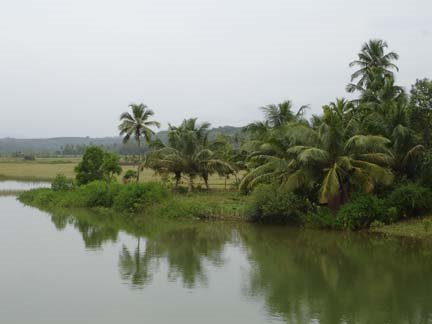
Holegadde near Honavar,Uttara Kannada dist, Karnataka
Copy? Right - but kindly remember to acknowledge!

" tulu-research.blogspot." ತುಳು ರಿಸರ್ಚ್. ಬ್ಲಾಗ್ಸ್ಪಾಟ್. ಇನ್

Have a nice day !