In deciphering etymology of place-names, accuracy plays a vital role, therefore philological and topographical conformities to the places need to be verified. In the absence of any systematic study of Tulu Place-names, local legends are the known documents for reference. The ‘Sthala Puranas’, have been woven around legends as a means of aggrandising the greatness of places of worship, (aptly called ‘Sthala Mahatmye’), and hence may or may not be faithful to the original meaning of the place name.
Our place-names are mostly are made of two or more compound words, that reflect mostly geographical, evolutionary and tribal signatures of the location.
In Post No.186 (dated 25.05.2009), we have provided some cognate place-names distributed all over India such as :
Prefixes (such as Ad/Ade, Adya, Agad/Agal/Agar, Al/Ala, Ar/Are, Bar/Bari, Bel, Er, Kunji (=hill, e.g. Kunjibettu), Mal/Male, Mad/Man, Pa/Pan and
Suffixes (viz. Banja = Barren, Kanja = Reddish, Punja = Rocky, Renja = fragrant; ang/angadi/angar, ar, ooru/ur, od/odi, oli, oni, ade, adka, adiri/adri, anje/anje, Ja/Je/Jar, kodi, kodu/god/godu, goli, ga/gao/gaum, khed/kheta, gal/kal, kala, kona/kone, kudru, kula/kola/kolambe, kuru (=manja) = raised place, valli/pally/hally mād/mādi, mar, mār, man/manner, pad/padi, hat/haad/haadi, Padpu, padavu, pe/pu/pur, se/sar, wal/wadi) etc commonly found in place-names of Tulunadu. This was an attempt to show a layers of past socio-lingual history, common to regions. Attempts were also made to explore and analyse various Tulu place-names. Readers would appreciate if they read Posts, 116-152, 127 (on Proper names), 141 (Village name suffixes), 162 (Evolution of Tulu Language), 192 (Place-names with root of old diction in Tulu), 209 (Dravidian place-name cognates), and No.238 (Dark, Forest and Bay) etc.
One place , more names
Difficulty arises in analysing the etymology when there are many names for a place, Eg. Posodi (Posa+Odi). It is known as Hosabettu (in Kannada) in Government revenue records. Narayan A. Bangera, Mitrapatna (Mumbai) opined (Ref: Mogaveera, October 2009 – p.2) that ‘Posodi’ is a corrupt abbreviation of ‘Posa Kodi’. He is silent about earlier name of Posodi. (Legend: Jarandaya or Jarantaya, the Divine Spirit, follows Nandu Marakala and expresses his wish to stay at his village. Devout villagers construct a temple, wooden chariot and erect a ‘Posa Kodi’ (= New Flag Post), and conduct periodical annual celebration ‘Nema’ thereafter). The word ‘Odi’, though now stands for ‘place of habitation or settlement’, has many shades of meaning, such as Divine place (as in ‘Pitrodi’), Port or sheltering station (as in Airodi = Ayer + Odi). Word ‘Odi’ also refers to agriculture, breach or bursting of ridge or bund, as we can make out in ‘Odikanda‘ and Odipu (Former location of Udupi – so named possibly due to bursting of a Sandbar in a rice field in a remote past).
English Poet Wordsworth has beautifully expressed in verse the changes wrought in British Place-names by the Saxon conquerors. Readers might have read his poem (Monastery of Old Bangor) on naming of places:
“Another language spreads from Coast to Coast,
Only perchance some melancholy stream,
And some indignant hills old names preserve,
When laws, and creeds, and people all are lost I “
Global spatial word : ‘Kar’
There are so many place names suffixed ‘kar’ and ‘bar’ in Tulunadu. In the last Post No.238 we have explained the various shades of meaning of ‘kar’ and related place names in context of Tulu culture. In this Post, we are giving examples of place names in Indian as well as global context with regard to ‘kar’.
Stem ‘Kar’
Various meanings, assigned to the word ‘kār’ are : (1) Leg, (2) Exude or seep, (3) Dark coloured or black, (eg, kari=soot; kartale >. kattale=darkness. (4) Forest, (5) Clouds; rain and rainy season, eg. kārtelu – period of June-July, (6) Sea coast/brackish water (‘ubār’ in Tulu), river bank (7) Saline stream, estuary or bay. (Post 238). (8) ‘Kār’ probably was also the older equivalent of ‘kal’(=stone). Kār>.kal. Possibly, the prefix kār in place name Karkala stands for dark rock.
Karnataka: Karu+nata+ka (= black soil cultivated area), poetically expressed as ‘Karunadu’, is fertile land of black soil, immensely suitable for farming since ages. Paleo-botanical evidences and ash mounds suggestive of ancient farming in south India were recovered from this black cotton soil region. However, Adrian Room’s book on ‘Place names of the World’ considers it as ‘karuppa (=black)+natu (=country) as a Tamil word. It is an erroneous interpretation. Kar, kari or karu is a Proto-Dravidian word common to Kannada, Tamil , Tulu etc – so, borrowing, or lending of words need not be visualized. It was a land of turu-karu (=cows and calves) and Turukāras (=farmers), preponderantly from ‘Kanna’ tribes; hence ‘kanna+ da’, i.e. Land of Kanna tribes.
Karyodi (Kariya>Karya+Odi): It is the old name of Kārkala, land of granites with dark exteriors. Geographically located on the lower flanks of the Western Ghats (Sahyadri), it is a Taluk Town in Udupi District. In Tulu, it is called as ‘Karla ( kār+la ), meaning an area of dark rocks by the side of a water-body. Rama-samudra lake is a perennial water supply source here. There is a monolithic Bahubali statue, popularly known as Gometeshwara, besides many granite monuments, that make Karkala a popular Jain pilgrimage centre.
Kārla reminds us another place: ‘Karla’ Caves (also known as Kārli ) near Lonavala in Maharashtra. It is a Theravada Buddhist Monastery. Topography here is similar to that of Karkala.
The word kār can also be found in many place names outside India. Consider the following examples:
Karnak: It is a village in Northern Egypt on the Nile. This name is derived from ‘kar’, meaning ‘stone’. Northern part of France is beset with many megalithic monuments. This place is also called ‘Carnac’, resembling the sound of ‘Karnak’.
Khar: Capital of Bajaur Agency, Pakistan.
Kara Sea: Sea in Northern Russia. The sea, an arm of the Arctic Ocean, takes its name from Kara River that flows into it. The river gets its own name from Mongolian word ‘Khar’ (=black).
Kara-Bogaz Gol: Lake in North-western Turkmenistan. The lake, a former inlet of the Caspian Sea, has a Turkmen name, meaning ‘Lake of black strait’ from ‘Kara’ (=black)+ bojaz (=strait, literally throat) and kol (=lake). The strait was formerly a narrow entrance to the inlet. The black colour is attributed to dried the local salt deposits.
Karacadag: Mountain, South-eastern Turkey. The mountain’s name means: ‘blackish mountain from Turkish Karaca; kara (= black) + dag (= mountain).
Karachi: Karachi is a bay described by Greek historians as ‘Krokola’. The port of Karachi was founded by Kolachi (Buloch tribes), a fishing community. Mai Kolachi put up a family and hence the village takes her name, which is still there. It grew as a trading centre with a fort constructed. Western side gate of it is called ‘Kharra Darwaaja’ (Brackish Gate - Khara+dar) and the other side gate facing Lajari River is known as ‘Meetha Darwaaza’ (Sweet Gate – Mitha+dar).
Karaichichi: Means a bare land along sea coast or lagoon coast, subject to salt water.
Karvi/Kharvi of Karwar and Karaavas of Sri Lanka are coastal people.
Kara-Kul (=Black lake): Frozen Kar-kul structure in Tajikistan is an inaccessible area. It is partly filled by the 25 km dia Kara-kul lake. It is located at 3900 m. above sea level in Pamir Mountain Range, bordering Afghanistan. Kara-kul lake, was formed out of meteorite impact crater around 5 million years ago. It is discovered recently by NASA Space Shuttle imagery. It has no drainage outlet. There are lakes with similar names in China and Uzbec.
Carrara: It is city and commune in the province of Massa-Carrara (Tuscany, Italy), famous for the white and blue-grey marble quarried there. According to a hypothesis, it is pre-Roman term, borrowed from Latin, Carraria (=quarry). ‘Kar’ (=stone) + aria (=place) = Carraria = Place of stones.
Ayastan > Karastan: It stands for Armenia, the stone country. Located between East and West, it withstood onslaughts of great empires of antiquity such as Rome, Iran, Byzantium, Arabs, Seljuks and Mongols. Ara/Are’ in Tulu language, equivalent to ‘Kara’, has also a meaning, among others, of ‘stone/rock’. Mark the word ‘Karba’ in Tulu, meaning iron ore or iron.
Mangar: Possibly Man + Kar: It is an old area in Mangalore, A spirit shrine still stands as a testimony to this old location name. Old names of Mangalore are discussed in earlier Posts in this Blog. Postulation of chronological occurrence of these place-names is difficult to arrive at. Mangarda Kariya or Mangaarakariya is a ferry point where pedestrians cross Netravathi River from Mangalore to Ullal on the other side. This place is located near Pandeshwara where a spirit shrine .
Kar(a), Ker(a), Khar/Khari, Kher (swampy area): These are notable words. We have designations to place and people, based on these words. Khar (Mumbai), Kherwadi (east of Bandra, Mumbai), Karkera(Kar+kera) and Bangera (Ban+Kera) surnames in coastal Tulunadu. Karkar surname in Maharashtra ought to have connection to coastal side.
We are listing below some of the Indian place-names with the spatial word ‘Kar’ for the readers to guess and analyse.
Andhra Pradesh: Karamchedu, Karavadi, Karanji, Kareyagudem.
Bihar: Karakat, Karba.
West Bengal: Karandighi, Karanjali
Gujarat: Kara Ghogha , Karakhad, Karakthal, Karannagar, Karbatiya.
Haryana: Karanpur
Karnataka: Karje, Karki,Karadi, Karagaon, Karahalli (2 - one in Bangalore), Karajagi, Karakurchi, Karamadai, Karankote, Karapure, Karatagi, Karandalaje, Karamdoor.
Kashmir: Kargil, Karakaoram.
Kerala: Karakkad, Karakonam.
Maharashtra: Karjat, Karad,Karghar, Karadkhed, Karanjagi, Karamba, Karambali, Karamboli (Kalamboli), Karandi, Karamwadi, Karanj Phen, Karanja (2 – one in Wardha), Karanjala, Karanji (2 – One near Pune), Karanji Kaji. (Note: Suffix ‘ad’ in Maharashtra, mostly means forest but, in Karad it is made of: Karhat>Karhad>Karad).
Madhya Pradesh: Karakbel, Karanja Bhilai, Karanjia, Karanwas.
Orissa: Karachuli, Karamal, Karamdihi, Karanjia
Punjab: Karamgarh Sataam.
Rajastan: Karauli.
Tamilnadu: Karachurri, Karadivavi, Karaikal, Karaika Medu, Karatadi Palayam, Karavalur.
Uttaranchal: Karan Prayag.
Stem ‘Bār’
‘Bār’ means a vast open area, beside sea shore or river front. We know maritime trade thrived with good water transport system. ‘Bari or bali’ (lineage surname) as we explained in earlier Post on the subject, was coined for the clans living together in such settlements. These places developed into ‘nakhar > nagar, i.e. city. Today, it stands for an important place or city. Parts of Karkala and Panambur were also called Nakhar in the past.
In Sumerian language, ‘bār’ has the meanings of “open, expose, uncover.”( Euskara Magyar List-6)
In Afro Asiatic languages, ‘barri’ = open (of land), rural; Arabic: barr/burr = open area. A city in Dubai is called ‘Burr Dubai’.
Let us consider a few place-names with ‘bar’:
Barakur: Historical town Barakur has been analysed as ‘bara + kur’ as well as ‘baraka + ur’.
Kudumbara: Country of Kudi or Kuduva, an agricultural tribe of Dravida/Tulunadu.
Malabar: A country or place of mountains, as in Kerala and Mumbai.
Nicobar: It is known as Car Nicobar and described as (1):(in Hindi) 'Nagda' (=naked)+'Varam' (=country). Or the land of the naked tribes. Adrian Room an Arab historian (C.1300) wrote that the men were entirely naked whereas their women wore only a girdle of coconut leaves.
(2) It is corrupted form of 'Narikela dvipa', meaning a land of coconuts trees.
Zanzibar: Two Arabic words – Zing (meaning ‘black’) + al-bar (meaning ‘land of’). So it means the land of Blacks, i.e. Negro Coast.
Baramulla: An area in Kashmir attributed to Varaha Mula.
Conclusion:
Traditional tribal thoughts obviously revolved around the Nature. Our ancestors’ complete integration with Nature is reflected in the Place-names. Thus, in many cases the place-names have become identity marker of the ancient tribes.
Lack of inquisitiveness or interest to know the meaning of place-names is apparent by the absence of comments from readers. We want our readers to follow Bacon, who says: “Read not to contradict and confute, nor to believe and take for granted, but weigh and consider.”
- H. Vishwanath, 30.04.2010

A heritage blog by: Ravindra Mundkur & Hosabettu Vishwanatha
Showing posts with label kar. Show all posts
Showing posts with label kar. Show all posts
Sunday, May 2, 2010


Sunday, April 25, 2010
238. Dark, forest and bay
Fusion of several coexisting subcultures that had independent languages during the course of human historical evolution must have created eventually not only varied evolutionary set of meanings for each word, but also several similar sounding words having dissimilar meanings.
As an example of this, we may consider the word kār:
The common meaning of the word ‘kār’ in Tulu language is leg. (Equivalent: kāl in Tamil, Kannada). This word ‘kar’(1) (=limb, leg) has been considered to have origins in ancient Sumerian word ‘garro’. Tulu has also another kār (2) (verb: ‘kāruni’) which means exude or seep. For example, seepage of toddy liquid from the toddy palm (Kannada: kāru= vomit).
However, kār (3) in many place names means dark, dark colored or black. Kari= black, soot, carbon.
Note: Variants of kār (3) can be seen in kār (4)=rock,[kar>kal=stone],(5)kar = forest and kār (6) = cloud or rain.
(kār =forest (5) because it is dark(3); kār= cloud/rain(6) because rainy clouds are dark.)
I. Dark villages
Obviously there is a disadvantage in having several possible meanings for a single word (like kār) as we may be unable to ascertain unequivocally the originally intended meaning a village name.
Check the following place names:
Kārgal= (kār+kal) Dark colored rocks.
Karoor=(kar+oor). A Dark village. (Dark colored because of the black soils?)
Karadi =(kar+aDi). Dark (=black soil?) or forest settlement.
Kāradka =(kār+aDka). Dark, tree covered (ancient) burial field.
Karinje= (kar+inje). Dark rocky area.Karinje village is near Mudabidre, Mangalore Taluk. Alternately, the word 'kārinja' also represents the name of a wild flowering plant.
Kārinja= (kār+inja). Forest area. Kārinja is a dark,large granitic hill, with a famous temple on top, in Bantval Taluk.
Kārkala= (kar+kala). Dark colored rocky plot (because of blackened rock outcrops).In Tulu, Karakla is known as Kārla (kar=dark,rocky + la= habitation beside water body of lake)
Ajekār= (aje+kār). Lands (adjoining) a dark forest.
Kannada
The word Kannada has been considered by some as derived from ‘Karnad’ or ‘Karunadu’.
Kārnādu= (kār+nāDu). Dark (black soil) cultivated area. Originally the Kannada Kingdoms during the history flourished in the expansive black soil covered cultivable planar regions of northern Karnataka. Hence the name kar+nāD=dark soil cultivated area.
However,an alternate school of thought by Sham Baa Joshi has suggested possible derivation of the same word 'Kannada' as (Kanna+ Da), the region of Kannar tribes.
II. Saline bay
The word kār has another set of meanings relevant to (7) Sea coast, (8) Saline bay or estuary or saline streamlet. The related Prakrit (?) words are ‘khār’ or ‘khāri’(=bay or saline).
Thus the following place names could be related to this set of meanings:
Kadekar: (kaDe+kār).End part of a saline bay or stream. There are at least two Kadekar localities one near Udyavara, Udupi another near Jeppu, Mangalore.
Kāramogaru: (Kara+mogaru). A Saline river bank. Karamogaru locality is located on the northern bank of Gurupura River, Gurupura village
Kārnād= (kār+nāD). A saline stream beside a cultivable area. The place Karnad near Mulki has been made famous by author Girish Karnad. Historically, Karnad is associated with the name of freedom fighter par excellence Karnad Sadashiva Rao. A main road in Central Mangalore carries his name (though now known in abridged form as 'K.S.R. Road'. The original saline streamlet of River Shambavi(Mulki) beside Karnad has apparently changed position during the course of history.
Karnire= (kar+nire). Saline waters. A village beside Baluknje, near Mulki and Padubidri.
Kārkada. (kār+kaDa). A ferry point across a saline bay or tributary. Karkada is on the West coast, near Saligrama, Kundāpur taluk.
III. Calf pen
There is possibly one more 'kar' (8) =pen for calves, the word being derived from Toda language. There are distinct signatures of Toda cattle breeding tribes in Tulunadu as evidenced by place names such as Todar.Apparently, the Kannada word 'karu' for calf is derived from this source.
Karopādi =karo+pāDi. A settlement of cattle breeders and calf pens.
- With H.Vishwanath.
®
Subscribe to:
Posts (Atom)
A Coastal estuary
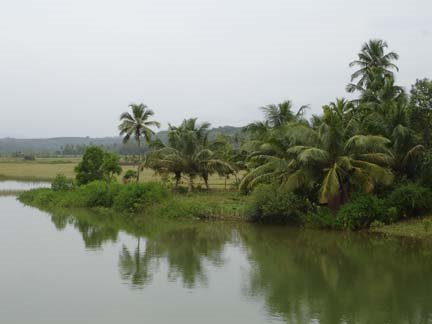
Holegadde near Honavar,Uttara Kannada dist, Karnataka
Copy? Right - but kindly remember to acknowledge!

" tulu-research.blogspot." ತುಳು ರಿಸರ್ಚ್. ಬ್ಲಾಗ್ಸ್ಪಾಟ್. ಇನ್

Have a nice day !