Er/Eri has many shades of meaning (See Tulu Lexicon pages 486-487):
Eri = A species of a tasty fish (A wise-saying is prevalent in Tulunadu: “Eri tindudu bori’ maariye.” It means, the man addicted to the taste of ‘eri’, sold out his bullock). Bullock/Bull is an indispensable thing for a farmer. Also, it is a complementary to cart, for transport of goods and travel even in these days. Moral of this proverb is that one, who cultivates uncontrolled tastes to something, becomes reckless in life without minding the outcome).
Eri = A seed-bed, i.e. a bed or raised strip of soil for sowing seeds and planting vegetables.
Eri = Who are you?
Eri = Heat from fire or the Sun. Also means pungency of chilli.
Eri = A bund or bank in agricultural fields. Note the proverb in Tulu: “Erigu (Dande = bank to a water-course) neerda bala, neergu erida bala (=support). Neer and Eri are complementary to each other and hence their inter-dependence for survival).
Eri = An element of place name (Examples: Erya, Neriya, Erikkala (in Tulunadu), Andheri (MS), Vankaner (Guj). Tamilnadu and Srilanka have many place-names with this name-part.
Neriya
We expound below the landscape or topography of Neriya in Tulunadu (Dakshina Kannada District with an attempt to arrive at its possible meaning.
Neriya (N’eri+ya). ‘Ya’ means a place or habitation. From this, we construct the meaning as ‘neera+erida+ya (=oor)’ (Post No.190). In terraced farming in hilly areas, there is a necessity of constructing ‘kattas’, dykes or bunds and tanks, to store water from (rapidly flowing) cascades, streams and brooks for daily subsistence and irrigation.
The word ‘neari’ is a good example for the survival of Proto-Dravidian strain in the place-names of Srilanka and for the affinities of this strain with the dialect of Southern tip of Tamilnadu. We have gleaned some related place-names in Sri Lanka with ‘neari’ as constituent thereof from ‘Tamilnet’. With due apology, we give them below:
Vaaka-neari/Vaaka-nearik-kulam (The reservoir of Vaakai trees/The banked reservoir of Vaakai trees, Van-nearik-kulam (The banked reservoir of Vanni trees), Thuvarai Neri = Bank of Thuvarai shrubs.
-Hosabettu Vishwanath
----------

A heritage blog by: Ravindra Mundkur & Hosabettu Vishwanatha
Showing posts with label sea erosion. Show all posts
Showing posts with label sea erosion. Show all posts
Monday, June 8, 2009


Sunday, April 20, 2008
110. Mukka

Bhagavathi temple at Kadike,northern beach of Mukka-Sasihitlu.
Travelling northward from Mangalore to Udupi, after Surathkal you shall find places called Mukka and Sasihitlu, where Pavanje and Mulki rivers confluence before debouching into Arabian Sea. A northern part of this coastal beach area is called 'Sasihitlu' or 'Kadike'. ‘Sasihitlu’ can be translated as a compound consisting of seedlings and the ‘Kadike’ refers to short native grass or the ‘garike’.
The part of Mukka beach is known as Mitrapatna,possibly signifying influence of Buddhism .However,it is said that the name Mitrapatna is a recent one,ca. 1920 (Hosabettu Viswanath). Near Kadike in the northern part of Mukka,is a Bhagavathi temple evincing eroded marks of transition from Buddhism to Hinduism.Some more studies may be requirred to prove or disprove the Buddhist heritage of Mukka, apart from the Bhagavathi temple.
A part of the beach area between Mukka and Sasihitlu is designated Lacchil meaning a garden with cultivated plants.Note the analogies between the words Sasihitlu and Lacchil.
Mukka
Mukka appears to be an unusual place name. The word Mukka means deformed. It also means ‘blow with the fist’ signifying destructive attack. Of the several words derived from the Mukka, the interesting one is ‘mooka’ (=dumb).
Sea erosion
Well, to explain why the place acquired such a negative or ominous name, we have to take the help of coastal geomorphology and geography of the area. The Mukka beach is known for severe sea erosions during the monsoon period. Severe sea erosions involve destructive attack of powerful storm surged sea waves that destroy the delicate sandy beaches. The coastal wave attack destroys, in successive stages, everything that is near the beach such as plants, buildings and structures.
It seems the beach was destroyed many times in the historical past due to severe sea erosions which prompted our ancestors to name the place as Mukka!
This again proves that our ancestors were highly conscious of the geography of the places they lived in.
Mukha.>Mukka
There is one more interesting legendary angle to the derivation of the place name Mukka.
A divine connection is cited by Mithrapatna Narayan A. Bangera in his book 'Kandevu Kshetra Mahatme'. As against the several reincarnations of Lord Vishnu, Lord Shiva has a few ones. He established 'Tulasi vrindavana' in every home by destroying Tripura. He bestowed longevity to Maarkhandeya, son of Muni Mrikhandu. He became the main deity of Dravida Race by appearing before Hunter Kannappa, who offered his own eyes in devotion. In the guise of a hunter, he bestowed Pashupataasra to Arjuna. He appeared as 'Dharmarasu Ullaya (meaning 'Swayambhu)' in River Nandini in the form of a face. The west of River Nandini where he put his face is called mukha(=face)>Muga>Mukka. The place where he 'espied to stay' is now called as Kandya/Kandevu (also Khandige). Thus these western and eastern sides of Nandini are considered as sacred places.The Yermal Festival is harbinger of festivals of Tulu Nadu and Kandevu festival signifies end of festivals in a year. Hence the famous saying: "Yermal jappu Kandevu Adepu".
Acknowledgments: Hosabettu Viswanath
®
Sunday, January 27, 2008
81. Barakur II
Some more explanation on the origin of the word Baraka+Oor!
Viswanath pointed out an interesting and related Tulu word ‘barakane’ that helps us to understand the meaning and significance of the word ‘baraka’ or ‘barka’ in Barakur/ Barkur. The word ‘barakaNe’ finds entry under the variant ‘barankaNe’ in the Tulu nighanTu (p.2236; Vol. 5).
barakaNe
The word barakane is used commonly along the beaches of Kapu, Kaipunjal, Polipu where the devastating effect of severe sea erosion is a commonplace event during monsoons. The severe sea erosions along beaches of Karavali initiate during the peak monsoon, with development of beach-parallel linear faults (fractures) in the near-shore seabed (triggered by storms, as a consequence of increase of pore water pressure in the beach-estuary environs).On the linear fault, the seaward sandy layer usually slumps vertically downwards leaving a depression or ‘gundi’. The opposite, beach-ward face raises vertically upward like a wall, one to two meters in height. The process is called ‘barakaNe’.
Hence, the word ‘baraka’ refers to the raised or elevated part of land by the side of river. There are several related words in Tulu that provide shades of similar meanings: bare (=linear ridge), barike (=large house/manor on an elevated ground), barak (=raised, filled), barata (=high tide), barakel (=filled, flooded), etc.
Earth movements
The Karavali region has undergone several periods of earth movements even during the recent history (of last four to five thousand years).The Barkur- Hoode -Bengre area has also experienced such changes in the morphology of the earth.
Our observant ancestors have employed meaningful place names that document the significant past events.
®
Subscribe to:
Posts (Atom)
A Coastal estuary
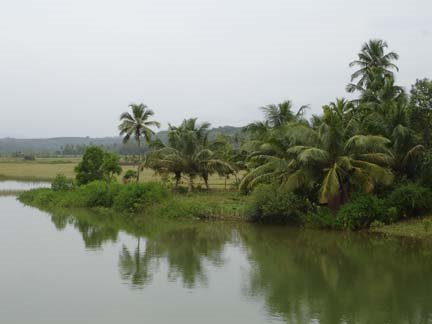
Holegadde near Honavar,Uttara Kannada dist, Karnataka
Copy? Right - but kindly remember to acknowledge!

" tulu-research.blogspot." ತುಳು ರಿಸರ್ಚ್. ಬ್ಲಾಗ್ಸ್ಪಾಟ್. ಇನ್

Have a nice day !