Who were the Neolithic tribes that inhabited south India in terms of ethnicity?
The archeological pre-history of human evolution is conventionally divided into (a) Paleolithic [=Old Stone Age] representing age characterized by use of primitive stone tools by the early human beings and (b) Neolithic [=New Stone Age] representing use of polished or refined stone tools like stone axes. In some areas an intermediate ‘Mesolithic’ [=Middle Stone Age] age has been recognized between the two.
Paleolithic usually refers to pre-LGM (Last Glacial Maxima, ca. 18,000-10,000 years ago) or prior to the Last major Ice Age on the Earth. Neolithic usually refers to post LGM evolution that heralded domestication of animals, farming, agriculture, and establishment of villages and also development of crafts such as pottery and weaving etc. Neolithic Age has been recognized at slightly different time periods at different places.
In the southern India, Paleolithic stone tools have been reported in association with volcanic deposits (formed out of the aerial spread of emanations from the massive Mt Toba volcanic eruption, in Sumatra, ca.74, 000 years before present) from the archeological excavations carried out in Jwalapuram (Kurnool district, Andhra Pradesh) and other areas. These suggest the existence of early human tribes in southern India since that estimated age.
Similarly, archeological evidences for the existence of Neolithic civilization have been excavated in the formations dated ca. 2800 to 1200 BC from several sites spread in Krishna and Tungabhadra river basins of Gulbarga (Budhihal, Watagal), Bellary (Sanganakallu, Hiregudda, Tekkalakota) and Bijapur districts.
Archeological data on Karavali sites are not reported adequately so far either due to paucity of studies or due to destruction by natural elements such as heavy rainfall, changes in river channels and fluctuation of sea levels.
The archeological excavations studies by Paddaya, Korisettar and others in peninsular India (parts of Eastern Karnataka and Andhra Pradesh) followed up with archeo-botanical studies by Dorian Fuller and others indicate a pastoral (ash mound culture) and agricultural society that was growing millets, tubers and pulses like urd, green gram, horse gram with minor wheat and, barley. The occurrence of rice granules associated with younger formations suggests that rice was introduced later around ca.800 BC in the area.
The above data reveals that the early human beings settled in South India since Paleolithic Ages and evolved agricultural-farming inhabitations during the Neolithic Age. The inhabitants grew pulses (Tovar, green gram, horse gram and black gram), millets, tubers with minor wheat and barley. The ethnic identity of these early Indians corresponds with the Early Munda lingual-cultural substrata described in the earlier posts. Secondly, the rice was generally unknown to them until it was introduced by early Dravidian immigrants around 800 BC or later.
Basic lingual-ethnic fabric of India
In spite of the fact that the present generation of Indians are admixtures of several ethnic groups, the study of constituent ethnic groups may be of some interest to those who look for our early roots.
Basically, three major lingual-ethnic groups have been recognized in India: (1) Austro-Asiatic (or Munda) (2) Dravidian and (3) Indo-Aryan.
Of these, the Austro-Asiatic/Munda ethnic group that arrived and settled in India sometime during early Paleolithic apparently evolved into several lines of hunting-farming-artisan communities, as understood from the spread of extant and remnants of Munda group of languages and cultures.
Early views held that Indo-Aryans invaded the country that was dominated by Dravidian natives. Subsequently, Prof. Michael Witzel and others, based on the linguistic analyses of Vedas proposed that early Dravidians also migrated into India like Indo-Aryans. Similarity of Indo-Aryan Vedic stanzas with those of Iranian Zend-Avesta suggests mutual influence. Similarly the presence of Dravidian borrowed words in Vedic texts suggests that speakers of Dravidian languages co-existed with Indo-Aryan Vedic sages.
(In the meanwhile, some orthodox patriots have resented the Indo-Aryan invasion /migration theories and have introduced counter-proposals of out-of-India emigrations.)
Southworth Hypothesis
Prof.Franklin Southworth (2006) attributes the recent Neolithic archeo-botanical remains reported in Southern India to Dravidians. Southworth correlated the said archeological finds with proto-Dravidian words and proposed that Dravidian tribes and languages originated around Godavari basin. He suggests that “Since languages of all three subgroups (of Dravidian languages) are found in eastern central India, in the lower Godavari River basin, it would be most economical to assume that Proto-Dravidian was spoken somewhere in that region.” Dorian Fuller also followed Southworth proposal of Neolithic Dravidian culture.
Obviously, the present distribution of Dravidian languages and culture in southern India has influenced the thinking of Southworth and Fuller. Munda inhabitations are almost absent in present southern India. Munda tribes are presently distributed around Chotanagapur region. Thus, Southworth and Fuller have overlooked the Munda undercurrent that assimilated with the Dravidian culture in south India.
Southworth, however, notes that the list of faunal remains and depictions compares favorably with those listed for Late Proto-Dravidan words, though canids, felids, bears, and primates (along with several smaller animals such as the mongoose, squirrel, porcupine have not been reported in the archaeological findings. Similarly, while chickens found in 21.7% of archeological sites, (Korisettar et al., 2001) are missing from the inventory of proto-Dravidian words.
Early Munda vestiges
These discrepancies reflect that the south Indian Neolithic archeological finds represent the early Munda ethnic culture, rather than Dravidian as proposed by Southworth. Assimilated remnants of early Munda language and culture have been found in present Tulu and other Dravidian languages and culture in the form of vestiges of Munda words, customs and legends (like that of King Bali).
Later arrival of Dravidians (post 800 BC) into the region is also reflected by finding of the rice grain remains in archeological formations younger than ca.800 BC, suggesting that the immigrant Dravidians introduced the rice cultivation in southern India.
®

A heritage blog by: Ravindra Mundkur & Hosabettu Vishwanatha
Wednesday, November 21, 2007


Sunday, November 18, 2007
54. The legend of Bali
Deepavali is a very popular festival in India and the significance is explained as a celebration symbolic of our innate aspiration to progress towards light from darkness, towards knowledge from ignorance and towards prosperity from poverty. It is also described as a festival of thanks-giving to the Mother Nature. Deepavali means array of lights.
In spite of this modern, positive-thinking style of explanations, the fact remains that the festival was originally conceived and celebrated by his subjects as an annual welcome- back ceremony for their beloved exiled King Bali. King Bali variously described as Baliyendra or Bali or Maha-Bali or Bali Chakravarthy (emperor).Remnants of what was originally a pan-Indian custom in ancient days of early civilization remains even today in Tulunadu and Kerala.
Vamana incarnation
The legend of King Bali and Vamana, the dwarf, has been absorbed into Purana-s, with Vamana considered as one of the incarnations of Lord Vishnu. (cf. Post 34: Ten incarnations).According to the viewpoint of Vishnu’s followers, Bali (a follower of Shiva cult) was pictured as a despicable Asura who deserved to be subjugated. This was in conformity with the Sura-Asura conflict of pro-Vishnu and pro-Shiva cultures in ancient India.
However, the other side of the story is more interesting and throws light on the theological-cultural conflicts during the early historical period.
Asura King Bali
What was the great sin done by this Asura Bali?
He was a philanthropist to the core, who willingly gave away free gifts to the needy people!
If we brush aside all humanly impossible fantasies woven into the said legend, the remaining core story is that King Bali, was fond of giving away gifts desired by the recipient! The standing offers was that Bali would give whatever is asked of him! One clever, dwarf beggar (Vamana) came and begged him to grant land enough to place his three steps.(Or maybe, he asked that he should be given wherever he places his steps ).King Bali agreed to provide him whatever the dwarf desired and the mischievous Vamana placed his foot on Bali’s head! Thus, Bali had no other choice than offer himself to the wishes of the dwarf, who sent him to exile to a place called Patala.
The word ‘bali-daan’ (means ‘sacrifice’, but literally ‘gift of Bali’) might have been coined from the self-sacrificing act of King Bali.
Patala
The concept of Patala in Purana-s, describe it as a nether world, a parallel world beneath the Earth. Since, there is no realistic/scientific basis for such a illusory world, we can presume that the ‘Patala’ fantasy represented a sinking island beneath the sea level. Early historical Greek reports like ‘Indika’ report a sinking island called ‘Patala’ near the Gulf of Cutch.
Deepavali in Tulunadu
In spite of depiction of Bali as a villain by the followers of Vishnu, the actual subjects of Bali fondly remembered and continued to respect their exiled King! They believed that their King would return and pay a visit to his subjects once in a year. They celebrated annual welcome their King festival in the form of Deepavali!
The chant of ‘Poli Poli Baliyendra’ in rural Tulunadu during the Deepavali night echoes the age-old custom of welcoming King Bali. Similar customs prevail in Kerala also.
Onam
Dr Zacharias Thundy in his ‘Kerala story’ reports similar legends on Bali from Kerala. Onam, in Kerala, is the celebration of the return of Maha Bali,(or 'Maveli') the legendary former and future king of the land. The King Bali according to the folklores, ruled over the Kerala during the Golden Age before castes existed, "when all men were equal, when no one was poor, when there was neither theft nor dread of thieves.
Mahabalipuram, Mavalli
It appears that in the early historical (pre-Sangam) period, the legend of Bali pervaded throughout the south India. In Tamilnadu, Mahabalipuram in the East coast is a town built in honour of King Bali.
Similarly,the town Mavelikkara in Kerala is named after the Maveli or the Mahabali.There are villages named Mavalli in Karnataka also.(One such 'Mavalli' is part of Bangalore city now)
Asura-Munda culture
Dr.Thundy reports that the Munda tribes of Chotanagapur area also have legends (somewhat different from those prevalent in Tulunadu and Kerala) built around their Asura King Bali. Asura is a group within Munda tribes. Bali is a common name among Munda tribes.
Munda substratum
All these data lead to the suggestion that King Bali was ruling Munda people in early historical days before. It was before the castes existed according to folklores. Caste system was systematically enforced ca.300 BC during the reign of Maurya dynasty. A large section of Early Munda people that inhabited all over southern India once upon a time were a civilized society that honored truth, democracy, philanthropy and other good values of life. Munda tribes were ruled by benevolent Kings like Bali. Possibly this led to the conceptual classification of civilization era into Satya, Treta, Dwapara and Kali Yuga-s (epochs).
Assimilation of cultural components
The immigrant Tulu, Malayali and Tamil and other (south) early Dravidian tribes that came and settled in various parts of southern India during the period 700 to 400 BC, peacefully coexisted, merged and assimilated with the early Munda culture. In the subsequent years Dravidian languages became powerful vehicles of mass communication. Consequently, the independant identity of early Munda culture in southern India was totally masked under the burden of evolving societies. Remnants of original Munda tribes in southern India are represented by some of the tribal groups living today.
Genetic studies
The genetic haplogroup studies apparently are in favor of such a theory of assimilation of immigrant tribes with the aborigines that settled and evolved in southern India during Paleolithic- Neolithic period. Manjunath is making concerted efforts to compile the available data on the genome studies done so far.
The current Tulu, Malayalam Tamil and other south Dravidian languages still carry an implicit undercurrent of Munda cultural elements and words in them. The persisting legend of King Bali in Tulunadu and Kerala is only an example of such assimilated undercurrent of Munda elements in our unified culture.
Friday, November 2, 2007
53. More on Munda influence on Tulu.
The substratum of Munda language and culture that prevailed in the Karavali region has been amalgamated with the overall Tulu culture during passage of some past 2500 or more years of recent history. Yet the present Tulu language and culture has still hidden vestiges of Munda words and culture that can be deciphered. I have compiled some of the Munda words and cultural characteristics from online sources.
The Munda words cited here below are adopted from Munda Kharia lexicon compiled by Patricia J.Donegan and David Stampe (2004) base on field studies in present day Chotanagapur region in North-Central India. Apart from the chance of missing many original ancient words in the cited dictionary, it should be remembered that Munda words also have evolved regional variations like Dravidian or other languages. Some of the actual original, ancient proto-Munda words of south India may have been more nearer to present Tulu and other Dravidian words. And there could be many more words missing in this list that were eventually absorbed by Tulu language.
Tulu words adopted from older Munda language
Ajja ( aja=grandfather), aeri (aer =ridge), ajao (ajo’D =dry up), appa(apa=father), anDu (anDu =testicle), arka(arkhi=liquor), baar(ba), bala (bha=come on), batti (bati=wick), bave (bav=brother-in-law), churi (churi=knife), aena (ena=what,for), anjov (anDia=male), kanile (karil=bamboo shoot), sapura (sakura=thin), saal(sa:l=year), muDi (muDhi=puffed rice), pura (pura=complete), punnime (puni=fullmoon), Samudra (Samudra=sea), purku (purkha=generation), satyo(sat=truth), suru (suru=begin), Taari (ta:R,taaRi=palm), ter(=temple car)<(ter=to prepare, apply)>tayar., theriya( =round, necklace like)( theriya =plate, round necklace), tiga (tiG=to weave (hive?),toppi (Topi=cap), tuj / duj (tuj(=arrow), umma (um=no), ulTa,(ulTa =topsy turvey, upside down), urdu (urid=black gram), tude (tuDa=to float, water)
Munda based Tulunad place names!
Tulunadu has several villages with odd sounding or unintelligible place names whose meanings cannot be ascertained in present Tulu language! Meanings of many of these puzzling names can be solved by tracing their Munda roots.
Sirwa (=red thread), Parkala (=mirror), Parengi (= a variant of Munda tribe/language, meaning unknown presently), Nagori (= a variant of Munda tribe/language, means Naga settlement), Ubar (=two) For two-rivers? Uphe (=three) > Uppinangadi?. Bold words above indicate Munda words.
Some village names of Tulunadu are similar to Telugu words and earlier were considered to have been derived from the latter. For example: Rayi and Manchakal. It has to be verified whether these words came from Telugu or from proto-Munda, that gave words to both Tulu and Telugu.
Munda inspired Tulu month names!
In traditional Tulu calendar, the year start with the month ‘paggu’, beginning someday in January or February. The word ‘paggu’, apparently, does not have any understandable meaning in the current Tulu. ‘Phagu’ is an annual Munda festival celebrated at the beginning of Munda New Year, during Jan-Feb every year! So, some of the unusual or seemingly odd sounding month-names in the Tulu calendar may have been borrowed from the precursor language of Munda!
Munda inspired Tulu festivals
Origin of some of the traditional Tulu (also Malayali and Kodava) festivals may have roots in the ancient Munda culture. The Munda ‘Karam’ festival may have influenced the ‘Koral parba’/’Posatt’, ‘Onam’ and ‘Huttari’ festivals! The Munda word ‘Karam’ also known as ‘kaim’ or ‘kaddam’ refers to Kadamba tree. The Munda Karam festival begins with bringing flowers from the Kadamba tree. (Mitragyne parvifolia).The festival has similarity with ‘Kural’(=‘posatt’) festival of Tulu people that starts with bringing home new ‘Kural’ (fresh ear of paddy grains).
The Kadamba tree was considered auspicious during the earlier historical days. The Kannada dynasty founded (5th Century AD) by Mayura Sharma/Varma was known as Kadamba dynasty. It is said there was a Kadamba tree in front of Mayura Sharma’s residence at Banvasi.
Direction names in Tulu and Kannada?
The roots of two direction indicators in Tulu, Kannada and other Dravidian languages are derived from Munda language. muDu and paDu. Mudu =east .< (mu=come out), paDu (=west) .<(puD=jump, sink?).
The data relating to the origin of other two directional words: ‘baDa’(=north) and ‘tenka’(=south) is not available at present.
Munda words in Kannada
Early Kannada and early Tulu languages during and before Kadamba period were very similar to each other except for local variations and local influence of proto Munda words in Tulu and Kannada areas.
Note that the following Kannada words are of Proto-Munda origin.
Ajja (aja), aeri(aer=ridge), anDu (anDu),Hege (ighay=how?) enu (ena=what?), banda (banDa=castrated), churi (churi), bava (bav), baa (bha=come), baDagi (baDhi=carpenter), appa (apa), bhaga(bhag=share), bati (bati=wick), dhoti (dhoti), iswi (iswi=year), joru (joar, johar=greet), kamba (=pillar), kumbar(=potter), kaRba (karba=plough handle), mudhaliar (mudha=village head), suru(suru=begin), suley(suley=hot), ter (ter=to prepare, apply)>tayar, toppi(Topi=cap), turtu (turte=quick), ele(ula=leaf),Ri,re (re,ri =form of address).
Debatable origin of few Sanskrit words?
Some of the words are currently commonly used in Sanskrit and we generally assume them to be original Sanskrit words. However, there is need to verify whether these could be the words borrowed into Sanskrit from earlier Munda roots. For example:
Puja (=sacrifice), balidaan (=sacrifice), dharama (=supreme spirit), sa:t (=truth, seven). The word ‘Puja’ has previously been suggested to of non-Sanskrit origin. ‘Balidaan’ is a special word. Bali is a common Munda name. It is also the name of a righteous legendary Munda king, who sacrificed all of his territories in favour of a dwarf (Vamana) only to ensure his promise of Gift. It may not be surprising if this word ‘balidaan’ (=gift of Bali) has originated from that legendary/historical event.
The Tulu word ‘parba’ is generally assumed to be derivative of Sanskrit word ‘parva’. Could the Munda parab (=festival) be the original word from which Tulu ‘parba’ and Sanskrit ‘parva’ were evolved?
Thursday, November 1, 2007
52. Munda aborigines of Karavali
When Early Tulu tribes migrating from Pirak region came and settled in Karavali (coastal tract) of present Karnataka around 750 -600 BC, they found the coastal tract was already inhabited by civilized people living in village type settlements with agricultural, farming and pastoral occupations. The whole of southern India, especially all hospitable river banks and estuaries were inhabited by proto-Munda tribes.
Proto-Munda (south)
Let us use the word ‘Proto-Munda (south)’ to denote these aborigines of southern India because the generally prevailing socio-anthropological impression is that there are no Munda (language/ culture) groups in southern India at present. But there are distinct and strong evidences for their presence in southern India and by the time Early Tulu and Dravidian tribes arrived on the south Indian scene ca.750-600.
The Munda tribes are currently distributed in parts of central and eastern India. This present limited distribution of Munda tribes may be only the relics of a bygone vast empire of Proto-Munda groups that were spread all over India during the Neolithic period. They evolved into several subgroups and sub languages of their own before the arrival of relatively later entrants. The civilized among the Proto-Munda tribes during the course of subsequent history, were eventually assimilated with later entrants into the region like Dravidians and Indo-Aryans.
Early Tulu and Proto-Munda encounter
Early Tulu tribes initially settled in favorable estuaries of rivers proximal to the sea. Probably the estuaries and river banks of Sharavathi (around Honnavar), Swarna-Seetha (around Hoode-Hangarakatta), Haladi (around Barkur-Kundapur), formed the initial settlements of Early Tulu tribes judging by the distribution of major ancient primary settlements (moolasthanas).Adequate archeological supporting data may not be available for want of detailed studies or because of destructions due to extensive rainfall, fluctuation in the sea levels, changes in the river courses and floods that characterize the region.
Proto-Munda tribes must have been a dominant cultural group in Tulunad when people with ‘Tulu’ tag arrived from the north. As the Early Tulu tribes encountered Proto-Munda tribes, the former noticed that the latter are relatively a shorter breed, a physiology characterized by broad foreheads, Munda were wearing different attires or dressing styles. Early Tulu people coined several words containing Munda affixes to denote items new or strange to them but common for the pre-existing Mundas! Obviously,these words are not from Munda language but coined by early Tulu people.
So Tulu language acquired a few new words like ‘mundu’1 (= a sheet of cloth traditionally wrapped around the hips) ‘mundas’(a sheet of cloth wrapped around the head), ‘mundu’2 (a measure about five feet, average size of a Munda man in those days),’mundu’3 (=knee),’munda’(=forehead) etc. (The Munda tribes apparently had prominent, high or wide foreheads and their knees were exposed, unlike the new comers from colder region who covered their entire body in the beginning).
Newcomers from the northwest were of tall breed. They called themselves ‘aaL’ (=literally means one person) One ‘aaL’ represented six feet of height.
Both these relative height measures of ‘mundu’ and ‘aaL’ co-exist even now in rural Tulu usage.
Tulu tribes slowly encroached into the Karavali inlands, where Munda tribes already had built settlements. For convenience of refernce, Tulu tribes named these Munda dominated settlements like Mundadi, Mundukur,Mundaje etc.
‘Munda’ related words in Tulu
Some of the Munda related words coined in Tulu language are cited below:
1. Names of Munda villages/settlements:
Mundukur, Mundagaru, Mundagodu, Mundadi, Mundodi, Mundaje, Mundur, Mundrupadi, Mundaka, Kallamundukur etc
2.Names of Munda plants:
‘Mundevu’ (Pandanus utilis), Mundu tevu, Munda kalli,
3. Names for Munda Attire:
‘Mundu’(waiste cloth, a standard part of rural attire even now in southwestern coastal India), ‘Mundas’ (=a native headgear, fashioned by rolling and tying a longer cloth around the head),
4. Names of Munda measure:
1.one ‘Mundu’=about five feet. (Average height of a short Munda man).
Possibly Munda men were of shorter stature than the newly arrived Tulu tribes.
2.one ‘AaL’= about six feet (An average height of a tall man).
5. Names of parts of the human Body:
‘mundu’= knee, ‘munda’ =forehead. (Kasha ) ‘mundana’ =shaving head.
(The word ‘munda’ in Kannada refers to the trunk or the body part below the head, as against runda=head .
6. Name of Tribe/language: Mundala.
Friday, October 26, 2007
51.Stage III: Migration from Pirak . 800-500BC
The Pirak civialization phase was reported to have culminated around 800 BC. Tulu language even today has the retained word “pirak” that means ‘ancient’ or ‘aspects connected to remote past’.This can be considered as the fossil memory of Tulu people of their residence at Pirak. In other languages like Kannada the word survived as ‘prak’(=ancient) and Prakrit can be considered as the language of the pirak (prak) area. Prakrit is also considered to be the unrefined form of Sanskrit. Tulu and other south Indian languages have ample Prakrit words in them. Mostly, these were borrowed and assimilated during their residence in Pirak area. At the same time, early Tulu and other early Dravidian language groups lent some words that were absorbed into prakrit and Sanskrit.
During the 800-500 BC period most of the resident groups left Pirak region and entered India proper (as is now) and settled in comfortable areas nearer to water sources like rivers and perennial springs. Possibly, the groups left in different batches, maybe each of some 5 to 10 individual families of able bodied members and found their ways through the new territory before settling in relatively comfortable zones. It is possible that early South Dravidian groups consisting of early Tulu, Tamil, Kannada and Malayalam tribes migrated in different batches during the period.At this stage these early Dravidian languages were similar to each other and were more like regional variations of a single language. Predictably they settled intermittently at several places on the way before reaching their ultimate destinations in select parts of Southern India. The identity of early Kannada and early Malayalam ancestors probably carried different name tags then, since the present identity names ‘Kannada’ and ‘Malayalam’ were coined chronologically later and in situ in the present habitat.
Theological evolution
During the period Upanishads and Puranas were being compiled. The Rigvedic Gods Mitra, Indra,Varuna, Agni and others took back seat in favour of ascendacy of Brahma, Vishnu and Mahesha independantly among three different tribal groups. Brahma atained the status of Almighty Creator. The concept was further extended to include the all-pervasive cosmic force of Brahman. Valmiki, a hunter turned into bard and sage compiled the epic of Ramayana, based on primitive legend of Rama, that originally dated back to the post-LGM period when the sea-levels receded and Srilanka was accesible from Indian mainland on foot.The epic that highlighted the supremacy of the Lord Brahma, was subsequently edited and interpolated by several later authors, with liberal addition of fantasies and exaggerations.During the period, the Mahabharata was also being compiled, as an expanded and blown up version of battle of ten kings described in the Rigveda.
Another group, possibly led by the cattle-herders (Yadavas), upgraded and expanded the ancient legend of Vishnu. Vishnu, worshipped by early pre-Vedic, dark-colored tribes, was a minor god of lesser grade than the lord of Sea, Varuna for the Vedic sages during the compilation of Rigveda. Ten different theologic legends of the region were compiled together under the ten incarnations of Vishnu.(More on Vishnu and ten incarnations, cf. post 34 ).
Similarly, another group advocated the supremacy of Lord Shiva, who was tribal superman who possibly advocated the cult of phallus worship. Thus the phallic worship gradually merged with the Shaiva cult.Several tantric and mystic cults evolved during the period.
Yet there were many who did not subscribed to any of these theological cults.These dissatisfactions led to the development of Jainism and Buddhism. In response these diversions the followers of Brahma, Vishnu and Mahesha joined hands together and formed the concept of Trimurthy.
Similarly the primitive cult of Yoni worship assimilated with parallel Mother Godess worship that eventually evolved into the cult of Shakti or the Durga later in the history.
The Panjurli (Boar or Varaha) cult apparently originated in N Africa and Central Asia. The boar (or swine or Sus scrofa) is native of central Europe, Mediterranean, Atlas mountains, N.Africa and Asia. In Celtic mythology boar was sacred to Godess Arduinna. In Persian (Iran) Sassnid Empire, the boar was respected as a brave and fierce animal; the title of ‘boraz ‘or ‘Goraz’ (=boar) was added to the personal names of the braves. In Belgium, boar is the mascot of one of the infantry divisions of the Belgian army. In Chinese horoscope, boar is one of the twelve months of the zodiac
Early Tulu migration
Tulu tribes carried the Panjurli and Bermer cults of spirit worship from Pirak to Tulunadu as described in earlier posts. The early Tulu tribes were not inspired or influenced by theological evolution of Brahma, Vishnu or Mahesha. They adhered to their cults of spirit and serpent (Naga) worships. Tulu tribes picked up words from the languages existing in the regions they travelled through. Throughout the route from Rajasthan border to Tulunadu, we find numerous settlements named after Naga: Nagur, Nagor, Nagori etc. Similarly along the same route we find relics of ‘Bermer’ (horse mounted deity )worship that were later converted to ‘Brahma’(the creator God) worship especially in north India(example: Pushkar, Rajasthan).
Early Tamil migration
The early Tamils carried the Shiva cult, along with the assimilated primitive phallus worship cult, with them when they migrated and eventually settled in the present Tamilnadu. The early Tamils were inspired by the style of compilation of Vedas and Upanishads were by group of Vedic sages. They adopted the concept and composed the Tamil Sangam literature in early Madhurai kingdom, established near Kanyakumari during ca.300BC .
Monday, October 22, 2007
50.The legend of Rama
The character of Rama is one of the most influential ever portrayed in the history of India. The basic Indian ethics of righteousness is modeled on the legend of Rama. He has influenced the lifestyle and temperaments of many Indians, including the Mahatma Gandhi. In the words of Swami Vivekananda: “Rama, the ancient idol of the heroic ages, the embodiment of truth, of morality, the ideal son, the ideal husband, and above all, the ideal king.”
The original legend of Rama appears to be an ancient folk-lore, dating back to some thousands of years and was passed on orally from generations. The original story may also have evolved with spicy additions, of fantasy, when passing down the ages.
The Ramayana, built on the mass legend of Rama, is the first epic of India.. Based on the analysis of linguistic style of the text, Ramayana is considered to have been compiled between 500 BC and 200 AD. A portion of Ramayana was added even during 4th 12th century AD. But the core story could be as old as 700 BC considering reference to the kingdom of Kosala. The epic of has undergone numerous modifications and interpolations during the course time. A large number of fantasies have been added to increase the mass appeal of the product. So Ramayana as it is available now was not written by Valmiki alone. Sages of Bhrgu clan who composed AtharvaVeda also contributed to the text of Ramayana. The chief composer Valmiki is considered a descendant of Bhrgu. Apart from the Valmiki Ramayana there are also other versions.
As S.S.N.Murthy (2003) has summarized Ramayana was compiled and written when the cult the Brahma was held in high esteem in the pious society. The numbers four, seven and ten symbolic of the Brahma cult have been profusely used in the Ramayana compiled during that period. Besides, a lot of symbolism has been included. Sita (the word means furrow) is an symbol of agriculture. Similarly astrology and geographic details have been profusely added. However, archeological excavations so far have not confirmed any of the historical aspects cited in Ramayana. According to various scholars the places mentioned in the epic are from northwestern Indian subcontinent and the surrounding areas. Many scholars including Murthy have suggested that Lanka mentioned in Ramayana literally means an island and need not be the Srilanka of today.
In southern India many locations are describes as part of Rama legend. The Srilanka is described as the Lanka of Ramayana with the land connection between India and Srilanka as the ‘Rama Sethu’ built by Vanaras.
Pushkar Bhatnagar has dated Ramayana based on the digital analysis of position of stars and planets described by Valmiki and the date of birth of Rama arrived at is 10th January 5011BC.The date of birth looks accurate but does not tallies with the dates inferred by linguistic analysis. Simply it put Rama in an age older than Indus Valley Civilization.
Ancient folklore of Rama.
Rama was a simple ideal son who willingly took trouble of living in a forest for years just to ensure his fathers oral agreement. The Rama, however, is not of an infallible superman: he made mistakes like ordinary mortals. He ordered for his wifes ritual testing (agnipariksha) to appease his subjects. He killed Vali (or Bali) in an unrighteous manner. Had the legend been a creative masterpiece without factual basis, Rama would have been totally infallible in righteous judgments.
There are several interesting backdrops in the legend of Rama that indicate a primitive environmental setting.
1.Rama (the word means 'pleasant') has been described as blue-skinned. Either this is pure eulogy for the dark skinned charming young man. Or maybe at some point in the early history, almost gray-blue appearing men existed during the course of post-glacial evolution. The dark skinned Rama can be visualized as a primitive Indian young man.
2.He used primitive bow and arrows like those used by hunters and nomadic tribes.
3.The legend curiously describes Vanara tribes, the primitive homonids that were existing before the evolution of homo sapiens(‘Nara’)! It is possible that in the early history species of homonids (‘Vanara’) co-existed with homo sapiens.
4.The cart was a rare vehicle in those primitive days. The chariot used by the kidnapper Ravana, spelled wonders to the beholders.
5.The land bridge between India and Srilanka has been described. The land bridge in fact is a natural structure formed on the earth when the super Gondwana continent broke into several smaller continents some 90 million years ago. Since then India and Srilanka are attached through this natural continental link. The land area between India and Srilanka was evidently exposed during major recession of sea levels during major global droughts like those between 135,000-75,000 years and during the last glacial maxima some 10.000 years ago facilitating to and fro migration of human beings.
The continental connection is a natural structure of the earth. The rocks found at the top of the ‘Ram’s bridge’ zone, at present under the shallow sea (about 1 to 30m deep), consists of coral reefs. Some people have suggested that the light weighted coral reefs were carried to the sea and dumped to form the bridge by the homonid army. Coral reefs are built by living corals, a kind of primitive life forms, and do not grow on land; they grow naturally under favorable shallow marine conditions. The sandy formations reported by some geological studies in the ‘Rama Sethu’ link area indicate that it was an exposed land bridge in the historical past.
One possibility is that where only a small part of the continental connection was under water, it could have been filled by sundry material as a temporary measure.
6.Recent excavations and archeo-botanical studies have proved existence of early primitive men some 75,000 years ago in southern India. And in the Post Glacial Neolithic age,due to decrease in sea levels, the natural land bridge exposed and was accessible for journey to and fro between India and Srilanka by foot.Archeo-botanical studies have confirmed the existence of extensive agricultural habitations in various river valleys of India.
In the light of these it appears to me that the legend of Rama is a very ancient folk lore (paD-dana) built on the original story of a dark, righteous,primitive, unassuming young man whose wife was abducted to Srilanka through the natural land bridge during the Early Neolithic age. And with the help of Vanara hominid friends he fought with the kidnapper and brought back his devoted wife.
Valmiki, a hunter himself, representing the lineage of ancient Neolithic aborigines of India, made employed this folklore as a back ground story to compose the famed Valmiki Ramayana.Valmiki and numerous other later anonymous writers and editors have added and contributed their bits to blow up the simple, original legend into a fantasy filled Ramayana as we find today.
Friday, October 19, 2007
49.Early Human settlements in South India

Recent archaeological excavations at Jwalapuram, in Kurnool district of Andhra Pradesh, by Dr. Michael Petraglia (University of Cambridge, U.K) in association with Prof.Kori Settar (Karnataka University) and Dr.Venkatasubbaiah (Kurnool, Andhra Pradesh) showed evidences for settlement of anatomically modern humans in southern India before 74,000 years ago. The eruption of the Toba volcano in Sumatra some 74,000 years ago was a major volcanic event in the human history. The ash thrown up high into the atmosphere by the volcanic explosion reached India and deposited as layers of volcanic tephra found at Jwalapuram excavations. Apparently, the early inhabitants of south India survived the volcanic eruption without pronounced devastation as assumed by earlier studies. (see also, Post. 38).
Excavations at Jwalapuram have unearthed fine stone flakes used tools for various purposes by the primitive human settlers. The stone tool assemblages used by early men at Jwalapuram were similar to those produced in Africa at the same time. Similar stone implements have been unearthed in Malaprabha river valley, Hunsigi and Baichbal valleys.
Neolithic Bronze Age South India
Archeological studies by Dorian Fuller (England) in association with Ravi Korisettar and. Venkatasubbaiah and revealed existence of numerous sites of the Neolithic cultures (2800 BC-1200 BC) spread in the Krishna and Tungabhadra river valleys of Karnataka and Andhra Pradesh. These ancient villages and settlements on the southern peninsula are roughly contemporaneous with the Bronze Age settlements of the Indus valley in Northwest India and Pakistan. Two important categories of Neolithic sites have been recognized: habitation villages and cattle-herd settlements.
Agriculture was the mainstay in the permanent habitation sites. Villages were located margins of granite hills, possibly in the vicinity of springs or river. The studies showed evidences for the cultivation of small millet-grasses (like brown-top millet, Brachiaria ramosa, and bristley foxtail grass, Setaria verticillata) and pulses [like urd (black gram,Vigna mungo), green gram (mung bean, Vigna radiate), and horsegram, Macrotyloma uniflorum]. These crop species are native to Southern India and were probably domesticated in the region. In addition there is evidence for the use of tuber foods. During the later Neolithic (from ca. 1800 BC) a number of other crops including Wheat (Triticum sp..) and Barley (Hordeum vulgare) were introduced from the northwest (Indus-Pirak region) and Hyacinth Bean (Lablab purpureus) and Pearl Millet (Pennisetum glaucum) of African Origin. Rice (Orizha sp.)is supposed to have been introduced at a later stage.
The 'ash mound' sites consist of large, heaped accumulations of burnt cattle dung, the largest about 8 meters in height and 40 meters in diameter. Archaeological evidence from a couple of the ash mounds indicates sites of ancient cattle penning where dung was allowed to accumulate and periodically burnt, perhaps in seasonal rituals. The ash mound sites were camps of groups linked to the agricultural production sites.
Subscribe to:
Posts (Atom)
A Coastal estuary
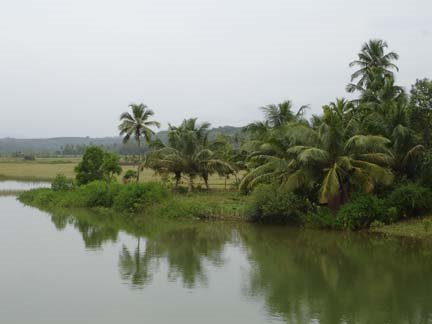
Holegadde near Honavar,Uttara Kannada dist, Karnataka
Copy? Right - but kindly remember to acknowledge!

" tulu-research.blogspot." ತುಳು ರಿಸರ್ಚ್. ಬ್ಲಾಗ್ಸ್ಪಾಟ್. ಇನ್

Have a nice day !