The oldest known human fossils of homo sapiens, designated Omo I and Omo II, were discovered from the Omo river valley in Ethiopia by Richard Leakey and were dated to be 195,000 years old. The journey of mankind from 165,000 to 8000 years before present, coinciding with the pre-agricultural hunter-gatherer nomadic phase of human evolution, inferred based on the genetic studies of mtDNA and Y- chromosomes, reveals that almost entire globe was populated by the mankind before 8000 years as result of incessant migrations during the last 150,000 years. With such extensive migratory trends it can assumed that mankind almost evolved and perfected verbal/lingual communications in this huge period. The factors of time, distance, environment and tribes have introduced so many variations in the languages of the world that simple genetic connections between languages can be hardly deciphered.
The data in the compilation of journey of mankind suggests that:
1). 85,000-75,000 years ago.
The first phase (batch) of human migration from Africa to India. The earliest Indian settlers.
2). 74,000 years ago.
The massive volcanic eruption documented at Mt. Toba in Sumatra. It was followed by heavy dust storms that led to nuclear winter in the entire south Asian region with volcanic dust dissipations spreading up to India for six years. Volcanic activity was followed by a millennium of ice age. Widespread devastation of the human beings, animals and plants possibly occurred in most of the southern Asia.
3). 74,000-65,000 years ago. A group of tribal people entered India from the north east Assam and Bengal from the Borneo side.
4).65,000 -52,000 years ago.
Two way coastal migrations into India have been visualized:
(a).One branch from NW India migrating along the West Coast. This is second phase of migration from Africa, possibly more evolved anatomically than the first batch.
(b).Other branch from Bengal side migrating via East coast. This is the first batch returning from the tour of South-east Asia and Australia. Possibly this branch represents the advent of Austro-Asiatic (Munda) tribes into India.
5) 10,000 years ago. The global Ice Age also called the Last Glacial Maximum(LGM).
The Glaciation caused lowering of sea levels to the tune of about 100m.This facilitated human migrations across the continents and land masses as many of the land bridges were exposed and people were able to cross the sea routes through the exposed land bridges.
The sea had retreated exposing wider land coastal mass and the land bridge between India and Srilanka (‘Ram Sethu’ or the Adams bridge) was more accessible for human migrations across the sea from India to Srilanka and vice versa. These geological-geographic aspects have ramifications that inspired some of the famous folklores of India.

A heritage blog by: Ravindra Mundkur & Hosabettu Vishwanatha
Showing posts with label human migration. Show all posts
Showing posts with label human migration. Show all posts
Thursday, September 27, 2007


Tuesday, September 18, 2007
37. Early Human migrations

Earliest known human beings originated in the eastern Africa some 165,000 years ago as understood by the anthropological studies based on the occurrence of oldest known human fossils found in the Ethiopia. Genetic studies of mtDNA and Y chromosomes coupled with paleontology, paleo-climate and archeology point out that early human beings originated in East Africa and migrated to different continents as hunters and gatherers wandered in the ensuing period.
The broad trends of global migration in the earliest human history are outlined below based on the compilations of Bradshaw foundation based on the data from Prof. Stephen Oppenheimer. The data are limited to the period 160,000 and 10,000 years before past. Migrations after the prominent ice age (10,000 years before present), introduction of agriculture (8000 years before present) and the development of civilizations, therefore, are grossly missing in the studies done so far.
Years ago. Broad Human Migration events and climate
160,000. Origin of homo sapiens in East Africa
160,000-135,000. Hunters and gatherers. Migration along four divergent paths from Ethiopia. First generation mtDNA gene type L1
135,000-115,000. Migrations: Sahara> Nile>Levant
115,000-90,000. Levant branch died out. Desertification of North Africa. Reoccupied by Neanderthal man
90,000-85,000. Migrations: Red Sea> Arabian Coast> India. All non-African races evolved from this branch.
85,000-74,000. Migrations:Srilanka>IndianOcean>W.Indonesia>Borneo>S.China
74,000. Volcanic eruption at Mt.Toba, Sumatra. Indian subcontinent covered by Volcanic fly ash deposits almost depopulated.
74,000-65,000. Migrations: Timor> Australia>New Guinea. Repopulation of Indian subcontinent
65,000-52,000. Warming of climate around 52,000 years
52,000-45,000. Mini -ice age. Paleolithic culture.
45,000-40,000. Migrations: 1.East Asia coast >Central Asia >Steppe >NE Asia.2.Pakistan>Central Asia.3.Indochina>Tibet
40,000-25,000. Migrations: Central Asia>East Europe. Cave arts in France
25,000-22,000. Migrations: Siberia>Alaska through Bering land bridge. Native Americans
22,000-19,000. North Europe Asia, North America almost depopulated.
19,000-15,000.Last Glacial Maximum, 18,000 years ago. Bradshaw rock paintings, Australia.
15,000-12,500. Amelioration of global climate. Simple stone tools, flaxes, cobbles
12,500-10,000. Reoccupation of West America. Ice Age 10,000 years
10,000-8,000. End of Ice Age. Heralded agriculture. Sahara was grassland. Recolonization of Britain and Scandinavia.
Monday, August 27, 2007
31. Tulu tribes - Migration from Pirak : 1000-600 BC
The Tulu identity and civilization as it exists now in Tulunad is a composite culture developed chronologically over not less than the last four thousand years. Like numerous rivers and streams flowing into the sea, several individual cultural streams have merged with the Tulu culture at different periods during the long historical past. One of the recognizable major events in the evolution of Tulu language and culture is the contribution of Tulu tribes that migrated to this Tulunad in the remote historical past dating back to the period 1000 to 600 years BC. [I quote the broad period of 400 years – i.e. 1000 to 600 BC- because I am not able to sharpen it more at present. With availability of more historical data, hopefully, we can narrow down this period.]
Iravattam Mahadevan suggested that the Indus valley civilization was an early form of Dravidian culture. Further after the decline of Indus valley civilization, possibly due to migration of rivers and abrupt floods, ca.1900 BC, Dravidians apparently moved out of the Indus valley region and lived in the north and northwest parts of the Indian subcontinent, before the advent of the Aryans. Brahui, a Dravidian language still spoken in Baluchistan, parts of Iran and adjoining areas is evidence in favour of the existence of Dravidians in those parts.
Among those who lived in the northwestern part of Indian subcontinent around Pirak, Mehrgarh, Multan and surrounding areas (now a part of Pakistan) ca.1900 to 1500 BC are Tulu and other Dravidian tribes. Aryans, migrated from Indo-European homelands also settled in these areas and composed the famous Vedas, initially in the oral tradition prevalent at that time.
That Tulu tribes were one of the groups of settlers in this area during the period cited above can be deduced by Atleast four lines of evidences recapitulated here below:
1. Presence of distinct Tulu words in Rigveda like : okha, aaNi, pala/ pela etc. These cited words have been considered by Michael Witzel as words borrowed into the early Sanskrit, since they do not conform to the linguistic word structure of Indo-European language in which the Vedas were composed. Rigveda, in original oral form, has been dated ca.1700-1500 BC. There may be more such words, for example like the suffix -aaN in braahmaN. [cf: previous posts 20,25,28 ]
2. The absorption of the legend of Abraham, into Tulu tradition as Bermer (Brahma) in the original form as a horse mounted hero.
Abraham, a popular leader of masses (legendary prophet for Jews, Christians and Muslims,) lived approximately 2000 BC in the NW Indian subcontinent-Asia Minor-Central Asia region. After his death in the tradition of spirit worship he became the “Bermer(u)” for Tulu tribes. Vedic Aryans converted the Abraham legend into the Brahman, the supreme cosmic creative power. Gradually with time Brahman evolved into the God Brahma with ten or four heads in different Purana epics, by the time of composition of the Ramayana ca. 800-500 BC. The dominance of Lord Brahma in Ramayana has been analysed in detail by SSN Murthy.
Since Tulu tribes carried their original horse mounted “Bermer” image with them to Tulunad before the evolution of the Brahma concept into ten or four headed God of creation, in northern India, the time of Tulu tribe migration can be fixed as pre 500 BC. [cf: previous posts 4, 5, 26,28 ]
3. The presence of ample Prakrit words in Tulu language, speaks of the heritage from their erstwhile homeland in Northwest Indian subcontinent. Especially the word Pirak is interesting. “Pirak” in Tulu language means ‘anything related to remote past’. Incidentally Pirak was the area of early civilization ca. 1700-800 BC. [cf: previous posts 3,6].
4. The basic “moolasthana”( literally means ‘primary inhabitation’ or ‘original homeland’) concept of Tulu tribes settled in Karavali Tulunad homeland is derived from the original concept of the tribes in their former homeland of northwest Indian subcontinent. Even today, Multan is a town in the Punjab province of Pakistan. [cf: previous posts: 9.18.19 30].There is a temple devoted to Prahlada at Multan.The legend of Prahlada,Hiranyakashipu and Narahari might have originated around this place.Incidentally,as pointed out by Manjunath,Prahlada is the grandfather of King Bali(also known as Baliyendra) who is reverred by Tulu and Malayali people since remote historical times.
®
Sunday, August 26, 2007
30.Multan and moolasthana
The multi-talented great scholar (“Mahapandit”) Indologist, multilinguist (he knew thirteen languages), and widely traveled Kedarnath Pande (1893-1963) was born at Pandah village in Azamgarh district of Uttara Pradesh as a bhumihar Brahmin on 9April1893. He mastered Sanskrit, Hindi and its various dialects of Hindi like Bhojpuri, Malavi, Avadhi, Maithilli, Braj, Rajasthani and Nepali. He studied Pali and Sinhalese languages and read Buddhistic texts in the original form. He converted to Buddhism and changed his name to “Rahul Sankrityayan”. Rahul was the name of Buddha’s son and ‘sankrityayan’ means the assimilator.
“Volga se Ganga” (Original in Hindi, also translated to Kannada “Volga Ganga”) is one of his best works that traces the migration and evolution of Indian people from 6000 BC to present.
Multan is one of the places cited in his work Volga se Ganga.Multan at present is a city and district headquarters in Punjab province of Pakistan. Multan is the simplified version of the Sanskrit name “moolasthan” meaning the original inhabitation.
The original settlers of the ancestral Indian subcontinent in this area called this place as their moolasthan (also written variously as “mūlsthan” or “mūlstan”).The word tan or than was their in Prakrit. It has been traveled along with migrating ancestral Indians absorbed into Marathi and Kannada languages as “thana” or “thane”.
Migrant Tulu tribes retained the moolasthan concept from the original homeland of northwestern Indian subcontinent (now part of Pakistan) and carried it to their subsequent homeland, Tulunad in the Karavali of Karnataka. The early settlements of Tulu tribes in Karavali(coastal Karantaka) are called moolasthanas.(cf:Post).
ß
Wednesday, February 21, 2007
Language and culture
Language and culture are sensitive and emotional issues. We all have grown up with certain set of ideas and it will be difficult to give up our clichés when somebody suggests anything contrary to our coveted opinions.
Anthropologists are almost unanimous that early man originated in
Dravidians as well as Aryans have settled in
It is just like the comfortable experience we enjoy in the house or the town in which we live and wherein many of our ancestors had have lived. Just because several generations of our ancestors lived in this house or town and etched unforgettable pages in the history should not mean that at some point of early period of history, one of our primal ancestors came from some other town and settled here.
If we believe that human populations migrated, it is taken for granted that the proto languages they were speaking and the cultural habits they were accustomed to also migrated with them to different parts of the world.
Subscribe to:
Posts (Atom)
A Coastal estuary
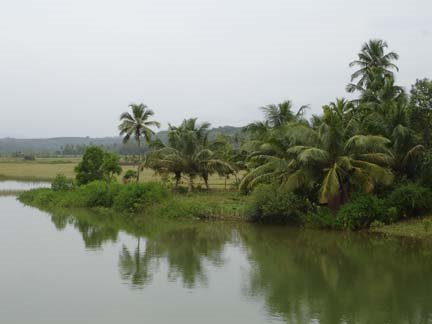
Holegadde near Honavar,Uttara Kannada dist, Karnataka
Copy? Right - but kindly remember to acknowledge!

" tulu-research.blogspot." ತುಳು ರಿಸರ್ಚ್. ಬ್ಲಾಗ್ಸ್ಪಾಟ್. ಇನ್

Have a nice day !