The Tulu identity and civilization as it exists now in Tulunad is a composite culture developed chronologically over not less than the last four thousand years. Like numerous rivers and streams flowing into the sea, several individual cultural streams have merged with the Tulu culture at different periods during the long historical past. One of the recognizable major events in the evolution of Tulu language and culture is the contribution of Tulu tribes that migrated to this Tulunad in the remote historical past dating back to the period 1000 to 600 years BC. [I quote the broad period of 400 years – i.e. 1000 to 600 BC- because I am not able to sharpen it more at present. With availability of more historical data, hopefully, we can narrow down this period.]
Iravattam Mahadevan suggested that the Indus valley civilization was an early form of Dravidian culture. Further after the decline of Indus valley civilization, possibly due to migration of rivers and abrupt floods, ca.1900 BC, Dravidians apparently moved out of the Indus valley region and lived in the north and northwest parts of the Indian subcontinent, before the advent of the Aryans. Brahui, a Dravidian language still spoken in Baluchistan, parts of Iran and adjoining areas is evidence in favour of the existence of Dravidians in those parts.
Among those who lived in the northwestern part of Indian subcontinent around Pirak, Mehrgarh, Multan and surrounding areas (now a part of Pakistan) ca.1900 to 1500 BC are Tulu and other Dravidian tribes. Aryans, migrated from Indo-European homelands also settled in these areas and composed the famous Vedas, initially in the oral tradition prevalent at that time.
That Tulu tribes were one of the groups of settlers in this area during the period cited above can be deduced by Atleast four lines of evidences recapitulated here below:
1. Presence of distinct Tulu words in Rigveda like : okha, aaNi, pala/ pela etc. These cited words have been considered by Michael Witzel as words borrowed into the early Sanskrit, since they do not conform to the linguistic word structure of Indo-European language in which the Vedas were composed. Rigveda, in original oral form, has been dated ca.1700-1500 BC. There may be more such words, for example like the suffix -aaN in braahmaN. [cf: previous posts 20,25,28 ]
2. The absorption of the legend of Abraham, into Tulu tradition as Bermer (Brahma) in the original form as a horse mounted hero.
Abraham, a popular leader of masses (legendary prophet for Jews, Christians and Muslims,) lived approximately 2000 BC in the NW Indian subcontinent-Asia Minor-Central Asia region. After his death in the tradition of spirit worship he became the “Bermer(u)” for Tulu tribes. Vedic Aryans converted the Abraham legend into the Brahman, the supreme cosmic creative power. Gradually with time Brahman evolved into the God Brahma with ten or four heads in different Purana epics, by the time of composition of the Ramayana ca. 800-500 BC. The dominance of Lord Brahma in Ramayana has been analysed in detail by SSN Murthy.
Since Tulu tribes carried their original horse mounted “Bermer” image with them to Tulunad before the evolution of the Brahma concept into ten or four headed God of creation, in northern India, the time of Tulu tribe migration can be fixed as pre 500 BC. [cf: previous posts 4, 5, 26,28 ]
3. The presence of ample Prakrit words in Tulu language, speaks of the heritage from their erstwhile homeland in Northwest Indian subcontinent. Especially the word Pirak is interesting. “Pirak” in Tulu language means ‘anything related to remote past’. Incidentally Pirak was the area of early civilization ca. 1700-800 BC. [cf: previous posts 3,6].
4. The basic “moolasthana”( literally means ‘primary inhabitation’ or ‘original homeland’) concept of Tulu tribes settled in Karavali Tulunad homeland is derived from the original concept of the tribes in their former homeland of northwest Indian subcontinent. Even today, Multan is a town in the Punjab province of Pakistan. [cf: previous posts: 9.18.19 30].There is a temple devoted to Prahlada at Multan.The legend of Prahlada,Hiranyakashipu and Narahari might have originated around this place.Incidentally,as pointed out by Manjunath,Prahlada is the grandfather of King Bali(also known as Baliyendra) who is reverred by Tulu and Malayali people since remote historical times.
®

A heritage blog by: Ravindra Mundkur & Hosabettu Vishwanatha
Showing posts with label Moolasthana. Show all posts
Showing posts with label Moolasthana. Show all posts
Monday, August 27, 2007


Sunday, August 26, 2007
30.Multan and moolasthana
The multi-talented great scholar (“Mahapandit”) Indologist, multilinguist (he knew thirteen languages), and widely traveled Kedarnath Pande (1893-1963) was born at Pandah village in Azamgarh district of Uttara Pradesh as a bhumihar Brahmin on 9April1893. He mastered Sanskrit, Hindi and its various dialects of Hindi like Bhojpuri, Malavi, Avadhi, Maithilli, Braj, Rajasthani and Nepali. He studied Pali and Sinhalese languages and read Buddhistic texts in the original form. He converted to Buddhism and changed his name to “Rahul Sankrityayan”. Rahul was the name of Buddha’s son and ‘sankrityayan’ means the assimilator.
“Volga se Ganga” (Original in Hindi, also translated to Kannada “Volga Ganga”) is one of his best works that traces the migration and evolution of Indian people from 6000 BC to present.
Multan is one of the places cited in his work Volga se Ganga.Multan at present is a city and district headquarters in Punjab province of Pakistan. Multan is the simplified version of the Sanskrit name “moolasthan” meaning the original inhabitation.
The original settlers of the ancestral Indian subcontinent in this area called this place as their moolasthan (also written variously as “mūlsthan” or “mūlstan”).The word tan or than was their in Prakrit. It has been traveled along with migrating ancestral Indians absorbed into Marathi and Kannada languages as “thana” or “thane”.
Migrant Tulu tribes retained the moolasthan concept from the original homeland of northwestern Indian subcontinent (now part of Pakistan) and carried it to their subsequent homeland, Tulunad in the Karavali of Karnataka. The early settlements of Tulu tribes in Karavali(coastal Karantaka) are called moolasthanas.(cf:Post).
ß
Thursday, April 26, 2007
19. Moolasthana..
The bootha (spirit deity) shrines worshipped by Tulu people consist of small single room structures called ‘
The
Thus the bari/bali lineage system is common to people of West coast irrespective of the regional languages, Kannada Tulu or Malayalam.
Many of the
All the lineage surnames may not be of single generation. There could be several generation of lineages as result of resettling of people.
Manjunath reports that Tulu baris have equivalent but different maternal lineage or ‘tavazhi’(
Thus overall it appears that these coastal tribes Halakkis, Tulus and Malayalis came from north before settling in the west coast. They share similar lineage characters, the lineage names mostly being derived from the place of their settlement. Besides lineage, they also share the concept of ancient Brahma worship. Halakkis and others in Uttara Kannada call it ‘Bommaya devaru’, Tulu people call it ‘Bermer’ or ‘Bermeru’. The Bommaya devaru is an image of horse mounted soldier like Bermer of the Tulu people.
Saturday, April 21, 2007
18. Locations of Moolasthanas in Dakshina Kannada & Udupi districts
The Moolasthanas are the original settlements of Tulu tribes before they split into various castes based on their occupations. It can be estimated based on crude markers that the Tulu migrant tribes settled in coastal parts of Karnataka about 2200(±200) years ago. The estimation of settling date can be made more accurate with availability of more accurate markers. Fishing was, apparently, one of the earliest occupations they could adapt to.
The ‘Mogaveera’ monthly, Mumbai, (March 2007) has published a list of Tulu Moolasthanas that celebrate annual festivities during March to May period this year. The list is provided for studying some of the locations of Moolasthanas in the coast. There could be more Moolasthanas than given in the list. Documentation of more than one Moolasthana for a lineage possibly indicates subsequent migration of the fraction of the
| Lineage | Location | Village | District |
| Amin | Yermal | Tenka | Udupi |
| Bangera | | Hoode | Udupi |
| Gujaran | Sultan-battery | Bolur | Mangalore |
| Kanchan | | Polipu | Udupi |
| Karkera | | Baikampadi | Mangalore |
| Karkera | Yermal | Bada | Udupi |
| Kotiankar | | Kaup | Udupi |
| Kundar | Kodi | Hejmadi | Mangalore |
| Maindan | | Mulki | Mangalore |
| Mendon | Kote | Katpadi | Udupi |
| Pangalannaya | | Baikamapdi | Mangalore |
| Puthran | | Mulki | Mangalore |
| Puthran | Tadambail | Surathkal | Mangalore |
| Salian | Kadike | Haleangadi | Mangalore |
| Salian | Yermal | Bada | Udupi |
| Salian | | Palimar | Udupi |
| Shriyan | Gudde | Pangala | Udupi |
| Shriyan | Kadapi kariya | Kuloor | Mangalore |
| Suvarna | | Hiriyadka | Udupi |
| Suvarna | | Kulai | Mangalore |
| Tingalya | Kadike | Haleangadi | Mangalore |
lineage.
Saturday, March 24, 2007
9.The Moolasthana concept
The moolasthanas in Tulunad have a small temple dedicated to the divine spirit (Daiva or Bootha), Naaga or the Bermer′. As a consequence of socio-cultural evolution, many of these moolasthanas have replaced the original deities with subsequent deities like Durga or other Gods and are located near the beaches or in the proximal areas in the coast. Tulu families have a ritual of visiting their respective moolasthanas at least annually. At the small temple there they conduct ceremonial worships.
I visited one such moolasthana near Hoode, about ten kilometers north of Udupi town. Hoode hamlet is located near the estuary of Sita and Swarna rivers. The word Hoode is a place indicator. ‘Ade, ide, ode’ etc place indicators mean ‘there,here,where’ respectively in Tulu.(Similar words exist in Malayalam).
The moolasthana is located at Bengare near Hoode. The word bengare or bangere has equivalent meaning of a sand spit. Ben+kare stands for ‘a place opposite coastline or beach ’. The lineage indicator bangera is apparently derived from bangare. This is the moolasthana of TuLu people of bangera lineage. Interestingly, all TuLu communities belonging to the lineage of bangera have designated this site as their moolasthana. The present day castes like poojari, sapalya, moolya, marakala etc have been formed on the basis of their trades or professions. But all these TuLu communities carry common lineages tags (surnames) like bangera, putran, anchan etc. Lineage of a person is affixed based on the lineage of his mother (as in matriarchic society).
The common lineage for diverse communities indicates that the lineage system predates the classification of people into diverse communities based on trade or profession. It seems the trade based classification, the
However, due to various reasons, several families migrated southward through Rajasthan Gujarat, Maharastra and settled in sites in the West Coast. It appears that when their offsprings/progenies migrated again within Tulunad, these coastal settlements were again called moolasthanas.
I request other researchers to comment or contribute with any relevant information that they may have.
Subscribe to:
Posts (Atom)
A Coastal estuary
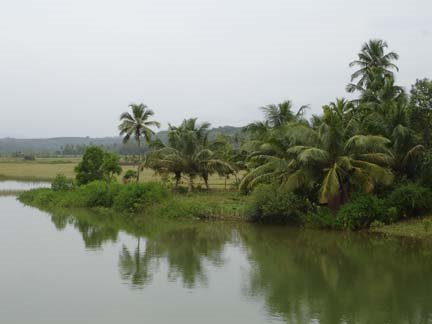
Holegadde near Honavar,Uttara Kannada dist, Karnataka
Copy? Right - but kindly remember to acknowledge!

" tulu-research.blogspot." ತುಳು ರಿಸರ್ಚ್. ಬ್ಲಾಗ್ಸ್ಪಾಟ್. ಇನ್

Have a nice day !