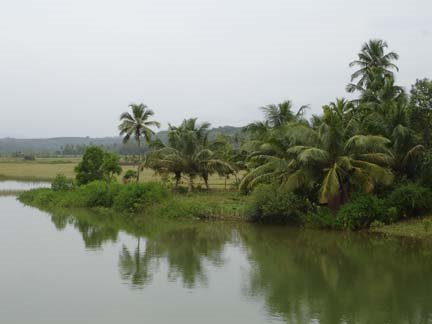
The
ancient port town of Basarur (or Basaruru, Basrur, Basroor), is one of the
oldest known ports in the Karavali (West
Coast) Karnataka that played far reaching cultural, commercial and religious roles
in the historical perspective. Portuguese merchants had preferred this port
during 17th Century for importing initially rice and later pepper to
Europe.
Basarur
Basarur
is a village presently located about 4 km east of the coastal
town of Kundapur in the district of Udupi. It is located on the southern bank
of River Varahi. The present Basarur town about four square kilometers in
extent boasts of heritage of of some 7 colonies (‘kEri’), 7 water ponds (‘kere’),
27 temples, 40 spirit shrines, 4 garodis,
2 agraharas,2 mutts, 2 mosques and 2 churches, besides ruins of ancient fort
walls enclosing remnants of a former twin city structure.
 |
| Location map of Basarur, Kundapura Taluk, Udupi district,Karnataka. |
The
seven colonies are named as follows: Mandi keri (=market colony), Vilasa keri
(=pleasure colony), Basadi keri (=Jain colony), Raut keri (= horse riders
colony), Gudigar keri (=artists’ colony), Mel keri(=upper colony) or Saler
keri(= weavers colony) and Mudu keri (=Eastern colony). The names of colonies
are suggestive of evolved city with emphasis on commerce (Mandi), defence
(Rauts), culture(Gudigar), fashion(Saler) and pleasure(Vilasa) in the ancient
port town.
Basarur
Magane traditionally consisted of adjacent
villages of Anagalli, Hatti-kuduru, Balkur, Japti and Kandavara. Hattiangadi
village is located on the northern bank of Varahi River and to the north of Basarur
town.
Basarur: colorful history
The
ancient port town of Basarur is generally considered to have been named after king
‘Vasu’ who is thought to have ruled the region in the remote antiquity. However
available historical records do not throw light on the legendary king Vasu who
is also considered to have constructed Kotilingeshwara temple at Koteshwara in
the neighborhood of Basarur. Others consider that the town was named after ‘Basuri’
(Ficus virens), a kind of tree
related to the family of banyan tree. The place name Basarur has been mentioned
as ‘Vasupura’ in ‘Keladi Nripa Vijaya’ (compiled in Kannada during Nayak rule,
18th Century CE). Dr Gururaja Bhat considered that the name Vasupura
has not been cited in older documents and it is a Sanskritized version of the name
of the Basarur.
 |
| Village map of Basarur showing relics of old fort along with island of Hatti kuduru within River Varahi |
It
is possible that the name Basurur came from the name of immigrant Basu tribes.
The Basu (Bashu or Bose) people were a Kayastha clan of Kshatriyas (warrior
class) from Kannauj area of Uttar Pradesh who migrated to various regions. The surname
Basu is widespread now in Bengal region. It is possible that the place name
Basarur was derived after the ‘Basar(u)’ (the Basa or Basu people; suffix’ –ar(u)’
is a Kannada/Tulu honorific signifying
people) migrant tribes settled in the area under study.In Tulu Siri folklore(paDdana), Basarur has been recorded as 'Basalur', suggesting that it was based on Basa-lu tribes,as in Tulu 'lu' suffix is indicative of plurals.
In fact, the common male proper name ‘Basava’ could have originated from the ancient ‘Basa’ or ‘Basava’ people. The proper name Basu can also be found in Africa where it means brilliant. A renowned poet ‘Bhasa’ was living in medieval period in northern India.
In fact, the common male proper name ‘Basava’ could have originated from the ancient ‘Basa’ or ‘Basava’ people. The proper name Basu can also be found in Africa where it means brilliant. A renowned poet ‘Bhasa’ was living in medieval period in northern India.
Historical
data suggests that Konkan coast was ruled by Bhargavas during early centuries
of the Common Era. The Bhargavas with iron axes were generally credited with
the conversion of forest lands into organized villages by cutting the densely
grown trees. The legendary Parasurama (also known as Bhargava) could have been
one those early heroes who actively propagated the process of converting forests
into open fields suitable for inhabitation and cultivation.
The
port town was under the rule of Kadambas based at Banavasi, after 4th
century CE. The Kadambas were also merchants to begin with and were considered
as sea pirates in some reports. It appears that the river flowing by the town
of Basarur was named Varahi, after the
female form of Panjurli Spirit, now also
known as ’Varte’(derived from <.’Varahiti’) during the Kadamba rule. Ancient
Legends concerning the power of Panjurli are dominant in this region. Legends
of Parasurama were also codified into Puranas under the Kadambas who were
instrumental in reactivation of Hinduism.
Apart
from the Basu settlers from the North suggested in the place name, there are
evidences of visits of people to Basarur from northern India like monks of Natha
cult (also known as Jogis) from Nepal and Bengal. Signature of Kol tribes in a pond (‘kere’)
named after them as ‘Kolkere’ in Basarur. Similarly, Uppara , BattaDa and other
tribes resided in Basarur.
The administration
and affairs of the port of Basarur was apparently controlled by Nakhara and
Hanjuman merchant guilds. The Halas and Settis domicile in the town were also influential
in the administration. Disputes and legal matters were resolved in the presence
of these power groups as suggested in some inscriptions.
The Alupas
originally from Mangalore ruled this area at Hattiangadi with capital at Barkur
between 8th and 11th century CE. The Alupa Kings were
also sea-faring merchants by tradition. It was followed by representatives of
Vijayanagara rulers who encouraged revival of Hinduism under Natha monks.
Telugara hitlu (colony) in Basarur for example documents the existence of
Telugu speaking settlers possibly during Vijayanagara realm. Further, after the
fall of Vijayanagara, Keladi Nayak Kings [1554-1641CE] controlled the
administration of Basarur. Characteristically, the Shiva/ Mahadeva/Ishwara temples
were renamed as ‘Mahalingeshwara’ Temples under the Veerashaiva Kings of
Keladi.
Portuguese
[1510-1646] and Dutch [1662-1748] merchants had sway over the commerce of this
port. Maratha King Shivaji attacked Basarur in the year 1665 (February 8th]
to strangle the foods supply chain to the Portuguese who had occupied Goa. By
the time of Hyder Ali the port of Basarur lost its eminence as it turned to be
an interior port, silted up with poor navigation facilities. It is said that Hyder Ali unsuccessfully tried
to repair and update the port with the help of Dutch technicians. Influence of
Tippu Sultan [1784-1799] over Basarur has also been recorded.
The ‘Gudigars’,
artisan experts in Temple arts (‘guDi’) and art of icon making, were considered
to have been migrated here from northern parts of India. The presence of Icons
of five Chinese women as spirits in an ancient Garadi of Basarur suggests
cultural connections between Basarur and China in the antiquity.
Ancient Temples
The
Basarur area shows evidences of several religious cults during the evolutionary
course of history. It is inferred that Alupa kings initially followed ‘Pashupata’
cult, as suggested in Halmidi inscription. However during their initial reign,
Jainism and Buddhism were dominant. Subsequently Bhagavati and Natha cults
dominated. The Bhagavati cult culminated into Mother Goddess, Shakti (or Durga)
cult, whereas the Natha cult revived Shaivism. Stamps of Janardhana as well as
’Shankara-Narayana’ (‘Harihara’ or fusion of Shiva and Vishnu concepts) cults
can be seen in parts of Kundapur Taluk, where one of the villages is named
after Shankaranarayana.
One
of the temples in ruins at Basarur is known as Tuluveshwara Temple, which is considered to be ( PS Narasimha
Murthy,1997) is older than 1400 CE. However, the original Tuluveshwara temple
could be as old as 5th to 6 Century CE. The Tuluveshwara tag is quite
interesting and suggestive of prevalence of Tuluva tribes in this region in the
antiquity. It is possible that this region ruled also by Alupa Kings from
Mangalore was earlier inhabited by Tulu speaking people, till the advent of
Vijayanagara rulers who apparently encouraged Kannada in Barkur State.
Adinatheshwara Temple in Murukeri
colony has been dated to 11th Century CE. Basarur region inclusive
of Hattiangadi was under the sovereignty of Barkur State, ruled at that time
period by Alupas (up to the end of 12th
Century CE). Adinatha being the earliest Guru of Natha cult popularized by
Macchendra Nath and Gorakanath represents transition from Buddhism to Natha
cult in the region. Macchendra Nath
and Goarkanath duo from Bengal and Nepal are also credited with the
establishment of the Kadri Manjunatha Temple at Kadri, Mangalore.
Legends
suggest that sometime during 13th or 14th Century CE, a
Linga icon from the pond of Kadri Manjunatha temple was carried to Kuduma in
Belthangadi Taluk by Annappa (who is since then revered as Spirit Annappa Panjurli)
and the new temple there was renamed as ‘Dharmastala’. Similarly, during the period
a new temple was consecrated at Basarur and the locality was named ‘Dharmapatna’. Somehow the latter temple
did not achieve fame comparable to that of Dharmastala, but the local legends
consider that it was due to skipping the exact auspicious ‘muhurta’
(initiation) time, the temple failed to reach the pinnacle of glory. Thus in records Basarur is also known as
‘Dharmapatna’.
Another
famous temple in this town is Nakareshwara
Temple dedicated to Mahadeva (Shiva) which contains inscriptions of the
period of Alupa King Kavi Alupendra dating back to 1154 and 1176 CE. There is a
Mahisha Mardini icon in the temple, considered to be of 9th to 10th Century CE
by PS Narasimha Murthy. The name Nakareshwara suggests that it was built by the
Nakara (=merchant) community of Basarur.
Hanjuman
referred to the association of Moslem traders of Arabic origin who entered West
Coast from Kerala during 6th Century CE and were present in many of
the Karavali Ports in the successive period. Thus, some of the oldest Mosques
could be dated back to 8th and 9th Century CE in the
Karavali Port towns.
The Keladi
Nayak Kings were followers of Veera Shaiva cult who patronized the temples
during 16th and 17th Centuries, changed the name of Nakareshwara
temple to Mahalingeshwara Temple.
Under
the Portuguese rule of Goa, Gowda Saraswats fled Goa, migrated south and settled
in Karavali places like Basarur. They built Tirumala Venkateshwara, Santeri
Kamakshi, Mahalsa Narayani etc Temples in Basarur. Similarly immigrant
Chitpavan Brahmins established temples dedicated to Ramachandra.
With
Goa falling under the rule of Portuguese ca 1571, Christianity was propagated
and Roman Catholic Churches were built in Basarur as early as 1574. It is said
that in the year 1783, Tippu Sultan who was under the impression that
Christians would support the British destroyed several churches in Basarur.
Hattiangadi
The Hattiangadi
(Pron: haTTianagdi) village is located to the north of Basarur on the opposite
bank of Varahi. The Hatti (pron: haTTI; =cottage, shed) is ancient place name suggesting antiquity of
the settlement. An ‘angaDi’ refer to an open field, mostly bazaar or ‘sante’ type rural market, where
commodities were sold on daily or weekly basis. The word ‘angaDi’(=open field,> bazaar,> shop) has evolved with time
and presently it means a shop. Therefore it can be presumed that the original ‘Hatti’
village was renamed as ‘Hattiangadi’ after the rural bazaars were used to be
held there. The ‘Hatti’ name has also been given to an island (‘kuduru’) on River Varahi, located close
to Hatti-angadi. It appears that the ‘kuduru’ was part of main land, attached
to Hatti village till about 1450 and subsequently separated from the Hatti
mainland due to drastic changes in river channel morphology, as interpreted
from geological data and from Alupa inscriptions.
Hattianagdi
village, formerly ruled by Alupa Kings, has an ancient temple dedicated to
Lokanatha. The Natha suffix indicates that the temple dates back to the period
of dominance of Natha cult that flourished under Alupa and Vijayanagar regimes.
The ‘Lokanadu’ referred to in Siri
paDdana appears to a place around Lokanatha Temple in Hattiangadi. The attributed
place name ‘Lokanadu’ also signifies the traces of cult of Buddhism
(Lokeshwara, Avalokiteshwara forms of Buddha). (cf: Kadire).
Basarur and Barkur
It
has been pointed out that the town plans of Basarur and Barkur are similar in
style suggesting their inter-relationship during the evolutionary history. Basarur
was called Hosa-pattana (=New town) because it was rebuilt during 12th
Century CE. The position of the Port suggests that it was originally developed
much earlier (probably 1000 BC or so) when the original Basarur was located on the
coastline.
However, it seems based on geomorphic analysis
that Barkur was a later developed port town than Basarur. The old port of Barkur could have been
converted into a capital (ca 10 Century CE?) after receding of the Western Sea
coast and Kalianpur was the Port.
Siri paddana
Oral
Songs of Siri (Siri paDdana) composed in Tulu language describe the ordeals of
a brave legendary woman called ’ Siri’ and her fight for justice. The Siri
paDdana has been considered as the Tulu Sangam orature (oral literature) contemporary
to the traditions of Tamil Sangam. It is interesting that Basarur forms a major
landmark in the story of Siri.
The Siri was a charming, golden colored
daughter of Berma Alva of ‘Satyanapura’ or ‘Satyandara’ mansion, in Majalottu,
Bola village (Karkal Taluk). Berma Alva married Sommakka Devi of Basarur. After
her death during child birth, as suggested by Berma Alva along with servants
goes to Lokanadu, near Basarur and repairs and updated ancient shrines
dedicated to various spirits worshipped by their families. After this Birma returns to Majalottu and magically
finds a charming female child in his house, who is named as Siri and brought up by love and affection.
The
Siri was married to one Kanthu Poonja, son of Shankaru Poonjedi from the
mansion (‘guttu’) of Basarur. However Kanthu had ongoing illicit affair with a
prostitute called Siddu (or Kinnega) in Basarur. Frustrated with deviant
Kanthu, Siri divorces him and leaves Basarur with her child Kumara and servant
Dāru.
Parasurama
In
the west Coast of India people believe that legendary heroic sage Parasurama,
endowed with divine powers, wielded his axe towards the Sea demanding that the
Sea withdraw itself till the point marked by his axe. And it is believed that
the Sea actually withdrew itself accordingly leaving a wide stretch of
uncovered land. The legend traceable to Skanda Purana, appears to have been
composed under the patronship of Kadamba Kings who were ruling the Malnad and
Karavali regions [ 4th to 7th century CE].
Apart from the legendary record, there are geological evidences to suggest that
a natural event of regression of Sea occurred sometime between ca 400 to 100 BC
in the West Coast.
Old Port town of Basarur
It
is interpreted that the port of Barace or Barcelore mentioned in Greek
historical documents compiled by Ptolemy during 2nd century CE refer
to Basarur. In that case it would be the old town of Basarur that was later
destroyed (ca 750 CE) due drastic northward shifting of the flow channel of River
Varahi.
The Basarur
town was reconstructed in 12th century CE as it has been recorded as
new town [‘Hosapattana’] in inscriptions dated 1154 CE [kg Vasantha
Madhava1997]. This information combined with geological data suggests that that
the old port town of Basarur was destroyed by natural factors between the
period 8th and 11th Century CE necessitating relocation
and reconstruction of the town.
Geological
features of the area and the interpreted data reveals that two major
events affected the region during and after the Megalithic period (ca.1000 - 400
BC).
 |
| Parasurama legend of land creation (retrieval of land from Sea) and Changes in shoreline near Basarur .0 submerged area under sea (ca 1000-200BC).1.Shoreline ca.1000 BC.2. Shoreline at present. 3.Old estuary of River Varahi ca.200 BC. 4. Present estuary of River Varahi. 5.Old estuary of Varahi and Old Port of Basarur,ca.1000 BC. 6.Rebuilt new port of Basarur (1150 CE).7. Old course of River Varahi ca.700 CE. |
It
is interpreted that the original Basarur port was established on the estuary of
river Varahi (also known as Haladi River) around 1000 BC or before when Basarur
was on the Western Sea coast and it was
about 4 to 6 km inland as compared to present situation of coastline. The sea
coast appears to have been receded westwards due to natural reasons during the
period ca. 400-200 BC. In the legends this natural event of regression of sea
has been attributed to the divine powers of legendary sage-hero Parasurama.
After the regression of the Sea from the point of Basarur estuary, the port of
Basarur was rendered geographically into an inland port.
Further
it is interpreted (here) that the original Basarur port was destroyed around 750
CE due to migration and shifting of river Varahi and a new town was built on
the southern bank of Varahi in the new place around 1150 CE. It is possible
that River Varahi was unstable and shifting gradually northwards between the
period 750 to 1100 CE.
Similarly
due to further changes in river morphology, river bed silting and formation of
river islands Basarur lost its significance after 1700 CE. According to
Portuguese records, around the year 1740, major floods in the River Varahi
destroyed the Basarur port and parts of the town including the fort and adjoin
areas of Anagalli and Baragundi.
At
present it has been reduced into a minor village due to drastic changes in
historical coastal geomorphology and attendant
geopolitical circumstances.
(1)
Regression of the Sea, attributed in legends to the myths of Parasurama. People
were made to believe that Varuna (the Arabian Sea) receded back obediently in
response to the wielding of Parasurama’s axe. The Position of Ancient Port of
Basarur implies that originally it was established before the regression of the
Sea attributed to Parasurama. The regression event probably occurred between 400 BC to 200 BC.
(2)
The coastal rivers like Varahi (Haladi) shifted laterally towards North,
possibly between the period Eighth to Eleventh Century CE due to Neo-tectonic
activities in the west Coast. As a consequence of migration of Rivers, the Old
Basarur was destroyed. Since the new Port town was built during 12th
Century CE as per inscriptions of Alupa Kings, it can be surmised that the
migration of Rivers and destruction of the old Port occurred somewhere between
8th and 11th Century CE.
It
can be recalled that between 7th and 8th Century River
Netravati also suffered drastic natural
disasters in terms of shifting and migration of rivers in the Mangalore region
also. And it forced Alupa Kings to abandon their Mangalore port base at
Pandeshwara and shift to Udyavara.
Ò
References
“Hesarāda
pattana Basarūr; Ondu adhyayana” ( Renowned town Basarur: A study) - [in
Kannada], Compiled and Published by Sharada College Trust, Basarur-576211,Udupi District,
1997, p.255+14.
Ashoka Alva, K, Dr. (Ed) ( 2009) 'Siri Kavya Loka': ( A text of Tulu epic sung by Smt Kargi Shedthi of Nalkur, Belthangadi Taluk, Dakshina Kannada district, Karnataka. Karnataka) Janapada Ranga Kalegala Adhyayana Kendra, MGM College Udupi. p.608+90.
Ashoka Alva, K, Dr. (Ed) ( 2009) 'Siri Kavya Loka': ( A text of Tulu epic sung by Smt Kargi Shedthi of Nalkur, Belthangadi Taluk, Dakshina Kannada district, Karnataka. Karnataka) Janapada Ranga Kalegala Adhyayana Kendra, MGM College Udupi. p.608+90.
Note:
The interpreted dates in this post for transgression (ca 1000 BC) and
regression events of the Arabian Sea (ca 400-200 BC) attributed to ‘Parasurama’
may be refined further with availability of new data in future.
**