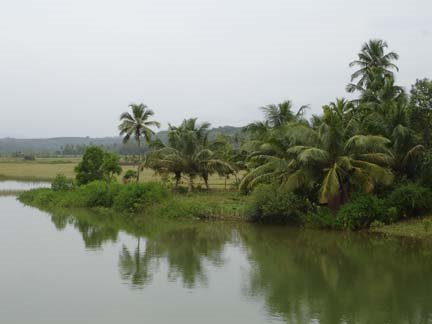
Small update on Jack fruit (posting No 20).
Dundiraj mentioned in his Kannada column in ‘Vijaya Karnataka’ that the English word ‘Jack fruit’ is derived from the Malayalam word ‘Chakku palam’.

A heritage blog by: Ravindra Mundkur & Hosabettu Vishwanatha
Small update on Jack fruit (posting No 20).
Dundiraj mentioned in his Kannada column in ‘Vijaya Karnataka’ that the English word ‘Jack fruit’ is derived from the Malayalam word ‘Chakku palam’.
Manjunath’s recent reference to ‘Origin of Idlis’ points to an article by Vikram Doctor on the ancestry of the now ubiquitous ‘Idli’, one of the healthiest dishes available. He quotes K.T. Achaya who infers that ‘idli’ is a recent introduction to
One thing is certain: Idli in the modern form has evolved over the years. Nobody could have invented it instantaneously. Even today idli is evolving. Mass idli producers in Mangalore are replacing urad dal with yeast producing soft spongy rice idlis that taste different from the urad+rice combination.
The existence of words ‘iddalige’ and ‘iddarika’ in Kannada/Sanskrit literature suggest that this dish already existed in south
However, more details if available on iddalige, iddarika and Indonesian kedli and other similar cousins of idli are welcome!
Lady-1: “Why not?, in two minutes I’ll be at your home!”.
Lady-2 hurriedly went back home to receive Lady-1. Lady-1 took one vessel to prepare the “sambar” (that day, that was the only ingredient she had at home), proceeded towards the house of Lady-2. On the way she picked up a nice looking smooth pebble of the size of a paper-weight.
Lady-2: “Oh! You came. Have you brought the magic-stone?”
Lady-1: “Yes.” [She cleaned the stone thoroughly and handed over to Lady-1].
Lady-2: “Lovely!, but it looks ordinary”.
[Lady-1 did all the necessary initial preparations. Now we are in the next scene, where the magic stone was dancing inside the vessel in the plain boiling water].
Lady-1: “Give me a few chillies- just to make little spicy”.
Lady-2: “Is it done?”
Lady-1: “Yes, almost!, Do you have a little tamarind?”.
Lady-2: “Yes please, what else do you need?”
Lady-1: “Nothing!. If you want it little thicker, you can add a little dal”
Lady-2: “Let it be thicker” [ Gave a little thoor dal]. “Don’t you need any vegetables?”.
Lady-1: “It is optional, what do you have?”
Lady-2: “I have a few beans, a few brinjal, and tomato”.
Lady-1: “That would be fine”.[ In between, she continued stirring the mix].
Lady-2: “Is it done now?”
Lady-1: “Of course yes!, only a little salt to taste”
The sambar was done. All along the magic stone was rattling inside the vessel. Lady-2 tasted the sambar. It was tasty, nice smelling and Yummy!.
Lady-2: “What do you do with the magic stone?”
Lady-1: “ You just take it out and throw it away”
That day Lady-1 had enough to feed her children. The moral of the story is – the taste is relatively simple-but you only have to know how to blend different ingredients.
(Please also see Blog Sl.No.10,11).
When Neil Armstrong first landed on the Moon, what did he see? The answer is, a Kaka’s petty shop and a Udipi Hotel. This is an old joke. This is also a positive attribute to the people of TuLu Nadu who excel in Food and Hospitality industry. Kakas are one of the sects of Malayali people. Udipi Hotel is a generic term used to indicate that it is a South Kanarese Hotel. The joke simply means that they are ubiquitous. Leaving petty shop behind let us straight away go to Udipi Hotel. The reason why they are everywhere is because, people like their food. Madrasi’s from the land of Idli Sambar, like their Kadabus (a variant of Idli). Spicy Andhraites who have contributed the word “Andhra Meals” like their Kori Rutti (Chicken – Rice_Roti). Bangaloreans who generally eat Masala Dosa like their Neer Dosa. Bombay-wallas who make 100s of flavors of ice creams like their Gadbud. Delhi bai-saabs who are “sweet people” like their wheat Halwas. These are a few of the dishes which have become generic trade names and have enticed millions of people across the country and beyond. People like these dishes because these dishes are tasty. Physiologists say that ‘Taste’ is a subjective matter. One man’s ‘Yummy!!!’ may be another’s ‘yucky!!!’. But the chemistry of Taste is not that simple. The ones who have mastered the art of culinary expertise know the ‘taste’ of taste. Surely ‘Taste’ and some of the ‘Karavali’ dishes need more discussion.
Which is the earliest popular fruit in the Indian subcontinent? In my opinion, it is the humble jack fruit which was the most popular and possibly earliest used fruit in the Indian subcontinent. The fruit was called the ‘pela’ in Tulu, ‘palas’ in Kannada or simply the ‘phala’ in Sanskrit. Micheal Wizel (1999) who made a detailed analyses of the words used in Rigveda, the earliest Veda dated around 1700 BCE (early part of Rigveda), concluded that it contains several extraneous words that do not belong to the word structure of Sanskrit sensu stricto. Sanskrit words derived from Indo-european roots have a specific structure. His list of extraneous words includes the term ‘phala’.
Obviously, the extraneous Sanskrit word ‘phala’ in Rigveda must have been derived from the Tulu words ‘pela’ or ‘pala’ or the early Kannada word ‘palas’. Since the borrowed Sanskrit word ‘phala’ (=fruit) itself stands for the jack fruit, it should have been the most common fruit in those days and in those areas.
In Tulu language, both the ‘pela’ and ‘pala’ word versions are there. The Tulu word ‘palai’ (=wooden plank) is derived from ‘pala’ or ‘pela’ (=jack tree). The jack tree trunk was used for making wooden planks that were called ‘palai’.
The borrowing of Tulu/ Kannada/Dravida words into Rigveda by early scholars of Vedic tribes suggest that all these (Vedic, Tulu and other Dravida) tribes were living together (coexisting) in the Pirak region ca.1700 BCE, where early Vedas are considered to have been composed orally.
The bootha (spirit deity) shrines worshipped by Tulu people consist of small single room structures called ‘
The
Thus the bari/bali lineage system is common to people of West coast irrespective of the regional languages, Kannada Tulu or Malayalam.
Many of the
All the lineage surnames may not be of single generation. There could be several generation of lineages as result of resettling of people.
Manjunath reports that Tulu baris have equivalent but different maternal lineage or ‘tavazhi’(
Thus overall it appears that these coastal tribes Halakkis, Tulus and Malayalis came from north before settling in the west coast. They share similar lineage characters, the lineage names mostly being derived from the place of their settlement. Besides lineage, they also share the concept of ancient Brahma worship. Halakkis and others in Uttara Kannada call it ‘Bommaya devaru’, Tulu people call it ‘Bermer’ or ‘Bermeru’. The Bommaya devaru is an image of horse mounted soldier like Bermer of the Tulu people.
The Moolasthanas are the original settlements of Tulu tribes before they split into various castes based on their occupations. It can be estimated based on crude markers that the Tulu migrant tribes settled in coastal parts of Karnataka about 2200(±200) years ago. The estimation of settling date can be made more accurate with availability of more accurate markers. Fishing was, apparently, one of the earliest occupations they could adapt to.
The ‘Mogaveera’ monthly, Mumbai, (March 2007) has published a list of Tulu Moolasthanas that celebrate annual festivities during March to May period this year. The list is provided for studying some of the locations of Moolasthanas in the coast. There could be more Moolasthanas than given in the list. Documentation of more than one Moolasthana for a lineage possibly indicates subsequent migration of the fraction of the
| Lineage | Location | Village | District |
| Amin | Yermal | Tenka | Udupi |
| Bangera | | Hoode | Udupi |
| Gujaran | Sultan-battery | Bolur | Mangalore |
| Kanchan | | Polipu | Udupi |
| Karkera | | Baikampadi | Mangalore |
| Karkera | Yermal | Bada | Udupi |
| Kotiankar | | Kaup | Udupi |
| Kundar | Kodi | Hejmadi | Mangalore |
| Maindan | | Mulki | Mangalore |
| Mendon | Kote | Katpadi | Udupi |
| Pangalannaya | | Baikamapdi | Mangalore |
| Puthran | | Mulki | Mangalore |
| Puthran | Tadambail | Surathkal | Mangalore |
| Salian | Kadike | Haleangadi | Mangalore |
| Salian | Yermal | Bada | Udupi |
| Salian | | Palimar | Udupi |
| Shriyan | Gudde | Pangala | Udupi |
| Shriyan | Kadapi kariya | Kuloor | Mangalore |
| Suvarna | | Hiriyadka | Udupi |
| Suvarna | | Kulai | Mangalore |
| Tingalya | Kadike | Haleangadi | Mangalore |
lineage.