A comment from Purushotham Puthran rather innocently enquires: “May I also Know what to say when the Temple priest ask us for the GOTRA.”
Many of us who piously follow Hindu traditional worship patterns and customs, like Purushotham , may have encountered certain degree of embarrassment, especially if you are from non-brahmin lineages , when the temple priest asks you the name of your Gotra,.
Gotra system
The ‘Gotra’ is an ancient system (origin ca. 1700 BC or older) of identifying and classifying the individual. Then there were no genome studies. The individual hymns in the Vedas were said to have been composed by a set of (twelve or so) sages independently and then collated together as a consensus after presenting them in a like- minded group discussion forum or seminar.
Yadava : cow lineage
It seems the Vedic sages adopted a scheme of identification of families earlier used and adopted by pre-Vedic Yadava group (Idiya, Yedava etc equivalents) that specialized in cattle-herding. Or it could be that Yadava cattle camps in the due course adopted a Vedic sage or Guru for guiding them in various physical and metaphysical aspects of life. In other words ancient families were attached to specific cowsheds, since dairy products were one of the primary source of wealth in those days. It was designated Gotra system (go=cow, tra=line), since the classification was based on the name of the cowshed to which joint families were attached at that time.
One of the possibility is that the ‘tra’ (tra=thread; tara,dhara=flow) or lineage system was in vogue among civilized people and the Yadava tribes specially formulated a ’go-tra’ (cow- lineage) system to identify and distinguish persons from their community. The Vedic poet-sages were associated with or sponsored by camps of cattle-herders (Yadava) who depended on dairy products for their livelihood. With passage of time, when families in each camp grew in size, persons were identified by the cow-pen which was named after the priest (Guru) of the camp.
Thus then it was a convenient general practice to identify individuals based on the name of their camps. Subsequently, post-Vedic people of dominant communities (brahmin, kshatriya and vaishya groups) had also the option of joining or adopting any of the pre-existing set of ‘ gotra’ camps, and the opted ‘gotra’ tag was continued in their progeny from father to son.
Thus the gotra tag during the timeline was either innate or acquired. Some of the common ancient gotra were named after sages Agashtya, Angirasa, Athri, Brighu, Bharadwaja, Kashyapa, Vasishta, Vishwamitra etc. (The gotra system obviously evolved over a period of long time. For example Bhardwaja was said to be a descendant of Angirasa. Jamadagni was said to be a descendant of Bhrighu and so on).These sages were scholars of that time and it should be remembered that many of the sages like Valmiki, Vyasa and Markandeya during the history originated from so called backward classes.
Since the ‘gotra’ system was like an identity tag for individual that was perpetuated over the years for the purpose of matrimonial alliances etc, there are inheritors of this ‘gotra’ system even today. The temple priest who asks the name of your ‘gotra’ is only trying to identify you in terms of the original Vedic camps your forefathers possibly belonged to!
However, it should be remembered that were also other people in the antiquity who did not belong to any of these gotra camps or subscribed to their theories.
Bari system
However, there were similar wise systems of identifying persons from different groups was in vogue at that time in the subcontinent. Tulu-Dravida ancestors, for example, had adopted the ‘Bari’ system or the ‘Bali ‘system.
The word ‘bari’ specifically means a side or a flank. In an early civilized human settlement, there were several families residing in a colony and each house was designated specifically based on the origin of the senior persons/parents in the house.
The word ‘bali’ is said to be a variant of the word ‘bari’. However the word ‘bali’ specifically means a forest creeper that was used as thread or rope in the olden days. Therefore the word ‘bali’ means lineage, like the suffix ‘tra’ in gotra. Obviously in the later system there is no mention of 'gow' or the cow, which leads us to surmise that in the beginning this system probably was originally designed by non- Yadava sects and subsequently adopted by Yadavas as gotra system.
Therefore we can conclude that lineage (bali) or side (bari) system was probably prevalent in (at least) north-western India during pre-Vedic (ca. 1700 BC) and ensuing periods. The concept spread to other regions later along with migrating people.
Gotra or Bari
Now back to the dilemma posed by Purushottam Puthran. What to say when your priest asks the name of your Gotra? The answer basically depends on your convictions and beliefs. If you feel that following a ‘gotra’ of Vedic to post Vedic period elevates you, please select (adopt as many have done traditionally) a ’gotra’ name and utter it. Many priests spontaneously classify you as ‘Kashyapa’, ‘Viswamitra’ or ‘Markandeya’, when you are unable to tell your gotra.
Or if you are scientific in your temper, tell the Priest your actual ‘bari ‘. Note that Brahmin families in Tulunadu have adopted surnames based on the names of their family houses such as Kakkilaya, Pejathaya, Kalluraya etc. If the ancient ‘gotra’ system was ever enduring and satisfactory this kind of subsequent adoption of family names was not required.
If you are a ‘Puthran’ in terms of ’bari’ system, I suggest that you should adopt ‘Puthran’ tag as your both ‘bari’ and ‘gotra’.It would be more meaningful than adopting some unknown or unrelated genetic tags.
®

A heritage blog by: Ravindra Mundkur & Hosabettu Vishwanatha
Friday, October 30, 2009


Thursday, October 22, 2009
210. Palli

Some of the words have multiple meanings that introduce a degree of uncertainity and indecisiveness as to their originally intended exact meaning when encountered in the form of place names. The multiple meanings inherited by some of these words may have originated from divergent proto-language sources during the course of evolution, leading to perpetuation of dissimilar meanings for similar sounding words. Let us look into the word ‘palli’ for an illustration of this observation.
Palli (pronounced as paLLi or palli in different regions) is a common place name indicator in southern India. Madanapalli, Tiruchirapalli, Bellampalli, etc places suggest the prevalence of this word among Dravidian ancestors. However, the word is not geographically exclusive to southern India. We find place names ending with palli Sindhi and Baluchistan village names in Pakistan (Palli-Mas, Goth-Palli etc), Afghanistan and also in northern Africa and Mediterranean region. Palli is also the name of a settlement in Voru, Estonia. Palli an Israeli male surname. Palli is also name of a Sindhi tribe in Pakistan.Data from Vanniyars suggest that the South Indian royal group of Pallavas were also formerly referred to as Pallis.In mideval Kannada ‘palli’ became ‘halli’, while ‘palle’ and ‘palliya’ variants also exists in Andhra Pradesh.. In Maharastra and Gujarat, modified -valli suffix also exists.
It is suggestive of flow of the ancient words along with human migrants and possibly that traces the relics of history of past settlement and migration paths of Dravidian language speakers in the antiquity. The word could have been originated in ancient Sumerian environs and passed on to other regions along with ancient human migrants.
Palli in Karavali
Palli is a rocky village in Karkal Taluk, Udupi district. It is a continuation of the granite rock belt extending in the surrounding villages of Sooda, Nitte, Kalya, Kukkundur and Kawdoor. There are no major water bodies (palla=water pond) in this Palli village. Therefore this Palli is derived from Palla or water body. On the other hand, the abundant granitic, rocky outcrops in the village remind us of the word Palli (3) as also explained in Tamilnet and derived from the ancient rock-cut beds of Jain period. However, detailed historical studies may be required to confirm existence of any ancient Jain rock cut bed structures in the granites of Palli village, Karkal taluk. Now, since the granites of the region being quarried extensively for winning building material, chances of finding ancient archeological structures are also quite remote.
There are some more 'Palli's in Udupi region. Perampalli near Manipal, Parampalli near Kota,Varamballi near Brahmavara, Nayampalli near Udupi, Bairampalli and Nellampalli near Herga and so on.
Perampalli ( peram+palli) =A large village.There are villages called Perampalli in Tamilanadu also suggesting that it is an old Dravidian place name.
Parampalli (Param+palli) = An old ('para' or 'pala') village. Possibly, Parampalli, possibly, is a later modification of original place name Peramapalli. And it appears that the place name Varamballi is possibly a Sanskritized version of the word Peramaplli or the Parampalli.
Most of these Pallis in Udupi district could be of Buddhist or Jain heritage as most of these are located beside rivers and there are no large Palla (ponds) in any of these villages.
Comparatively, the villages having a suffix of 'palli' are rare in Dakshina Kannada district. Kandathapalli near Bolur in Mangalore city is suggestive of a Mosque ('Palli') located in an agricultural field ('kanDa'). Nidpalli ('niD' or 'neD'=to plant) in Puttur Taluk is suggestive of an ancient agriculture based village.
Palimar, Pallimar
Palimar village located to the southeast of Padubidri town is sometimes pronounced as 'Phalimar' or ‘Pallimar’ also. The word Pali-mār would mean sisters (‘pali’) agricultural field(‘mār’). However, there are no known legends in the village that connect to any of sister’s agricultural property. Therefore we can conclude that the original name possibly was ‘Pallimar’ instead of Palimar as usually pronounced at present.
Palli-mār means agricultural field(mār) located beside a Palli, where the word ‘palli’ possibly represented an ancient Buddhist (or even Jain) temple.
Palli 1, Pallava
The word ‘palli’ possibly originated as a human settlement by the side of a ‘palla’ (natural lake or pond). In inland regions away from natural streams the water ponds were the exclusive source of water for irrigation and domestic consumption. Thus villages, towns and temples were built by the side of large perennial water bodies. The word ‘Pallava’ also means the same: palla+va =an area or settlement by the side of a palla (pond). The word ‘Pallava’ was the name of a famous south Indian dynasty.
Palla, an unit
In inland regions away from the rivers and streams, in the earlier days of civilization, the ‘palla’ (water pond) was the exclusive source of irrigation. Like the ‘pola’(=agricultural field) that represented ‘poli’(=prosperity),in those days, the ‘palla’(water pond) eventually stood for the quantity or measure of grains produced. Thus the ‘palla’ became a volumetric measuring unit (made of wooden or metal vessel) for 100 seers of rice. In some areas (especially Kannada) the word was modified into ‘balla’.
The relevant word ‘palla’ also meant a heap of cooked rice during ceremonial mass feedings. The traditional Tulu words ‘pallada kotya’(=a room or cubicle where cooked rice for serving is stored) and ‘palla puje’(=the worship of ceremonial cooked rice) were customarily derived in these lines.
Pali, Palli 2
Palli2 or the second source of meaning for the word palli probably came as variant of the word pāli.
Pāli is also a place name in Western Rajasthan. The word Pāli apparently holds the key to the origin of the word Palli2.
The word Palli2 was used to designate ancient Buddhist shrines in southern India and Srilanka. Later the name was also extended to Jain temples and Christian churches. Further in Kerala and southern parts of Tulunadu, it represents Muslim shrines. The application of the word Palli2 for shrines appears to have changed during the passage of time.
Tamilnet records that the word Palli was adapted to represent Buddhist and subsequently Muslim shrines. Tamilnet explains that the word Palli was derived from the word ‘palla’ (depression) which was used to bury the dead bodies in the past. The word Pali was said to have been applied to Buddhist shrines these were repositories of dead bodies or relicts thereof.
However we feel that the origin of the Palli as a shrine was derived from another route.
Pali 2 =Older
Pāli was the ancient Indian language adopted by Buddhists to communicate and preach. The usage of the word Palli for Buddhist Chaitya might have been actually a modification of the word Pāli used by Buddhists. The meaning of the word Pāli is said to be line or text.
However it also should be considered that the word is related to another ancient Prakrit word pala/ para/ pali that is also preserved in Tulu till today. The word ‘pala’ (or its variant para) means old, mature or senior. Note the related and derived words for comparison: The word pali means elder sister. ‘Palaye’ (or ‘paraye’) represents elder brother. ‘Paratt’ (or ‘palatt’ ) means the old. ‘Parabe’ and ‘parabu’ represent an old man and an old woman respectively. ’ParakaTT ‘means old and torn (cloth).
A variant of the word ‘Pala’ was ‘Pela’ or Jack-fruit (and tree), the oldest fruit known in the subcontinent. It has been suggested in earlier posts that the word Pala was adapted into Sanskrit to represent fruits in general.
Thus the word Pāli could have been adapted to represent an older language and tradition. Similarly it appears that the word Pāli was also applied to represent older generation of shrines of Buddhist origin. Historical data suggests that the Buddhist temples and Chaityas were the forerunners of Hindu temples and architecture.
The name of the Southeast Asian island Bali is a simple variant of the word Pāli..
Palli3
Tamilnet explains that the word ‘palli’ also means a rock-cut bed used by early Jain monks. It also suggests that the word ‘palli’ meant a sleeping area, before being adopted as a village.
Apparently the word palla meant a sleeping or resting place in the older Prakrit/ Pali languages. The derived word ‘pallanga’ means a bed. Similarly, ‘pallenki’(Tulu) or ‘pallaki’ means a mane where a person can relax comfortably while being carried by two to four servants during early days. These words suggest that ‘palli’ derived from Prakrit source was a relaxing or sleeping area to begin with.
Palli4
The word ‘palli’ (pronounced with soft ‘l’) also means common household lizard.
Thus the ancient word ‘palli’ preserved in the Dravidian languages at present carries several meanings, such as: 1. Habitation beside a pond or water source. 2. A relaxing area or comfort zone (in contrast with zone of wilderness or business) and 3. A Shrine: Buddhist, Jain, Islamic or Christian.4. A common lizard.
Of these meanings, the word Palli as a habitation indicator can be considered as an very ancient root word that originated in the early civilizations of Mediterranean-Sumerian environs. Kawdoor Narayana Shetty (see comment section below),for example, rightly points out that the affinity between the Dravidian word 'palli'(village) and the Greek word 'polis'(city). It seems that both these words originated from a common root word (ancient Sumerian?) that meant civilized area.
In reality, the multiple senses the word palli conveys essentially reflect the interesting facets of socio-cultural interaction and evolution the people and the languages have undergone.
With -Hosabettu Vishwanath
®
Monday, October 19, 2009

Monday, October 12, 2009
209. Dravidian place-name cognates

In Post-186 (Traces of common regional lingual history in Tulu Place Names), we have just illustrated the affinities between Place- names in Tulunadu and other near and far States and far away countries. In the materialistic world, a layman is lukewarm about understanding the origin and meaning of Place-names. In the first place, affinities are not noticed in hurly-burly of one’s routine life. Secondly, relevance of these similarities is ignored as coincidence. Revelation of such similarities is misunderstood by parochial feelings and is construed as offensive.
Cognate place-names
Cognate place-names, spread all over India and neighbouring countries, do not neccessarily mean that one area was occupied by a later arrived other tribes. As the behavioural pattern of early mankind, each group/tribe lived in isolation side by side but they mingled at appointed days in a barter-economy society. Each group maintained their uniqueness, at the same time having some commonality with regard to languages and customs. This is because of some base language of a tribe, which branched off into different tribes in gradual evolution.
Dravidian languages
Dravidian languages are geographically distributed in and around India. There are around 26 to 27 languages in the family of Dravidian languages in India, out of which five languages, known as ‘Panch Dravida Bhasa’, have emerged prominent in South India, having more or less similar Brahmi Script in the beginning. They are Tamil, Kannada, Telugu, Malayalam and Tulu. Former four languages have rich literary tradition, which Tulu fails to measure up. Though Tulu is having a script of its own and some written literature, it fell into disuse on the political influence of Kannada overlords. Tulu is considered as a dialect of Kannada but it is not so. All the languages have branched out of the Proto-Dravidian language, which has a bearing on all the languages spoken in India. Tulu is still vibrant in Tulunadu in Tulu Folklores and PaDdanas. PaDdanas are oral poems about heroic deeds of the Tulu ancestors, who are later on deitified and are worshipped. These lengthy ballads have trickled down orally through ages.
In North India, Dravidian languages were lost through absorption of Prakrita and Sanskrit. In South India, in Marhatti (Marathi) area, Sanskrit engulfed the Dravidian language (B.M.Shri– ‘Poorvada Halegannada mattu Tamil’, p.168. Earlier Old Kannada & Tamil). Respected B.M.Shri opines in this article that Telugu was spilt first from Proto Dravidian language and then Tamil and Kannada.
Olden literary works are indicators of linguistic interactions. In ‘Puranaarooru’ (a literary work in Tamil of circa 2nd C), there are two poems describing Hoysala Dynasty (Source: Anthology of B.M. Shri’s writings p.302). I have read somewhere that Karnataka Bharata Kathamanjari, popularly known as Gadugina Bharata of Naranappa (Kumaravyasa), was translated into Marathi in those days itself.
There are many scholars and researchers conversant with many languages of the world who do research on comparative history of Dravidian languages. Robert Caldwell is the forerunner in the academic field of Dravidian linguistics. There are around 75 languages all over the world (including 27 languages spoken in India) with or without scripts.
The word ‘Dravidian’ refers to a peninsular region, surrounded by seas (Arabian and Indian Seas and Bay of Bengal) and is based on Sanskrit word: Dramila > Dramida > Dravida. It is a designation for the entire people, living in South India below the Vindhya ranges, and not a description of race.
Recent international genetic research has ruled out the postulations of Aryan and Dravidian races. The European imperialists perpetuated racial theories of European intellectuals of 18th -19th Century. In his article ‘The Aryan-Dravidian Controversy’, David Frawley writes: “The Nineteenth Century was the era of Europeans’ imperialism. Many Europeans did, in fact, believe that they belonged to a superior race and that their religion, Christianity, was a superior religion and all other religions were barbaric, particularly a religion like Hinduism, which uses many idols………..European thinkers of the era were dominated by a racial theory of man, which was interpreted primarily in terms of the colour. They saw themselves as belonging to superior ‘White’ or Caucasian Race. They had enslaved the Negroid or ‘Black’ race. As Hindus were also dark in or coloured, they were similarly deemed inferior. The British thus, not surprisingly, looked upon the culture of India in a similar way as having been a land of a light-skinned or Aryan Race (the North Indians), ruling a dark or Dravidian race (the South Indians).”
All traditional thoughts are based on powerful under-current of reality and its reflection in land and nature. Our remotest ancestors were emotionally integrated with nature with respect to their beliefs about Universe and their relationship with places, animals, plants and other people. (Source: Australian Aboriginal Personal & Place Names – John S. Ryan). So these people, as is evident in many place names, like to be called as ‘a man from……..’ (as reflected in ethnonyms, eponyms, euonyms and toponyms).
Legends give some input about historicity of place names but pure legends may not decide the origin of a place name. Archaeological findings help solving ‘mysteries of antiquity’. It is advocated that probes of linguists can give clues only when it is ‘relied on linguistic substrata, linguistic paleontology, dialectical geography and loan words’.
Tribes and migration
The recent researches talk of wandering tribes. The Nature’s fury displaces land mass – sometimes, devouring the entire civilisations, eg. Mayans, Atlantis, Lemuria, etc. Geographical and political upheavals and escapades of inhabitants with their lifestyle and languages are interesting, though pathetic.

Amitabh Sinha writes in The Indian Express (dated 6th October 2009, p. 1): ‘1 in 3 Indians a migrant, 1 in 7 wordwide’, based on Human Development Report of UNDP.” Further, “… Migration process, globally, has today become much bigger than that, though it has been mostly silent and spontaneous and largely beneficial to people, unlike the one that was forced by Partition.” Migration was a continuing process in bygone days as is the trend even today; HDR Report calls it a healthy trend.
In his Epilogue to his Book: ‘Search for Vedic India’, Devamrita Swami says, “Everything that has come down to us from heathendom is wrapped up in a thick fog. It belongs to a space of time we cannot measure. We know it is older than Christiandom, but whether by a couple of years or even by more than a millennium we can do no more than guess.” He tells about the surprises – both on the land and skies – in the year 2001, viz. (1) Discovery of two more planetary systems, not resembling each other nor anything else in the solar system, (2) Mystery of consciousness, i.e. medical research (at Caltech) that points to consciousness surviving after the brain ceases and a person is clinically dead, (3) New Discoveries by Russian and American Archaeologists of more than 4000 years old ancient civilization during the biggest quake of 2001 in Republics of Turkmenistan and Uzbekistan, in Central Asia. He writes, “The newfound civilization comprises settlements that cover an area of in Central Asia 300 to 400 miles long and 50 miles wide. Who the people were or what they called themselves is a mystery. Lacking a name for the culture, archaeologists call it the Bactria Margiana archaeology Complex (Bmac). Dr. Victor H. Mair, a specialist in ancient Asian languages and culture, stated that these ruins of an unknown advanced culture had emerged in a region where there was thought to be just space and emptiness. The discovery indicated that more than 4,000 years ago Asians were not as isolated as scholars thought, he said, but probably had continent-wide connections.”
When we glean lot of information for comparison, we observe a frenzied hanker for proving superiority. This is seen in some of the comments to Blogs/Articles. Unsubstantiated carping leaves ‘Q’ mark on toadyism, i.e. a servile sycophancy. Controversies in history are always there. However it should be realized that the history is written and rewritten based on surfacing of new facts.
Kol tribes
When available data is analysed, through insight, in an objective manner, it is naturally away from the trodden path. Our attempt is only to unravel the mystery of place names, made of archaic compound words, with comparable prefixes and suffixes. For example, mark these word parts: Koli/Karava (= fisherman), Kola/Kolli/Kula(m)/ Kolam(b)e (= Pond/tank/water body/bay/low land/marshy land). Some examples of place names are in Post-186), Kola/Kolla/Kolle (= man engaged in mining and smelting, i.e. blacksmith/ coppersmith/goldsmith – both kola/kole works with liquids or water, i.e. drava or rasa), kol (= iron/metal. So kolame means furnace > kolamekotya). Mark place names: Kolara, Kolluru, Kolnadu, Kolya, Kolchar, Kollamogaru, Kolivada, Kollam, and Kollegal.
Race and fossil words
What are we – a single race with intermingling but at the same time trying to maintain an identity? Vedanta teaches a Philosophy of ‘Samanya’ and ‘Asamanya’. It is a classification and is the secret of progress. In Vedanta, pre-state of Universe before creation is known as ‘Unknown or Unexpressed’. That nameless one-mass is ‘formless’ and hence ‘endless and limitless’. What has remained ‘unknown’ is Samanya (common) and what is known is Asamanya (not common and hence with special qualities or attributes). It is called ‘Prakriti’ , the Nature. It has an end and so limited and changeable. Changed part of ‘expressed whole’ (Asamanya) again becomes ‘special with epithets’ and that which remained unchanged is ‘Samanya’, e.g. Srishti , the Nature, expressed as Movable & Unmovable, Life & Lifeless. Lifeless is expressed as Earth & Water. Earth, in turn, is classified as ‘stones, soil, iron’. Life - in trees, animals, insects, mankind. These epithets again become common and we can understand their uniqueness by differentiation. One class but many people. This gives rise to origin, caste (based on profession), group, habitats, village, province, country, language – all traceable in ‘equal’ and ‘unequal’. By comparison, we can identify strings of commonalities. Intemperate expression of ‘inequality’ creates a tense situation, disturbing peaceful co-existence.
In nutshell, place names with fossils of old words, are indicators of our ancestors’ itinerary. Prof. Arysio Nunes dos Santos , a Nuclear Physicist, Geologist and Climatologist, and a linguist, writes in Introduction to ‘The Mysterious Origin of the Guanches’: “Ethnologists generally admit that languages afford the strongest evidence of close affinity – not necessarily ethnic, between different civilizations. The a-priori probabilities of random coincidences between several words in the two languages under comparison are essentially nil.”
-Hosabettu Vishwanath
®
Sunday, September 27, 2009
208. Murudeshwara

MuruDeshwara is a well known temple town near Honnavar in the Karavali Coast of Karnataka. RN Shetty group has invested special interest to develop Murudeshwara temple town into an interesting tourist attraction.
The original geomorphic feature of the Murudeshwara is a tombolo structure. A tombolo is a littoral rocky island connected to the coastal mainland through a strip of sand bar. Due to civil modifications in the area it is difficult to distinguish the original tombolo structure.However the tombolo features can be recognised if we watch the profile of the area at a distance from the beach north of Murudeshwara ( as can seen in the photo below)

The place name Murudeshwara has special historical significance as it unravels a hidden layer of theological history of the region. It reveals that the place renowned for the worship of Lord Shiva in the form of Murudeshwara, probably since 5th Century CE (or the Kadamba period) was earlier a site of Muruda (or Muruga) worship. Apart from documenting the cult of Kanda in the Karavali during the early centuries of CE, the toponym has also preserved the lesser known word ‘Muruda’.
Now the place name Murudeshwara is popular as a center of Shiva worship. However it can be deduced that the place was originally known as ‘Muruda’ during early history before the onset of Shaiva cult in the area.There are similar places known as Muruda in other parts of India. One such Muruda village still exists in Orissa in the east Coast of India.Another Murud is in coastal Raighad District of Maharashtra known for its famous beach.There is one more Murude village in Maharastra.
This specific place name ‘Muruda’ apparently was transformed into ‘Murudeshwara’ possibly ca. 5th to 6th Century CE. We have discussed earlier the significance of place names that end with the suffix of ‘eshwara’ as ‘eesh+vara’ or divine habitations ( see Post on suffix -va).
Muruda
Muruda literally means the God of the village or the vice versa. (muru=God,spirit. da=area,village). The component word Muru, discussed below, is of ancient African origin. Da is an ancient word from Munda languages.
Apart from the above we can also discuss some of the related words for comparison:
Mu = Three (as in Munneer = ocean)
Mu = Muddy soil, left by receding flood water.
Muru= A 'U' shaped ear ornament with a big precious stone - white or red), worn by men of older generation. A big 'OnTi' opposed to 'Tikki'.( OnTi and Tikki are two popular ear ornaments among Tuluvas of older generation.
Morod (Konkani)= a rough, coarse dry elevated land.
Murul= Punarpuli (Kokam or birinda) a medicinal sour fruit bearing plant.
Muru Meen = a fleshy and tasty fish. It is slightly curved below belly and deeply curved on upper side.
Muruda=Muruga
Muruda, the forgotten word preserved only in place names appears to be the equivalent (or regional variant) of the other familiar word Muruga. Muruga represents the ancient south Indian God also known by alternate names such as Kumara, Kanda,Skanda, Subramanya, Shanmuga etc. The suffix –ga, in Muruga, also represents a village or an habitation (as in place- names Herga, Binaga etc, for example). Therefore Muruda= Muruga.Thus both the ancient words Muruda as well as essentially originally meant: the God of the village.
The name Muruga ( Murugan) for Kumara or Kanda has been in usage mainly in Tamilandu. However, there are indications that the word was earlier in vogue in Eastern Karnataka also as evident by the name ‘Murugha Rajendra’ used by religious institutions based in places ranging from Gulbarga to Chitradurga.
The available data on Muruda=Muruga suggests that the equivalent cult was known as ‘Muruda’ in northern Karavali and Orissa Coasts dominated by Munda tribes in the historical past.In the southern Karavali place names like Kandavara provide evidence for the existence of Kanda (.> Skanda) cult.
Kumara=Muruga
It has been suggested that several early tribes in southern India had adopted worship of trees. Place names like Maravoor, Maroli, Maroor,Marodi etc in the Tulunadu remind us the heritage and footprints of Marava tribes in the region.In south Indian languges the word mara represents a tree.Early Tamil Sangam literature also documents anecdotes of spirits in trees. The soul of King was considered to have been lodged in a specific tree.The Kadamba tree was held sacred by early Munda tribes. Successive tribes adopted worship of other trees like Banyan, Peepal (Ashwatha or Bodhi), Banni, etc.The cult of Spirit in the tree (‘mara’),possibly evolved into the cult of Māra.The cult of Māra was evident during early centuries of CE, when Buddhism held sway in southern India also as evident from early Buddhist texts.
The cult of Māra subsequently evolved into the cult of Ku-Māra, the youthful God. Kumāra means an unmarried young man. It appears that the cults of youthful God prevalent among different tribes like Kumara, Kanda, Muruga and Muruda were unified and later considered synonymously.The regional cult of Kanda (=child) cult was later sanskritised as Skanda. And apparently the Kumara cult was Sanskritized as Subramanya (Su+brahman+ia).
The cult of Māra as tempter in certain regions later evolved independently into or equated to the cult of Kāma or the cupid.
African roots
There are overwhelming evidences for the suggestion that the word Muru originated in Africa and was distributed to other region probably along with the human migrants. For example, the name of the country ‘Morocco’ is said to have been originated from the Persian word ‘Marrakech’which in turn was derived from the Berber word ‘Mur-Akush’ that means the Land of God.
The word Muru also occurs as a surname in Arab names such as : Abd al-Fattah Muru.
It has been suggested by earlier researchers that the cult of Muruga (Murugan) is derived from the ancient East African concept of spirit God ‘Murungu’. In several African cults, Murungu is a Spirit God, the supreme being, the almighty, all-seer, all-giver, master of life and death, creator of all things and of man.The evolution and transition of spirit worship into Deity worship apparently has origins in Africa. In Meruimenti and Merutig languages, Murungu means God. In Nyaturucha languge it means evil spirit,spirit,ghost or apparition.In Nyaturwil languge it is Spirit or God.In Shona language it means employer.
In Uganda, the God Murungu is also known as Mulungu. Murungu is also a surname among Akamba tribes of Uganda and among speakers of Shona langauge, for example, Solomon Murungu. In Zambabwe,the word Murungu (=God) is also applied to white –skinned persons, mostly in an invective sense. Murungu is also the name of a place in Tanzania,United Republic of Kigoma.
Early tribal people have freely borrowed cults, concepts and above all words, from other civilizations. In other words migration of tribes during different periods in the history have carried cults originated in one region to the other.
The world was a global village long before the internet was invented!
-with Hosabettu Vishwanath
®
Sunday, September 13, 2009
207. Tottam tremors
Earthquakes of various magnitude are known to our people as judged by reference to such events in our ancient texts including Ramayana.
The peninsular terrain of southern India was generally considered to be a stable zone free from major devastating earthquakes. However it does not rule out the posibility of having minor eathquakes. Minor tremors are usually felt in the monsoon season in the coastal Karavali / Tulunadu due to imbalances (especially the overload and choking of flood waters )in the coastal rivers. Recently a minor tremor occurred at coastal Tottam village near Malpe and Udupi, on 22nd August 2009.
Check a short note on this minor tremor that fortunately lasted for only a few of minutes.
Tottam tremor 2009
Sunday, August 30, 2009
206. Poli Poli
The emotive chant of “Poli Poli Baliyendra” has been reverberating in Tulunadu during annual Deepavali, festival of lights, since centuries. The word ‘poli’ has been accepted in this environs as representative of the prosperity. Let us explore the origin and evolution of this word.
Pola
The word ‘pola’(=agricultural field) is not familiar at present to Tuluvas as it is not employed in current usuage in general. However there are indications that the word (pola) was in frequent usuage in Tulu also in olden days. Pola is the ancient equivalent of ‘hola’ or the agricultural field as used in current Kannada. In Kannada language during evolutionary transition from old to middle Kannada p>h consonant replacement has taken place. Therefore, the word 'pola' existed in Kannada language also during the early centuries of CE.But the widespread occurrence of the word 'pola' suggests that it could be ancient Dravida or Munda word existing in India since early farming days.
Thus it seems the original meaning of poli is the produce from the pola. During early days of civilization the agricultural produce was the measure of wealth and prosperity. Good crops meant prosperity. Thus the word ‘poli’ (agricultural produce from the pola) came to be accepted as prosperity and wealth.
Pola festival
The word pola however is not unique to Tulu and Kannada areas.It was spread widely all over India during ancient days. During Shravan Amavyasa (New-moon) day mostly in the month of August, rural folks celeberate pola festival annually in Maharastra, Madhya Pradesh, Uttara Pradesh , Bihar and other surrounding regions. Possibly the original meaning of the word ‘pola’(=agricultural field) has unfortunately been lost even in all these areas, even though the celebration has persisted over the centuries.
During the Pola festival rural folks decorate and worship their cattles. In other words, the Pola festival has remained in these rural societies as token of thanksgiving to the animals that work in the agricultural field and contribute directly to the prosperity of the farmers. Dairy and farming were the major source of revenue during early periods of civilization . Thus cows,oxens and bullocks that are traditionally employed for agricultural field works are worshiped and sweetmeats like poli, kichidi etc are distributed. In other words, the Pola festival of Maharastra and northern India in its present state is equivalent of ‘Gow-puja’ (cattle worship) celebrated in Tulunadu during Deepavali.
Note the name of the important sweetmeat distributed during the festival: Poli.
Poli
The sweetmeat name ‘poli’ (or poLi) may also appear unfamiliar to most Tulu and Kannada people, even though it is familiar in most of the other parts of India.However Tulu and Kannada people are aware of the sweet-dish ‘holige’ very well! Infact the ‘poli’ is presently known as ‘holige’ in Tulu and Kannada areas. It is also called as Obbattu or Bobbattu in other areas.
If you again realize that p>h transitions that have taken place in kannada, it becomes clear that present ‘holige’ was known as ‘polige’ in olden days in Kannada areas.
Idli : The addition of suffix ‘–ige’ to edible dishes seems speciality of old Kannada. Even the popular steam-baked rice-black gram dish ‘iDli’ was known as ‘iDDalige’ during the writing period of the first recorded Kannada text “Vaddaradane”( pron. vaDDārādane) of 10th century CE.The addition of suffix -ige could be considered as a feature of regional variance of those times.
It has been suggested in an earlier post herein that Idli in the beginning was possibly invented or designed by or named after the Iddya (= Ediya, Yedia or Yadava) communities. In any case the name Idli has been named after them. Also note that both Iddli and Poli have suffix –li suggesting that the suffix (–li ) was applied to the name of the dishes in those days.
Thus these discussions clarify that the dish holige was known as poLi even in Tulu and parts of Kannada areas during early centuries of CE.
Poli = polige,holige, obbattu, bobbattu etc.
The basic ingredients used for the preparation of poli (holige) are bengal gram, wheat flour and jaggery.These are all products of agriculture or derived from the pola!
A 'poli' is a thin circular roasted pancake of wheat flour (nowadays replaced by maida) that contains within it a soft sweetish mixture (purana) of cooked gram and jaggery.
Pūrana
Northern Indians designate this sweet-dish as ‘purana poli’. The word ‘pūrana’ means the filler and refers to contents present inside the poli or the holige. (The word ‘pūrana’ is not to be confused with ‘purāNa’ =the ancient).
The word ‘pūraNa’(=filler) still exists in Tulu language. It may be vestigial word brought by the immigrant tribes.
Deepavali
Deepavali festival has evolved to encompass several themes such as the return of exiled King Bali, execution of Narakasura,Cattle worship originally from the Pola festival, Worship of the place of business (shop, factory etc) etc apart from the festival of lights.
During the coming Deepavali, if you happen to be in your rural environs where your folks chant ‘Poli poli Baliyendra’ try to recollect the related strings of evolution behind these words.
The difference and the timing of these seasonal festivals 'Poli' (part of Deepavali in Dravidian languages speaking areas) and 'pola' (in Maharashtra and other Northern regions) is apparently governed by regional variations in weather conditions. These are festivals of Nature worship and Thanksgiving for Natures beauty and bounty.In other words Nature and the components of the Nature(like cattle) were considered as the primary divine force.
Bringing harvested crop to home with devotion and joy is the essence of 'poli' festival. This is modified as 'Puddar'(=new rice) in Tulunadu, 'Huttari'(<. putt+ari =new rice) in Kodagu, 'Onam'(<.soNa or Shravana) in Kerala and celebrated during July-August months. These are the occasion of bringing home first spikes of paddy and having ceremonial special meal of new rice. Kural/Koral paduna/ kattuna parba) and Bali Padya during Deepavali (Oct.-Nov ). These are the occasions of remembering Bali Chakravarti and cattle-worship by farmers (See Post 'Bridge on mud crack').
The 'Pola' festival in Maharashtra and other parts of northern India represents the beginning of ploughing and sowing season whereas,during the Dussera /Deepavali time cattle are worshiped in the Karavali.
The other related harvest festivals are Pongal (in Tamilnadu and Srilanka, when the Sun and cattle are worshipped), Vasantotsava and Baisaki or Vaishakhi.
Rituals and language:
Customs and rituals enrich a language. Poli vindicates this statement of truth. Expressions 'Pola' (=agricultural field) to 'Poli' (=crop) are tangible, but extention of the meaning of 'Poli' into auspiciousness and abundant wealth, is a perception of positive mind. Quoting some usages in Tulu Lexicon (p.2148) may not be irrelevant. Mark the following words and phrases:
Poli = Granary
Poli ODDaavuni = To bring first harvested crop into house.
Poli paaDuni = To pile up paddy crop and sprinkle ashes in the form of lines on it. This gave rise to an idiom: 'Poli paaDandye baar aleppaDa' (Don't measure paddy prior to piling and sprinkling ashes around the pile in a linear form). This is an advice to farmers. This ensures protection of paddy - both from insects and pilferage.
Poli = Interest, i.e. interest paid in the form of grains while returning borrowed grains (in a barter economy).
Poli kanapuni = to borrow grains, promising to give more grains as interest while repaying.
While the word 'poli' stood for auspiciousness and positivity in Tulu culture, the word 'pola' also gave rise to derived words like 'polus' (= soil,mud or dirt) which acquired different shades of meanings in different Dravidian languages in the due course.
The interrelated words 'pola' and 'poli' and their regional distribution remind us the wider spread of the under currents of Dravidian language, culture and heritage in various parts of India in the antiquity.
-with Hosabettu Vishwanath
®
Subscribe to:
Posts (Atom)
A Coastal estuary
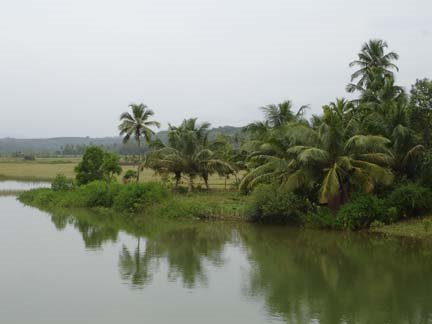
Holegadde near Honavar,Uttara Kannada dist, Karnataka
Copy? Right - but kindly remember to acknowledge!

" tulu-research.blogspot." ತುಳು ರಿಸರ್ಚ್. ಬ್ಲಾಗ್ಸ್ಪಾಟ್. ಇನ್

Have a nice day !