1. The proposal of the earliest stage of migration of proto- Tulu tribes is based on (a) the presence of Tulu words in African and Sumerian derived languages. The basic word ‘Tulu’ itself can be found in several place names and persons names. Similarly the Tulu words bant, oor (<.ur1=village), uri2 (<.ur2=to burn), ain (<.ai=five), sike(<.sige=sultriness), sima (samba=lion), puttu (putt=to birth) etc. are derived from ancient African/Mediterranean proto languages.
2. The timing suggested ca.2000 BC is approximate and is based on the mass migration of tribes out of Africa due to adverse environments like drought and desertification. There are actually many phases of African migrations beginning with the origin of evolved man around 165,000 years ago. Since the words Tulu, bant, oor, ain etc were well formed in African –Mediterranean region during the 4000-2000 BC period, the ca.2000 BC migration episode has been considered. The dates can be further refined with availability of new data.
3. The place of origin or initial dispersal was chosen as Ethiopia based on the presence of maximum number of place-name associations with the word Tulu. Even in those early days Tulu might have been a small ethnic group. Apparently even now there are ethnic groups called Tulu in Ethiopia.
4. For comparison of genome characteristics of Ethiopian and Tulu people extensive data may be required on either side, since both sides have undergone extensive human assimilations in the post-migration period. Right now, there may not be sufficient compilation of genetic data on this front, especially on the Tulunadu side. Besides, the present day Ethiopian have also changed considerably because several generations of migrations to and from Africa throughout the history. Apart from the declared complexities of genetic substructure of Ethiopian chromosomes, at least three major phases of back migrations from Asia into Ethiopia have been explained based on Y -chromosome genetic studies (Ornella Semino and others, 2002).Beside the present, Ethiopian (and Yemeni) maternal lineages are said to be composites of sub-Saharan and West Eurasian mtDNA haplogroups suggestive of extensive bidirectional gene flow on either sides of the Red Sea (Toomas Kivisild et al, 2004).
As pointed out by Kivisild et al (2003) in the Indian context, “It will take larger sample sizes, more populations, and increased molecular resolution to determine the likely modest impact of historic gene flows to India on its pre-existing large populations”
®

A heritage blog by: Ravindra Mundkur & Hosabettu Vishwanatha
Showing posts with label Origin of Tulu. Show all posts
Showing posts with label Origin of Tulu. Show all posts
Sunday, October 14, 2007


Tuesday, October 9, 2007
42. Origin of the word Tulu -II
The word ‘Tulu’ itself is of remote antiquity. Online search shall convince you that the word Tulu is more global in dimension than we can imagine.It appears that the word 'Tulu' originally meant 'water and water related aspects' in the language of its origin, but might have acquired additional meanings subsequently due to changes in environmental situations.
In the ancient Sumerian language“tu” morpheme represented ‘water spring or well’ or ‘water connected activities like bathing or washing’ and the morpheme “lu” was indicative of quantity or abundance, people etc. There was another Sumerian word “tulu” or “tule” that meant ‘soft or placid’. (Compare similarity of the latter meaning with our ‘tuluve’ jack fruit.).Tulu is found in the list of African personal names and the word means ‘spread out in different directions’, possibly implying migratory character of the Tulu tribes. Another vocally analogous African word ‘Zulu’ also means water.
I believe that the word ‘Tulu’ existed since Sumerian period of early civilization (ca. 6000-4000 BC) in north African-Mediterranean region, where from these original ancient Tulu tribes migrated. The ancient Sumerian and related languages form the basis for the evolution of many of the Afro-Asiatic languages of present day. The word 'Tulu' originally meant (1) water or activities connected with water (2) placid and soft.These ancient meanings still survive today in spite of the passage of several millenia in the time scale. These Sumerian meanings are analogous to those interpreted by Sediyapu Krishna Bhat and Manjeswar Govinda Pai in the context of present Tulu in Tulunad.
The Ethiopia can be described as cradle of human race, since the earliest human fossils (Homo sapiens) Omo I and Omo II dated back to 165,000 years were found in Ethiopia. As reconstructed by the genome studies complemented with archeology and paleontology, human migrations started out of Ethiopia and Africa in several phases.
Tulu place names
Tulu is the name of several Ethiopian towns and settlements. ‘Tulu’ is also a surname or part of the name among the Ethiopian people. For example, Derartu Tulu is an Ethiopian female athlete. There are at least four places (towns, settlements) called ‘Tulu’ in Ethiopia, at least one each in the other neighboring African countries like Kenya, Sudan, Nigeria and Zaire. In Ethiopia there are more than 12 places in the online maps with ‘Tulu’ as prefix, such as Tulu Bolo, Tulu Bora, Tulu Ferda, Tulu Guracha etc.
Tulu Migrations
On the basis of these data I suggest that the original Tulu tribes originated in Ethiopia in northern Africa and migrated out of Africa under adverse environmental conditions.Based on environmental geological data scientists have interpreted that around 2000 BC, wide spread desertification of northern Africa prompted many tribes to migrate out of Africa. Tulu place names in other African countries are suggestive of migration of early Tulu tribes in different directions. The present African meaning of ‘spread in different direction’ for the word ‘Tulu’ could have been the result of migrations.
The exact nature of the language of the primary Tulu tribes hailing from Ethiopia is difficult to conjecture now but we can presume some of the original words are still preserved as fossils in present Tulu language.
The Tulu language has grown or evolved independently of African languages during the last 6000 years in such a way that they have entirely separate identities and characteristics. A lot of things change as a result of divergent evolutionary trends. But some fossil root words may exist still!
Outside the African continent, Tulu place names can also be found in Pakistan (‘Thulu’), Afghanistan, Mynamar, China, Bolivia, Brazil, Papua New Guinea and Phillipines.
The Afghan Television channel, at present, is called ‘Tulu TV’, the word ‘Tulu’ in the present Afghan language means something like ‘the rising’ or ‘the dawn’. Note that Afghan meaning of ‘Tulu” is different from the African roots. Afghanistan is close to Pirak where many of the tribes settled during the period ca.2000 to 500 BC. The Pirak episode of Tulu tribes has been discussed in several earlier posts in this blog.
The Tulu tribes settled and lived in the Pirak area for some 1500 years, then again migrated (ca 500-300 BC) to their present homeland in Tulunad.
The original ‘Tulu’ may have been the name of the mother who migrated from Africa to Pirak along with her family. The original ‘Tulu’ family carried several root words along with them during the migration from their early homeland. A few such Tulu families or clans were active in the last millennium also around Kundapur, Honavar and Banavasi region.
And Krishnadevaraya who ruled Vijayanagar was product of one such family that called itself Tulu clan.
In the ancient Sumerian language“tu” morpheme represented ‘water spring or well’ or ‘water connected activities like bathing or washing’ and the morpheme “lu” was indicative of quantity or abundance, people etc. There was another Sumerian word “tulu” or “tule” that meant ‘soft or placid’. (Compare similarity of the latter meaning with our ‘tuluve’ jack fruit.).Tulu is found in the list of African personal names and the word means ‘spread out in different directions’, possibly implying migratory character of the Tulu tribes. Another vocally analogous African word ‘Zulu’ also means water.
I believe that the word ‘Tulu’ existed since Sumerian period of early civilization (ca. 6000-4000 BC) in north African-Mediterranean region, where from these original ancient Tulu tribes migrated. The ancient Sumerian and related languages form the basis for the evolution of many of the Afro-Asiatic languages of present day. The word 'Tulu' originally meant (1) water or activities connected with water (2) placid and soft.These ancient meanings still survive today in spite of the passage of several millenia in the time scale. These Sumerian meanings are analogous to those interpreted by Sediyapu Krishna Bhat and Manjeswar Govinda Pai in the context of present Tulu in Tulunad.
The Ethiopia can be described as cradle of human race, since the earliest human fossils (Homo sapiens) Omo I and Omo II dated back to 165,000 years were found in Ethiopia. As reconstructed by the genome studies complemented with archeology and paleontology, human migrations started out of Ethiopia and Africa in several phases.
Tulu place names
Tulu is the name of several Ethiopian towns and settlements. ‘Tulu’ is also a surname or part of the name among the Ethiopian people. For example, Derartu Tulu is an Ethiopian female athlete. There are at least four places (towns, settlements) called ‘Tulu’ in Ethiopia, at least one each in the other neighboring African countries like Kenya, Sudan, Nigeria and Zaire. In Ethiopia there are more than 12 places in the online maps with ‘Tulu’ as prefix, such as Tulu Bolo, Tulu Bora, Tulu Ferda, Tulu Guracha etc.
Tulu Migrations
On the basis of these data I suggest that the original Tulu tribes originated in Ethiopia in northern Africa and migrated out of Africa under adverse environmental conditions.Based on environmental geological data scientists have interpreted that around 2000 BC, wide spread desertification of northern Africa prompted many tribes to migrate out of Africa. Tulu place names in other African countries are suggestive of migration of early Tulu tribes in different directions. The present African meaning of ‘spread in different direction’ for the word ‘Tulu’ could have been the result of migrations.
The exact nature of the language of the primary Tulu tribes hailing from Ethiopia is difficult to conjecture now but we can presume some of the original words are still preserved as fossils in present Tulu language.
The Tulu language has grown or evolved independently of African languages during the last 6000 years in such a way that they have entirely separate identities and characteristics. A lot of things change as a result of divergent evolutionary trends. But some fossil root words may exist still!
Outside the African continent, Tulu place names can also be found in Pakistan (‘Thulu’), Afghanistan, Mynamar, China, Bolivia, Brazil, Papua New Guinea and Phillipines.
The Afghan Television channel, at present, is called ‘Tulu TV’, the word ‘Tulu’ in the present Afghan language means something like ‘the rising’ or ‘the dawn’. Note that Afghan meaning of ‘Tulu” is different from the African roots. Afghanistan is close to Pirak where many of the tribes settled during the period ca.2000 to 500 BC. The Pirak episode of Tulu tribes has been discussed in several earlier posts in this blog.
The Tulu tribes settled and lived in the Pirak area for some 1500 years, then again migrated (ca 500-300 BC) to their present homeland in Tulunad.
The original ‘Tulu’ may have been the name of the mother who migrated from Africa to Pirak along with her family. The original ‘Tulu’ family carried several root words along with them during the migration from their early homeland. A few such Tulu families or clans were active in the last millennium also around Kundapur, Honavar and Banavasi region.
And Krishnadevaraya who ruled Vijayanagar was product of one such family that called itself Tulu clan.
41. Origin of the word Tulu -I
Origin and meaning of the word Tulu has been disputed in literary circles since pre-Independance days. Dr. Palthadi Ramakrishna Achar(1999) has compiled the available historical information on the word ‘Tulu’ in his book ‘TuLu naaDu- nuDi’. Most of the appraisals, as remarked by Dr Achar, have been made considering Tulu as a character of the territory or the people rather than the language.
1.In ‘Rajatha Peethapura Mahatme’(1913) it is described that a chieftain of Udupi called Ramabhoja offered Tulābhāra to the deity, to amend for the sin of killing a serpent. Tulābhāra is the offering of gold or other material (according to the status of the worshipper) equivalent to ones body weight. Thus the word Tulu has been suggested to have been derived from the Tulābhāra. The theory has not been accepted by experts since Rama bhoja appears to be an imaginary ruler unsubstantiated in the actual history of the land.
2.Another similar legend in ‘Keralotpatti’, an ancient work that originated from Kerala, describes the rule of one ‘Tuluban Perumal’ from Koteswara, Kundapaura area, who gave the name Tulunad for the area.This is again a figment of fertile imagination since there is documented evidence of any Tuluban Perumal ruling Tulunad.
3. Dr B. A. Salettur derived the word ‘Tulu’ from the Kannada root ‘tooL’ which means to attack. Dr. Gururaja Bhat had discounted this suggestion since Tulu people were never attacked anyone nor had any expansionist ideals.
4. Manjeswara Govinda Pai proposed that the word Tulu has been considered to have derived from the Tamil word ‘Tulai’ which means to row or play with water.
5. Kudkadi Viswanatha Rai (cited in Dr Achar,1999) suggested that the Tulu has been derived from the phrase ‘Tullal naadu’, wherein ‘tullal’ means to wriggle or to dance. Native Mera or Muger tribes describe their marriage ceremony as 'tullal'.
6. Dr. Gururaja Bhat proposed that the word Tulu is modified form of the term ‘turu’ that refers to cattle. Cattle herding and grazing is considered to be one of the earliest known professions in India. Cow-herders of Gujarat, also known as Yadavas are considered to be one of the early settlers in Tulunad. Haritha of Yadava clan was said to have ruled in Tulunad according to Harivamsha. However there are no solid evidences in favour of turu>tulu word conversion .
7. ‘Tolahars’ were a royal clan that ruled a part of Tulunad. Tola>Tulu conversion has been thought of by some workers.
8. J.Sturrock in his South Canara Manual ( Vol.I ) inferred that word Tulu possibly refers to the ‘soft’ nature of the local people, since the adjective “tuluve” is applied to the soft pulpy variety of jack fruit. However, this argument has not been accepted by experts like Dr. Gururaja Bhat.
9. Sediyapu Krishna Bhat has pointed out that the word ‘Tulu’ is connected with water. ‘Tuluve’(jack fruit) also means ‘watery’ and that should be considered instead of the ‘soft’ implication. The other water related words in Tulu are talipu, teli, teLi, teLpu, tuLipu, tulavu, tamel and additionally in Kannada are tuLuku and toLe. In Tamil tuli means water drop and tulli means the same in Malayalam.
Interestingly, earlier Manjeswar Govinda Pai also had suggested that the term Tulu is derived from the Tamil word tulai which means to row, dive or play in water.
Thus it can be concluded that the word Tulu implies ‘related to water’.
10. The term ‘Tulu’ was also used as a clan name, as recorded in the Honnali inscription of Shimoga district, dated 1203AD. Dr. Gururaja Bhat has cited several personal names with Tulu as affixes like Tuluveswara, Tuluva Chandiga, Tulu Senabova, Tuluvi Setti, Tuluvakka Heggadati,Tulu Alva, Tulai Amma etc. as have been recorded in the inscriptions. In the Basrur (in Kundapur taluk) inscription dated 1401 AD, mentions a Tuluvi Setti donating land to maintain the routine expenditures of the Tuluveswara temple of Basrur. Besides, Krishnadevaraya, the famous emperor of Vijayanagar was said to be hailing from the ‘Tuluva’ dynasty.
Thus we can conclude that the word ‘Tulu’ means ‘that connected with water’ and it is also name of a clan or group.
However the word Tulu is more global than we ordinarily imagine!
(..to be continued)
1.In ‘Rajatha Peethapura Mahatme’(1913) it is described that a chieftain of Udupi called Ramabhoja offered Tulābhāra to the deity, to amend for the sin of killing a serpent. Tulābhāra is the offering of gold or other material (according to the status of the worshipper) equivalent to ones body weight. Thus the word Tulu has been suggested to have been derived from the Tulābhāra. The theory has not been accepted by experts since Rama bhoja appears to be an imaginary ruler unsubstantiated in the actual history of the land.
2.Another similar legend in ‘Keralotpatti’, an ancient work that originated from Kerala, describes the rule of one ‘Tuluban Perumal’ from Koteswara, Kundapaura area, who gave the name Tulunad for the area.This is again a figment of fertile imagination since there is documented evidence of any Tuluban Perumal ruling Tulunad.
3. Dr B. A. Salettur derived the word ‘Tulu’ from the Kannada root ‘tooL’ which means to attack. Dr. Gururaja Bhat had discounted this suggestion since Tulu people were never attacked anyone nor had any expansionist ideals.
4. Manjeswara Govinda Pai proposed that the word Tulu has been considered to have derived from the Tamil word ‘Tulai’ which means to row or play with water.
5. Kudkadi Viswanatha Rai (cited in Dr Achar,1999) suggested that the Tulu has been derived from the phrase ‘Tullal naadu’, wherein ‘tullal’ means to wriggle or to dance. Native Mera or Muger tribes describe their marriage ceremony as 'tullal'.
6. Dr. Gururaja Bhat proposed that the word Tulu is modified form of the term ‘turu’ that refers to cattle. Cattle herding and grazing is considered to be one of the earliest known professions in India. Cow-herders of Gujarat, also known as Yadavas are considered to be one of the early settlers in Tulunad. Haritha of Yadava clan was said to have ruled in Tulunad according to Harivamsha. However there are no solid evidences in favour of turu>tulu word conversion .
7. ‘Tolahars’ were a royal clan that ruled a part of Tulunad. Tola>Tulu conversion has been thought of by some workers.
8. J.Sturrock in his South Canara Manual ( Vol.I ) inferred that word Tulu possibly refers to the ‘soft’ nature of the local people, since the adjective “tuluve” is applied to the soft pulpy variety of jack fruit. However, this argument has not been accepted by experts like Dr. Gururaja Bhat.
9. Sediyapu Krishna Bhat has pointed out that the word ‘Tulu’ is connected with water. ‘Tuluve’(jack fruit) also means ‘watery’ and that should be considered instead of the ‘soft’ implication. The other water related words in Tulu are talipu, teli, teLi, teLpu, tuLipu, tulavu, tamel and additionally in Kannada are tuLuku and toLe. In Tamil tuli means water drop and tulli means the same in Malayalam.
Interestingly, earlier Manjeswar Govinda Pai also had suggested that the term Tulu is derived from the Tamil word tulai which means to row, dive or play in water.
Thus it can be concluded that the word Tulu implies ‘related to water’.
10. The term ‘Tulu’ was also used as a clan name, as recorded in the Honnali inscription of Shimoga district, dated 1203AD. Dr. Gururaja Bhat has cited several personal names with Tulu as affixes like Tuluveswara, Tuluva Chandiga, Tulu Senabova, Tuluvi Setti, Tuluvakka Heggadati,Tulu Alva, Tulai Amma etc. as have been recorded in the inscriptions. In the Basrur (in Kundapur taluk) inscription dated 1401 AD, mentions a Tuluvi Setti donating land to maintain the routine expenditures of the Tuluveswara temple of Basrur. Besides, Krishnadevaraya, the famous emperor of Vijayanagar was said to be hailing from the ‘Tuluva’ dynasty.
Thus we can conclude that the word ‘Tulu’ means ‘that connected with water’ and it is also name of a clan or group.
However the word Tulu is more global than we ordinarily imagine!
(..to be continued)
Subscribe to:
Posts (Atom)
A Coastal estuary
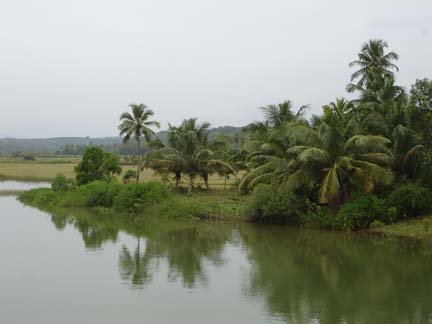
Holegadde near Honavar,Uttara Kannada dist, Karnataka
Copy? Right - but kindly remember to acknowledge!

" tulu-research.blogspot." ತುಳು ರಿಸರ್ಚ್. ಬ್ಲಾಗ್ಸ್ಪಾಟ್. ಇನ್

Have a nice day !