In a previous post on the legend of Rama, inference was that Ramayana was composed and built around a folk-lore on a tribal hero, specifically a Bhil archer. The hero of the epic, the Rama as well as the compiler of the epic, Valmiki both hailed from the ancient Bhil archer community.
It is generally believed that the name ‘Rama’ is a Sanskrit word. However, the available clues show that the name ‘Rama’or ‘Ram’ also may have been borrowed from the ancient/pre-Sanskrit folklores.
A research paper by Malini Srivastava (2007) on Munda culture and customs describes some interesting Munda customs and festivals. Munda tribes celebrate an annual festival called ‘Karam’. The origin of the ‘Karam’ festival is explained as a simple story that is quite interesting.
There were two brothers known as ‘Karam’ and ‘Dharam’. Dharam did not work whereas Karam worked hard in the agricultural fields, got good crops and became rich. Munda tribes celebrate the victory of Karam over Dharam in the form of a festival called ‘Karam’!
Karam and Dharam
The origin of the ancient ‘Karam’ festival shows some new insight into the nature of Early Munda words. As it is obvious from the story, ‘Karam’ means action or work, whereas ‘Dharam’ stands for philosophy. The ancient Munda anecdote reinstates the evergreen wisdom that work is worship.
These same words Karam and Dharam have subsequently been taken into Sanskrit and, may be, all present Indian languages. Now, both the words have detailed shades of meaning far more complex than the original simple connotations.
Karam-Kadamba
Karam in Munda language also represented a tree called ‘Karam’ or ‘Kaim’. Later this tree was known as Kadamba tree. The Kadamaba tree must have been quite auspicious since early historical days. The royal clan founded by Mayura Sharma at Banavasi (5th century AD) designated themselves as Kadamba dynasty.
Karam is the festival of victory of the farmer (agriculturist), celebrated on the eleventh moon day of the month ‘bhado’(September). A twig of ‘Karam’ (Kadamba) tree is brought and worshipped in the courtyard of the house. Later on the day, young shoots (‘ears’) of grain are distributed among friends and relatives.
This festive custom has been adopted by Tulu people in ‘Posatt’ (‘new crop’ festivity) or the ‘Koral parba’. The impact of the ‘koral parba’ on the regional populace is so deep that it is also celebrated by local Christians, converted from Hinduism. ‘Onam’ (Kerala) and ‘Huttari ‘(Kodagu) are regional variants of this festival.
Ram-Rama
The byproduct of the story is that if ‘Karam’ and ‘Dharam’ are antique words from Munda/Bhil languages, then the word Ram also was derived from the same source.
The existence of ancient Munda personal names like Karam and Dharam suggests that there may have been personal name like Ram or Rama.
®

A heritage blog by: Ravindra Mundkur & Hosabettu Vishwanatha
Showing posts with label Palthadi Ramakrishna Achar. Show all posts
Showing posts with label Palthadi Ramakrishna Achar. Show all posts
Thursday, December 20, 2007


Tuesday, October 9, 2007
41. Origin of the word Tulu -I
Origin and meaning of the word Tulu has been disputed in literary circles since pre-Independance days. Dr. Palthadi Ramakrishna Achar(1999) has compiled the available historical information on the word ‘Tulu’ in his book ‘TuLu naaDu- nuDi’. Most of the appraisals, as remarked by Dr Achar, have been made considering Tulu as a character of the territory or the people rather than the language.
1.In ‘Rajatha Peethapura Mahatme’(1913) it is described that a chieftain of Udupi called Ramabhoja offered Tulābhāra to the deity, to amend for the sin of killing a serpent. Tulābhāra is the offering of gold or other material (according to the status of the worshipper) equivalent to ones body weight. Thus the word Tulu has been suggested to have been derived from the Tulābhāra. The theory has not been accepted by experts since Rama bhoja appears to be an imaginary ruler unsubstantiated in the actual history of the land.
2.Another similar legend in ‘Keralotpatti’, an ancient work that originated from Kerala, describes the rule of one ‘Tuluban Perumal’ from Koteswara, Kundapaura area, who gave the name Tulunad for the area.This is again a figment of fertile imagination since there is documented evidence of any Tuluban Perumal ruling Tulunad.
3. Dr B. A. Salettur derived the word ‘Tulu’ from the Kannada root ‘tooL’ which means to attack. Dr. Gururaja Bhat had discounted this suggestion since Tulu people were never attacked anyone nor had any expansionist ideals.
4. Manjeswara Govinda Pai proposed that the word Tulu has been considered to have derived from the Tamil word ‘Tulai’ which means to row or play with water.
5. Kudkadi Viswanatha Rai (cited in Dr Achar,1999) suggested that the Tulu has been derived from the phrase ‘Tullal naadu’, wherein ‘tullal’ means to wriggle or to dance. Native Mera or Muger tribes describe their marriage ceremony as 'tullal'.
6. Dr. Gururaja Bhat proposed that the word Tulu is modified form of the term ‘turu’ that refers to cattle. Cattle herding and grazing is considered to be one of the earliest known professions in India. Cow-herders of Gujarat, also known as Yadavas are considered to be one of the early settlers in Tulunad. Haritha of Yadava clan was said to have ruled in Tulunad according to Harivamsha. However there are no solid evidences in favour of turu>tulu word conversion .
7. ‘Tolahars’ were a royal clan that ruled a part of Tulunad. Tola>Tulu conversion has been thought of by some workers.
8. J.Sturrock in his South Canara Manual ( Vol.I ) inferred that word Tulu possibly refers to the ‘soft’ nature of the local people, since the adjective “tuluve” is applied to the soft pulpy variety of jack fruit. However, this argument has not been accepted by experts like Dr. Gururaja Bhat.
9. Sediyapu Krishna Bhat has pointed out that the word ‘Tulu’ is connected with water. ‘Tuluve’(jack fruit) also means ‘watery’ and that should be considered instead of the ‘soft’ implication. The other water related words in Tulu are talipu, teli, teLi, teLpu, tuLipu, tulavu, tamel and additionally in Kannada are tuLuku and toLe. In Tamil tuli means water drop and tulli means the same in Malayalam.
Interestingly, earlier Manjeswar Govinda Pai also had suggested that the term Tulu is derived from the Tamil word tulai which means to row, dive or play in water.
Thus it can be concluded that the word Tulu implies ‘related to water’.
10. The term ‘Tulu’ was also used as a clan name, as recorded in the Honnali inscription of Shimoga district, dated 1203AD. Dr. Gururaja Bhat has cited several personal names with Tulu as affixes like Tuluveswara, Tuluva Chandiga, Tulu Senabova, Tuluvi Setti, Tuluvakka Heggadati,Tulu Alva, Tulai Amma etc. as have been recorded in the inscriptions. In the Basrur (in Kundapur taluk) inscription dated 1401 AD, mentions a Tuluvi Setti donating land to maintain the routine expenditures of the Tuluveswara temple of Basrur. Besides, Krishnadevaraya, the famous emperor of Vijayanagar was said to be hailing from the ‘Tuluva’ dynasty.
Thus we can conclude that the word ‘Tulu’ means ‘that connected with water’ and it is also name of a clan or group.
However the word Tulu is more global than we ordinarily imagine!
(..to be continued)
Subscribe to:
Posts (Atom)
A Coastal estuary
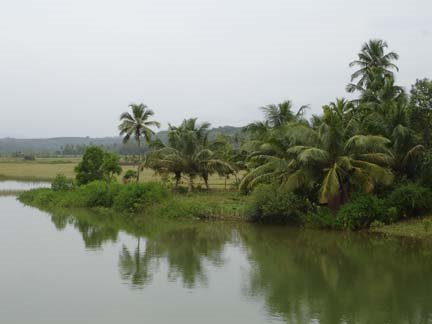
Holegadde near Honavar,Uttara Kannada dist, Karnataka
Copy? Right - but kindly remember to acknowledge!

" tulu-research.blogspot." ತುಳು ರಿಸರ್ಚ್. ಬ್ಲಾಗ್ಸ್ಪಾಟ್. ಇನ್

Have a nice day !