The Tulu identity and civilization as it exists now in Tulunad is a composite culture developed chronologically over not less than the last four thousand years. Like numerous rivers and streams flowing into the sea, several individual cultural streams have merged with the Tulu culture at different periods during the long historical past. One of the recognizable major events in the evolution of Tulu language and culture is the contribution of Tulu tribes that migrated to this Tulunad in the remote historical past dating back to the period 1000 to 600 years BC. [I quote the broad period of 400 years – i.e. 1000 to 600 BC- because I am not able to sharpen it more at present. With availability of more historical data, hopefully, we can narrow down this period.]
Iravattam Mahadevan suggested that the Indus valley civilization was an early form of Dravidian culture. Further after the decline of Indus valley civilization, possibly due to migration of rivers and abrupt floods, ca.1900 BC, Dravidians apparently moved out of the Indus valley region and lived in the north and northwest parts of the Indian subcontinent, before the advent of the Aryans. Brahui, a Dravidian language still spoken in Baluchistan, parts of Iran and adjoining areas is evidence in favour of the existence of Dravidians in those parts.
Among those who lived in the northwestern part of Indian subcontinent around Pirak, Mehrgarh, Multan and surrounding areas (now a part of Pakistan) ca.1900 to 1500 BC are Tulu and other Dravidian tribes. Aryans, migrated from Indo-European homelands also settled in these areas and composed the famous Vedas, initially in the oral tradition prevalent at that time.
That Tulu tribes were one of the groups of settlers in this area during the period cited above can be deduced by Atleast four lines of evidences recapitulated here below:
1. Presence of distinct Tulu words in Rigveda like : okha, aaNi, pala/ pela etc. These cited words have been considered by Michael Witzel as words borrowed into the early Sanskrit, since they do not conform to the linguistic word structure of Indo-European language in which the Vedas were composed. Rigveda, in original oral form, has been dated ca.1700-1500 BC. There may be more such words, for example like the suffix -aaN in braahmaN. [cf: previous posts 20,25,28 ]
2. The absorption of the legend of Abraham, into Tulu tradition as Bermer (Brahma) in the original form as a horse mounted hero.
Abraham, a popular leader of masses (legendary prophet for Jews, Christians and Muslims,) lived approximately 2000 BC in the NW Indian subcontinent-Asia Minor-Central Asia region. After his death in the tradition of spirit worship he became the “Bermer(u)” for Tulu tribes. Vedic Aryans converted the Abraham legend into the Brahman, the supreme cosmic creative power. Gradually with time Brahman evolved into the God Brahma with ten or four heads in different Purana epics, by the time of composition of the Ramayana ca. 800-500 BC. The dominance of Lord Brahma in Ramayana has been analysed in detail by SSN Murthy.
Since Tulu tribes carried their original horse mounted “Bermer” image with them to Tulunad before the evolution of the Brahma concept into ten or four headed God of creation, in northern India, the time of Tulu tribe migration can be fixed as pre 500 BC. [cf: previous posts 4, 5, 26,28 ]
3. The presence of ample Prakrit words in Tulu language, speaks of the heritage from their erstwhile homeland in Northwest Indian subcontinent. Especially the word Pirak is interesting. “Pirak” in Tulu language means ‘anything related to remote past’. Incidentally Pirak was the area of early civilization ca. 1700-800 BC. [cf: previous posts 3,6].
4. The basic “moolasthana”( literally means ‘primary inhabitation’ or ‘original homeland’) concept of Tulu tribes settled in Karavali Tulunad homeland is derived from the original concept of the tribes in their former homeland of northwest Indian subcontinent. Even today, Multan is a town in the Punjab province of Pakistan. [cf: previous posts: 9.18.19 30].There is a temple devoted to Prahlada at Multan.The legend of Prahlada,Hiranyakashipu and Narahari might have originated around this place.Incidentally,as pointed out by Manjunath,Prahlada is the grandfather of King Bali(also known as Baliyendra) who is reverred by Tulu and Malayali people since remote historical times.
®

A heritage blog by: Ravindra Mundkur & Hosabettu Vishwanatha
Monday, August 27, 2007


Sunday, August 26, 2007
30.Multan and moolasthana
The multi-talented great scholar (“Mahapandit”) Indologist, multilinguist (he knew thirteen languages), and widely traveled Kedarnath Pande (1893-1963) was born at Pandah village in Azamgarh district of Uttara Pradesh as a bhumihar Brahmin on 9April1893. He mastered Sanskrit, Hindi and its various dialects of Hindi like Bhojpuri, Malavi, Avadhi, Maithilli, Braj, Rajasthani and Nepali. He studied Pali and Sinhalese languages and read Buddhistic texts in the original form. He converted to Buddhism and changed his name to “Rahul Sankrityayan”. Rahul was the name of Buddha’s son and ‘sankrityayan’ means the assimilator.
“Volga se Ganga” (Original in Hindi, also translated to Kannada “Volga Ganga”) is one of his best works that traces the migration and evolution of Indian people from 6000 BC to present.
Multan is one of the places cited in his work Volga se Ganga.Multan at present is a city and district headquarters in Punjab province of Pakistan. Multan is the simplified version of the Sanskrit name “moolasthan” meaning the original inhabitation.
The original settlers of the ancestral Indian subcontinent in this area called this place as their moolasthan (also written variously as “mūlsthan” or “mūlstan”).The word tan or than was their in Prakrit. It has been traveled along with migrating ancestral Indians absorbed into Marathi and Kannada languages as “thana” or “thane”.
Migrant Tulu tribes retained the moolasthan concept from the original homeland of northwestern Indian subcontinent (now part of Pakistan) and carried it to their subsequent homeland, Tulunad in the Karavali of Karnataka. The early settlements of Tulu tribes in Karavali(coastal Karantaka) are called moolasthanas.(cf:Post).
ß
Wednesday, August 15, 2007
29.The Rice: Vrihi and Arih
The relics of rice grains recovered from the archeological sites of Pirak area, Baluchistan suggest that the area was known for rice cultivation around 1700 BC. The mixed civilization at that time period composed of Vedic scholars and proto-Tulu, proto- Tamil and Dravidian communites at Pirak, as has been dealt in earlier posts here before.
Origin of the Sanskrit word ‘Vrihi’ that means rice (Oriza sativa) and sometimes other cereals like wheat and barley, has been discussed by Indological experts like Asko Purpola. The word is generally said to be not directly influenced by or related to the Dravidian words ‘arih’ (Tulu) and ‘arisi’ (Tamil) that represent the rice. On the other hand it has been fairly accepted that the Tamil word ‘arisi’ was adopted by Greek, Latin and also English as ‘rice’.
Sankaran Nair (2003) suggested that ‘Vrihi’ is a modified form of the word ‘varahi’. He cited that there are several varieties of rice designated as Graishmic, Hemanti, Varshic, Sharada, Salini etc described in ancient Sanskrit texts. Varahi is the female form of mythological Varaha, the boar incarnation of Lord Vishnu. (Varahi, is also the name of a river in Western Karnataka).
The word ‘Varahi’ has further ramifications. First connotation is that the Varaha was worshipped at that time by communities and cultures prevalent then at Pirak area. Spirits worshipped by the Tulu communities, even to date, include ‘Panjurli’ which is the Tulu form of Varaha. Appaently, the Panjurli or the Varaha was worshipped more widely at that time. The Varaha concept, later in the history, was absorbed as one of the ten incarnations of Lord Vishnu.
Thus the word ‘vrihi’ might have brought into Sanskrit usage as rice was predominantly grown and consumed by those who worshipped the Varaha or Panjurli. Besides, there is certain degree of similarity in pronunciation of the words ‘vrihi’ and ‘arih’.
ß
Tuesday, August 14, 2007
28.Significance of the Brahma
One well-wisher who read my post on Brahma commented that I erred in equating the Brahma with Brāhman (pronounced ‘BraahmaN’).
It is not that I equated the two but expressed that the word Brahma gave rise to the word BraahmaN. The latter word came into represent ‘the one who knew about Brahma’. Here the ‘Brahma’ or the ‘Brahman’ (pronounced ‘brahman’) meant the refined theological / metaphysical and esoteric concept of Brahma, the cosmic power that created the universe as well as the supreme power that pervades the universe. Subsequently, the word ‘brahma’ also meant large and gigantic (‘bruhat’). Words like Brahmanda ( literally means ‘the gigantic egg’ =universe), brahma-rakshsha, brahma-ratha, naga-brahma etc came into usage.
My objective of reconstructing the original legend and further the concept of Brahma is to understand the evolution of our religious beliefs from the historical and sociological viewpoint. I am not elaborating the theological aspects that are reasonably well known since it has been dealt extensively by others so far.
A historic heroic person, a leader of masses, Abraham, who claimed to be the creator of tribes, became a legend during his life time and also after his death. He is cited in the Bible and is revered as a leader by the Jews and as a prophet (Ibrahim) by Muslims. The Vedic scholars accepted him as the creator and the ultimate cosmic power. The legend of Abraham/Brahma was spread throughout the connected geographic region of West Asia-Asia Minor-and Central Asia.
The Vedic people and contemporaneous Jews had deep-seated rivalry, in spite of both communities sharing many common concepts and beliefs. Whatever words starting with A the Jews used, Vedics used it without initial A. (It may be the other way round also.) So Ahura or Asura of Jews became Sura for Vedics. (Recall the Sura-Asura wars described in Puranic legends.) Avesta became Veda. Abraham became Brahma and so on.
Some more discussion on the word ‘braahmaN’: The word is composed of ‘brahma + aN’. The word ‘aaN’ is a Tulu word meaning a male person. AaN+ jovu (literally ‘male being’ refers to man) in Tulu. Interestingly, the word ‘jovu’, currently used in Brahmin Tulu to refer to the girl child, is also related to the Sanskrit word ‘jeeva’.
It appears to me that the word ‘aaN’ was borrowed into early Sanskrit from Tulu like some of other words discussed in earlier postings. So the word braahmaN originally meant young male who studied scriptures relating to the knowledge of Brahma, the cosmic power. Perhaps, Prof Michael Witzel may throw better light on the status of the suffix /word ‘aaN’ in Brahman and also ‘jovu’ to ‘jeeva’ conversion or vice versa.
On the whole, these discussions further affirm my theory that atleast some Tulu ancestors dwelled in the Pirak civilized habitation in Sind, Baluchistan during the early historical period when Vedas were composed. The Tulu ancestors that migrated carried the worship of Brahma in the form of ‘Bermer(u)’ to Tulunad their subsequent homeland.
The image of Tulu Bermer (Brahma) was akin to the original form of Abraham, the horse riding hero. In a way these Tulu ancestors were following the ancient cult of hero worship that became the spirit worship after the death of the Abraham. The cult of hero worship (example: Koti- Chennaya, Kanthabare- Boodabare etc) and spirit worship (example Panjurli, Kalurti, Kodamanthaya etc) have continued to persist in Tulu culture even to date.
On second thinking, it appears that cult of Brahma worship was more widespread in India in the past till the ascent and domination of Shaivism. Along with the Tulu people, migrating other Dravidian like Kannada and Tamil ancestors carried the Brahma cult to different parts of southern India as evidenced by the relics of Brahma temples and Brahma name tags like Brahmaiah, Bommaya, Brahmasandra etc. The Jainism absorbed many features of the Brahma cult.
Therefore, the legend of Brahma stands testimony to trace the evolution and transition of our theological faiths from the primitive hero/spirit worship to the concept abstract cosmic powers at higher philosophic metaphysical levels on one hand and that of Hindu Gods in human forms at the other popular level.
®
Monday, June 4, 2007
27. The Sweet Potato
The sweet potato (botanical name: Ipomea batatas) was a humble food of the masses since early historical days. Rama, the dark skinned prince of Ayodhya, during the early part of Indian history, went to live in the forest for fourteen years along with his wife Sita and brother Laxmana, only to honour the promise made by his father Dasharatha to his wife (Rama’s step mother Kaikei). Rama and others had to consume roots and tubers like sweet potatoes and wild fruits in the forest. Sweet potato is a common root that can be consumed in raw as well as cooked form.
Reports said that sweet potato (see, Manjunath) was also brought to India by the Portuguese some five centuries ago along with chilies, beans, potato, cassava, breadfruit, sunflower, groundnut, pineapple, guava, sapota, passion fruit, cashew, tobacco, onion, garlic and so on. Sweet potato is reported to be native to the American continents since 5000 years. Archeological evidences suggest that it was cultivated ca.2400 BC in South America; and Columbus is said to have discovered it in the Caribbean region during AD1502.
Balasubramanian, a reader commenting on Manjunath’s cited posting on imported vegetables, elucidated an interesting custom of using native vegetables and materials in shraddha ceremonies of Tamil Brahmins. Sweet potatoes are one of the acceptable tubers used in the preparation of ceremonial food, indicating that sweet potato has attained nativity to our land since long time. They use bitter gourd, raw bananas, banana stem, colocasia, snake gourd, cluster beans, local cucumber, sweet potato, ginger, raw mango and black pepper. Similar ceremonies in Tulu households make use of specified vegetables and allied materials for the preparation of meal on the uttarakriya day. Raw bananas, ash gourds and inner part of plantain (banana) stem constitute the essential vegetables for obituary ceremonies in Tulu families, though modernization has tacitly replaced some of the traditionally accepted items with currently prevalent ‘desi’ items (like chillies for black pepper) in the menu. These obituary traditions appears to be quite ancient and some research is desirable on the nature and evolution of our traditional ceremonies.
Balasubramanian distinguishes between ‘valli kizhangu’(=sweet potato) and ‘mara kizhangu’(=cassava). Even in Tulu, cassava (tapioca) is called ‘mara kireng’, wherein ‘mara’(= tree )refers to the shrub of cassava. However the Tamil word sarkarai valli kizhangu is a clear translation of sweet ‘vine tuber’ inspired by the imported name of sweet potato.
Apart from its emphasized nativity to American continents, the sweet potato is being grown in diverse lands such as Polynesia, New Zealand and China. In Polynesia, New Zealand and Peru, it is called ‘Kumara’. The similarity of the word Kumara to the Sanskrit word may be coincidence. However, according to linguistics like Michael Witzel, the word ‘Kumara’ in Rigveda, composed in Indo-Aryan language (early Sanskrit) has been considered an extraneous word borrowed from uncertain language. How the sweet potato traveled into different continents is still an unsolved mystery.
The Tulu and Tamil words for the sweet potato are interesting. In Tulu it is ‘kireng’ (also, ‘kileng’ and other variants) and in Tamil it is ‘kilang’ (or with slightly different but allied pronunciation like kizhangu). Both the words mean the same: keeL or keer =the lower or underground; ang=part. The nomenclature is quite original and not an adopted word from the imported name of sweet potato. Most of the imported vegetables and fruits have names similar to or derived from their foreign names. The Malayalam word ‘kiraNNu’ is related to Tulu and Tamil words. However, Kannada and Telugu have the word ‘genasu’ for the sweet potato. In Tulu there are several related species of sweet potatoes cited in Tulu Nighantu (=dictionary) such as: Tuppe kireng, koLLi kireng, guddoli kireng, toonNa kireng, pottel kireng, muLLu kireng, apart from the kempu kireng (=red sweet potato), boldu kireng (=white sweet potato) and mara kireng(=cassava). I have seen tuppe kireng, a short variety of tuber named after tuppa, the butter. MuLLu(=spines) kireng refers to one with spines. Other species may still be surviving in our rural areas and our botanists should look into these research aspects. All these tubers, some of them rare and vanishing species, could not have been brought by the Portuguese. Tribals in India still consume several variety of tubers. Many of these tubers are possibly native to our land since ages.
Similarity of Tulu and Tamil words for sweet potato (or allied tuber) suggest certain antiquity to the said tuber. Available evidences indicate that proto-Tulu and proto-Tamil tribes coexisted in early Vedic times (ca. 1500 to 500BC) as suggested by borrowing of Tulu/Tamil words in Rigveda. (See, previous postings, No.26).The reference to edible tubers in the Ramayana (ca. 500-200 BC) only confirms this postulation.
Similar problems exist for other agricultural crops also. For example, peanut (groundnut) is also considered a native of Americas, but it is reported to be cultivated in China since 1500 BC. The antiquity of agricultural crops suggests that many of these are as old as our civilization, if not more. For example, how to fix the nativity of a now ubiquitous plant like coconut? Coconut (Cocos nucifera) is found on the earth since Miocene age ca. 20 million years ago, i.e. long before man appeared on this planet.
South American nativity of sweet potatoes and several other agricultural crops has been asserted based on the extensive archeological and paleo-botanical studies carried out in the Americas. Similar studies in Indian context are highly desirable for better understanding of our past.
Sunday, June 3, 2007
26 Origin of the concept of Brahma
The story of Brahma, the deified hero who is considered as the creator and one of the Trinity (Trimurthy) and ultimately the generally forgotten God, is a very interesting episode in the origin and evolution of culture and religious beliefs in the Indian subcontinent as well as
Brahma is also one of the earliest Gods in
The Brahma worship initiated in the present northwestern
The Tulu Bermer (e in bermer is pronounced as initial e in ‘eligible’) [‘berme’(< brahma) is the singular form and ‘bermer’ is the plural or respective form of address] is a dialectical corruption of the Vedic word Brahma. This leads to the suggestion that Tulu tribes then living with Vedic scholars were mostly ‘illiterate’ folks, who modified the high sounding Vedic words to suit their preferred pronunciation styles. The possible coexistence of Tulu tribes with Vedic scholars at Pirak during Rigvedic times is suggested in the previous posting (No. 25) on Pala and antiquity of Tulu words.
We go back in the timeline to about 1900 BC in search of the origin of Brahma. Then
The educated few (Vedic tribes) initially composed hymns of Veda in their native Indo-Aryan language. Similarity of Indo-Aryan Vedic hymns and hymns of Iranian Avesta have lead experts like Michael Witzel to suggest that Indo Aryans might have migrated from
The character of Abraham has been described in the Bible (Genesis) and later retold in the Anacalypsis. Abraham (or the Brahma) was actually a mass hero, an uncommon leader of early tribes, born ca. 1900 BC, more or less during the chaotic time of earth movements, migration of major rivers and mass exodus of tribes from the
Abraham is said to have been lived for a period of 175 years. (The cited lifespan appears to be an exaggerated figure, characteristic of hero worship societies, nevertheless may imply that Abraham was a strong, dynamic character and had considerably long healthy lifespan.) Different tribes called him slightly differently depending upon the style of pronunciation native to them. He was called Abraham by Jews and subsequently by Christians. Arabs called him ‘Ibrahim’ whereas IndoAryans referred to him as Brahma. His father, ‘Terah’ originally came from a place known as Ur of Chaldees or Culdees, a part of
Terah had a beautiful daughter called ‘Sara’ (or ‘Saraswati’ for Indo- Aryans and cohabitants of Pirak and northwest
At that time, the present day Asia minor-Indian subcontinent region consisting of
The people of Pirak worshipped him as a hero, the creator of the tribes. Thus original Brahma as worshipped by Tulu tribes was a hero straddling on a horse. This leads me to suggest that Abraham was a horse rider. The original concept of horse seated Brahma was transported by migrant proto-Tulu tribes from Pirak to Tulunad. (see postings 4 and 5).The Bermer idol in garodis of Tulunad even today consist of idol of brahma (abraham>berme) in the form of soldier seated on a horse. The garodis, the ancient institutions of Tulunad, established to propagate the art of body building, physical development and techniques of warfare, continue to have brahma as worshipping idols. The legendary Tulu heroes Koti and Channayya worshipped the Bermer according to the paD-dana folklore. There were many brahmasthans in Tulunad in olden days that have been dilapidated or destroyed on the wake of people changing over to Shiva, Shakti or
Vedic tribes venerated his legends as Brahma, the almighty, the creator of universe and incorporated the concept into Vedas. The word ‘Brahma’ gave rise to ‘braahman’(=educated person), ‘brahmaanDa’ (=universe), ‘brahma kalasha (=the holy pot used in the installation of temples and also the connected ceremony)’, brahma-ratha (=large temple chariot), brahma-rakshsa (= a huge demon), brahma-sthana (=temple of brahma) etc. The words root ‘brih’ to mean big or great was developed as a consequence of Brahma worship.
Brahma worship was at its peak during the composition and writing of Ramayana (ca.300 BC to 200AD). Then Brahma became a fusion of a creator deity with the impersonal absolute Brahman in a more popular and personalized form according to indology experts. S.S.N.Murthy (2003) of
However, the subsequent ascent of Shiva and later Vishnu worships sent the initial God Brahma into the background.
Thus the Tulu concept of horse riding Brahma may be older than the ten or four headed Brahma depicted in Ramayana and the Tulu tribes were not aware of the transformation of initial horse riding Brahma into four headed God. In that case, it appears that Tulu tribes migrated from Pirak and northern
25. Pala and Antiquity of Tulu words
Strange it may seem,that the Jack fruit was the first edible fruit in use in antiquity in the Indian subcontinent. The nature of the word Pala, Phala or Pela to represent the Jack fruit even today suggests that the word (Pala / Pela/ Phala) was originally or since beginning was used to denote the common Jack fruit, arguably a native fruit of Indian subcontinent.
The basic word ‘phala’ stands for ‘fruit’ in Sanskrit. The presently commonplace word has been absorbed by most of the Indian languages, like phala (Kannada), phalam (Malayalam), etc.
Michael Witzel (1999) while analyzing words found in the Vedas concluded that some words in Rigveda (early part of Rigveda were estimated be ca.1700-1500 BC old) are not original Indo-Aryan (or early Sanskrit) words. He has given a list of words borrowed into middle compositions of Rigveda (ca.1500 BC or younger) which includes phala, mayur etc. These extraneous words must have been borrowed from contemporaneous languages that existed in the proximity of Vedic scholars and their settlements. He has stated that phalam is derived from the Tamil word ‘palam’ meaning ripe fruit.
Incidentally, apart from the word ‘palam’(=ripe fruit), the word ‘pala’ also means jackfruit in Tamil according to Dravidian Etymological Dictionary by T. Burrow, M. B. Emeneau. Similarly, in Tulu language word ‘pela’(>pelakai) or ‘pila’ (>pilakai) represents the jack tree/fruit. Earlier, in Tulu also the ‘pala’ version might have existed; since the wooden planks derived from the jack tree are called ‘palai’. However, presently the word palai in Tulu represents any wooden plank.
It seems that during the early historical period of composition of Rigveda, the proto-Tulu/Tamil word pala represented the jack fruit. Possibly, it was the most popular or common fruit at that time. It can be visualized that the Vedic scholars considered the pala (or pela or pila), the jack fruit, at that time of history as an important and popular edible fruit and adopted it in the form of ‘phala’. The word ‘phala’ incorporated into Sanskrit subsequently stood to represent the fruits. Maybe the mango, the king of Indian fruits, was not properly recognized at that time.
Thus, subsequently the word pala (>phala) represented any ripe fruit.
The jack fruit/trees may not have been common trees in Pirak region or Vedic scholars were initially not familiar with the Pala /Pela tree. Therefore it appears that the Vedic scholars picked up the word from proto-Tulu/Tamil tribes.
Similar words exist in Malayalam. The equivalent word for jack fruit in early Kannada was ‘palas’. Telugu equivalent word for jack is ‘panasa’.
The existence of similar words in Tulu and Tamil suggest (a) either their derivation from a common proto language or (b) coexistence of proto-Tulu and proto-Tamil tribes at a certain point of history dating back to the period of compilation of the Vedas. In other words, this coexistence or common heritage of Tulu-Tamil languages and exchange of words among these communities imply that some members of these tribes were living in the vicinity of Vedic tribes at the period of compilation of Vedas.
However, the Tulu tribes do not commonly use the word ‘pala’ or ‘phala’ to represent fruits in general. They employ the term “parn′d” to mean fruit. [The symbol ′ here represents the time delay in pronunciation; d as unaspirated th in English ‘the’]. The Tulu word “parn′d” also means ripe banana; alternately, it also means any ripe fruit. It is interesting to note that when Vedics adopted the ‘pala’, the jack, to represent edible fruits, Tulu tribes preferred the word ‘parn′d’, the banana, to signify fruits!
Apart from the intriguing pala/ pela in Vedas, Michael Witzel lists three extraneous words which he considers as words of uncertain origin in the early part of Rigveda. These are ukha(=hip), phalgu (=minute weak) and aaNi (=lynch pin). These words exist in Tulu and may be that Vedics borrowed them from proto-Tulu neighbours.
Ukha means hip in Tulu. Okka noolu in Tulu refers to ‘loin string’ or the thread tied around the hip in olden days. Phalgu has similarity to ‘palku’ in Tulu; palkuni (verb) in Tulu means becoming soft, like a ripe fruit. And aaNi in Tulu means nail. Another word of interest is mayUra (=peacock), which is also considered as an extraneous word in Rigveda. In Tulu ‘maira’ exists since olden days; the ‘Maire’(=peahen, the female pea fowl) was a favourite name kept for women among Tulu tribes in earlier days.
The existence of Tulu words in Rigveda, indicates the antiquity of Tulu language. It may also mean that proto-Tulu speaking people were living in the area where Vedas were composed.
Footnote on Pela and Peja
The English word ‘jack fruit’ was derived from the Malayalam word ‘chakku palam’. In an earlier note (24) I erroneously suggested that word came from ‘jakku palam’, based on a random reading. I must have misread it. Manjunath pointed out to me that he has not heard any ‘jakku palam’ in Malayalam. So I googled on this howler and found some interesting information provided by Julia F Morton (1987).
Jack fruit or Jakfruit or Jak or Jaca (botanical name: Artocarpus heterophyllum) is considered native to Western Ghats of India
Morton classified Kerala jack fruits into (1) Kooja chakku and (2) Kooja phazam (barke or Varika). The ‘kooja chakku’ is the jack fruit with soft, puply carpels, called ‘tuluve’ in Tulu. So we find the word ‘chakku’ here that became ‘jack’.
The Malayalam word ‘kooja’ is related to the Tulu word ‘gujje’, the jack fruit. The Tulu word ‘barke’ denoting soft jackfruit that can be opened with hand is found also in Malayalam. ‘Varika’(Malayalam), varukkai(Tamil) and ‘varaka’ (Srilanka) appear to be related to the ‘barke’.
The Sahyadri, Western Ghats and coastal hinterland has another species of Artocarpus genus (A.pubescens?-wild jack ) known as peja or pejakai. The fruit, is of the smaller size of orange with soft spiny exterior and contains smaller carpels of grape size that taste distictly different from jackfruit. Otherwise it is similar in features to jackfruit. This tree is not described elsewhere and hence may not be a common tree in other tropical forests. The village name Pejavara (=peja+avara) means an open ground containing peja trees. Note the similar sounding tree names: pela and peja in Tulu.
Early Kannada (or Old Kannada, ca.400 AD)) bloomed around Banavasi town (presently southeastern Uttara Kannada region), with establishment of the Kadamba dynasty by Mayur Sharma at Banavasi. The similarity of Tulu ‘pela/pala’ and Kannada ‘palas’ words, in the two languages that grew up in close proximity is significant.
Subscribe to:
Posts (Atom)
A Coastal estuary
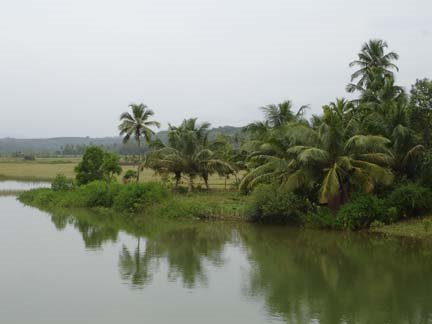
Holegadde near Honavar,Uttara Kannada dist, Karnataka
Copy? Right - but kindly remember to acknowledge!

" tulu-research.blogspot." ತುಳು ರಿಸರ್ಚ್. ಬ್ಲಾಗ್ಸ್ಪಾಟ್. ಇನ್

Have a nice day !