Madhvaacharya was a prodigious sage from 13th Century Udupi who disagreed with the Shankaracharyas doctrine of ‘Advaita’(unitary) theosophy and founded the religious school of ‘Dwaita’ or dualism of Atma or Jiva (Soul) and Paramatma (Creator). Narayana Pandithacharya subseqently wrote biographic narration of life and travels of the sage Madhva in a Sanskrit work known as Su-Madhva Vijaya. Poet Narayana Panditacharya was son of Trivikrama Panditacharya, the principle disciple of Madhva. Narayana Panditacharya was fond of Sanskrit, the pan-Indian link language at that time. He has translated even the local Tulu place names into complex Sanskrit words in his work and eventually also added explanatory notes to his poetic work called ‘Madhva Vijaya Bhava Prakashika’. Further Vishvapati Tirtha in a commentary called ‘Padartha Deepikodbhodika’has given some of the equivalent Tulu place names for the Sanskrit names created poetically by Narayana Panditacharya. On the whole these works provide some rare insight into the Tulu place names as well as general attitudes of people at that historical juncture.
Dr Uppanagala Rama Bhat wrote an interesting review paper in Kannada on the“ Tulu words in Madhva Vijaya”. The Kannada paper (entitled ‘Madhva Vijayadalli Tulu Shabdagalu’, pp 415-419) has been included in the compendium ‘Tulu Sahitya Charitre’(2007) published by Kannada University at Hampi. In this post let me share some of my observations and analysis derived from the reading of this interesting paper.
Madhva (1238-1317)
Sage Madhva was born at Pajaka in Belle village ,Udupi taluk bearing the name of Vasudeva. His father was known by his surname Naduvantillaya.His full name has not been recorded.The surname ‘naDillaya’ or ‘naDuvantillaya’ in Tulu means one hailing from the middle house. This pattern of surnames with -aya (=person) at the end are common feature among Tulu Brahmins. Narayana Pandita has translated the surname ‘Naduvantillaya’ into ‘Madhyageha’ Bhatta.
Vasudev was inducted as ‘Poornaprajna’ into sagehood by Guru Achuta Preksha and subsequently after taking charge of administration of the Mutt, Poornaprajna became known as ‘Ananta-tirtha’. However, Vasudev finally preferrred to adopt the name of ‘Madhvācharya’. (Acharya=learned person, teacher).
Madhva = Nadillaya
According to Narayana Pandita, the Sanskrit name ‘Madhva’ represents ‘Ananda-tirtha’. Madhu= Ananda (=happiness), va=tirtha(=sacred water). However, it is possible that the actual meaning of the name Madhva preferred by the sage for himself may be different from what Narayana Pandita has speculated. There are many Tulu village/hamlet/habitation names ending with suffix –va: Shirva, Kakva, Urva etc. Therefore it seems logical to predict that the Madh(ya) in Madhva possibly represented the ‘middle’ and –va suffix represented family house or habitation. Thus the original intention of the sage was to represent his family surname ‘Nadillaya’ or the ‘Madhyageha’, the one hailing from the middle house.
Rajatha-pita-pura
The area around the original Shiva temple in Udupi was known as Shivalli, the Shiva’s village.However, the town ‘Odipu’ or the ‘Udupi’ has been translated as ‘Rajatha-peeta-pura’in the work of Narayana Pandita.(‘rajatha’=silver; ‘piTa’= seat,foundation; ‘pura’=town). Many have wondered how the word silver(‘rajatha’) came to be associated with Shivalli and the Odipu.
One possible explanation to this riddle is that Madhva loved his native village, known as Belle.The word ‘Belle’ originally might have represented the immigrant white people, but the word ‘belli’ also means silver. Therefore Madhvaacharya could have named Udupi-Shivalli town (pura) as the theological foundation (peeTa) created by people of Belle (rajatha) village.
**
Brief notes on some of the place names cited in the commentaries on the Madhva Vijaya:
Pajaka: Uppanagal Rama Bhat has analysed the place name ‘Pajaka’ as pāja=pāde(rock) and ka=water.However the original Tulu toponym as recorded in Survey of India Topo-sheets appears to be "Paajai"
Kodavur-kana: The Kodavur village near Malpe was known as Kodavaur-kana during 13th century , (kāna=forest) implying that the area was covered with dense growth of trees.
Nayampalli: There is avillage known as Nayampalli or Neyampalli near Udupi. The Neyampalli vallage name has been translated as Ghrithavalli by Narayan Pandit. (The words ‘gritha’(Sanskrit) or ‘neyi’ (Tulu) means clarifed butter.However, the original name of the village appears to be ‘Nāyampalli ‘(village of the dog) rather than village of the refined butter. There are several villages in southern India named after dogs in the antiquity. Southworth has cited ‘Napalli’ or ‘Navalli’ from Maharastra as named after a dog.
Talikude: (Tali or tari=palmyra, toddy palm; kude= cavity). Talikude is said to be a part of Bannanje suburb near Udupi.
Kokkada: Kokk+kada. (Kokk or Kukke= an ancient tribe; kada=river bank). A village in Belthangadi Taluk on the bank of initial flow of River Nethravathi. It is said that Kokkada was also known as Iddya.The hamlet ’Idepadi’ that elicited the surname ‘Idepadittaya’ might have been an ancient locality near this village.
Ujire: The village Ujire near dharmasthala was known as ‘Ujiriya’ during the 13th entury. Ujir+iya, village with a water spring. Possibly there was a spring (Ujir) during early times that fetched the name.However, now there are no conspicuous springs in the area.
Goa: It is cited that the coastal territory of Goa (or specifically ‘gova’, gov+va,=cattle habitation) was also known as ‘Pashupe’ in Tulu.
Kumble :The Kumble town of present Kasargodu district Kerala,was known as ‘Kabenaad’.Cricketer Anil Kumble derived his surname from this village name.(Kabe=pillar).
®

A heritage blog by: Ravindra Mundkur & Hosabettu Vishwanatha
Showing posts with label Origin of Udupi. Show all posts
Showing posts with label Origin of Udupi. Show all posts
Sunday, August 9, 2009


Saturday, June 6, 2009
191. Udupi : an additional note
Udupi, the renowned temple town is known as ‘Odipu’ in Tulu.The present Udupi has been a shifted town probably during the lifetime of sage Madhvacharya. Originally it was located at a place nearer to the coast known as ‘Adiudupi’ (ādi=original) now.
We have discussed about the origin of the place name of Odipu along with that of Vadabhandeswara, Malpe and Udyavara in post No.184 (The Magic of Malpe). In that the association of the word ‘Mala’(hill) with place name ‘Malappe’(now called‘Malpe’) as well as the association of the ancient word ‘Odi’ with ‘Odipu’, ‘Odibande’ (later known as ‘Vadabhandeswara’) and ‘Odiara’(subsequently known as ‘Udyavara’) have been discussed.The word ‘Odi’ basically represented a magical natural phenomenon from the viewpoint of the early man.
Subsidence
Geolological evidences in the area between the St Mary group of islands and the Malpe-Vadabhandeswara-Adiudupi-Udyavara coast suggest that a slice of land mass originally located between St Mary islands and present beach-line actually broke down, sank and was submerged into the Arabian Sea.This act of breaking down and sinking of a land is described as faulting and subsidence in geological parlance.The word ‘Odi’ employed by the early man in his parlance conveyed the effect of the said geological phenomenon.The word ‘oDipuni’ or ‘uDepuni’ means to break or breech in Tulu and other Dravidian languages even today.
Udappu
There are further collateral evidences on the existence of this word suggestive of natural phenomenon of breaching in other parts of southern India and Srilanka.For example, www.TamilNet.com describes the origin of the name of a similar sounding place- name ‘Udappu’ or ‘Udaipu’ in coastal Srilanka. The village Udappu (Udaippu),in Srilanka is located at the point of 'the breach'. It was a natural breach, later made permanent by the Dutch Canal, linking the waters of the Indian Ocean and the Munthal Lake.
Tamilnet describes the Tamil word ‘Udappu’ as follows:
” A breach, the bursting of a bank, a channel cut or broken through a dam in a field (Tamil, Winslow's dictionary, Dravidian Etymological Dictionary 946); Udappu: The colloquial Tamil form of Udaippu; Odappu: Breach or bursting of a ridge in a rice field or bund (Malayalam, DED 946); from verb roots Odi and Udai: To break (Tamil, DED 946); Udappuwa, Udapuwa: The recently Sinhalicized form of the place name Udappu that doesn't have any meaning in the Sinhala dictionaries.”
-Vishwanath and Ravi
®
We have discussed about the origin of the place name of Odipu along with that of Vadabhandeswara, Malpe and Udyavara in post No.184 (The Magic of Malpe). In that the association of the word ‘Mala’(hill) with place name ‘Malappe’(now called‘Malpe’) as well as the association of the ancient word ‘Odi’ with ‘Odipu’, ‘Odibande’ (later known as ‘Vadabhandeswara’) and ‘Odiara’(subsequently known as ‘Udyavara’) have been discussed.The word ‘Odi’ basically represented a magical natural phenomenon from the viewpoint of the early man.
Subsidence
Geolological evidences in the area between the St Mary group of islands and the Malpe-Vadabhandeswara-Adiudupi-Udyavara coast suggest that a slice of land mass originally located between St Mary islands and present beach-line actually broke down, sank and was submerged into the Arabian Sea.This act of breaking down and sinking of a land is described as faulting and subsidence in geological parlance.The word ‘Odi’ employed by the early man in his parlance conveyed the effect of the said geological phenomenon.The word ‘oDipuni’ or ‘uDepuni’ means to break or breech in Tulu and other Dravidian languages even today.
Udappu
There are further collateral evidences on the existence of this word suggestive of natural phenomenon of breaching in other parts of southern India and Srilanka.For example, www.TamilNet.com describes the origin of the name of a similar sounding place- name ‘Udappu’ or ‘Udaipu’ in coastal Srilanka. The village Udappu (Udaippu),in Srilanka is located at the point of 'the breach'. It was a natural breach, later made permanent by the Dutch Canal, linking the waters of the Indian Ocean and the Munthal Lake.
Tamilnet describes the Tamil word ‘Udappu’ as follows:
” A breach, the bursting of a bank, a channel cut or broken through a dam in a field (Tamil, Winslow's dictionary, Dravidian Etymological Dictionary 946); Udappu: The colloquial Tamil form of Udaippu; Odappu: Breach or bursting of a ridge in a rice field or bund (Malayalam, DED 946); from verb roots Odi and Udai: To break (Tamil, DED 946); Udappuwa, Udapuwa: The recently Sinhalicized form of the place name Udappu that doesn't have any meaning in the Sinhala dictionaries.”
-Vishwanath and Ravi
®
Monday, April 27, 2009
184. The Magic of Malpe
Reconstruction of logical history of some of the areas in Karavali Tulunadu have the potential to surprise us with unexpected results that throw open unexpected historical data before us. Let us probe the geological data on the area around Malpe and extrapolate it further in the backdrop of analysis of fossil place names.
Madhva
The Malpe -Udipi region is well known for historical events associated with sage Madhvacharya. Madhvacharya (1238-1317 CE) founded the theological doctrine of 'dwaitha' (=duality) philosophy which states that the human soul (atma) has independent identity from the Super soul (paramatma)or the God. He differed from Shankarachaya (788-820 CE) who propounded the 'adwaitha' (=unitary) doctrine that Soul and Supersoul are identical with the former unifying with the latter after the death of human body.
Once the sage Madhva was praying in the coast of Malpe-Vadabhandeswara when he saw a ship sailing south from Dwaraka got struck up near Vadabhandeswara.The sailors approached him for help. He waved his towel ('uttariya') and prayed for the safe journey of the stranded ship.Miraculously the stranded ship moved and sailed. The sailors were happy and grateful. They requested the sage to select any material from their stock as gift. Madhva opted for two lumps of ochre('gopi chandana') that are commonly used in pooja ceremonies.
Later Madhva found that the clay-ochre lumps contained idols of Krishna and Balarama. He founded the idol of Balarama at Vadabhandeswara and that of Krishna at Udupi.
Antiquity
However, apart from the anecdotes associated with sage Madhva a little is known about the early history or pre-history of the area.We shall endeavour to explore into the dark early history of the magical Malpe region.
One of the key we invoke here is the word ‘Odi’ which is almost nonexistent in current usage but has several meanings enlisted in the Tulu Nighantu (lexicon) including the magic and the hunters stop.
There are atleast three places in the area under discussion that are based on the basic word Odi: Odipu,Odiara(>.Udyavara) and Odibande(>.Vadabhandeswara).The ‘Odi Bande’ appears to the original name applied to what we now call Coconut islands in the St.Mary group of islands a national geological monument known for unusual columnar structures developed in dacite volcanic rocks.
Malpe
Malpe, the place name suggests (‘mala+pe’), a village by the side of hills. Surprisingly there are no hills nearby the present Malpe. However there is a series of strange volcanic hills which are located to the West of Malpe in the Arabian Sea in the form of islands that have been named as St Marys islands by the sea-farer Vasco da gama. It is certain that these hills were attached to the coastal mainland when the word 'Malape' was coined! A stretch of coastal land between the St Mary and the present coast floundered and submerged into the Sea as a result of rise of sea level and related earth movements and consequently the “Odi bande” were converted into strings of islands.
Odi, the ancient hunters stop
Analysis of the meanings attributed to the ancient word ‘oDi’ throws special light and perspectives on evolution of the land. One of the essential meanings of the word oDi refer to ‘hunters stop’. This possibly takes us back to pre-farming days of human civilization probably the 8000-3000 years ago. Farming started in Sumerian civilization in Mediterranean valley some 6000 years ago. However, the farming stage in peninsular India began slightly later and has been dated to be ca. <3000 a="" as="" began="" br="" had="" hunters="" hunting.="" known="" odi="" of="" old.="" place="" resting="" ritual="" the="" they="" where="" years=""> The region covering the Odi villages (Odipu,Odiyara,Odi Bande) was a familiar hunters stop during hunting stage of human civilization. The hunters tribe was known as ‘Bhils’ or later locally as ‘billavas’. The tribal name itself was derived from archery. The word ‘bhil’ represents the bow.
Being near to sea coast, the hunting fish might have been the main pastime.And the tribes possibly included members from the fishing community. Before fishing net was invented, fishing was just like hunting, i.e. chasing and hitting by sharp poles, big stones tied to a rope or 'anas' (small anchor attached to rope in deep sea) in ponds, lakes, lagoons or in deep sea. Fishermen engaged in shark fishing expedition (balyare) were described as hunters by passing ships in olden days.
Odi, the magic
At the odi,the hunters stop, early hunters worshipped their hunting weapons and prayed for the success and safe return from the hunting operation. Consequently the magical rituals or the witchcraft were also known as Odi . The Bhils had a sorcerer known as Baid or Baidya who specialized in the magical rituals and the sorcery. The rituals also led later to development of native medicine the forerunner of Ayurveda. From the ancient word ‘Baida’ the later title for native doctor ‘Vaidya’ was derived.
Odi, the submergence
There are other meanings for the word apparently adapted and developed during the later period of civilization. These include (a)to break,collapse (b) to cease, stop or decrease;(c) a drain in the agricultural field,(d) bunch of fruits,(e) measure for assessing the quantity of food grains etc. Of these the break and collapse apparently refer to the event of floundering and submergence of a strip of land between St Mary and the present Coast into the Sea.
It appears that the early generation of hunters have witnessed the unusual strange pillar type of rocks and strange happenings such as gradual rise of sea level and submergence of land into the Sea that made them wonder-struck and attach special importance and reverence to the magical powers of the Odi region.Possibly the word Odi and some of the early meanings for the word were coined in this area as a result of above discussed magical events in the area which were flabergasting and unexplainable from the viewpoint of the ordinary folks who inhabited the area.

Figure above:The reconstructed geography of Malpe region 6000 years before present.

Figure:The present geography of malpe area.
Odi bande
The reconstructed ancient name 'Odi bande' helps us to understand the real significance of the ancient word ‘Odi’, the magic!
The group of volcanic islands off Malpe Coast were named “St Mary islands” by Vasco da Gama who explored this place during 1498 CE.The natives earlier apparently called this rocks as “Odi bande”

Figure: Columnar jointed Volcanic rocks in St Mary islands
St. Mary's islands are a series of volcanic islands formed about 98 million years ago according to radiometric datings of the volcanic rocks.These volcanic rocks are quite young compared to the quite ancient Precambrian granite and gneiss hard rocks of 3000 to 2600 million years age found all along the Karavali.
However, there are several strange things about these islands.The volcanic rocks called Dacites. In Coconut islands these rocks show well developed columnar structures that appear as if a pile of rock columns were heaped together mysteriously by some unseen force in the nature.
Infact, volcanic rocks extruded under marine conditions generally show pillow structures due to rapid cooling on contact with water, whereas the volcanic rocks extruded in land conditions show columnar structures developed as a result of slower rate of cooling of the lava.
The strange thing about these volcanic rocks is that they were formed under land conditions where slower cooling of the extruding lava flow is ensured. But due to submergence of a strip of coastal land they have been converted into marine islands.! Presently the distance between the coastline at Malpe-Vadabhandeswara and the Coconut islands of St.Mary group of islands is about 5 kms.
What I described above is not something totally disbelievable! Sinking of a stretch of west coast into the Arabian Sea has been advocated by the geologists to explain for the strange submerged structures found in the continental shelf of West Coast.In Gujarat coast submerged Dwaraka is a strong evidence for the floundering of the West coast. Similarly there are geological evidences for a major rise of Sea level around 6000 years before present (BP) Rise of sea level leads to submergence of low lying areas as shown in Figure.

Figure. Sectional view of the effect of Sea level changes (Rise) around Malpe Coast and continental shelf.
'Fire torches', called 'Toote' in Tulu, were recently reported at nights in one of the uninhabited Islands. It is discovered that these lights were seen at the place of a Naga Bana and Temple structure for Kallurti. On consulting Tantris it emerged that it was a worshipping place for Nagabrahma and the Spirit God Kallutti once upon a time and now abandoned and neglected. So now there is a wave of rekindling of religious fervour among locals
Vadabhandeswara
The early settlers in the West Coast were witnesses to some of the strange magical happenings around Malpe area.In the first place the pillar like volcanic rocks were strange that they preferred to designate as “Odi bande”(=strange or magical rocks).The Odi bande appears to be the oldest name for the St Mary islands which were possibly part of the mainland at that time.After the submergence of landstrip into the Sea the village name Odibande (later refined to or Vadabhandeswara)was extended to the settlement in the Coast.
The ‘Odi banDe’ village later became a place known for temple devoted to Lord Shiva or Eswara during 5th to 10 th century CE and the village name was converted to more stylish or refined ‘Odabandeswara ‘ or ‘Vada bhandeswara’. Later in 12 th Century Shri Madhvacharya founded the Balarama temple here.
Udyavara
The recurrence of the Odi theme is evident in the old place name of Udyavara also. Udyavara in Greek literature was known as ‘Odara’! Odara appears to be a variant of Odi+ara, the magical ground.The Odiyara or the Odara was subsequently refined to Udyavara possibly after 5th century CE. Odiara or the Udyavara must have been a famous port place by the time Alupa Kings shifted their base to Udyavara from Mangalore.
Udupi
The influence of Odi further existed in the renowned place name of Udipi which was originally “Odipu”(magical village) in Tulu.The original Odipu now known as Adiudupi is quite proximal to Malpe.Originally the place Adiudupi was on the bank of a river (Malpe River) that dried up in the later centuries. Vestiges of the old Malpe river exist now in the form of small streamlet near Malpe. The place name Pandikatta near Adiudupi suggests existence of Port on the banks of dried up Malpe river nearby. It appears the original Odipu was shifted eastwards later towards present Udupi, formerly known as Shivalli, during 13 th century CE after Shri Madhwacharya established the shrine of Lord Krishna there.
Odi villages
It is somewhat strange that all the three major villages (Odipu,Odara,Odi bande) were modifications of the word Odi.This makes us to conclude that intitially ca 8000-6000 years ago, the entire region was a major Odi or hunters stop with strong beliefs in supernatural powers and where magical rites were practiced or developed.The unusual pillar like volcanic rocks and the strange event of submergence renedered special magical backdrop to the Odi region.Even the word Odi might have been coined here by the early hunters.Later villages developed in the area after farming stage, after ca.3000 years, continued the legend of Odi by naming the new villages as Odipu, Odiara Odi bande etc.
Evolution of words
Thus it appears that the words Odi,Malape,ara,bande etc were quite ancient coined by early hunters in the region. The place name Malape is repeated in Srilanka also.The word ‘Malayala’(malai+ala,= hills and rivers) aptly applied to the neighbouring southern territory of Kerala also appears equally ancient.
The word 'mala' or 'male' originally referred to lofty, tall and huge structures like hills. Another related Tulu word 'malla '(=big) seems to have been derived from the 'mala'. Tulu word 'malepini' is to act big or to threaten innocents.The word 'malla' entered Kannada with a different meaning: It means a fighter obviously referring to the huge size of the fighters physique. Similarly the word 'Odi' in Kannada means to break or disintegrate. Apparently the latter meaning is influenced by the destruction of land by submergence!
The antiquity of the word 'Odi' can be gauged by its prevalence in other parts of India especially among tribals. Various malign forms of black magic 'Odi' practices prevailed among the ancient Paravan tribes of Kerala and Tamilnadu, according to the noted work on 'The Castes and Tribes of southern India'. The dance forms of Orissa are known as 'Odissi'. The name Orissa is itself a deformed variant of the word Odissa.The Sanskrit equivalent of Orissa was 'Oudra' which sounds similar to Odera, the early form of the place name Udyavara. The Oudra(Odissa) and Bangla are placed closely together in the eastern India, whereas the place names Odera(Udyavara) and Pangala can be found in close proximity in the West Coast of India. This only speaks the spread of ancient words and culture in different parts of India.
®
Madhva
The Malpe -Udipi region is well known for historical events associated with sage Madhvacharya. Madhvacharya (1238-1317 CE) founded the theological doctrine of 'dwaitha' (=duality) philosophy which states that the human soul (atma) has independent identity from the Super soul (paramatma)or the God. He differed from Shankarachaya (788-820 CE) who propounded the 'adwaitha' (=unitary) doctrine that Soul and Supersoul are identical with the former unifying with the latter after the death of human body.
Once the sage Madhva was praying in the coast of Malpe-Vadabhandeswara when he saw a ship sailing south from Dwaraka got struck up near Vadabhandeswara.The sailors approached him for help. He waved his towel ('uttariya') and prayed for the safe journey of the stranded ship.Miraculously the stranded ship moved and sailed. The sailors were happy and grateful. They requested the sage to select any material from their stock as gift. Madhva opted for two lumps of ochre('gopi chandana') that are commonly used in pooja ceremonies.
Later Madhva found that the clay-ochre lumps contained idols of Krishna and Balarama. He founded the idol of Balarama at Vadabhandeswara and that of Krishna at Udupi.
Antiquity
However, apart from the anecdotes associated with sage Madhva a little is known about the early history or pre-history of the area.We shall endeavour to explore into the dark early history of the magical Malpe region.
One of the key we invoke here is the word ‘Odi’ which is almost nonexistent in current usage but has several meanings enlisted in the Tulu Nighantu (lexicon) including the magic and the hunters stop.
There are atleast three places in the area under discussion that are based on the basic word Odi: Odipu,Odiara(>.Udyavara) and Odibande(>.Vadabhandeswara).The ‘Odi Bande’ appears to the original name applied to what we now call Coconut islands in the St.Mary group of islands a national geological monument known for unusual columnar structures developed in dacite volcanic rocks.
Malpe
Malpe, the place name suggests (‘mala+pe’), a village by the side of hills. Surprisingly there are no hills nearby the present Malpe. However there is a series of strange volcanic hills which are located to the West of Malpe in the Arabian Sea in the form of islands that have been named as St Marys islands by the sea-farer Vasco da gama. It is certain that these hills were attached to the coastal mainland when the word 'Malape' was coined! A stretch of coastal land between the St Mary and the present coast floundered and submerged into the Sea as a result of rise of sea level and related earth movements and consequently the “Odi bande” were converted into strings of islands.
Odi, the ancient hunters stop
Analysis of the meanings attributed to the ancient word ‘oDi’ throws special light and perspectives on evolution of the land. One of the essential meanings of the word oDi refer to ‘hunters stop’. This possibly takes us back to pre-farming days of human civilization probably the 8000-3000 years ago. Farming started in Sumerian civilization in Mediterranean valley some 6000 years ago. However, the farming stage in peninsular India began slightly later and has been dated to be ca. <3000 a="" as="" began="" br="" had="" hunters="" hunting.="" known="" odi="" of="" old.="" place="" resting="" ritual="" the="" they="" where="" years=""> The region covering the Odi villages (Odipu,Odiyara,Odi Bande) was a familiar hunters stop during hunting stage of human civilization. The hunters tribe was known as ‘Bhils’ or later locally as ‘billavas’. The tribal name itself was derived from archery. The word ‘bhil’ represents the bow.
Being near to sea coast, the hunting fish might have been the main pastime.And the tribes possibly included members from the fishing community. Before fishing net was invented, fishing was just like hunting, i.e. chasing and hitting by sharp poles, big stones tied to a rope or 'anas' (small anchor attached to rope in deep sea) in ponds, lakes, lagoons or in deep sea. Fishermen engaged in shark fishing expedition (balyare) were described as hunters by passing ships in olden days.
Odi, the magic
At the odi,the hunters stop, early hunters worshipped their hunting weapons and prayed for the success and safe return from the hunting operation. Consequently the magical rituals or the witchcraft were also known as Odi . The Bhils had a sorcerer known as Baid or Baidya who specialized in the magical rituals and the sorcery. The rituals also led later to development of native medicine the forerunner of Ayurveda. From the ancient word ‘Baida’ the later title for native doctor ‘Vaidya’ was derived.
Odi, the submergence
There are other meanings for the word apparently adapted and developed during the later period of civilization. These include (a)to break,collapse (b) to cease, stop or decrease;(c) a drain in the agricultural field,(d) bunch of fruits,(e) measure for assessing the quantity of food grains etc. Of these the break and collapse apparently refer to the event of floundering and submergence of a strip of land between St Mary and the present Coast into the Sea.
It appears that the early generation of hunters have witnessed the unusual strange pillar type of rocks and strange happenings such as gradual rise of sea level and submergence of land into the Sea that made them wonder-struck and attach special importance and reverence to the magical powers of the Odi region.Possibly the word Odi and some of the early meanings for the word were coined in this area as a result of above discussed magical events in the area which were flabergasting and unexplainable from the viewpoint of the ordinary folks who inhabited the area.

Figure above:The reconstructed geography of Malpe region 6000 years before present.

Figure:The present geography of malpe area.
Odi bande
The reconstructed ancient name 'Odi bande' helps us to understand the real significance of the ancient word ‘Odi’, the magic!
The group of volcanic islands off Malpe Coast were named “St Mary islands” by Vasco da Gama who explored this place during 1498 CE.The natives earlier apparently called this rocks as “Odi bande”

Figure: Columnar jointed Volcanic rocks in St Mary islands
St. Mary's islands are a series of volcanic islands formed about 98 million years ago according to radiometric datings of the volcanic rocks.These volcanic rocks are quite young compared to the quite ancient Precambrian granite and gneiss hard rocks of 3000 to 2600 million years age found all along the Karavali.
However, there are several strange things about these islands.The volcanic rocks called Dacites. In Coconut islands these rocks show well developed columnar structures that appear as if a pile of rock columns were heaped together mysteriously by some unseen force in the nature.
Infact, volcanic rocks extruded under marine conditions generally show pillow structures due to rapid cooling on contact with water, whereas the volcanic rocks extruded in land conditions show columnar structures developed as a result of slower rate of cooling of the lava.
The strange thing about these volcanic rocks is that they were formed under land conditions where slower cooling of the extruding lava flow is ensured. But due to submergence of a strip of coastal land they have been converted into marine islands.! Presently the distance between the coastline at Malpe-Vadabhandeswara and the Coconut islands of St.Mary group of islands is about 5 kms.
What I described above is not something totally disbelievable! Sinking of a stretch of west coast into the Arabian Sea has been advocated by the geologists to explain for the strange submerged structures found in the continental shelf of West Coast.In Gujarat coast submerged Dwaraka is a strong evidence for the floundering of the West coast. Similarly there are geological evidences for a major rise of Sea level around 6000 years before present (BP) Rise of sea level leads to submergence of low lying areas as shown in Figure.

Figure. Sectional view of the effect of Sea level changes (Rise) around Malpe Coast and continental shelf.
'Fire torches', called 'Toote' in Tulu, were recently reported at nights in one of the uninhabited Islands. It is discovered that these lights were seen at the place of a Naga Bana and Temple structure for Kallurti. On consulting Tantris it emerged that it was a worshipping place for Nagabrahma and the Spirit God Kallutti once upon a time and now abandoned and neglected. So now there is a wave of rekindling of religious fervour among locals
Vadabhandeswara
The early settlers in the West Coast were witnesses to some of the strange magical happenings around Malpe area.In the first place the pillar like volcanic rocks were strange that they preferred to designate as “Odi bande”(=strange or magical rocks).The Odi bande appears to be the oldest name for the St Mary islands which were possibly part of the mainland at that time.After the submergence of landstrip into the Sea the village name Odibande (later refined to or Vadabhandeswara)was extended to the settlement in the Coast.
The ‘Odi banDe’ village later became a place known for temple devoted to Lord Shiva or Eswara during 5th to 10 th century CE and the village name was converted to more stylish or refined ‘Odabandeswara ‘ or ‘Vada bhandeswara’. Later in 12 th Century Shri Madhvacharya founded the Balarama temple here.
Udyavara
The recurrence of the Odi theme is evident in the old place name of Udyavara also. Udyavara in Greek literature was known as ‘Odara’! Odara appears to be a variant of Odi+ara, the magical ground.The Odiyara or the Odara was subsequently refined to Udyavara possibly after 5th century CE. Odiara or the Udyavara must have been a famous port place by the time Alupa Kings shifted their base to Udyavara from Mangalore.
Udupi
The influence of Odi further existed in the renowned place name of Udipi which was originally “Odipu”(magical village) in Tulu.The original Odipu now known as Adiudupi is quite proximal to Malpe.Originally the place Adiudupi was on the bank of a river (Malpe River) that dried up in the later centuries. Vestiges of the old Malpe river exist now in the form of small streamlet near Malpe. The place name Pandikatta near Adiudupi suggests existence of Port on the banks of dried up Malpe river nearby. It appears the original Odipu was shifted eastwards later towards present Udupi, formerly known as Shivalli, during 13 th century CE after Shri Madhwacharya established the shrine of Lord Krishna there.
Odi villages
It is somewhat strange that all the three major villages (Odipu,Odara,Odi bande) were modifications of the word Odi.This makes us to conclude that intitially ca 8000-6000 years ago, the entire region was a major Odi or hunters stop with strong beliefs in supernatural powers and where magical rites were practiced or developed.The unusual pillar like volcanic rocks and the strange event of submergence renedered special magical backdrop to the Odi region.Even the word Odi might have been coined here by the early hunters.Later villages developed in the area after farming stage, after ca.3000 years, continued the legend of Odi by naming the new villages as Odipu, Odiara Odi bande etc.
Evolution of words
Thus it appears that the words Odi,Malape,ara,bande etc were quite ancient coined by early hunters in the region. The place name Malape is repeated in Srilanka also.The word ‘Malayala’(malai+ala,= hills and rivers) aptly applied to the neighbouring southern territory of Kerala also appears equally ancient.
The word 'mala' or 'male' originally referred to lofty, tall and huge structures like hills. Another related Tulu word 'malla '(=big) seems to have been derived from the 'mala'. Tulu word 'malepini' is to act big or to threaten innocents.The word 'malla' entered Kannada with a different meaning: It means a fighter obviously referring to the huge size of the fighters physique. Similarly the word 'Odi' in Kannada means to break or disintegrate. Apparently the latter meaning is influenced by the destruction of land by submergence!
The antiquity of the word 'Odi' can be gauged by its prevalence in other parts of India especially among tribals. Various malign forms of black magic 'Odi' practices prevailed among the ancient Paravan tribes of Kerala and Tamilnadu, according to the noted work on 'The Castes and Tribes of southern India'. The dance forms of Orissa are known as 'Odissi'. The name Orissa is itself a deformed variant of the word Odissa.The Sanskrit equivalent of Orissa was 'Oudra' which sounds similar to Odera, the early form of the place name Udyavara. The Oudra(Odissa) and Bangla are placed closely together in the eastern India, whereas the place names Odera(Udyavara) and Pangala can be found in close proximity in the West Coast of India. This only speaks the spread of ancient words and culture in different parts of India.
®
Subscribe to:
Posts (Atom)
A Coastal estuary
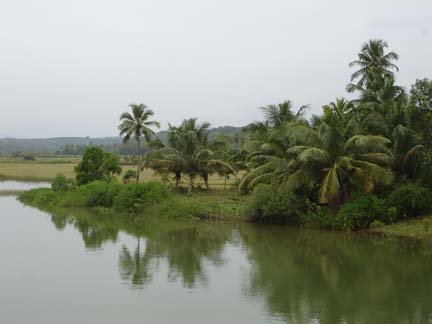
Holegadde near Honavar,Uttara Kannada dist, Karnataka
Copy? Right - but kindly remember to acknowledge!

" tulu-research.blogspot." ತುಳು ರಿಸರ್ಚ್. ಬ್ಲಾಗ್ಸ್ಪಾಟ್. ಇನ್

Have a nice day !