Showing posts with label Sea. Show all posts

Friday, July 6, 2018

406. Ancient lake names: ‘Sandra'/‘Samudra’ (Kannada) and 'See' (German)


 What is common between the English word ‘sea’ and Indian word ‘samudra’ or 'sandra' (Kannada), apart from both represent a large body of saline or marine water? In case you are not aware, both of these words have another shade of meaning: a  fresh water body, a lake or pond especially in land locked regions. Similarly, the German word ‘see’ (related to English word 'sea' in origin) also means a  lake or pond, a land locked fresh water body. We shall discuss implications of these ancient analogous words in spatially remote langauges for lakes located in diverse land locked regions of the world.

The ancient declaration “Vasudaiva kutumbakam” (= the world is one family) clearly connotes that our ancestors were in socio-cultural contact with diverse people from different regions of the world. In other words, people of different region were involved in journeys from their native lands to other regions, apparently for the sheer thrill of exploration or various other reasons including search for better havens, besides basic amenities of food, water, environment, shelter and security. The tribal journeys are described as ‘migrations’ in scientific literature.

Our previous post on the words: Bāhn, bāhana and banḍi (Post No. 405) – [bāhn- German; bāhana-Bengali and banḍi-Dravida] - only documents one of the ways the words have travelled to diverse regions along with ancient people in olden days, acquiring in the process, slight modifications subject to ambient socio-cultural and linguistic environments.

 There is another pattern of dispersion of word based analogous concepts among the ancient people living in diverse regions of the world. We can illustrate this concept, using the meaning and scope of a common word like Sea/Samudra in European and Dravidian languages.
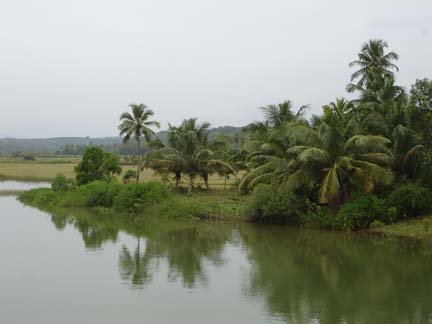
Landlocked fresh water bodies connected to Zurichsee, Switzerland

Scope of meaning of the words: Sea and Samudra
The English word ‘sea’ in general represents a considerably large body of saline water. Similarly the Indian word ‘samudra’ also means the same. In coastal Karnataka, Tulu/Kannada areas, samudra exclusively means the sea like the nearby Arabian sea.
Arabian Sea near St Marys island, off Malpe Udupi coast, Karnataka, India.

However, the English word ‘sea’ also has a meaning of a large body of water like lake or pond. Even though this usage is not prevalent in coastal regions, in mainland Karnataka we can find numerous lakes and ponds designated as ‘samudra’ (or simplified to sandra). Examples like Singa Sandra, Vitta Sandra, Channasandra, Banasandra, Bommasandra, Dwarasamudra etc illustrate this point. (One exceptional usage in coastal region can be found in the name of Rāma-samudra lake at Karkala town, probably named by migrants from Karnataka mainland during the past history.
Strangely enough, the application of the equivalent word representing sea or samudra to lakes is also existing quite commonly in regions of Central Europe. The German equivalent word for sea is ‘see’. In Switzerland we can find numerous lakes called 'see' in German language, like  Zurichsee, Lake Lucerne (Vierwaldstättersee in German language),  Bodensee, Untersee, Zugersee, Rotsee  etc.

Migration of the lingual/word concepts
Unlike in the case of words Bāhn, bāhana and banḍi (discussed in previous post here), in this case, we can find the original scope and meaning of the word representing the sea or samudra has been transferred over distant lands in the past history. Since the meaning of lake for the word sea is also found in old English, it probably means that in olden days these  equivalent synonymous words in different languages (such as: sea, see, samudra etc) were used in different parts of the world, for describing smaller stretches of  fresh water bodies like lakes or ponds, especially in land locked regions, in the past. The similar lingual word connotations, for the land locked fresh water bodies, as in this case, were appear to have been carried to different regions by the ancient people migrating from one region to another.

There could be equivalent words, synonymous with sea, see or samudra in other languages for representing lakes. If you are aware of such words you may kindly share with us in this blog.

**   **
Sagara
 Another related word 'Sagara' is equivalent of the English word ocean. In the modern times, however, the term is also being applied to reservoirs connected with major dams and irrigation projects. For example the Kannambadi reservoir ( KRS near Mysore), is named as Krishnaraja-Sagara. Similarly, we have Nagarjuna-Sagara and Hussain Sagar (Hyderabad) in Telangana/Andhra Pradesh. 
R

Saturday, September 16, 2017

389. ‘Palke booruni’ – a sign of sea subsiding from roughness


Nature plays an important role in traditional occupations or professions of a region.  As we observe, ‘geographical niches’ have conditioned everyday life of inhabitants therein from pre-historic ages.  We observe such conditioning of people living on coastlines too.
Recently, there was a news-item in Kannada vernacular newspaper (Udayavani, 21st July, 2017).  It reported sighting of ‘kadaluda madi’ (wastes of sea in form of woody substances), washed ashore at Malpe beach.  This is a phenomenon observed during July-August.    This is a natural process how the sea cleans itself by throwing out the ‘madi’ to shoreline.  This coincides with the process of calming of the sea after a stormy weather.

Palke booruni
Returning of calmness to sea after the stormy summer monsoon (May end to July-August) is called ‘Palke booruni’ In Tulu.  Ferocious tidal waves subside, yielding place to normal waves.  This is a condition when sea water is placid and calm.  Waves are not so threatening to fisher-folk for venturing into sea by boats.
Heavy rain water washes down all kinds of tid bits  of wood, logs and leaves, fruits and seeds like pallekkayi and akrot,( apricot: with heart-shaped nut with brown-yellow hard outer-cover) from forest areas to rivers through ‘pallas’ (water collected naturally at low lying areas), canals and streams.  These pieces of forest waste are drained into sea when these rivers debauch into sea near the  sea-river mouth  (estuary) known as  aluve or alivey in Tulu.

Factors of Palke
Calmness of sea water occurs for various reasons.  The factors are:
1.Action of under-currents of sea makes erosion at bank and creates ‘barakane’ (sand-walls) at the bank. Normally a shore-parallel depression develops in the sea bed,  quite close to the shore.  This is called a fault in geological parlance or gundi-barakane booruni in Tulu parlance.
These pits or ponds are not found in entire stretch of coastline.  At some place sea bed is flat near shore.This can be understood by the fact that ‘palke booruni’ is not uniform in the entire stretch of shoreline though ‘madi’ is scattered on beachline.

2.In some coastal villages, water-bodies (i.e. canals, streams and rivers) are running parallel to sea coastline.  As observed by the writer during his native high school days, the chance of occurrences of ‘palke booruni’ is more at this stretch than at other places.  In other areas sea is rough at the same time. He observed such palke occurrence in Chitrapur area, i.e. the stretch of coast between Hosabettu and Baikampadi.  Storm water drainage used to flow through  a ‘Bailare’ (a flood zone) and drained to Gurupura River near Kulur-Panambur before implementation of the Projects of Fertilizer Plant and New Mangalore Harbour at Panambur.  This natural canal was bye-passed to sea near Baikampadi thereafter (Read our Post: Debacle of a place called Bailare’).

Reminiscences
Formative years of the writer are spent in a coastal village.  He used to play a game of ‘pallekkayi’, collected from the sea-shore.  One more memory connected with sea is collecting of small coins while there are ‘barakanes’.  Coins, which are thrown into sea as offering on certain religious rituals, surface on such sand-wall.  While returning from school, we children used to take beach route to home. I noticed in later life pallekkayi and akrot are included in ‘Bālaguti’ along with other roots and fruits/seeds like Badām (almond).

Spawning of fish
Monsoon is fish-spawning time.   Fish thrive in such deeper ponds, filled with woody substances.  Hence ‘palke booruni’ is harbinger of fishing season.

Cast-net (Beesana) Fishing
Cast-net fishing is common during this period as sea waves are sober at ‘palke booruni’ places.  So country boats venture into sea to catch fish by throwing round nets (beesanigeda bale).   Boats from neighbouring villages too throng to this stretch of calm sea.  These boats are pushed through shallow shore waters.  Common catch is ‘etti’ (prawns), kuruchi, a thorny fish and nangu, a flat fish.
At times, kai-ramponi type of fishing is also carried on (a smaller version ramponi, which is now extinct).   The catch is called as ‘kare meenu’, which is a common name for group of fish thriving near shore (= kare).

Rituals
On full-moon day of August (Shravan Pournami), fisher-folk worship the sea and throw coconuts to the sea, praying the Sea God to bestow them with bountiful catch of fish.  This ritual is called ‘Samudra Pooje or Poojan’.  Fishing season starts from this day.
This day of ritual is known by many names as Nārikela or Nālikera Pournami (i.e. Coconut Day or Nāriel Pournima in Hindi-speaking Belt), and Raksha Bandhan or Rakhi.  This day sisters tie sacred threads to wrist of their brothers or brotherly friends. This sacred knot of sisterly-brotherly love is believed to protect their brothers. They do ‘arati’ (waving of sacred light) to their brothers,   apply vermilion ‘Tilak’ on their foreheadsand feed them with sweetmeats.   This is a symbolic ritual when brothers vow to protect their sisters.  They give presents to their sisters.

Conclusion
As I observe, ‘palke or palike’ is nothing but pieces of woody substances drained to sea through rivers.  So ‘palke’ is same as ‘madi’.  While ‘madi’ has a narrow meaning ‘palke’ has a wider connotation as is explained in foregoing paragraphs.  Another meaning of palke(palike) is ‘a valley, slope or low lying area on mountainous or hilly area’.  Depth on sea-shore, created by slippage action as aforesaid, can be compared to the other meaning of  palke(palike).
Action of Nature is instrumental in undisturbed fish spawning, thereby balancing the fish production against the rigorous fish harvesting of previous year.  This ensures a steady flow of catch to fishermen. Intensive or excessive fishing is detrimental to fisher-folk as well as the Nation.

-Hosabettu Vishwanath, Pune

September 15, 2017

Blog Archive

Books for Reference

  • A Comparative Study of Tulu Dialects By Dr. Padmanabha Kekunnaya. Govinda Pai Reserach Centre, UDupi. 1994
  • Koti Chennaya: Janapadiya Adhyayana. By Dr. Vamana Nandavar. Hemanshu Prakashana ,Mangalore.2001.
  • Male kudiyaru. Dr B. A.Viveka Rai and D.Yadupathi Gowda, Mangalore University,1996.
  • Mogaveera Samskriti By Venkataraja Punimchattaya. Karnataka Sahitya Academy.1993.
  • Mugeraru:Jananga Janapada Adhyayana. By Dr Abhaya Kumar Kaukradi.Kannada & Culture Directorate,Bangalore & Karnataka Tulu Academy, Mangalore,1997.
  • Puttubalakeya Pad-danagalu. Ed: Dr B.A.Viveka Rai,Yadupati Gowda and Rajashri, Sri Dharmasthala Manjunatheswara Tulu Peeta. Mangalore University.2004
  • Se'erige. Ed:Dr K.Chinnapa Gowda.Madipu Prakashana,Mangalagangotri,2000.
  • Studies in Tuluva History and Culture.by Dr P Gururaja Bhat (1975).Milagres College,Kallinapur,Udupi.
  • Taulava Sanskriti by Dr.B.A.Viveka Rai, Sahyadri Prakashana,Mysore 1977
  • TuLu naaDu-nuDi By Dr.PalthaDi Ramakrishna Achar, Puttur.
  • TuLu NighanTu. (Editor in Chief: Dr U.P.Upadhyaya, Govinda Pai Research Centre,Udupi. Six volumes. 1988 to 1997
  • Tulu Patero-A Philology & Grammar of Tulu Language by Budhananda Shivalli.2004.Mandira Prakashana Mangalore. p.317. (The book is in Tulu Language using Kannada script)
  • TuLunadina ShasanagaLa Sanskritika Adhyayana. By Shaila T. Verma (2002) Jnanodaya Prakashana,Bangalore, p.304.(Kannada)
  • Tuluvala Baliyendre. Compiled by N.A.Sheenappa Hegde,Polali,Sri Devi Prakashana,Parkala,1929/1999

A Coastal estuary

A Coastal estuary
Holegadde near Honavar,Uttara Kannada dist, Karnataka

Copy? Right - but kindly remember to acknowledge!

Creative Commons License
This work is licensed under a Creative Commons Attribution 3.0 License.

" tulu-research.blogspot." ತುಳು ರಿಸರ್ಚ್. ಬ್ಲಾಗ್‌ಸ್ಪಾಟ್‌. ಇನ್

" tulu-research.blogspot."  ತುಳು  ರಿಸರ್ಚ್.  ಬ್ಲಾಗ್‌ಸ್ಪಾಟ್‌. ಇನ್
Have a nice day !