Monday, January 13, 2014

326. Nāravi and Nāra villages

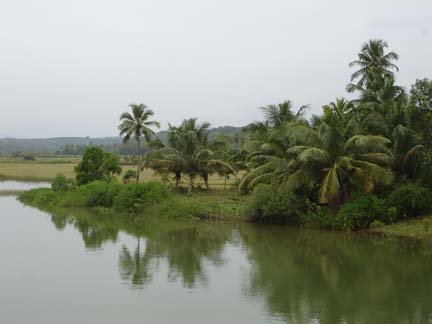
The Village Nāravi (in Belthangadi Taluk, Dakshina Kannada), known for an ancient Suryanarayana temple (Post 301), is located on the bank of a stream tributary to River Gurpur (or Phalguni).  It is said that the older name of the village Naravi was Narol.
The term nāra (in Sanskrit), means water; The best explanation for the relatively less known term ‘nāra’ is the divine name of Nārayana, which is explained as one resides in water (nāra + ayana). (Wiki page on ‘Narayana’). 
In 'Satyārtha Prakāsha', Swami Dayananda Saraswati expounds the meaning of  ' nāra ', which means water and also the soul of living bodies. According to him the 'Nārāyana' means, the one whose abode (ayana) is  nāra and thus he is considered as the all pervading God. One more meaning of  nāra  is knowledge.  Thus,  Nārada  means the one who spreads knowledge. Similarly, Narial or Narikela means coconut which contains water. 
 Some attribute the term nāra to white birds frequenting the water bodies.  In Uttar Kannada nyari (or neri) in local Kannada means grassy weeds growing in water. In Dravidian languages like Tulu and Kannada nār also means fiber or fibrous weed. An variant of the nāra, the  nāla also means stream or rivulet. Thus connection of nāra to water is clear. In Dravidian languages neer means water. Thus the parallelism between the words nāra and neer is quite interesting.
A similar sounding word nara (short na) represents man or human being and similarly nāri means a woman. In poetic lines we can see nār for nāri. (As in Hindi film Padosan: Ek chatur naar ..). Thus some believe that nāra also means living beings in general.

One more striking word in usage based on the word 'nāra' and commonly used in Tulu, Kannada and Sanskrit languages is  kināra which means the sea coast or river bank (wherein the possible word origin  was ki [= place, area] + nāra [=water]) . 

Nara villages
There are numerous villages in Tulunadu having names like Narla, Narsha, Narya, Narve, Naravi etc. Of these Nārla appears to be one of the most common village names not only in Karavali/Tulunadu but also in other regions of India. Thus Nārla or similar Nāra place names are not exclusive to Tulu or Dravidian language and culture but part of the pan-Indian evolutionary scenery.

Nārla
There are villages named Nārla in different parts of the country like Karnataka,Andhra Pradesh, Orissa, Maharastra, Himachal Pradesh, Jammu & Kashmir, Rajasthan and Uttar Pradesh. Besides, we can also find Narlakantiguda, Narlapuram and Narlavaram In Andhra Pradesh, Narlavalas, in Andhra and Orissa, Narla-halli in Karnataka and Narlad in Maharastra, Narlai and Narlay in Madhya Pradesh. Etc.

Nārya
Similarly, villages named Nārya can be found in other States of India like Haryana (Naryana), Madhya Pradesh (Naryaval), Himachal Pradesh (Naryaval), Uttar Pradesh (Naryanpur), West Bengal (Naryanpur), Rajasthan (Narya ka bas) etc.

Forgotten Episodes
Present generation of Tulu people have almost forgotten the word nāra, which means water, since it has been completely replaced by the Tulu-Dravidian equivalent word neer. However, the Nāra place names have remained immortally all over India since ages as in Karavali/ Tulunadu also. This paradox can only be explained by the existence of undercurrent layers of forgotten episodes in our past history.
Â


Saturday, January 11, 2014

325. Ila and Ilantila

Ilantila is a village in Belthangadi Taluk. The village name is quite interesting as the word ila repeats twice in the place name. The suffix –ila represents a habitation as in place names Kedila, Baltila, Bardila, Manila, Uchila, Panapila, Nettila, etc. The term -ila is apparently related to the word illu (=house) present in Tulu and Telugu. Thus the word Ilantila means ila within ila;   (since, ant generally means within), wherein possibly it means habitation within the (larger) land mass . Alternately it could also mean a row of houses or house after a house.

Ila, the Earth
The word Ila or Ile in Kannada and Sanskrit generally means the Earth or landmass.  The Indian legends of Manu have also envisaged personification of  Goddess Ila Devi after a major deluge. Incidentally, the Ile   is an Earth Goddess according to West African (Yoruba) tribal mythology. Further, in Arabic language the word Ilah   represents God and the Ilahi means my God. The root word Ile from the ancient West African mythology could have been carried by the migrating people and adopted in early Indian languages.

Ila Villages in India
The northern Tamil part of Srilanka is known as Ilam or Elam. Besides, there are hundreds of villages all over India that carry the prefix of Ila. Some of these villages are:
Andhra Pradesh: Ilapur, Ilaparru, Ilapkuru, Ilapvulur, Ilavera, Ilavaram, Ilaganur, Ilaspur.etc
Chattisgarh: Ila, Ilaspur. etc
Gujarat:  Ilav, Ilampur, etc
Jharkhand: Ilaki, Ilami, Ilaspur. etc
Karnataka: Ilal, Ilval, Ilapur, Ilantila, Iladoni, Ilatore, etc.
Madhya Pradesh: Ilahipur, Ilaskhedi, Ilahi, Ilamkhedi etc.
Maharastra: Ilakhi, Ilane. etc
Orissa:  Ilaspur, Ilajanga. etc
Rajasthan: Ilahipura. etc
Tamilnadu: Ilamangalam, Ilangiyanur, Ilaiyalur, Ilandabanur, Ilayathgudi, Ilankhudi, Ilandamngalam, Ilaknnivayal, Ilanyangudi, Ilamnur, Ilangiyendal, Ilandikulam, Ilaiathanvayal, Ilankakoor, Ilanchembur, Ilambuvanam, Ilangulam, etc.
West Bengal: Ilaspur, Ilam, Ilamkuri,Ilampur, Ilamdanga, Ilashpur etc.

Â


Friday, January 10, 2014

324. Kāntara vs. Kāntāvara

Kantavara is a remote sylvan village in Karkal Taluk of Udupi District. It can be approached from Mudabidri via Beluvayi or from Karkal or Belman via Manjarapalke or from Mundkur via Bola.
The village list in the Census of India shows it as Kanthavara. There is also a village known as Kantavaram in Visakhapatnam district of Andhra Pradesh.
In Tulu language the village Kantavara is known as Kantara. The general impression among the people is that Kantavara is the actual original name of the village and the illiterate villagers tend to deform the place name as Kantara. We shall delve into these place names and make an endeavor to verify if this impression is correct or not.
Kantara
Kāntāra means a forest in Kannada and Sanskrit.  According to Kittlel's Kannada Dictionary says, it is a Dravidian word. However,Kānt(h)ar or Kant(h)ara is not a place name unique to Tulunadu.  Kantar and its numerous variants such as Kant(h)a, Kant(h)an, Kant(h)ari, Kant(h)ari(y)a, Kanthal, Kant(h)ali, Kant(h)apada, Kant(h)a(va)ram, Katharpur,  Kantharia,  Kanthalur, Kantaoh, Kantaroli, Kantarda, Kantargre, Kantaranguri, Kantarabali, Kantharpata, etc are found in many parts of India suggesting its wide distribution in States such as Andhra Pradesh, Tamilnadu, Orissa, West Bengal, Uttar Pradesh, Uttara Khand, Gujarat and Rajasthan apart from Karnataka.
The existence of more number of villages having the word Kantar in their name over Kant(h)avara(m) suggests that Kantara could been the original ancient place name which in some cases has been subsequently modified or Sanskritized into Kantavara(m) with passage of time during the history.
Incidentally, the word Kantara also represents a male personal name of among certain tribal people.
Origin
The word Kantara can also be found in African and Mediterranean regions. In fact village and streams named Kantar(a) can be found around Euphrates, Cyprus and Algeria. In Arabic language Kantara means a bridge. Whether the Arabic word Kantara is derived from similar ancient Sumerian word or does it has any genetic significance in respect of Indian place names is to be studied further.

Â

323. Ajji biru, the Rainbow – An exposition

The rainbow is popularly known as, ‘Ajji biru’ (or Ajja biru) in Tulu language.  Literally, it means a ‘bow of grandma (or grandpa) or even bow of an old woman. This archaic word is still extant in local tongue in rural areas. So it has rightly and deservedly found an entry in the mighty Tulu Lexicon (page 51).  However, the origin of this word is obscure. An attempt is made here to find out the secret of this word in pursuance of our inquisitiveness.
We have been using this word during our upbringing in native villages.  Besides the natural ‘ajjibiru’ seen during rainy days, we used to create it while bathing near draw-well or pond. By standing opposite to the Sun, we puff out and splash the water collected in the mouth to create a magical imagery of rainbow for a few seconds.
Who has not seen a rainbow near waterfall or fountain on spraying water?  A rainbow means a bow or arc of prismatic colours.  It appears on eastern or western horizon when clouds are opposite to the Sun.  Rainbow is created by the refraction of the Sun’s rays through the drops of rain water. Momentary appearance of this natural phenomenon is encased in a Tulu Proverb:
ಅಜ್ಜಿಬಿರು ಅಜ್ಜೆ ಬನ್ನಾಟ ಕಾಪಂದು” (Ajjibiru ajje bannaata kapandu).
=A rainbow does not wait till grandfather comes.

Origin
Let us explore the origin of word ‘Ajjibiru’, which is also pronounced as ‘Ajjibeer’ erroneously by some:
1.   The most probable explanation is that the rainbow bending is compared to bending of an old woman (or old man)
2.   ‘Aje’ in Tulu means ‘a row’ or ‘raised line’ (as is used for clothesline). So it could be explained as ‘a row or range of bows’.
3.   Next explanation could be ‘bow created by ‘Aaji neeru’ (i.e. evaporated water).
4.   There is one more reason for originating this name.  Whenever a rainbow is seen on the horizon, it is elders, say grandma or grandpa, who point out first the rainbow to their young ones.
5.   Another explanation is ‘Aaji biru’, meaning ‘six (coloured) bows’.  But this is a highly improbable proposition, as rainbow has seven colours and not six. Could it be a mistake in counting when this word is coined by our forefathers?
6.   The phrase ‘Ajji biru’ might have originated as an  idiomatic phrase to represent the colorful bow (‘biru’ in Tulu) shaped rainbow shown to children as a momentary object of curiosity and intensive interest by grandmothers.


Aja biru
7. Another probable argument that   'Ajabiru' (= Brahma dhanu) has been corrupted to 'Ajjibiru' in the course of time  by illiterate rustics. Brahma, (= Aja), has the meaning of 'Big or Great'. So, Aja biru means 'a great bow'.  This reminds us the story of  'Tripura Samhara'.  After the death of their father Tarakasura by Lord Kartikeya, his three sons (Tarakaksha, Kamalaksha and Vidyunmali) after rigorous penance get the boon of invincibility in three worlds from Lord Brahma.  Brahma gives boon with a condition that they would be killed together with one darting of an arrow.  He orders them to get three citadels (fortifications) made through Demon architect Mayasura.  These three cities are movable in sky but they are not to align in a line, so that Shiva can destroy them (in Pushya Nakshatra) with a single arrow, as per the condition. They know that being devotees of Shiva, he would not kill them. They start troubling one and all in three worlds as Lord Shiva is also helpless single-handedly.  With three energies of Brahma, Narayana and Shiva put together, Lord Shiva destroys the three citadels altogether

Conclusion
Readers may not agree to our logical listing of reasons.We invite them to come out with the correct reasoning in coining the Tulu word ‘Ajjibiru’, i.e. rainbow. 
A bright display or event is also compared to a ‘rainbow’.  A visionary goal or ambition is alluded to ‘rainbow’. Example: “He went in pursuit of ‘rainbow’ of becoming so and so in life.”  It also means a range of things, groups, etc.  Rainbow is, therefore, a symbol of brightness, a dream and a logical connection for peaceful co-existence.

-Hosabettu Vishwanath, Pune


323.  Ajji biru, the Rainbow  – An exposition

Tuesday, January 7, 2014

322. Preposition ‘da’ in Punjabi & Tulu


“ Paani da rang vekh ke,
ankhiyan cho hanju rod de”.

-On seeing the color of the water tears rolled down from (my eyes).
The cited Punjabi lyrical lines penned by Anshuman Khurana’s and popularized in the Hindi   film Vicky Donor  has haunted me many times especially for the presence of preposition ‘da’. The common preposition da (pronounced as 'the' in English) in Punjabi as well as in Tulu Language represents the English preposition of !  Like ‘pāni da’ in Punjabi ‘neer da’ in Tulu means relating to water.

Punjabi and Tulu
Punjabi is a north Indian language belonging to the family of Indo-Aryan languages. Tulu is a Dravidian language. Even though the two languages are entirely different in structure and content, this particular preposition is common to the two languages. Many may like to consider this common preposition in Punjabi and Tulu as a mere coincidence.

Da, di, de

There are other prepositions related to da in Punjabi and Tulu. The equivalents in Hindi are ko, ki and ke. The feminine form di is used in Hindi as a suffix for Goddesses like Mātā-di. The feminine form di (ki in Hindi) or ti has also been vogue in Tulu in forms reverential feminine forms such as Ullaldi/ Ullalti, Shedti, Konkandi, Marakaldi/ Marakalti, Sapaldi/Sapalti, Baideti/Baidedi,  Baikaadi/Baikaadti', Maankaldi/ Mangaldi etc. It is also (especially the -de feminine form) there in Tulu usages in respect of feminine genders as in Dāda de ?  or Dāni de? or Anda de! ..etc.
In Tamil Da (masculine) and Di (feminine) suffix forms do exist; However these are pronounced as Da and Di (D as in Dog). In Kannada feminine suffix ti (instead of di) has survived, even though other forms (da, de) have apparently vanished during the course of evolution.

Migration route
One of the possibilities is that a component of migrating speakers of Tulu language who had lived in the northwestern Indian subcontinent during the ancient history picked up and absorbed this preposition. The migration of the people during the history from the North-western Indian subcontinent to the Karavali has brought the preposition da along with them.
It has been pointed out in earlier posts herein that the Tulu word pirak (=ancient) signifies the place name Pirak, which is a part of Pakistan now.


Mediterranean  roots?
The preposition da can be found survivng in a number of Mediterranean and European languages. The word da has varied meanings in some of the European languages such as : from or of (in Italian and Dalmatian), yes (in Russian), to (in Breton), surely, then, when, as etc (in Danish) and so on. Of these it can be seen that the meaning of da is quite close to that of Punjabi and Tulu in the case of   Mediterranean languages like   Italian and Dalmatian. Thus the Italian name Leonardo da Vinci means the Leonardo from or of the place known as Vinci.


In our older posts, Kaudur Narayana Shetty has contributed an essay outlining the similarities between the Italian and Tulu languages.

Â

Friday, December 27, 2013

321. Bangalore: Origin of the place name

Some places like Bangalore have standard explanations for the origin of place name that is being accepted and believed by people without questioning. This includes the explanation for the worlds’ favorite software city, Bangalore. Some smart one dared to think of the origin of Bengaluru (Bangalore) as a village of boiled beans (benda + kaalu + ooru)  and it has been accepted in general.
However, many like me may have their own doubts as to how the Benda-kaalu-ooru can become Bengal-ooru? In formal and/or common dialectical Kannada, benda-kaalu (=boiled beans) is not usually abridged to Bengaalu!  Only in poetry such a union or words can be expected. And it is quite unusual that a poetic term should become   accepted as a place for Bangalore.

Alternate theory for Origin
How about an alternate explanation for the origin of place name Bengaluru? The name Bengaluru could have been a modification of original Bangalur. The place name of Bangal+ur, the ooru (village) of Bengal or Bangal is similar to the Bengal or Bangal in origin.

Bengāl / Bangal
Surprisingly, the name Bengal in Bengaluru or Bangalore is also shared by Bengal (West Bengal, East Bengal, Bangladesh) region, where there is no widely accepted explanation for the origin of the word Bengal, even though the current wiki page on Bengal suggests that the term Bengal or Bongo may have been derived from the Bang tribes of Dravidian origin. In this blog we have explained that the suffix –al represents an (ancient) habitation located by the side of a river.
Banga being a tribe the Bengal or Bangal (Banga + al) means an ancient habitation located on the bank of a river. In fact even today, the Bangal or the Bengal is located on the banks of river Ganges.
Bangalore is not on the banks of any river at present but the geological and geomorphological evidences suggest that there was a river flowing on the western side of Bangalore once upon a time. The river appears to have dried up during the course of history.

Banga tribes
In different parts of India we have hundreds of place names associated with or attributable to ancient Banga tribes (Banga, Bangaria, Bangaon, Banganapalle, Bangarpalle, Bangarpete, Bangadi, .Bangara, Bangaro, Bangatiya, Bangawa, Bangama, Bangai, Banganj, etc ) Some of these places have been modified into prefix of Benga (Benali, Bengahi, Bengabari, Benga male,. Banganur, Baengadi, Bengama, Bengaipatti, Bengabad etc) . The Banga were an African tribe that apparently migrated and settled in different parts of India during ancient period.
As in Bengal, the term Vanga has been a regional modification of the term Banga.  Some of the Vanga villages in India are Vangara, Vangapalle, Vangai, Vangarai, Vangala, Vangali, Vangaon, Vangam, Vangad, Vangapalle, etc. Similarly, especially in southern India, the term Banga has become Panga (as in village name Pāngala) in some regions. Some of the Panga- villages in different parts of India are Pangal, Pangali, Pangam, Pangama, Pangar, Pangare, Pangari, Pangadi, Pangan, Pangaon, Pangaiyan, Pangath, Pangarkhed etc.

Surname:  Banga and Banger
The term Banga has survived as a surname among the Jains of Tulunadu.  Jain kings and chieftains with the surname Banga or Banga-arasa ruled parts of Tulunadu until independence.
Banger or Bangera is a most popular surname in Tulunadu common to many communities irrespective of their socio-communal status. The Banger is a plural or respectable for of the word Banga.
According to African mythology the Banga was a water God of the Ngbandi people. According to the African legends the Banga God created the white races. It is possible that Banga tribes in India were part of the white or fair skinned immigrants who have been documented distinctly as white tribes (Bola and Boller Tulu; Bellar -Kannada; Gore - Marati/Prakrit/Hindi etc) especially in the place names of the Southern India.

Â


Monday, December 9, 2013

320. Manch, Manchi, Manchale, Manchakall: Early Religions

My Kannadiga friends used to tease about the apparent odd sounding place names in Tulunadu. Some of these prompted me to delve deeper into the meaning behind some of these place names. People generally look for meanings in the place names using the currently   prevailing   language without realizing that some of these odd sounding names could be heritage words preserved as fossils that throws light on the existence of an earlier and older phase of bygone languages and culture in our terrain. During the course of my studies and analysis I have realized that odd sounding place names are not unique to Tulunadu. Some of these odd sounding ancient place names are found all over India.
For example there are some 113 officially listed villages having the prefix of ‘Manch’ or ‘Mancha’ in the census of India 2011 , which obviously includes numerous hamlets and unlisted villages with the tag of Mancha.
The word ‘mancha’ in Tulu, Kannada and other Dravidian languages mean a wooden or stone bed or cot.  In North-Indian languages ‘manch’ generally  means a platform or podium. Let us evaluate some of the place names associated with the word ‘manch’ or ‘mancha’ and analyse the historical significance of these place names.

Manchi
Manchi is a modest village in Bantwal   taluk, Dakshina Kannada district. Naturally most of the locals are not aware why or how their   place was called Manchi.  Some might think that it was derived from the Telugu word which means nice or good. Surely the word ‘manchi’ does not mean anything in Tulu language. Some have felt that the name Manchi was influenced by or derived from Telugu people since the word ‘manchi ‘ means good in Telugu.
 There are some 27 villages (this excludes hamlets named after Manchi   in different States of India. We find Manch in Uttarkhand and Mancha in Bihar and West Bengal. Similarly there are villages known as Manchi in Uttar Pradesh, Rajastan, Tamilnadu, Orissa,   Maharastra, Madhya Pradesh, Bihar, Jharkhand, Jammu & Kashmir, besides Andhra Pradesh and Karnataka. Therefore the place name Manchi is not a place name exclusive  to Tulunadu.

Manchale
Manchale was the original name of the village now known as Mantralaya famous for the Brindavan of Guru Raghavendra Swamy on the bank of Tungabhadra River in Kurnool District (which borders  Raichur district of Karnataka). Before the establishment of Raghavendra Mutt at Mantralaya an ancient tradition of mother Goddess cult prevailed in the village of Manchale and the deity was known Manchalamma (= Mother of Manchale Village). It seems the place name Mantralaya was  thought out by Raghavendra Swamy and is followers who were influenced by the original name Manchale.
The ‘Manchale’ or manch+ale represents a habitation containing a ‘mancha’ (traditionally a rock bed used by ascetics to take rest) located on the bank of river.
However, the place name Manchal, Manchala or Manchale can be found in Bihar, Rajastan, Arunachal Pradesh, and Other States. Manchalkuppe and Manchaldore can be found in Tumkur District of Karnataka.

Manchakallu
We have covered a post on Manchakallu. The Manchakall is a village in Udupi district near Shirva and Kapu. There is also a Manchakall in Kolar District and a Manchakal kuppe in Tumkur District of Karnataka, besides Manchikall in Guntur District and Manchikall-padu in Prakasham District of Andhra Pradesh.

Other Mancha place names
There are other Manch place names prevailing in different parts of India such as Manchod (Bihar), Manchar (Madhya Pradesh, Maharstra) , Manchur (Andhra Pradesh), Manchia(Orissa), Manchang (Meghalaya),  Manchagaon (Orissa), Manchapur( West Bengal),  Manchanpur (Maharastra); Manchanbele, Manchasandra, Manchinakoppa, Manchagondanhalli, Manchibeedu, Manchanahalli, Manchiganahalli (Karnataka); Manchipatna, Manchanpalu, Mancharami, Manchippa,  Manchirevula, Manchagonda, Manchalkatta, Manchili,(Andhra Pradesh) etc.

Mancha-the rock beds
In all the village names cited above the common word is Mancha. The name Mancha has been named after rock beds (beds  or platforms fashioned in rocks and designed for resting of Jain ascetics in different parts of India during the Early history).  It is generally claimed that Jainism is a very ancient religion and that Mahaveera was the 24th and the last Tirthankara of Jainism.  Stringent ascetism was the essential feature of Jainism and the monks made use of rock beds to meditate, relax or to take rest. Thus the rock beds or Mancha came into significance in early civilization.  In Buddhism the Mancha was the platform on which relics of Buddha were kept.
[ Â [


Blog Archive

Books for Reference

  • A Comparative Study of Tulu Dialects By Dr. Padmanabha Kekunnaya. Govinda Pai Reserach Centre, UDupi. 1994
  • Koti Chennaya: Janapadiya Adhyayana. By Dr. Vamana Nandavar. Hemanshu Prakashana ,Mangalore.2001.
  • Male kudiyaru. Dr B. A.Viveka Rai and D.Yadupathi Gowda, Mangalore University,1996.
  • Mogaveera Samskriti By Venkataraja Punimchattaya. Karnataka Sahitya Academy.1993.
  • Mugeraru:Jananga Janapada Adhyayana. By Dr Abhaya Kumar Kaukradi.Kannada & Culture Directorate,Bangalore & Karnataka Tulu Academy, Mangalore,1997.
  • Puttubalakeya Pad-danagalu. Ed: Dr B.A.Viveka Rai,Yadupati Gowda and Rajashri, Sri Dharmasthala Manjunatheswara Tulu Peeta. Mangalore University.2004
  • Se'erige. Ed:Dr K.Chinnapa Gowda.Madipu Prakashana,Mangalagangotri,2000.
  • Studies in Tuluva History and Culture.by Dr P Gururaja Bhat (1975).Milagres College,Kallinapur,Udupi.
  • Taulava Sanskriti by Dr.B.A.Viveka Rai, Sahyadri Prakashana,Mysore 1977
  • TuLu naaDu-nuDi By Dr.PalthaDi Ramakrishna Achar, Puttur.
  • TuLu NighanTu. (Editor in Chief: Dr U.P.Upadhyaya, Govinda Pai Research Centre,Udupi. Six volumes. 1988 to 1997
  • Tulu Patero-A Philology & Grammar of Tulu Language by Budhananda Shivalli.2004.Mandira Prakashana Mangalore. p.317. (The book is in Tulu Language using Kannada script)
  • TuLunadina ShasanagaLa Sanskritika Adhyayana. By Shaila T. Verma (2002) Jnanodaya Prakashana,Bangalore, p.304.(Kannada)
  • Tuluvala Baliyendre. Compiled by N.A.Sheenappa Hegde,Polali,Sri Devi Prakashana,Parkala,1929/1999

A Coastal estuary

A Coastal estuary
Holegadde near Honavar,Uttara Kannada dist, Karnataka

Copy? Right - but kindly remember to acknowledge!

Creative Commons License
This work is licensed under a Creative Commons Attribution 3.0 License.

" tulu-research.blogspot." ತುಳು ರಿಸರ್ಚ್. ಬ್ಲಾಗ್‌ಸ್ಪಾಟ್‌. ಇನ್

" tulu-research.blogspot."  ತುಳು  ರಿಸರ್ಚ್.  ಬ್ಲಾಗ್‌ಸ್ಪಾಟ್‌. ಇನ್
Have a nice day !