The ancient village of Kankanāḍi is now an integral part of the Mangaluru city. The innocuous sounding ancient place in its name has preserved obscure data relating to the early history of the region. The Kankanāḍi possibly holds a missing key to the obscure early history of the Ganga dynasty before ca. 350 CE. The Gangas’ ruled parts of southern Karnataka during the period ca. 350 CE to 1000 CE, but before ca 350 CE their whereabouts were not known.
Most of our
historians have concentrated only on Alupas who ruled parts of Tulunadu between
ca.400 CE and ca.1400 CE. Data on the
earlier periods, and also specifically from ca 400 BCE to ca
400 CE are quite nebulous. Even though concrete inscriptions are lacking, the
ancient place names supported by references in Tamil Sangam suggest that the
region was also home to Shatavāhana (Kanna),
Nanda, Ganga (Kanka) and other rulers
particularly before ca. 400CE
Here is an
attempt to reconstruct the initial presence of Ganga rulers and journey through
the West Coast, during the beginning centuries of the Common Era, based on the
prevalent ancient place names, partly
supported by indirect references in Sangam literature.
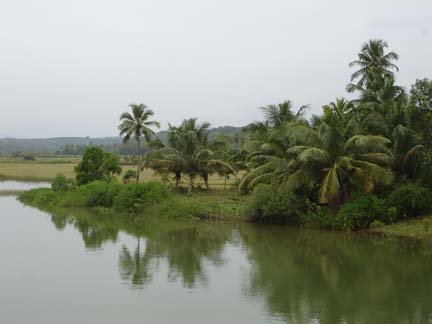
 |
| A view of Netravati River, near Kankanadi, Mangaluru. |
Kankanāḍi
The Kankanāḍi (ಕಂಕನಾಡಿ) now a well developed urban area, is located
to the eastern part of Hampanakatta, the throbbing center of Mangaluru. The present
Kankanāḍi is the gateway that welcomes you to this
pleasant city if you are entering Mangaluru from east. Kankanāḍi is located
near Alupe (Alape) another ancient town, the original headquarters of
the Alupa rulers of Tulunadu.
The geomorphological
data, especially the traces of river valleys that traverse the region suggest
that a river was flowing in the Kankanāḍi area. The river Netrāvati in the early centuries of the Common Era
was flowing along a course close to the ancient towns of Tuḷunāḍu such as
Alupe, Maroli and Kankanāḍi before joining
the Arabian Sea near Pandeshwara in the West coast of Kuḍla, later known as Mangaluru. The geological data such as the
presence of weathered quartz pebble rich shallow tidal sediments in the region,
further suggest that the area was submerged under shallow sea conditions during
the past and that subsequently, the sea has retreated back.
 |
| Historical reconstruction of Kudla (Mangaluru) ca 100 -300 CE. (click to enlarge) |
Etymologically,
the place name Kankanāḍi is quite
interesting, being made up of two word components namely, kanka + nāḍi. The kanka were an ancient
Austro-Asiatic Munda tribe reported to have been cited in the Mahābhārata epic. The kanka were a quite
widely distributed tribe in India as seen in many place/village names
distributed in different parts of India.
The other
term nāḍi (ನಾಡಿ) is appears to be a characteristic period
variant of the word nāḍu (ನಾಡು),
a group of
villages unified and covered under a single royal administration.
Sangam data on Tuḷu nāḍu
Aganānuru, a Tamil Sangam text dated to have been composed around 2nd
century CE, contains references to Tuḷunāḍu
of that period. It describes the Tuḷu language of the period as Tulunaṭṭa Tamil (The Tamil of Tuḷunāḍu), revealing that Tuḷu language at that period was quite similar to early Tamil.
The Sangam
recounts eulogies of three generations of “Nanna”
kings that ruled possibly parts of Tuḷunāḍu. In ancient Tuḷunāḍu we have heard
anecdotes of Nanda rulers from our
native elderly people, but no information whatsoever on ‘Nanna’ rulers. It follows that since the Tamil language since
antiquity has been endowed with limited consonants, the surname ‘Nanda’ must have been recorded as Nanna in the ancient Sangam poems.
The coastal land
has been described as Koṇ-kānam, which
apparently throws light on the origin of the word Konkana for a part of the West coast. The Kom were an ancient tribe as indicated by names of at least two
ancient settlements preserved within Mangaluru (Konchāḍi, ಕೊಂಚಾಡಿ) and near
Mangaluru (Kompadavu, ಕೊಂಪದವು).
According to
Sangam Agananuru (44-7-11), when Pālayan
Chola attacked on Kaṭṭūr, then
capital of Punnāḍu, the latter was
defended by an allied army of Nanda,
Yerai, Kangan Katti and Punar (“Punarurai”) soldiers. Apparently, the invading Chola died after
killing most of his enemies. It follows that the Kanka Vishaya was coexisting along with Nanda, Punar and other
contemporary domains. The exact location of the Kanka Vishaya cited in the Sangam literature is not clear. It could be the Kankanāḍi.
Western Ganga rulers
Rulers of
Ganga dynasty administered parts of southern Karnataka (region known as Konga nāḍu in
Tamil Sangam, but also known as Gangavāḍi later in history) from ca 350 CE to ca 1000 CE and were described
as “Western Gangas” to distinguish them from the “Eastern Gangas” who ruled
from Odisha after ca. 1300 CE.
The Gangas rather
abruptly made their presence felt in Kannada region after ca.350 CE beginning at
Kolar (Kuvalaya in history) and
subsequently shifted to Talakāḍu, on the banks of river Kāveri,
ca 390 CE and continued to rule up to ca.1000 CE, until Rājarāja Chola subjugated and accessed Gangavādi in a war.
However, the
early history of Gangas before 350 CE is rather hazy and shrouded in mystery.
Kongāni Varman Madhava
The first Western
Ganga ruler in uplands of Karnataka was Kongāni
Varman also known as Mādhava (ca.350-390CE) who ruled from
the capital of Kuvalaya located at
Kolar. His characteristic name Kongāni
connotes his heritage of his former domicile, Kon-kānam. It is possible that he (or his ancestors) hailed from
the Kankanāḍi in the
Konkanam.
Tracing the Kanka/ Ganga rulers in West Coast
We can trace
the journey of Kanka clan along the West Coast from Kankāvli in Maharashtra
coast down to Gangavali on the bank of River Gangāvali in Uttara Kannada
followed by Gangolli on the coast on the bank of River Varāhi near Kundapur,
ending up at Kankanadi in Mangaluru.
The ancient Kanka (ಕಂಕ) tribes in
Tulunadu were also referred to as Konga
(ಕೊಂಗ) due to the common transliteration (ka>ko) and
pronunciation (ka=ga) changes in the ancient languages of
the time. It is interesting to note that in Tulu language both stages of the above
cited transliteration, a>o do exist, as can be seen in the
examples: pātera and pātero.
In fact
there are several villages bearing the name of Kanka (>Ganga) along
the West Coast of Maharashtra and Karnataka. Kankavli in Maharashtra is followed by Gangavali near Gokarna and Gangolli,
near Kundapur in coastal
Karnataka. Further south in Mangaluru there is this interesting village known
as Kankanāḍi. The Kanka >Ganga name
conversion/modification in place names like Gangavali
and Gangolli, could have taken place
after 400CE, following developments in the native languages following adoption
and introduction of Sanskrit by the rulers.
Thus we can
trace the journey of Kanka tribes from north to south along the West coast that
ends up at Kankanāḍi. Before Kankanāḍi, along this route there is another interesting village in
this group located in northern part of Mangaluru, known as: Pachanāḍi. Also there is an ancient place
known as Nagori, by the side of Kankanāḍi. I specifically prefer to
include Pachanāḍi
and Nagori in the list because it appears
that most of the early Ganga settlements characteristically ended with the
vowel i, such as: Kankāvali, Gangāvali, Gangolli, Pachanāḍi,
Nagori, Kankanāḍi and also Gangavādi.
The suffixes
of Munda/Prakrit origin such as –vali and -oli /-olli as well as -nāḍi and –vādi, evince the influence of
northern languages on the native languages of Tulu and Kannada. In the place name Nagori, we find suffix –ori instead
of usual -ūru. Such a specific word
feature could have been inherited and assigned by the Munda tribes immigrant to
the West coast from the north.
Early historical period: ca. 50 to 350 CE:
Alupa rulers
are well known in Tulu history. Historians have traced their lineages since
about 400 CE onwards. However, the history of Tulunadu before 400 CE is rather
hazy because lack of datable historical sources like inscriptions. The early
Tamil Sangam literature throws some light on the geopolitical scenario of south
India during the early period.
Ganga, Alupa and Karumbas
It appears
that the Kanka (= Konga) rulers renamed themselves as
‘Ganga’ (ie., kanka > ganga), following widespread influence
of Sanskrit in the region during ca. 300 to 600 CE that led to further
evolution of alphabets (especially consonants) in the native languages like
Tulu and Kannada.
What were
the relationship between the Kanka/Ganga and the Alupas during the early
historical period, say 100 to 300 CE? Kankanadi and Alupe were the adjoining
towns therefore we can expect the Ganga and Alupa to be neighbors.
Kadamba
apparently were not popular as rulers at that time. Tamil Sangam poems describes
pirates of Karumba tribe, who
worshipped Kadamba tree as their
protective tree (kāval mara), used to
attack ships carrying goods to Chera
kings of Kerala. Karambār village in
northern Mangaluru, near Airport appears to be the home of the Karumba tribes. Tamil Sangam poems
describe that a Chera king fought with and vanquished the Karumba pirates
established in a island, with a Kadamba tree as their protective/worshipping
tree, in the Arabian Sea. The island cited Sangam text is not clear. It could
be
The Karumba
tribes later ca.350 CE migrated to Banavāsi
designated themselves as Kadamba and established the Kadamba dynasty.
Incidentally, the word Karumb appears
to be the equivalent word for Kadamba tree in Munda languages. The Alupas were
in friendly terms with Karumb/Kadamba since the days of seafaring. The ties of
friendship were further strengthened as youths of the Alupa family went to Banavāsi to assist and serve the Kadamba
rulers in their administration and warfare activities.
It can be surmised
that around the same time ca.350 CE the Ganga chieftains migrated from Kankanāḍi to Kannada
uplands and settled at Kolar (Kuvalaya)
initially and further established themselves on the banks of Kāveri at Talakadu.
References
Tulunada Itihasa- (2 nd Century CE). “Tulunaattu
Varalaaru” (Original in Tamil) by
Mayile Sheeni Venkatasami. Translated by: Dr. Shri Krishna Bhat Artikaje. Tulu Sahitya Academy, Mangaluru., 2015, xx+88
p
- Dr.
Ravindra Mundkur