We have analysed the place name “Bel (a) mannu” earlier. Bel+mannu at that point appeared perfect as land (soil-‘mannu’) of white (“Bel”) people. Besides, there are several villages having similar spatial suffixes like Kodmannu, Kemmannu, and Madmannu etc. However, a newly available string data suggests an amendment to my earlier analysis that was somewhat erroneous. The Belmannu, for example, should have been analysed as Belama+āNu (and not as Bel+maNNu).
So here we introduce the spatial indicator suffix -‘āNu’ instead of the earlier suggested -‘maNNu’.
Muddānu
The revelation surprisingly comes from the name of small hamlet known as ‘Muddānu’ (pron. muddāNu) in Inna village. Mudda+ ānu sounds similar to Belmannu, Kodamannu, Kemmannu, etc but note that the suffix is distinctly āNu and not mannu or annu. This also suggests that the presently accepted pronunciation of ‘BelamaNNu’ is a misnomer of the original word BelamāNu. Similarly the other analogous place names must have been originally KemmāNu, KodmāNu, and MadmāNu etc.
Ān, āNu
The ‘ān’ or ‘ānu’ which basically means a young male has been used as an affix possibly to denote tribes or people in general as discussed in earlier posts. An(u) prefix also occurs in the tribe/region indicator word Andhra, Ankola, etc. In the case of place names such as Akola, Akkole-guttu etc., the ‘an’ has been reduced to a (n).
So ‘Muddanu’ hamlet appears to be a fossil place name suggestive of ancient habitation of ‘Mudda’ tribes.
Peramanur
Peramanur is a village near Ullal in the southern part of Mangalore.It appears that this village was ‘PeramāNu’ to begin with like MuddāNu , KemmāNu etc and later another additional suffix ‘–ur’ was appended to make it ‘Peramanur’ or ‘Peramannur’.
Spatial suffix ‘Ne’
A variant of the spatial suffix ‘-aNu’ exists in the form of ‘-Ne ‘ (pronunciation: heavy N ) in some parts of Tulunadu. Examples are village names like ‘Marne’ (=mara+Ne), ‘Perne’ (=per+Ne), ‘Kokkarne’ (kokkar+Ne), etc. The village name ‘Pernankila’ (=per+Na+nkila), apparently an extended version of the toponym ‘PerNe’ also exists.
Note that most of the village names having '-aNu' or '-Ne' spatial suffix are ethnonyms or village names based on the name of tribes settled there in the remote past.
®

A heritage blog by: Ravindra Mundkur & Hosabettu Vishwanatha
Showing posts with label Kokkarne. Show all posts
Showing posts with label Kokkarne. Show all posts
Sunday, May 24, 2009


Wednesday, August 13, 2008
136. Kukkian lineage
Kukkian is one of the lineages among the present Billava community. This surname is generally not found in other Tulu communities. Evidences from place-names in Tulunadu suggest that Kukki or Kukke were a widespread tribal group in the past. It appears that the amalgamation of this tribal group with Billava group led to the formation of a distinctive lineage named Kukkian during the historical period.
Since the word ‘kukke’ represents the basket made from bamboos, creepers and other fibrous plant materials, we can deduce that these tribes were proficient in the art of basket weaving. The mango fruit ‘kukku’ which carries their name apparently was introduced by these people in this region.
Kukke
The famous Subramanya temple area in Sullia taluk is also known as Kukke or 'Kukke-pattana'. This appears to be the old name for the place now popularly known as Subramanya. Legends suggest that Kukke tribes installed and worshipped the initial form of Linga in the remote past at Kukke or Subramanya.The picturesque hill-side hamlet later developed into a major centre of Subramanya worship where Naga cult was combined with the worship of Kumara (Murugan in Tamil culture) or Subramanya.It is said that sage Shankaracharya visited and worshipped in this place.
Kukkipadi - Kowkradi
There are numerous place names in the Karavali that signify the existence of Kukke people in the past. The list of place names include Kukkatte, Kukkedi, Kukkipadi, Kukkikatte, Kukkala, Kowkradi (< Kokkaradi), Kokkada, Kokkarne,Kukkikatte, Kukkandur,Kukkadi etc.
Kukkanoor in Koppala district,Karnataka and similar places in other parts of southern India suggest the spread of these tribes in the past.
®
Since the word ‘kukke’ represents the basket made from bamboos, creepers and other fibrous plant materials, we can deduce that these tribes were proficient in the art of basket weaving. The mango fruit ‘kukku’ which carries their name apparently was introduced by these people in this region.
Kukke
The famous Subramanya temple area in Sullia taluk is also known as Kukke or 'Kukke-pattana'. This appears to be the old name for the place now popularly known as Subramanya. Legends suggest that Kukke tribes installed and worshipped the initial form of Linga in the remote past at Kukke or Subramanya.The picturesque hill-side hamlet later developed into a major centre of Subramanya worship where Naga cult was combined with the worship of Kumara (Murugan in Tamil culture) or Subramanya.It is said that sage Shankaracharya visited and worshipped in this place.
Kukkipadi - Kowkradi
There are numerous place names in the Karavali that signify the existence of Kukke people in the past. The list of place names include Kukkatte, Kukkedi, Kukkipadi, Kukkikatte, Kukkala, Kowkradi (< Kokkaradi), Kokkada, Kokkarne,Kukkikatte, Kukkandur,Kukkadi etc.
Kukkanoor in Koppala district,Karnataka and similar places in other parts of southern India suggest the spread of these tribes in the past.
®
Subscribe to:
Posts (Atom)
A Coastal estuary
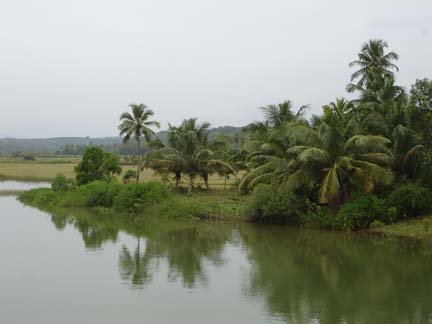
Holegadde near Honavar,Uttara Kannada dist, Karnataka
Copy? Right - but kindly remember to acknowledge!

" tulu-research.blogspot." ತುಳು ರಿಸರ್ಚ್. ಬ್ಲಾಗ್ಸ್ಪಾಟ್. ಇನ್

Have a nice day !