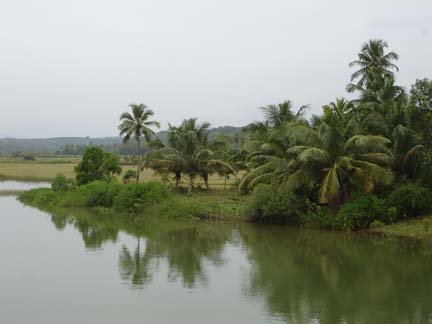
I heard some Tuluva uttering the word ‘KorDēl’ while I was in Mumbai last mid-November. Mention of this ‘lost name’ had an electrifying effect on me. Living away from Tulunadu for more than five decades, I have altogether forgotten this name. The casual remembering of this parallel name for Tannirbavi stirred my imagination to explore the meaning regarding:
1) when and how the village got this name, 2) whether it is applied to certain part of Tannirbhavi and 3) whether this nomenclature has any bearing on erosion (Tulu: korevuni) aspect of Gurupura ( Phalguni) River or tribal aspect of ‘Kor’s (Koraga,Kuruva,Kuruba), who were the predominant early tribes of historical India?
Though I had traversed this place several times up to 1956, before my moving out to Mumbai, it never tempted me to decipher the meaning.
Kordel village on coastal belt
KorDel is a village in the Mangalore coastal belt (from Suratkal, Hosabettu, Baikampadi, Panambur, Kuloor, Kordel, Boloor and Bengare). It is now disjoined after the construction of artificial all-weather New Mangalore Harbour at Panambur in the seventies that gobbled up a fertile arable land. We can ascribe erosion aspect of Gurupura aka Phalguni River for the village name, but we cannot altogether deny the possibility of applying ‘Kor’ tribal signature.
Etymology
Possibility. 1: On dissecting the word ‘KordEl, we can get ‘Koredu + El’. Koredu = eroding + el = melting of, say sand (in this case). ‘El’ could also mean ‘al’, i.e. water. Coastal area around western bank of Phalguni after Kuloor is ‘KordEl’. I think, this nomenclature in local Tulu tongue must be due to the acute erosion of sandy bank by the river after south-westerly bend at this stretch. This erosion is still more acute in monsoon swell. I have noticed in my teen-hood, the brink, i.e. steep edge or fall, along western bank. Time-line for coining this name must be the year when Gurupura River changed its course abruptly. It could be the year 1887 CE (cf: Posts on Mangalore) as there was no Tannirbavi-Bengre sand spit prior to this. The legendary shift may still be etched in memory of villagers, percolating through generations.
However, owing to displacements, consequent to harbour project, and dwindling older generation, there are very few who can provide older information on the area. Ms. Jyoti Gautam, a former scion of Tannirbāvi, now settled in Mumbai, could elicit a brief data from her aunt thus:
“The place is called ‘Kordel’ in Tulu and ‘Kodikal’ in Kannada. Earlier tribes used to reside near the river Gurupura but now they have moved towards Thanirbhavi as Harbour has come up. Few people like Harijans Christians and Muslims still reside there but Mogaveeras have moved out of Kordel. These earlier tribes now are much modernised and secured jobs in government offices. They do not prefer to be called as tribals now.”
Possibility 2: Alternatively, ‘Kordēl’ could be Kor (a tribe, like Koraga) + Da (land, area) + el (stream, water-source). It means a village beside river inhabited predominantly by Kor tribe. This explanation is more convincing as Koragas in Tulunadu (and for that matter their cognates elsewhere in India) were powerful during early history and reportedly built ancient kingdoms. It is reported that Habbasiga (or Hubasic), a Koraga King, fought with Kadamba King Mayura Sharma (aka Varma, ca. 400 CE). Hubasic was defeated by descendants of Mayur Sharma later on. This event apparently forced Koragas to flee to forests in hills.
Forgotten Well
In Land revenue records, Kordel is known as Tannirbāvi. What I understand, Kordel (western bank) or Kodikal (eastern bank) are locales a former larger village, Tannirbāvi. Topography of coastal beach in the Tannirbāvi west and lateritic or rocky ridge on the eastern Kodikal. Tannirbhavi beach can be approached by road from Panambur or by river from Boloor-Bokkapatna ferry points.
A perennial fresh-water well of potable water, must have been instrumental in giving the place name Tannirbavi. In olden days potable water wells were scarce in the beach area. Water near coast is brackish in general because of saline incursion from the sea. The legendary well must be sweet and potable all the year round and was catering to the entire village. Hence the proverbial place-name: Tannirbāvi.
Koragas of Tulunadu
There are conspicuous imprints of aboriginals and ancient tribes all over Tulunadu. In Tulu, ‘kādināye’ or ‘kādtaye’ (male person from the forest) and ‘kādināl’ or Kādtāl (female person from the forest.) mean a Koraga, dwelling in forest.
They are known as ‘Korava’ (also ‘Gorava’) in Kannada and Telugu and ‘Kuruvan’ in Tulu, Tamil and Malayalam. Alternative names are Koragar, Koragara, Kuruva, Korangi and Korra. In Orissa, they are known as ‘Karanga’ and ‘Korga’. (There are ‘Korangara pādi’ in Udupi and ‘Karangala pādi’ in Mangalore.) Goravas from upland Karnataka were the preists in early Shiva temples of Tulunadu.
Koraga demography:
Koragas, grouped under Scheduled Tribes in the modern Indian Constitution, are primitive ancient exogamous tribal clans with 17 ‘balis’ (lineages), now marginalised, in Tulunadu. They were the original inhabitants and rulers of Tulunadu and rest of West Coast in historical past with general features like medium height, thick lips, broad noses with rough and bushy hairs. They are usually classified into four sub-tribes: Ande Koraga, Kappada Koraga , Kappera Koraga, Sappu or Tappu Koraga. They live in forests and village outskirts in isolation in their ‘koppas’, colony of primitive houses made up of leaves in remote places. It is said that they are forbidden to live in houses of clay and mud.
They are Sun worshippers and name their babies by the week-days of birth, like Aitha (Sun), Toma/Soma (Moon), Angara/Mangara (Tuesday), Booda (Mercury) , Guruva (Thursday), Tukra/Shukra (Friday) and Taniya (Saturday). Girls are named Aithu, Tomu/Somu, Mangaru, etc. This feature of naming after members of solar system, they could have picked up from Tulu tribes because even among Tuluvas this was a common feature in earlier days as discussed in older posts.
Earlier, Koragas wore an apron of twigs and leaves over their buttocks, which practice is said to be a punishment meted out to them, for one of them asking for a upper class girl in marriage in their heydays. When they were subdued, upper class decreed that their women should not wear any kind of dress. To avoid disgrace, they took recourse to forest leaves to hide and protect their private parts. In my childhood, I have seen males wearing black cloth (short lungi) around their lower parts and upper part with white cloth (This may be the reason for contemptuously calling them as ‘black legged’). Their cap is made up of spathe of areca-nut palms (known as ‘muttale’ in Tulu). Women wear sarees but without blouse. Now, modern Koraga people wear dresses, common in the modern society. Their population was 15,146 as reported in Census-1981.
Language: Koragas are mostly illiterate, though there are now educated youth in the changed circumstances. Their language, considered as a dialect, is well-guarded and not shared with outsiders. Some books are available on Koraga language. A Vocubulary of Koraga Language is included in the South Kanara Manual-1895”. Mr. Stuart mentioned it “as a dialect of Tulu in his 1891 Census Report. But modern Koraga language is influenced by both Tulu and Kannada. Regional versions of Koraga Bhase, spoken by geographically scattered Koraga Groups are as under:
1) Ande Koraga (Hebri-Karkala – Southern Part): Bilingual influence with Tulu. Kasargod Tulu, Kannada and Malayalam – Central Part.
2) Sappu (Tappu)/Kappada Koraga (Udupi and Mangalore): Bilingual with Tulu and Kannada.
3) Northern Part: Both Groups have borrowed from Kannada and Tulu respectively but in Kundapur, it is influenced by Kannada because Kannada speakers are greater in number there.
For a general introduction to Koraga language, refer: Post-108: Koraga Language – A Primer.
Koraga: primitive powers of aborigines
The available data on the evolution of language and culture in India, including data from Tulunadu specifically, suggests that waves of immigrant tribes dominated the terrain after confiscating socio-political powers from the aboriginal primitive tribes like Koragas. However, the immigrant settlers, including Tuluva were apprehensive of the unknown, special occult powers residing with the aboriginal tribes. Some of the traditional ritual practices of Tulu people like ‘feeding the forest tribes’ (‘Kaadinalegu Nuppu Dippini’) or ‘gifting to koraga’ (‘koraga dāna’) can be seen as examples of this psychology.
Kaadinalegu Nuppu Dippini
It is customary in Tulu families to serve food to ‘Korapalu’ (female Koraga) on auspicious days as a part of ritual. Korapalu (or Korageti) is invited to the houses of upper class communities, including Brahmins.
In rural areas, formerly, the affected or sick child is made to sit with the mother or an elder, on a stool. The cooked food, containing rice and vegetable curries, are served in a banana leaf placed on a winnowing basket. Korageti goes around the child and the mother with the offerings three times and blesses the child by waving the winnowing basket of food over the head of the child. The child is handed over to Korageti and exchanged three times.
In the case of new-born babies, a lactating Korageti is allowed to breast feed the child for the purpose of curing unknown ills of the child. Even Brahmins have followed this custom. Korageti names the child as ‘Korapalu’, if it is female and ‘Koraga’, if male. This is considered as new birth to the child, warding off all ill-omens.
Note that there is no hint of practice of ‘untouchability’ in these ancient occult ceremonies. Irony of it, the other members of the family are not allowed to touch and come within the shadow of Korageti. This practice is originated from fear of power of black magic practiced by the Koragas. Koragas are animists, who believe in spirits and ghosts. There are many Divine Spirits from Koraga community, such as Koraga Taniya, Mankaldi, etc.
Untouchables
They are treated as untouchables, prior to enacting various Laws, banishing this practice. They accept food and water from all communities but water sources are not shared. They do not enter temples but beat drums and dance at allotted niche outside. They accept prasād or naivedya (holy food offered to God) at temple festivals. As folk-dancers, they go house to house as Siddis, Kangilo-mayilo, etc. In olden days, they were present at marriages and other social celebrations of various castes but accepted only left-over food after the feasts. During bonded-labour days, there existed cultivator-labourer relationships.
Traditional Wickerworkers
Most of them are highly skilled in wickerwork handicrafts making baskets from rattans, canes and wicker. Their products include: ‘tottilu’ (craddle), ‘kurve and kudpu’ (baskets), cylindrical containers to hold paddy, ‘tadpe’ (winnowing baskets), ‘kalasige’ (scale pans for measuring grains –usually measuring 14 seers), boxes, ‘tatti-kudpu’ (rice water strainer), ring stands for supporting pots, ‘kattavu’ (coir rope from coconut fibres), etc. They used to sell these articles to merchants or at periodical markets at different localities at cheaper rates. Now, they have organized themselves and sell their handicrafts in their own shops run on co-operative basis at market-places.
Some of them were employed as scavengers in Health Department of town or city municipalities. Now it is banned. Dead cattle are salvaged by them for hide and bones, which are sold to merchants.
‘Ajalu’ Prohibition
Untouchability is abolished under the Constitution. Karnataka Government passed an Act, named “Karnataka Koragas (Prohibition of Ajalu Practice) Act, 2000”. Ajalu practice means, performing of any act or ceremony: (i) differentiating between Koragas and persons belonging to other communities by paying no wages or lessor wages to Koragas for using their service, (ii) treating Koragas as inferior human beings as compared to others, (iii) mixing hair, nails or any other inedible or obnoxious substance in the food and asking Koragas to eat that food, (iv) driving Koragas to run like buffaloes before the beginning of Kambala (buffalo race in marshy land). The Act imposes penalty for persons using or abetting the using of the services of a Koraga for Ajalu practices with or without the consent.
Following quotation fascinated me: “The most radical revolutionary will become conservative the day after the Revolution”. This is demonstrated by Koragas in holding demonstrations in Mangalore recently against ‘Ajalu practies’.
Neglected
In spite of several laws, right from British era, for the uplift of down-trodden, they are neglected. “Kundapura Koragas in Karkada wait in darkness for light”: is a news Item in Daijiworld.com dated August 2, 2010. There is a ‘Spoorthi’ Orphanage for hapless children, run by a couple. It is struggling for patronage from public and Government to carry on their noble work.
References:
· Encyclopaedia of primitive Tribes in India, Vol.2 – By P.K. Mohanty (Read page 362-378)
· Ethnographic Atlas of Indian Tribes – By Prakash Chandra Mehta (Google Book)
· Castes & Tribes of Southern India (7 Vols.) – By Edgar Thurston (Though commendable work, it is reported that there are many inaccuracies).
· Koraga Language (1971) - by D.N. Shankar Bhat
· UOM-1997-523-3 – A Paper on Koraga Language
· Ethnic identity & intangible cultural heritage – A Study of Koraga Community of South India – Dr. V. Jayarajan (folkland@rediffmail.com)
· An Atlas of Tribal India (with compiled Tables) – by Moonis Raza & Aijaruddin Ahmad
· Mangalore Headlines – Aug. 18, 2010 – Mangalore Koragas celebrate ‘Bhoomi Pooja’.
-Hosabettu Vishwanath, Pune