Greek reports dating back to the beginning centuries of the Christian era describe a port in the west coast of India named ‘Nitrias’ (in Pliny, ca.23-29 CE), or 'Nitra' (Ptolemy, ca.110 CE). Our historians like Manjeswara Govinda Pai have identified the port of ‘Nitrias’ or 'Nitra' as the port of ancient Mangalore.
The port name ‘Nitria’ has been related with the similar sounding name of River Nethravathy. The name ‘Nitria’ apparently related to the word ‘Nethra’, may have been originated due to eye (‘nethra’) shaped landform near the port of ancient Mangalore.
Possibilty 1
There was a historical town known as Nitria on the bank of River Nile in Egypt. There is a possibility that our historians may have misinterpreted location of Nitria described in the Greek report
Possibility 2
If we consider that the word Nitria was referring to the ancient Mangalore, the ‘Nitria’ does not appear to be a natural Tulu word. Accepting that the Greeks might have distorted the actual word, we may presume that the original native word may be something like ‘Nettara’ or ‘Nettaru’. Since Sanskrit had not taken roots in Karavali during the First or Second century CE, we can rule out the name ‘Nethra’. There are places known as Nettarakere near the River. There are also places pronounced ‘NeTTar’. The place names ‘Nettar’ in Nettara-kere may possibly be the original ancient word from Early Munda languages that gave rise to Nethra in later Sanskrit.
Similarly, the name of the River Nethravathy might not have been exactly like that during the said period. The River might have been renamed/ modified in the Sanskrit style after Fifth Century CE. The former name of the River might have been ‘Nettaral’ or something similar.
Before analyzing further on the word Nitria, it is necessary to verify the original Greek records for the nature of actual reference to the town Nitria
®

A heritage blog by: Ravindra Mundkur & Hosabettu Vishwanatha
Showing posts with label Nethravathy. Show all posts
Showing posts with label Nethravathy. Show all posts
Tuesday, January 15, 2008


Sunday, April 8, 2007
16.Mangalore: Kudla and Nitria

Mangalore, the sultry and vibrant coastal town of
In Greek literature of early Christian era, there is said to be reference to an Oloikhera, which has been interpreted as Greek version of the name Aluva Kheda.
We do not find mention of either Mangalur or Kudla in Greek reports. Instead we find the
Mangalore is the anglicized version of the name MangaLooru. Premilla, a queen of Malabar, renounced her kingdom and became a disciple of Matsyendranath of Nath cult. She traveled with her Guru towards Kudla (or Mangalore) but had to settle near Bolar as she fell ill on the way. Eventually she died there and local people built a temple in reverence to her. The temple was renovated subsequently by an Alupa ruler, Kundavarma during the year 968 AD. Thus the town was known as Mangalapura.
The term Mangala also means fort, so a few believe because an ancient fort the name came. Infact,the name Mangalapura is found in the inscriptions earlier to the period of installation of Mangaladevi temple, ie., 968 AD. The Mangaladevi temple in the southern part of the city, reminds us that the city was named after goddess Mangaladevi. Thus Mangalapura later became Mangalooru during the Vijayanagar period. They called it Mangalur Rajya.
The name Kudla is a native geographic term indicating confluence of two rivers. The words KooD or KooDi (joined)+ala(=rivers) have become (1) kooDala > Kudla , and (2) kooDiala > koDiala. In other words, Koodla or Kudla is the Tulu equivalent of the Sanskrit word, sangam.The word Koodala is also there in Kannada. The river confluence of Kudalasangama is quite famous since the time of Basaveswara, the social reformer.Similarly the township at the confluence of Tunga and Bhadra rivers in Shimaoga district is known as Kudli.
A number of significant geographic modifications have taken place in Mangalore area during the historical past. At present, River Nethravathy flows westerly and joins the
This geographic situation was much different during the historical past. The rivers Phalguni and Nethravathy were flowing within the present city area of Mangalore and joining the sea near the Alake-Bokkapatna area.
Subscribe to:
Posts (Atom)
A Coastal estuary
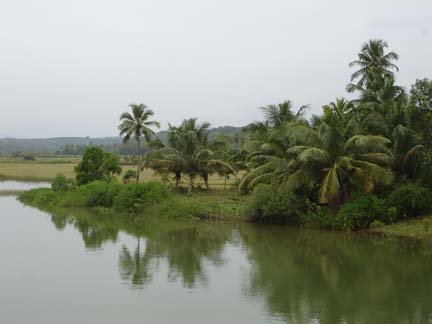
Holegadde near Honavar,Uttara Kannada dist, Karnataka
Copy? Right - but kindly remember to acknowledge!

" tulu-research.blogspot." ತುಳು ರಿಸರ್ಚ್. ಬ್ಲಾಗ್ಸ್ಪಾಟ್. ಇನ್

Have a nice day !