Antonios Vasileiadis, a scholar from Athens, Greece shares the opinion that many of our words have been borrowed or imported from Mediterranean, Africa regions along with immigrants.
He conveyed the following comments (under the post 77 in this blog).
“The Kodavas explain that by saying "Poly-poly Deva" ask Gods for " more or many more" and is the exact meaning the Greek word" Poly" has. You use it today when you say Polytechnic or Polyclinic. South Indian languages have given a lot of help to lost Mediterannean word's meanings. We were puzzled what the word Korymbas ( of the people present at God Zeus birth) was meaning. Finally I figured out that Korumbas in South Indian languages means "SHEPHERDS".Well with the tradition were shepherds are present at the birth of every miraculously born and then tortured,killed and resurrected God. For you Sheep is " kuri ' for the ancient Greeks it is "kura ".
As I ended a paper presented at the 2007 Indian and South Indian History Congress -
we are more close related than what we think. “
Inna
To the list of imported /immigrant derived Tulu words discussed in earlier posts I would like to add Inna. The word Inna has a distinct place in Tulu language, even though we may have forgotten what it exactly means. I stress the word forgotten because we do not find easy explanation to its meaning. For example, our Tulu Nighantu does not carry an entry or clues to the possible meaning to this word : Inna.
At least three villages in the Tulunadu namely Inna, Innanje and Innoli have preserved this word 'Inna' as fossil toponyms of our forgotten heritage.
The name 'Inna' survives in Central Asia and Europe as a feminine proper name. The word Inna in Russian languages means rough water and thus the word possibly represents a wild river. This meaning seems appropriate because all our Inna-villages (Inna, Innanje, Innoli) are located proximal to rivers.
Origin
Migration of human tribes on continental scale along the path of history is a reality considering the distribution pattern of genetic features and characteristics. The word 'Inna' must be one of the ancient words brought by the migrating people from Mediterranean -Mid-Asia region to Karavali region during course of early history. Thus human tribal settlements near the wild rivers were named 'Inna' with or without village-indicator suffixes.
®

A heritage blog by: Ravindra Mundkur & Hosabettu Vishwanatha
Showing posts with label immigration.. Show all posts
Showing posts with label immigration.. Show all posts
Wednesday, January 21, 2009


Saturday, February 23, 2008
95. Chenne or Mangala games
Chenne (or Chenne mane) game was popular in the rural Tulunadu since the time of Siri or even before. It is played on a wooden board with two parallel rows pf pits. The game is played using large seeds of local trees like that of ponge/pongar or coral tree.
Manqala
However this ancient game is not unique or original to Tulunadu. It is played widely in many parts of the world and there are some two hundred or more versions with as many names for the game! Now, they are generally known as Manqala (also spelt as ‘Mancala’) group of games.
Origin
Manqala games have been considered to have originated somewhere in central Africa ca. 5000 BC, according to the evidence gathered by National Geographic sponsored archaeological diggings. The word Manqala is derived from the Arabian root ‘naqala’ that means to move. Some of the names for different variants of the game include Adji-Boto, Adjito, Awale, Awari, Aware, Awele, Bantumi, Bao,Congklak, Dakar, Dao, Dara, Darra, Endovoi, Geshe, Halusa, Jodu, Kalaha, Kalah, Kale, Kalle, Lamlameta Mangala, Mandoli, Omweso,Oware, Ot-Tsjin, Solo, Songo Duala, Vai Lung Thlan, Wari, Warri,Wouri etc.
Mangala
A variant of the game played in Turkey is known as ‘Mangala’! Also note, for the sake of curiosity, that it is also called Kalah in parts of Africa. The word ‘kalah’ has shades of resemblance to the Tulu word ‘kala’ (=field).
A wealth of data is available on the internet on Manqala group of traditional games. Also a number of modified and modernized versions of the games ahave been evolved to suit the modern tastes.
Immigration
The game variant ‘Lamlameta’ played in Ethiopia is quite similar to Tulu game of Chenne (Cenne) according to Peter Claus.
The antiquity and distribution of the Manqala group of games and their similarity to the ancient Tulu game of Chenne, clearly suggest that the game concept originally evolved in Africa-Mediterranean region was brought to Tulunadu by early Tulu immigrants, possibly corresponding with the broad period of immigration ca. 750-500BC as discussed in the early posts in this blog.
®
Manqala
However this ancient game is not unique or original to Tulunadu. It is played widely in many parts of the world and there are some two hundred or more versions with as many names for the game! Now, they are generally known as Manqala (also spelt as ‘Mancala’) group of games.
Origin
Manqala games have been considered to have originated somewhere in central Africa ca. 5000 BC, according to the evidence gathered by National Geographic sponsored archaeological diggings. The word Manqala is derived from the Arabian root ‘naqala’ that means to move. Some of the names for different variants of the game include Adji-Boto, Adjito, Awale, Awari, Aware, Awele, Bantumi, Bao,Congklak, Dakar, Dao, Dara, Darra, Endovoi, Geshe, Halusa, Jodu, Kalaha, Kalah, Kale, Kalle, Lamlameta Mangala, Mandoli, Omweso,Oware, Ot-Tsjin, Solo, Songo Duala, Vai Lung Thlan, Wari, Warri,Wouri etc.
Mangala
A variant of the game played in Turkey is known as ‘Mangala’! Also note, for the sake of curiosity, that it is also called Kalah in parts of Africa. The word ‘kalah’ has shades of resemblance to the Tulu word ‘kala’ (=field).
A wealth of data is available on the internet on Manqala group of traditional games. Also a number of modified and modernized versions of the games ahave been evolved to suit the modern tastes.
Immigration
The game variant ‘Lamlameta’ played in Ethiopia is quite similar to Tulu game of Chenne (Cenne) according to Peter Claus.
The antiquity and distribution of the Manqala group of games and their similarity to the ancient Tulu game of Chenne, clearly suggest that the game concept originally evolved in Africa-Mediterranean region was brought to Tulunadu by early Tulu immigrants, possibly corresponding with the broad period of immigration ca. 750-500BC as discussed in the early posts in this blog.
®
Subscribe to:
Posts (Atom)
A Coastal estuary
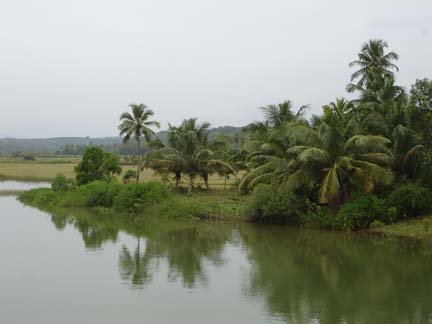
Holegadde near Honavar,Uttara Kannada dist, Karnataka
Copy? Right - but kindly remember to acknowledge!

" tulu-research.blogspot." ತುಳು ರಿಸರ್ಚ್. ಬ್ಲಾಗ್ಸ್ಪಾಟ್. ಇನ್

Have a nice day !