Chenne (or Chenne mane) game was popular in the rural Tulunadu since the time of Siri or even before. It is played on a wooden board with two parallel rows pf pits. The game is played using large seeds of local trees like that of ponge/pongar or coral tree.
Manqala
However this ancient game is not unique or original to Tulunadu. It is played widely in many parts of the world and there are some two hundred or more versions with as many names for the game! Now, they are generally known as Manqala (also spelt as ‘Mancala’) group of games.
Origin
Manqala games have been considered to have originated somewhere in central Africa ca. 5000 BC, according to the evidence gathered by National Geographic sponsored archaeological diggings. The word Manqala is derived from the Arabian root ‘naqala’ that means to move. Some of the names for different variants of the game include Adji-Boto, Adjito, Awale, Awari, Aware, Awele, Bantumi, Bao,Congklak, Dakar, Dao, Dara, Darra, Endovoi, Geshe, Halusa, Jodu, Kalaha, Kalah, Kale, Kalle, Lamlameta Mangala, Mandoli, Omweso,Oware, Ot-Tsjin, Solo, Songo Duala, Vai Lung Thlan, Wari, Warri,Wouri etc.
Mangala
A variant of the game played in Turkey is known as ‘Mangala’! Also note, for the sake of curiosity, that it is also called Kalah in parts of Africa. The word ‘kalah’ has shades of resemblance to the Tulu word ‘kala’ (=field).
A wealth of data is available on the internet on Manqala group of traditional games. Also a number of modified and modernized versions of the games ahave been evolved to suit the modern tastes.
Immigration
The game variant ‘Lamlameta’ played in Ethiopia is quite similar to Tulu game of Chenne (Cenne) according to Peter Claus.
The antiquity and distribution of the Manqala group of games and their similarity to the ancient Tulu game of Chenne, clearly suggest that the game concept originally evolved in Africa-Mediterranean region was brought to Tulunadu by early Tulu immigrants, possibly corresponding with the broad period of immigration ca. 750-500BC as discussed in the early posts in this blog.
®

A heritage blog by: Ravindra Mundkur & Hosabettu Vishwanatha
Showing posts with label Ethiopia. Show all posts
Showing posts with label Ethiopia. Show all posts
Saturday, February 23, 2008


Sunday, October 14, 2007
46.Proto-Tulu Migration: Stage I
1. The proposal of the earliest stage of migration of proto- Tulu tribes is based on (a) the presence of Tulu words in African and Sumerian derived languages. The basic word ‘Tulu’ itself can be found in several place names and persons names. Similarly the Tulu words bant, oor (<.ur1=village), uri2 (<.ur2=to burn), ain (<.ai=five), sike(<.sige=sultriness), sima (samba=lion), puttu (putt=to birth) etc. are derived from ancient African/Mediterranean proto languages.
2. The timing suggested ca.2000 BC is approximate and is based on the mass migration of tribes out of Africa due to adverse environments like drought and desertification. There are actually many phases of African migrations beginning with the origin of evolved man around 165,000 years ago. Since the words Tulu, bant, oor, ain etc were well formed in African –Mediterranean region during the 4000-2000 BC period, the ca.2000 BC migration episode has been considered. The dates can be further refined with availability of new data.
3. The place of origin or initial dispersal was chosen as Ethiopia based on the presence of maximum number of place-name associations with the word Tulu. Even in those early days Tulu might have been a small ethnic group. Apparently even now there are ethnic groups called Tulu in Ethiopia.
4. For comparison of genome characteristics of Ethiopian and Tulu people extensive data may be required on either side, since both sides have undergone extensive human assimilations in the post-migration period. Right now, there may not be sufficient compilation of genetic data on this front, especially on the Tulunadu side. Besides, the present day Ethiopian have also changed considerably because several generations of migrations to and from Africa throughout the history. Apart from the declared complexities of genetic substructure of Ethiopian chromosomes, at least three major phases of back migrations from Asia into Ethiopia have been explained based on Y -chromosome genetic studies (Ornella Semino and others, 2002).Beside the present, Ethiopian (and Yemeni) maternal lineages are said to be composites of sub-Saharan and West Eurasian mtDNA haplogroups suggestive of extensive bidirectional gene flow on either sides of the Red Sea (Toomas Kivisild et al, 2004).
As pointed out by Kivisild et al (2003) in the Indian context, “It will take larger sample sizes, more populations, and increased molecular resolution to determine the likely modest impact of historic gene flows to India on its pre-existing large populations”
®
2. The timing suggested ca.2000 BC is approximate and is based on the mass migration of tribes out of Africa due to adverse environments like drought and desertification. There are actually many phases of African migrations beginning with the origin of evolved man around 165,000 years ago. Since the words Tulu, bant, oor, ain etc were well formed in African –Mediterranean region during the 4000-2000 BC period, the ca.2000 BC migration episode has been considered. The dates can be further refined with availability of new data.
3. The place of origin or initial dispersal was chosen as Ethiopia based on the presence of maximum number of place-name associations with the word Tulu. Even in those early days Tulu might have been a small ethnic group. Apparently even now there are ethnic groups called Tulu in Ethiopia.
4. For comparison of genome characteristics of Ethiopian and Tulu people extensive data may be required on either side, since both sides have undergone extensive human assimilations in the post-migration period. Right now, there may not be sufficient compilation of genetic data on this front, especially on the Tulunadu side. Besides, the present day Ethiopian have also changed considerably because several generations of migrations to and from Africa throughout the history. Apart from the declared complexities of genetic substructure of Ethiopian chromosomes, at least three major phases of back migrations from Asia into Ethiopia have been explained based on Y -chromosome genetic studies (Ornella Semino and others, 2002).Beside the present, Ethiopian (and Yemeni) maternal lineages are said to be composites of sub-Saharan and West Eurasian mtDNA haplogroups suggestive of extensive bidirectional gene flow on either sides of the Red Sea (Toomas Kivisild et al, 2004).
As pointed out by Kivisild et al (2003) in the Indian context, “It will take larger sample sizes, more populations, and increased molecular resolution to determine the likely modest impact of historic gene flows to India on its pre-existing large populations”
®
Thursday, October 11, 2007
43. Evolution of Tulu Language

I propose a three stage evolution of Tulu language. Other Dravidian languages also share this global heritage.
Stage I: ca.4000-2000 BC - Proto Tulu
Proto Tulu originated in Ethiopia. It contained lot of words derived from Sumerian languages and African languages. Some of these words still survive in our language. Other Proto-Dravidian languages also were originated in the region.
Around 2000 BC severe desertification of northern Africa occurred with formation of Sahara desert. The adverse environmental conditions forced many human tribes to leave Africa and migrate to greener areas with basic amenities. Tulu and other Proto Dravidian tribes left Africa and migrated.
Stage II: ca.2000-500 BC - Early Tulu
Migrating Tulu tribes and proto-Dravidians settled in the Pirak region in Central Asia, now part of Pakistan. Pirak region had a native language: Early Prakrit. They interacted with Indo-Aryans that came from Eastern Iran. A group of Indo-Aryan sages were engaged in the oral composition of Vedas. Early Tulu and Dravidians tribes learnt rice cultivation in this area. Again unfavorable environmental conditions enticed these Tulu/Dravidian tribes to migrate into greener pastures of India.
Stage III: ca.500-300 BC - Tulu
Early Tulu and Dravidian tribes migrated into India. They traveled and settled for some time in different regions of northwestern India, interacted with local language groups and further migrated to West coast of India. Interaction of Dravidian tribes with Marathi tribes contributed exchange of words between Dravidian and Marathi. Marathi language is an evolved form of Early Prakrit.
Tulu tribes settled in Karavali region that is popularly known as Tulunadu. Early Kannada tribes settled in plains of Karnataka. (The names Kannada and Karnataka may have evolved later.) Early Malayalees traveled further south and settled in Malabar. Tamils moved further and settled in Early-Madhurai, somewhere in the southern coast of India. The Early-Madhurai was destroyed by the transgression of the Sea and Tamils resettled in inland townships designated again as Madhurai.
At that time Munda group of languages and culture prevailed all over southern India. Munda tribes were adept in agriculture.They were growing a variety of crops like wheat, barley, jowar, ragi, cow pea (kadale), black gram (urd), green gram (padengi), horse gram (kudu), togari etc. The incoming tribes interacted with Munda tribes leading to assimilation of Munda language and culture in Tulu and other Dravidian languages and culture. Dravidian groups introduced rice cultivation methods acquired from their earlier settlements.
®
Tuesday, October 9, 2007
42. Origin of the word Tulu -II
The word ‘Tulu’ itself is of remote antiquity. Online search shall convince you that the word Tulu is more global in dimension than we can imagine.It appears that the word 'Tulu' originally meant 'water and water related aspects' in the language of its origin, but might have acquired additional meanings subsequently due to changes in environmental situations.
In the ancient Sumerian language“tu” morpheme represented ‘water spring or well’ or ‘water connected activities like bathing or washing’ and the morpheme “lu” was indicative of quantity or abundance, people etc. There was another Sumerian word “tulu” or “tule” that meant ‘soft or placid’. (Compare similarity of the latter meaning with our ‘tuluve’ jack fruit.).Tulu is found in the list of African personal names and the word means ‘spread out in different directions’, possibly implying migratory character of the Tulu tribes. Another vocally analogous African word ‘Zulu’ also means water.
I believe that the word ‘Tulu’ existed since Sumerian period of early civilization (ca. 6000-4000 BC) in north African-Mediterranean region, where from these original ancient Tulu tribes migrated. The ancient Sumerian and related languages form the basis for the evolution of many of the Afro-Asiatic languages of present day. The word 'Tulu' originally meant (1) water or activities connected with water (2) placid and soft.These ancient meanings still survive today in spite of the passage of several millenia in the time scale. These Sumerian meanings are analogous to those interpreted by Sediyapu Krishna Bhat and Manjeswar Govinda Pai in the context of present Tulu in Tulunad.
The Ethiopia can be described as cradle of human race, since the earliest human fossils (Homo sapiens) Omo I and Omo II dated back to 165,000 years were found in Ethiopia. As reconstructed by the genome studies complemented with archeology and paleontology, human migrations started out of Ethiopia and Africa in several phases.
Tulu place names
Tulu is the name of several Ethiopian towns and settlements. ‘Tulu’ is also a surname or part of the name among the Ethiopian people. For example, Derartu Tulu is an Ethiopian female athlete. There are at least four places (towns, settlements) called ‘Tulu’ in Ethiopia, at least one each in the other neighboring African countries like Kenya, Sudan, Nigeria and Zaire. In Ethiopia there are more than 12 places in the online maps with ‘Tulu’ as prefix, such as Tulu Bolo, Tulu Bora, Tulu Ferda, Tulu Guracha etc.
Tulu Migrations
On the basis of these data I suggest that the original Tulu tribes originated in Ethiopia in northern Africa and migrated out of Africa under adverse environmental conditions.Based on environmental geological data scientists have interpreted that around 2000 BC, wide spread desertification of northern Africa prompted many tribes to migrate out of Africa. Tulu place names in other African countries are suggestive of migration of early Tulu tribes in different directions. The present African meaning of ‘spread in different direction’ for the word ‘Tulu’ could have been the result of migrations.
The exact nature of the language of the primary Tulu tribes hailing from Ethiopia is difficult to conjecture now but we can presume some of the original words are still preserved as fossils in present Tulu language.
The Tulu language has grown or evolved independently of African languages during the last 6000 years in such a way that they have entirely separate identities and characteristics. A lot of things change as a result of divergent evolutionary trends. But some fossil root words may exist still!
Outside the African continent, Tulu place names can also be found in Pakistan (‘Thulu’), Afghanistan, Mynamar, China, Bolivia, Brazil, Papua New Guinea and Phillipines.
The Afghan Television channel, at present, is called ‘Tulu TV’, the word ‘Tulu’ in the present Afghan language means something like ‘the rising’ or ‘the dawn’. Note that Afghan meaning of ‘Tulu” is different from the African roots. Afghanistan is close to Pirak where many of the tribes settled during the period ca.2000 to 500 BC. The Pirak episode of Tulu tribes has been discussed in several earlier posts in this blog.
The Tulu tribes settled and lived in the Pirak area for some 1500 years, then again migrated (ca 500-300 BC) to their present homeland in Tulunad.
The original ‘Tulu’ may have been the name of the mother who migrated from Africa to Pirak along with her family. The original ‘Tulu’ family carried several root words along with them during the migration from their early homeland. A few such Tulu families or clans were active in the last millennium also around Kundapur, Honavar and Banavasi region.
And Krishnadevaraya who ruled Vijayanagar was product of one such family that called itself Tulu clan.
In the ancient Sumerian language“tu” morpheme represented ‘water spring or well’ or ‘water connected activities like bathing or washing’ and the morpheme “lu” was indicative of quantity or abundance, people etc. There was another Sumerian word “tulu” or “tule” that meant ‘soft or placid’. (Compare similarity of the latter meaning with our ‘tuluve’ jack fruit.).Tulu is found in the list of African personal names and the word means ‘spread out in different directions’, possibly implying migratory character of the Tulu tribes. Another vocally analogous African word ‘Zulu’ also means water.
I believe that the word ‘Tulu’ existed since Sumerian period of early civilization (ca. 6000-4000 BC) in north African-Mediterranean region, where from these original ancient Tulu tribes migrated. The ancient Sumerian and related languages form the basis for the evolution of many of the Afro-Asiatic languages of present day. The word 'Tulu' originally meant (1) water or activities connected with water (2) placid and soft.These ancient meanings still survive today in spite of the passage of several millenia in the time scale. These Sumerian meanings are analogous to those interpreted by Sediyapu Krishna Bhat and Manjeswar Govinda Pai in the context of present Tulu in Tulunad.
The Ethiopia can be described as cradle of human race, since the earliest human fossils (Homo sapiens) Omo I and Omo II dated back to 165,000 years were found in Ethiopia. As reconstructed by the genome studies complemented with archeology and paleontology, human migrations started out of Ethiopia and Africa in several phases.
Tulu place names
Tulu is the name of several Ethiopian towns and settlements. ‘Tulu’ is also a surname or part of the name among the Ethiopian people. For example, Derartu Tulu is an Ethiopian female athlete. There are at least four places (towns, settlements) called ‘Tulu’ in Ethiopia, at least one each in the other neighboring African countries like Kenya, Sudan, Nigeria and Zaire. In Ethiopia there are more than 12 places in the online maps with ‘Tulu’ as prefix, such as Tulu Bolo, Tulu Bora, Tulu Ferda, Tulu Guracha etc.
Tulu Migrations
On the basis of these data I suggest that the original Tulu tribes originated in Ethiopia in northern Africa and migrated out of Africa under adverse environmental conditions.Based on environmental geological data scientists have interpreted that around 2000 BC, wide spread desertification of northern Africa prompted many tribes to migrate out of Africa. Tulu place names in other African countries are suggestive of migration of early Tulu tribes in different directions. The present African meaning of ‘spread in different direction’ for the word ‘Tulu’ could have been the result of migrations.
The exact nature of the language of the primary Tulu tribes hailing from Ethiopia is difficult to conjecture now but we can presume some of the original words are still preserved as fossils in present Tulu language.
The Tulu language has grown or evolved independently of African languages during the last 6000 years in such a way that they have entirely separate identities and characteristics. A lot of things change as a result of divergent evolutionary trends. But some fossil root words may exist still!
Outside the African continent, Tulu place names can also be found in Pakistan (‘Thulu’), Afghanistan, Mynamar, China, Bolivia, Brazil, Papua New Guinea and Phillipines.
The Afghan Television channel, at present, is called ‘Tulu TV’, the word ‘Tulu’ in the present Afghan language means something like ‘the rising’ or ‘the dawn’. Note that Afghan meaning of ‘Tulu” is different from the African roots. Afghanistan is close to Pirak where many of the tribes settled during the period ca.2000 to 500 BC. The Pirak episode of Tulu tribes has been discussed in several earlier posts in this blog.
The Tulu tribes settled and lived in the Pirak area for some 1500 years, then again migrated (ca 500-300 BC) to their present homeland in Tulunad.
The original ‘Tulu’ may have been the name of the mother who migrated from Africa to Pirak along with her family. The original ‘Tulu’ family carried several root words along with them during the migration from their early homeland. A few such Tulu families or clans were active in the last millennium also around Kundapur, Honavar and Banavasi region.
And Krishnadevaraya who ruled Vijayanagar was product of one such family that called itself Tulu clan.
Thursday, September 27, 2007
38.Earliest Indian Tribes
The oldest known human fossils of homo sapiens, designated Omo I and Omo II, were discovered from the Omo river valley in Ethiopia by Richard Leakey and were dated to be 195,000 years old. The journey of mankind from 165,000 to 8000 years before present, coinciding with the pre-agricultural hunter-gatherer nomadic phase of human evolution, inferred based on the genetic studies of mtDNA and Y- chromosomes, reveals that almost entire globe was populated by the mankind before 8000 years as result of incessant migrations during the last 150,000 years. With such extensive migratory trends it can assumed that mankind almost evolved and perfected verbal/lingual communications in this huge period. The factors of time, distance, environment and tribes have introduced so many variations in the languages of the world that simple genetic connections between languages can be hardly deciphered.
The data in the compilation of journey of mankind suggests that:
1). 85,000-75,000 years ago.
The first phase (batch) of human migration from Africa to India. The earliest Indian settlers.
2). 74,000 years ago.
The massive volcanic eruption documented at Mt. Toba in Sumatra. It was followed by heavy dust storms that led to nuclear winter in the entire south Asian region with volcanic dust dissipations spreading up to India for six years. Volcanic activity was followed by a millennium of ice age. Widespread devastation of the human beings, animals and plants possibly occurred in most of the southern Asia.
3). 74,000-65,000 years ago. A group of tribal people entered India from the north east Assam and Bengal from the Borneo side.
4).65,000 -52,000 years ago.
Two way coastal migrations into India have been visualized:
(a).One branch from NW India migrating along the West Coast. This is second phase of migration from Africa, possibly more evolved anatomically than the first batch.
(b).Other branch from Bengal side migrating via East coast. This is the first batch returning from the tour of South-east Asia and Australia. Possibly this branch represents the advent of Austro-Asiatic (Munda) tribes into India.
5) 10,000 years ago. The global Ice Age also called the Last Glacial Maximum(LGM).
The Glaciation caused lowering of sea levels to the tune of about 100m.This facilitated human migrations across the continents and land masses as many of the land bridges were exposed and people were able to cross the sea routes through the exposed land bridges.
The sea had retreated exposing wider land coastal mass and the land bridge between India and Srilanka (‘Ram Sethu’ or the Adams bridge) was more accessible for human migrations across the sea from India to Srilanka and vice versa. These geological-geographic aspects have ramifications that inspired some of the famous folklores of India.
The data in the compilation of journey of mankind suggests that:
1). 85,000-75,000 years ago.
The first phase (batch) of human migration from Africa to India. The earliest Indian settlers.
2). 74,000 years ago.
The massive volcanic eruption documented at Mt. Toba in Sumatra. It was followed by heavy dust storms that led to nuclear winter in the entire south Asian region with volcanic dust dissipations spreading up to India for six years. Volcanic activity was followed by a millennium of ice age. Widespread devastation of the human beings, animals and plants possibly occurred in most of the southern Asia.
3). 74,000-65,000 years ago. A group of tribal people entered India from the north east Assam and Bengal from the Borneo side.
4).65,000 -52,000 years ago.
Two way coastal migrations into India have been visualized:
(a).One branch from NW India migrating along the West Coast. This is second phase of migration from Africa, possibly more evolved anatomically than the first batch.
(b).Other branch from Bengal side migrating via East coast. This is the first batch returning from the tour of South-east Asia and Australia. Possibly this branch represents the advent of Austro-Asiatic (Munda) tribes into India.
5) 10,000 years ago. The global Ice Age also called the Last Glacial Maximum(LGM).
The Glaciation caused lowering of sea levels to the tune of about 100m.This facilitated human migrations across the continents and land masses as many of the land bridges were exposed and people were able to cross the sea routes through the exposed land bridges.
The sea had retreated exposing wider land coastal mass and the land bridge between India and Srilanka (‘Ram Sethu’ or the Adams bridge) was more accessible for human migrations across the sea from India to Srilanka and vice versa. These geological-geographic aspects have ramifications that inspired some of the famous folklores of India.
Subscribe to:
Posts (Atom)
A Coastal estuary
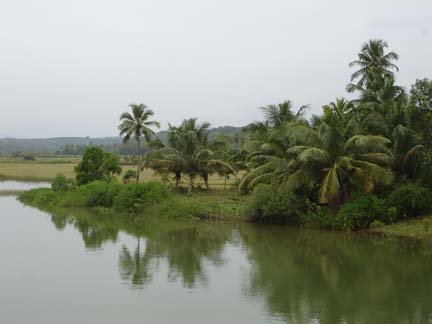
Holegadde near Honavar,Uttara Kannada dist, Karnataka
Copy? Right - but kindly remember to acknowledge!

" tulu-research.blogspot." ತುಳು ರಿಸರ್ಚ್. ಬ್ಲಾಗ್ಸ್ಪಾಟ್. ಇನ್

Have a nice day !