The Post-189 (Kuduma) was written to drive home the mutual relations of certain words in Tulu (and also Kannada) and the ingenuity of our ancestors in the remote history in coining words, related to day to day activities. Many of the Tulu words carry roots of old diction. Let us delve into the ancient root word ‘Ku’ and some of its dilations:
Ku = Earth/soil in Tulu, Kannada and other Dravidian languages and also Sanskrit. There are many words with this root word ‘Ku’.Possibly it also means auspicious, raised and encircled with water etc as studied in different contexts..
Kumbâr= (kum=auspicious/divine +bâr=to come, to manifest, bâ : pronounced as short ba as in December), to shiver. Physical shivering traditionally attributed to Spiritual manifestation. Compare ‘kumbar’ with ‘kudth barpini’.
Kud =(pron: d= as in dog). To sting. Kudolu or kundelu means a hornet or big black honey bee (‘pilikundolu’).
Kuda , Koda: (pron: d= as in dog). An early divinity. Serpent God,Naga (See, Post 189.Kudupu). The ancient Tulu expression ‘kudth barpini’ also refers to bodily shivering with trance,theologically attributed to divine or spiritual manifestation.
Many Dravidian and other allied language groups share similar etymology across the country and in neighbouring countries. Therefore, it must be a Proto-Dravidian root word. This amply illustrates the utilization of common substratum in coining terminology of the place-names by our common ancestors.
Kuda: (pron: d= as in dog). Besides meaning a dug up well, it also means hole, burrows and underground or hollow den. Burrows made by rats, ants, etc. in the ground or wall, is also called ‘Kuda’. Also kuDa> guDe. Thus ‘Kudettava’ means cobra and other poisonous snakes, which trespass and belong themselves to holes/burrows made by other creatures.Compare with Kudupa.
Kudār (KuDāl): (pron: d= as in dog). Modern Malpe, a West Coastal Port and Town, in Udupi District of Karnataka was called as ‘Kudaara/Kudaal’ in the remote historical period (See page 824, Tulu Lexicon,1988). It must have been a place around a small bay of the sea, as we see now around Kalmadi and Kodavoor, before bursting of banks of River Udyavara – an unrecorded event at a remote past (See Post on ‘Vanished Port of Udyavara’) and then its joining the sea at the present confluence at Malpe.
Kudhara =(pron: d= as in English the). That which is borne by the Earth (= hill or mountain). Or raised land, kudhara=kuru (‘dara’=’uru’= land or Earth).
Kudtale: (pron: d= as in dog). Means ‘Patta’, i.e. record of ownership of landed property with registered right of paying land revenue. Kudtale tabdeeli means transfer and registration of landed property. The registered owner of landed property is called as ‘Kudtaledaar/Pattadar’.
Kuduru: (pron: d= as in the). =Island within river.Kud+uru.Possibly raised land or land encircled by water.In Kundapur area, Kurve is the equivalent word for Kuduru the island.
Ku+urve.= encircled or raised land.There is an Urva area in Mangalore city.
Ur(u)va: Uruva or Urvi represents Earth (Tulu Lexicon,p.401).Possibly it referred to farming land or tilled soil.The word has affinity to the ancient Sumerian word ‘Uru’ (a town). Uru or Ooru has become a common Dravidian word to represent village. Compare with Kannada place-name Uluvi. Uru.> ulu.The Kannada expression ‘ulu’ is to till the soil.(With these words, we can visualize the stages of evolution of early man from forest dwelling to cultivation of land and consequential urbanization).
Kud(u)va (pron: d= as in dog). is the name of the Konkani community that lived around Goa, and migrated to Tulunadu, stretching from Gokarn to Kasaragodu in historical period, to escape the tyranny of Portuguese in Goa in 15th to 17th CE. Migrated converted Christians were called as ‘Kudumba’ for men and ‘Kudumbetti’ for women in Tulunadu (TL pages 824-825). They were originally agriculturists and hence these nomenclatures. Compare this with ‘Kunubi/Kunbi’ of Maharashtra.
Kudla: (pron: d= as in dog). Kūd+ala.Confluence of rivers. Also known as Kudāla or Koodala or Kodialabailu. It is a place at the confluence of Netravathi and Gurupura (Phalguni) Rivers before joining the Arabian Sea. Among many old names of Mangalore (explored and explained in earlier Posts), Kudla is still alive in the Tuluva tongues.
Kuja = That which grows on soil, i.e. tree.
Kula: Means tank, pond, lake, reservoir or a waterbody. The landed gentry, given to agriculture, are called as ‘Kula’ or ‘Kulawar’, meaning noble people.Also kula.>koLa.
Kulal(e), Kumbare (‘Kumbhakara’ in Sanskrit) = Potter, one who makes earthen pots using soil and water.
Kumara= (ku+māra). A God of the Earth. Young God. ( Ku=auspicious, young? ). ‘Mara’ was the ancient divinity among the early tree worshippers. In the next stage of civilization ‘Kumara’ or ‘Kanda’ (Skanda or Subramanya) was worshipped.
Kuriala: Kuriala is a village in Bantval Taluk.Kuriala means village beside river and hill.Kur(hill)+ala (village on the river bank). Similar cognate place names exist in Maharstra (Kurla), West Bengal(Kuruliya) etc.
Kuru = Raised landscape, mound, hill, mountain.(ku+uru) The man or the community, who lives in High land, is called as Kuruba (kuru = high land + ba = inhabitant).
Kuru: Name of the historical/Vedic State (of Mahabharata) located in present Haryana. The name apart from suggesting its antiquity, apparently was derived from the 'hilly' nature of the terrain.
Similarly, Kuru is a place name in Nigeria and Finland.
Besides, ‘Kuru’ in Tulu language also means a blister or sore developed on the skin. In Papua New Guinea, near Australia, ‘Kuru’ refers to a brain disease among cannibalistic Fore tribes also known as laughing sickness.Kuria in Fore language means to shiver.
Kuruda: Kuruda=blind. The King Drutharastra of Kuru kingdom in Northwestern India depicted in Mahabharata was blind. There is a possibiliy that the Kannada word ‘kuruda’(=blind person) was derived from the story of blind Kuru king Dhrutharastra.
Kuvel , Guvel = Encircled,embanked; Or pit (‘guv, kuv’) dug for water. A dug well for water.Compare ‘guv’ with ‘guhe’ (=cave).
**
Notes:
Kuda: In ‘tamilnet’, we bumped against an explanation to Tamil word ‘Kuda/Kudaa’, which we reproduce below, with due apology. Since it is a proprietary text, readers are cautioned not to mutilate it if they quote the material.
“Kudaa is a geographical term used to describe a cove, bay, or gulf. In the context of Naachchikkuda, it is a cove.
Kuda means curvature in the Urichchol (a class of words that had come from remote past), denoting curvature in the Changkam diction.”
**
With the help of these root words, we may be able to elucidate convincingly the Place-names from Udyavara to Udupi, including Malpe Kodavoor (>.Sanskritised to ‘Krodashram’).
The present generation may or may not be knowing exact meaning of the words coming down from our ancestors of past. Seldom we hear some of our old generation speaking such archaic words that carry rich meanings.
-Hosabettu Vishwanath & Ravi

A heritage blog by: Ravindra Mundkur & Hosabettu Vishwanatha
Showing posts with label kurumba. Show all posts
Showing posts with label kurumba. Show all posts
Tuesday, June 9, 2009


Sunday, April 13, 2008
108. Koraga language: A primer
A simple word can prompt different people to think in different dimensions and probe different shades of meanings leading to better appreciation of the genesis and evolution of the words.
Kavu:>Kapu
The derivation of the word kavu:>kapu / kayu in one of my previous post elicited some further analysis by Manjunath where he concluded that ‘kavu’ could be a Dravidian word. The word ‘kavu’ has been cited as a Koraga word (Ramakrishna Shetty, 2007). The frequency of occurrence of the words ‘Kavu’ and ‘Kapu’ as place names in Karavali Tulunad tempted me to conclude that Tulu word ‘Kapu’ has been derived from the pre-Tulu word ‘Kavu’
The word ‘kavu’ has several shades of meaning, as reminded by Hosabettu Viswanath, which includes (a) heat (b) husk(c) dark-coloured cloth or soil -‘kavi’ (d) to wait etc., apart from the place names that mean (e) reserved area (common in place names such as Kavu, Kavur, Kavugoli, Kapu, Kapikad, Modankapu, etc).
Early Munda groups
Normally, the Indian people have been classified into Dravidian, Aryan and Austro-Asiatic origins. In the earlier posts I have tried to support the existing theories that the point that Aryan and Dravidian ancestors immigrated into India during the period 1900-800 BC. At the time of arrival of these Aryan and Dravidian groups, the ancient India was not an empty zone. It was already manned by inhabitants who are generally designated as Austro-asiatics .The Austro-asiatics are at presented represented by Munda group of people who are distributed mainly in Chotanagpur and surrounding tribal areas. Various evidences and cultural vestiges in Tulu and other Dravidians suggest that these tribal groups were once distributed widely in different parts of India. To account for the pre-Tulu and pre-Dravidian lingual-cultural elements, I introduced the concept of “Early Munda tribes” that inhabited whole of southern India, especially at the time of arrival of Dravidians ca. 800-600BC.Somehow the phrase ‘Early Munda groups’ has confused many of the readers because of the present Munda tribes whose present distribution has been reduced to certain tribal pockets of India. Added to this, tribal groups like Koragas and Bhils are usually not classified as part of the present Munda tribes.
Early Indians tribes
My concept of introducing the phrase ‘Early Munda groups’ was to represent all those tribes that inhabited India before the arrival of Dravidians/Aryans into India. Since the usage of the phrase (‘Early Munda groups’) in my earlier posts has lead to confusion, I would to replace it with the phrase ‘Early Indian tribes’ to encompass the whole gamut of early settlers in India before 1900-800 BC periods.
These distinctions may be of help in further detailed philological and genetic studies of our evolution.
Koragas
Koragas are a distinct usually dark coloured tribal group that inhabit the Karavali area. It is not certain right now whether these tribes should be classified under Austro-Asiatics or under those migrated from Africa during the initial or subsequent stages of human evolution. Evidences of presence of relict Koraga words in Kannada, Tamil and Malayalam suggests that the Koragas groups thrived in different parts of southern India. Kurumba, Korava, Korama, Kuruvan and other tribes may be variants of Koragas of Tulunad. Kannada researcher, Sham. Baa.Joshi has suggested that the Kannada word ‘Kuruba’ (=Shepard)is derived from ‘Kurumba,’ wherein the word ‘Kuru’ stands for hilly region.
Koraga Subgroups: Several subgroups have been distinguished among Koragas of Karavali zone.Edgar Thurston (1975) recognized Ande Koraga,Vastrada Koraga,Tippi Koragaand Panti Koraga subgroups. D.N. Shankara Bhat (1971) recognized Ande Koraga, Onti Koraga, Tappu Koraga and Moodu Koraga,. Aravinda Malagatti and Odeyar Heggade distinguished Ande Koraga, Soppu Koraga, Chippu Koraga, Mundu Koraga and Bakuda Koraga. The 'bakuda', apparently is also a part of the Munda group of tribes.Ramakrishna Shetty (2007) concluded that the Koraga is not a sub-dialect of Tulu and it is an independent language. The following analysis of Koraga words is based on the cited research paper by Ramakrishna Shetty.
Koraga words adapted into Tulu language
During the spatial- temporal evolution, the Tulu ancestral people have borrowed several words that were in usage among the native Koraga tribes. Some of the Koraga words that were adapted into Tulu language are:
gaDi1 (=wound),
gaDi 2 (=mark made on the land to distinguish boundary),
koTTa>koTya (=hut,shed),
booru (=sleep)>booru (to fall),
koru:>keru’(=kill),
ijji.>ee (thou,you),
nikal:>nikul (=you people),
nakal.>.nama (=we people),
ayi:>aye (=he).
pakki =bird),
dina (=day),
pooja (=worship)
pari.> par (=drink)
oli.>olipu/leppu(=to call)
kudpu.>kudpu (=to peck)
kavu.>kapu (=to wait, reserve?)
laak.>lakk(=to get up)
kall.>kalpu(=to learn)
chanka.>tanka(=heart)
.. etc.
Koraga words adapted into Kannada language
Adoption of Koraga words was not restricted to Tulu people. Ancestors of Kannada Tamil and Malayalam ancestors have borrowed Koraga word from their respective areas. Some of the Koraga words that were adapted into Kannada language are:
gaDi 2(=mark made on the land to distinguish boundary),
koTTa.>koTTige.,
koru:>kollu(=kill),
nakal:>naavu (=We),
ayi:>ava(=he),
add’.>adu(=it),
nikal.>neevu (=you people),
kavu.>kayu(=to wait)
kall.>kali(=to learn)
kel.>keLu (to listen,hear)
ganDe.>ganDu (=male)
maavu.>maavu(=mango)
puDdu/ huDdu.>hiDi.(=to hold)
..etc.
Koraga Weekdays
The immigrant Tulu ancestral people brought the names for seven days of the week from the north. Thus the Tulu week names are similar to or derived from Sanskrit (or Prakrit derived) week-names based on names of solar planets and the Sun. Aitara (<.adityavara), Somara(<.Somavara), Angare(<.Angaraka is Mars),Budaara(<.Budhvara) etc.
But Koraga week names are distinctly different and not imitated from Prakrit/Tulu week names. For example, Koraga tribes use the word ‘Pooja dina’ for Sunday! It leads us to conclude that words like pooja(=worship), dina(=day), pakki (=bird), kodanTi(=wooden club) etc are originally derived from Koraga language.
Week days in Koraga language
Sunday= Pooja dina
Monday= Kunjar dina
Tuesday=Gadige dina
Wednesday=Pakki dina
Thursday=kodanTi dina
Saturday=Maral dina
Koraga community words
Similarly Koraga words that refer to certain communities of the Tulunad throw light on some ancient words. For example the word ‘Ajal’ refers to ‘authority, jurisdiction, religious rights ‘ etc (Tulu NighanTu,Vol.I,1988).Before the arrival of Tulu/Dravida tribes into Karavali, the ‘Billava’ (a part of the ancient Bhil tribes) were the authorized people to conduct the religious ceremonies in the Early Indian society. So the Koraga tribes used the words 'Ajalai' and 'Ajalthi' to refer to the religious authority of the Billava men and women during the pre-Vedic days. It is a pity that the word ‘Ajal’ has lost its original shade of meaning with passage of time.
The ‘Baida’ were the native doctors of that time. Hence the word ‘baida’ in Koraga means medicine! The ‘Baider’ sect later merged into Billava-Poojari community.
The fishermen constructed ‘pattana’ (colony) or ‘patna’ in their fishing villages and settlements. Hence they were referred to as ‘Patle’ (one from Patna) and ‘Patandi’( woman from the Patna)
Community words in Koraga langauge
Ajalai= Poojari billawa
Ajalthi=Billawa woman
Bonkudayi=Kumbare,Odari
Bonkudadd=Odari woman
duverdayi=Beary
kanchallayi=Christian
kanchald=Christian woman
Korre korai=Koraga male
Korr korti=Koraga woman
Melade=Kelasi(barber)
Patle=Marakale(Fisherman)
Patandi=Fisherlady
Pre-Dravida Koraga
It appears that the Koraga may be one of the pre-Dravida languages that supplied root words to Tulu and other Dravidian languages during the course of lingual evolution. Assimilation of the pre-Dravidian roots in the Dravidian languages must have taken place in the course of time after 800-600 BC.
*
Reference:
Ramakrishna T Shetty (2007) “Tulu-Koraga Bhashe”(in Kannada)..In: ‘Tulu Sahitya Charitre’.(Eds: AV Navada et al), pp.300-307. Kannada University, Hampi.
Kavu:>Kapu
The derivation of the word kavu:>kapu / kayu in one of my previous post elicited some further analysis by Manjunath where he concluded that ‘kavu’ could be a Dravidian word. The word ‘kavu’ has been cited as a Koraga word (Ramakrishna Shetty, 2007). The frequency of occurrence of the words ‘Kavu’ and ‘Kapu’ as place names in Karavali Tulunad tempted me to conclude that Tulu word ‘Kapu’ has been derived from the pre-Tulu word ‘Kavu’
The word ‘kavu’ has several shades of meaning, as reminded by Hosabettu Viswanath, which includes (a) heat (b) husk(c) dark-coloured cloth or soil -‘kavi’ (d) to wait etc., apart from the place names that mean (e) reserved area (common in place names such as Kavu, Kavur, Kavugoli, Kapu, Kapikad, Modankapu, etc).
Early Munda groups
Normally, the Indian people have been classified into Dravidian, Aryan and Austro-Asiatic origins. In the earlier posts I have tried to support the existing theories that the point that Aryan and Dravidian ancestors immigrated into India during the period 1900-800 BC. At the time of arrival of these Aryan and Dravidian groups, the ancient India was not an empty zone. It was already manned by inhabitants who are generally designated as Austro-asiatics .The Austro-asiatics are at presented represented by Munda group of people who are distributed mainly in Chotanagpur and surrounding tribal areas. Various evidences and cultural vestiges in Tulu and other Dravidians suggest that these tribal groups were once distributed widely in different parts of India. To account for the pre-Tulu and pre-Dravidian lingual-cultural elements, I introduced the concept of “Early Munda tribes” that inhabited whole of southern India, especially at the time of arrival of Dravidians ca. 800-600BC.Somehow the phrase ‘Early Munda groups’ has confused many of the readers because of the present Munda tribes whose present distribution has been reduced to certain tribal pockets of India. Added to this, tribal groups like Koragas and Bhils are usually not classified as part of the present Munda tribes.
Early Indians tribes
My concept of introducing the phrase ‘Early Munda groups’ was to represent all those tribes that inhabited India before the arrival of Dravidians/Aryans into India. Since the usage of the phrase (‘Early Munda groups’) in my earlier posts has lead to confusion, I would to replace it with the phrase ‘Early Indian tribes’ to encompass the whole gamut of early settlers in India before 1900-800 BC periods.
These distinctions may be of help in further detailed philological and genetic studies of our evolution.
Koragas
Koragas are a distinct usually dark coloured tribal group that inhabit the Karavali area. It is not certain right now whether these tribes should be classified under Austro-Asiatics or under those migrated from Africa during the initial or subsequent stages of human evolution. Evidences of presence of relict Koraga words in Kannada, Tamil and Malayalam suggests that the Koragas groups thrived in different parts of southern India. Kurumba, Korava, Korama, Kuruvan and other tribes may be variants of Koragas of Tulunad. Kannada researcher, Sham. Baa.Joshi has suggested that the Kannada word ‘Kuruba’ (=Shepard)is derived from ‘Kurumba,’ wherein the word ‘Kuru’ stands for hilly region.
Koraga Subgroups: Several subgroups have been distinguished among Koragas of Karavali zone.Edgar Thurston (1975) recognized Ande Koraga,Vastrada Koraga,Tippi Koragaand Panti Koraga subgroups. D.N. Shankara Bhat (1971) recognized Ande Koraga, Onti Koraga, Tappu Koraga and Moodu Koraga,. Aravinda Malagatti and Odeyar Heggade distinguished Ande Koraga, Soppu Koraga, Chippu Koraga, Mundu Koraga and Bakuda Koraga. The 'bakuda', apparently is also a part of the Munda group of tribes.Ramakrishna Shetty (2007) concluded that the Koraga is not a sub-dialect of Tulu and it is an independent language. The following analysis of Koraga words is based on the cited research paper by Ramakrishna Shetty.
Koraga words adapted into Tulu language
During the spatial- temporal evolution, the Tulu ancestral people have borrowed several words that were in usage among the native Koraga tribes. Some of the Koraga words that were adapted into Tulu language are:
gaDi1 (=wound),
gaDi 2 (=mark made on the land to distinguish boundary),
koTTa>koTya (=hut,shed),
booru (=sleep)>booru (to fall),
koru:>keru’(=kill),
ijji.>ee (thou,you),
nikal:>nikul (=you people),
nakal.>.nama (=we people),
ayi:>aye (=he).
pakki =bird),
dina (=day),
pooja (=worship)
pari.> par (=drink)
oli.>olipu/leppu(=to call)
kudpu.>kudpu (=to peck)
kavu.>kapu (=to wait, reserve?)
laak.>lakk(=to get up)
kall.>kalpu(=to learn)
chanka.>tanka(=heart)
.. etc.
Koraga words adapted into Kannada language
Adoption of Koraga words was not restricted to Tulu people. Ancestors of Kannada Tamil and Malayalam ancestors have borrowed Koraga word from their respective areas. Some of the Koraga words that were adapted into Kannada language are:
gaDi 2(=mark made on the land to distinguish boundary),
koTTa.>koTTige.,
koru:>kollu(=kill),
nakal:>naavu (=We),
ayi:>ava(=he),
add’.>adu(=it),
nikal.>neevu (=you people),
kavu.>kayu(=to wait)
kall.>kali(=to learn)
kel.>keLu (to listen,hear)
ganDe.>ganDu (=male)
maavu.>maavu(=mango)
puDdu/ huDdu.>hiDi.(=to hold)
..etc.
Koraga Weekdays
The immigrant Tulu ancestral people brought the names for seven days of the week from the north. Thus the Tulu week names are similar to or derived from Sanskrit (or Prakrit derived) week-names based on names of solar planets and the Sun. Aitara (<.adityavara), Somara(<.Somavara), Angare(<.Angaraka is Mars),Budaara(<.Budhvara) etc.
But Koraga week names are distinctly different and not imitated from Prakrit/Tulu week names. For example, Koraga tribes use the word ‘Pooja dina’ for Sunday! It leads us to conclude that words like pooja(=worship), dina(=day), pakki (=bird), kodanTi(=wooden club) etc are originally derived from Koraga language.
Week days in Koraga language
Sunday= Pooja dina
Monday= Kunjar dina
Tuesday=Gadige dina
Wednesday=Pakki dina
Thursday=kodanTi dina
Saturday=Maral dina
Koraga community words
Similarly Koraga words that refer to certain communities of the Tulunad throw light on some ancient words. For example the word ‘Ajal’ refers to ‘authority, jurisdiction, religious rights ‘ etc (Tulu NighanTu,Vol.I,1988).Before the arrival of Tulu/Dravida tribes into Karavali, the ‘Billava’ (a part of the ancient Bhil tribes) were the authorized people to conduct the religious ceremonies in the Early Indian society. So the Koraga tribes used the words 'Ajalai' and 'Ajalthi' to refer to the religious authority of the Billava men and women during the pre-Vedic days. It is a pity that the word ‘Ajal’ has lost its original shade of meaning with passage of time.
The ‘Baida’ were the native doctors of that time. Hence the word ‘baida’ in Koraga means medicine! The ‘Baider’ sect later merged into Billava-Poojari community.
The fishermen constructed ‘pattana’ (colony) or ‘patna’ in their fishing villages and settlements. Hence they were referred to as ‘Patle’ (one from Patna) and ‘Patandi’( woman from the Patna)
Community words in Koraga langauge
Ajalai= Poojari billawa
Ajalthi=Billawa woman
Bonkudayi=Kumbare,Odari
Bonkudadd=Odari woman
duverdayi=Beary
kanchallayi=Christian
kanchald=Christian woman
Korre korai=Koraga male
Korr korti=Koraga woman
Melade=Kelasi(barber)
Patle=Marakale(Fisherman)
Patandi=Fisherlady
Pre-Dravida Koraga
It appears that the Koraga may be one of the pre-Dravida languages that supplied root words to Tulu and other Dravidian languages during the course of lingual evolution. Assimilation of the pre-Dravidian roots in the Dravidian languages must have taken place in the course of time after 800-600 BC.
*
Reference:
Ramakrishna T Shetty (2007) “Tulu-Koraga Bhashe”(in Kannada)..In: ‘Tulu Sahitya Charitre’.(Eds: AV Navada et al), pp.300-307. Kannada University, Hampi.
Subscribe to:
Posts (Atom)
A Coastal estuary
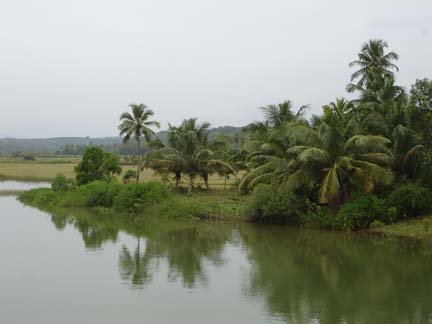
Holegadde near Honavar,Uttara Kannada dist, Karnataka
Copy? Right - but kindly remember to acknowledge!

" tulu-research.blogspot." ತುಳು ರಿಸರ್ಚ್. ಬ್ಲಾಗ್ಸ್ಪಾಟ್. ಇನ್

Have a nice day !