Lexicography and Onomastics are two closely related disciplines. Each complements the other. Linguistic connections are noticed between territories from an unknown historical past. The word ‘Kuda’, found in various languages, is an example to drive home the point. ‘Kuda’, as a suffix or prefix, is seen in place names all over India in general and in coastal belt in particular. Place names in other Asian countries too bear testimony to this observation.
Multiple meanings:
Whereas Ravi gives (in Posts-253 and 254) more stress on Ethnonym or Eponym function of popular place name ‘Kudla’ for Mangalore in Tulunadu (i.e. coastal Karnataka), I still hold the view that this Toponym bears testimony to geographical features. Multiple meanings of word elements make it difficult to decipher overall meaning of a place name, which is invariably a compound word. It is subject to many influences – geographical, cultural, political, natural catastrophes, migrations and lingual. So, modern onomastics consider that ‘a name is not simply equivalent to the sum total of its parts, but mutates at the moment of coinage’.
Kuda – what it imports?
Several meanings are found in Dictionaries of Tulu, Kannada, Malayalam, Tamil, Sri Lankan, and Maldives-Dhivehi, and in Dravidian Etymological Dictionary) for ‘kuda’, a Prakrit/Pali/Dravidian/Austro-Asian word:
Coastal Context:
Kuda/Kulhi/Kula/Ko(a)du: Used mostly describing coastal landscape, receiving sea water. It means a curve, bay, cove, gulf or sand-bank of sea or river.
‘Kuduma’ means ‘a ferry’ as per A. Manner’s Tulu-English Dictionary.
Kudaru/Kudiru/Kuduru (DED 1700) = Low ground, a hollow, bed of stream, stream. Kudura in Gond means ‘sand’. In Kurukh, it is ‘low situated rice-fields’.
‘Kuda’ in Tamil means West .(Eg. Kuda Kadal) and ‘Kuna’, East (Eg: Kuna Kadal).
Interior context:
It is also found in interior place names. In such instances, it means a hill ravine, river valley, and a nook, corner or remote and isolated place.
In Kannada, ‘Kuda’ means ‘a state of being crooked, bent, curved, a curve’. In Tulu ‘Gudke’ means crooked man. Tulu has more affinity to Kannada, especially old Kannada.
Kuda changes to Koota/Kooda when it means ‘meeting’.
In Prakrit, it means ‘a snare’ whereas in Kuwi, it is ‘cage, hen coop’.
Kuda and Kuru have the same meaning of ‘short or small’ in Tamil and Sri Lankan. Whereas in Kannada, kuru means ‘raised land or small mound or hill’.
Buddhist cave connection
Kuda means a retiring place, i.e. Buddhist Monasteries with stuptas, viharas and Buddhist cave arts. In Tulu Kude/gude (Kannada - Guhe, Sanskrit – Kuhara/Gahvara) means hole, secret place or hiding place.
Ku – a Root Word:
Reader may revisit the Post-193. It is made clear that ‘Kuda’ is a geographical term. Kuda > Kudtale refers to landed property. Place being close to water body, farming becomes important occupation of that area, besides fishing, toddy tapping and trade & commerce. So Kuda/Kudar/Kudaal/Kudla has acquired the meaning of agricultural land and people traditionally engaged in farming are called Kudva/Kuduma (Goa/Maharashtra cognate is ‘kunbi) in coastal area. Woodlanders in hilly tracks are called Kudiya > (Male) kudiyaru. Kodagu name is based on ‘Kuda > Kodu’.
Some examples
Kudla: Old name of Mangalore, still surviving in local tongue. It is coined for identifying the region, nestled in river basin/valley or at the confluence of two rivers, Netravati and Phalguni; hence has a ‘topographical signature’ of river basin. Its cognate is found in ‘Kudal’ in Sindhudurg District, Maharashtra and in ‘Kudār’, which is the old name of Malpe, a fishing town in Udupi District. The scarp, i.e. steep slope, of rocky islands, stands as true witness to ‘Kudār’. There may be a remote chance of these rocky crops having Buddhist caves before submerging. Evidences of Naga and Spirit worship are reported at these islands (See Post-182-183 – Uliyaragoli to Malpe 1&2 and Post-184 – The Magic of Malpe). It may, therefore, offer an interesting material for future research.
Kuda Caves
Kuda is a small village in Kolad at Janjira Hills Valley (Maharashtra). These rock-cut caves are classic examples of Buddhist cave art. In many of the caves in Kuda Hill, there are evidences to testify that monks used them as dwelling places. The inscriptions, letters and paintings in the Kuda Hill show that these caves are built between 1st and sixth Century BC (600-100 BCE). The Kuda caves give a magnificent view of the valley below. Hills terrain is a secluded place, hence an appropriate name ‘Kuda’ (Prakrit/Pali/Dravidian).
Kadri Hill
Kadri Hill caves in Mangalore, frequented by Buddhist monks for meditation and later on by Nath Panthi mendicants, make me to deduce Kuda>Kudla was a natural nomenclature for the area.
Hirakuda
Hirakuda Dam is the longest earthen dam across Mahanadi River near Sambalpur in Orissa, started in 1946 and completed in, 1957. It has a touch of Sir M. Visveswaraya. Before the devastating floods of 1937, he proposed a detailed investigation for storage reservoirs in the Mahanadi basin to address to the problem of floods in Mahanadi Delta. It may be interesting to note that name of Orissa is derived from original name of Odra Vishaya/Odra Desa. (Significance of Od/Odi is discussed in earlier Posts).
Kudankulam/Koodankulam
It is in Tirunelveli District, Tamil Nadu. A Nuclear Power Plant is located here.
Naachichikhudai, etc.Tamil.Net explains that these Sri Lankan place names fit into geographical description, being having a cove and curved coastline.
Moolaikkuda
This is a Sri Lankan place name for an isolated and remote place.Kuda Bandos, Kuda Hurra etc
These are atolls in Maldives. In Maldivian language Dhivehi, ‘kuda’ means marsh-land.
Kudamaloor (Kudam+al+oor)
It is located near Kottayam Town (Kerala) on the banks of Konakiri Canal. Konakiri Canal is a tributary of River Kudamaloor, which flows westward, forming a border line of Aarpookara and Kudamaloor. The land, being fertile, has many kinds of tropical trees. The greenery makes the place picturesque.
Classification
Dilation of ‘Kuda’ may be beyond the ordinary understanding and hence, may not be readily accepted. Classification of some of the place names may not be interesting but it may prove material to a serious Tulu researcher of future.
Conclusion:
I have come across a Native American proverb of unknown tribe, which goes thus: “Tell me I will forget, Show me and I may not remember. Involve me, I’ll understand.” We have been urging our readers to involve themselves by making comments but in vain. This reminds me another quote, read in ‘Jumbled Words’ game in Indian Express (28.06.2010):
“I honestly believe it is better to know nothing than to know what is not so” – Josh Billings.
As “All knowledge has its origins in our perceptions” according to Leonardo Da Vinci, isn’t the Billings’ statement a bit paradoxical? Search for meaning. It is an inspiration for a meaningful life. One can imagine the struggles of Siddhartha before attaining enlightenment and becoming a Buddha?
H.VISHWANATH, PUNE
14.10.2010

A heritage blog by: Ravindra Mundkur & Hosabettu Vishwanatha
Showing posts with label Kudala. Show all posts
Showing posts with label Kudala. Show all posts
Friday, October 15, 2010


Tuesday, June 9, 2009
193. Ku: A root word
The Post-189 (Kuduma) was written to drive home the mutual relations of certain words in Tulu (and also Kannada) and the ingenuity of our ancestors in the remote history in coining words, related to day to day activities. Many of the Tulu words carry roots of old diction. Let us delve into the ancient root word ‘Ku’ and some of its dilations:
Ku = Earth/soil in Tulu, Kannada and other Dravidian languages and also Sanskrit. There are many words with this root word ‘Ku’.Possibly it also means auspicious, raised and encircled with water etc as studied in different contexts..
Kumbâr= (kum=auspicious/divine +bâr=to come, to manifest, bâ : pronounced as short ba as in December), to shiver. Physical shivering traditionally attributed to Spiritual manifestation. Compare ‘kumbar’ with ‘kudth barpini’.
Kud =(pron: d= as in dog). To sting. Kudolu or kundelu means a hornet or big black honey bee (‘pilikundolu’).
Kuda , Koda: (pron: d= as in dog). An early divinity. Serpent God,Naga (See, Post 189.Kudupu). The ancient Tulu expression ‘kudth barpini’ also refers to bodily shivering with trance,theologically attributed to divine or spiritual manifestation.
Many Dravidian and other allied language groups share similar etymology across the country and in neighbouring countries. Therefore, it must be a Proto-Dravidian root word. This amply illustrates the utilization of common substratum in coining terminology of the place-names by our common ancestors.
Kuda: (pron: d= as in dog). Besides meaning a dug up well, it also means hole, burrows and underground or hollow den. Burrows made by rats, ants, etc. in the ground or wall, is also called ‘Kuda’. Also kuDa> guDe. Thus ‘Kudettava’ means cobra and other poisonous snakes, which trespass and belong themselves to holes/burrows made by other creatures.Compare with Kudupa.
Kudār (KuDāl): (pron: d= as in dog). Modern Malpe, a West Coastal Port and Town, in Udupi District of Karnataka was called as ‘Kudaara/Kudaal’ in the remote historical period (See page 824, Tulu Lexicon,1988). It must have been a place around a small bay of the sea, as we see now around Kalmadi and Kodavoor, before bursting of banks of River Udyavara – an unrecorded event at a remote past (See Post on ‘Vanished Port of Udyavara’) and then its joining the sea at the present confluence at Malpe.
Kudhara =(pron: d= as in English the). That which is borne by the Earth (= hill or mountain). Or raised land, kudhara=kuru (‘dara’=’uru’= land or Earth).
Kudtale: (pron: d= as in dog). Means ‘Patta’, i.e. record of ownership of landed property with registered right of paying land revenue. Kudtale tabdeeli means transfer and registration of landed property. The registered owner of landed property is called as ‘Kudtaledaar/Pattadar’.
Kuduru: (pron: d= as in the). =Island within river.Kud+uru.Possibly raised land or land encircled by water.In Kundapur area, Kurve is the equivalent word for Kuduru the island.
Ku+urve.= encircled or raised land.There is an Urva area in Mangalore city.
Ur(u)va: Uruva or Urvi represents Earth (Tulu Lexicon,p.401).Possibly it referred to farming land or tilled soil.The word has affinity to the ancient Sumerian word ‘Uru’ (a town). Uru or Ooru has become a common Dravidian word to represent village. Compare with Kannada place-name Uluvi. Uru.> ulu.The Kannada expression ‘ulu’ is to till the soil.(With these words, we can visualize the stages of evolution of early man from forest dwelling to cultivation of land and consequential urbanization).
Kud(u)va (pron: d= as in dog). is the name of the Konkani community that lived around Goa, and migrated to Tulunadu, stretching from Gokarn to Kasaragodu in historical period, to escape the tyranny of Portuguese in Goa in 15th to 17th CE. Migrated converted Christians were called as ‘Kudumba’ for men and ‘Kudumbetti’ for women in Tulunadu (TL pages 824-825). They were originally agriculturists and hence these nomenclatures. Compare this with ‘Kunubi/Kunbi’ of Maharashtra.
Kudla: (pron: d= as in dog). Kūd+ala.Confluence of rivers. Also known as Kudāla or Koodala or Kodialabailu. It is a place at the confluence of Netravathi and Gurupura (Phalguni) Rivers before joining the Arabian Sea. Among many old names of Mangalore (explored and explained in earlier Posts), Kudla is still alive in the Tuluva tongues.
Kuja = That which grows on soil, i.e. tree.
Kula: Means tank, pond, lake, reservoir or a waterbody. The landed gentry, given to agriculture, are called as ‘Kula’ or ‘Kulawar’, meaning noble people.Also kula.>koLa.
Kulal(e), Kumbare (‘Kumbhakara’ in Sanskrit) = Potter, one who makes earthen pots using soil and water.
Kumara= (ku+māra). A God of the Earth. Young God. ( Ku=auspicious, young? ). ‘Mara’ was the ancient divinity among the early tree worshippers. In the next stage of civilization ‘Kumara’ or ‘Kanda’ (Skanda or Subramanya) was worshipped.
Kuriala: Kuriala is a village in Bantval Taluk.Kuriala means village beside river and hill.Kur(hill)+ala (village on the river bank). Similar cognate place names exist in Maharstra (Kurla), West Bengal(Kuruliya) etc.
Kuru = Raised landscape, mound, hill, mountain.(ku+uru) The man or the community, who lives in High land, is called as Kuruba (kuru = high land + ba = inhabitant).
Kuru: Name of the historical/Vedic State (of Mahabharata) located in present Haryana. The name apart from suggesting its antiquity, apparently was derived from the 'hilly' nature of the terrain.
Similarly, Kuru is a place name in Nigeria and Finland.
Besides, ‘Kuru’ in Tulu language also means a blister or sore developed on the skin. In Papua New Guinea, near Australia, ‘Kuru’ refers to a brain disease among cannibalistic Fore tribes also known as laughing sickness.Kuria in Fore language means to shiver.
Kuruda: Kuruda=blind. The King Drutharastra of Kuru kingdom in Northwestern India depicted in Mahabharata was blind. There is a possibiliy that the Kannada word ‘kuruda’(=blind person) was derived from the story of blind Kuru king Dhrutharastra.
Kuvel , Guvel = Encircled,embanked; Or pit (‘guv, kuv’) dug for water. A dug well for water.Compare ‘guv’ with ‘guhe’ (=cave).
**
Notes:
Kuda: In ‘tamilnet’, we bumped against an explanation to Tamil word ‘Kuda/Kudaa’, which we reproduce below, with due apology. Since it is a proprietary text, readers are cautioned not to mutilate it if they quote the material.
“Kudaa is a geographical term used to describe a cove, bay, or gulf. In the context of Naachchikkuda, it is a cove.
Kuda means curvature in the Urichchol (a class of words that had come from remote past), denoting curvature in the Changkam diction.”
**
With the help of these root words, we may be able to elucidate convincingly the Place-names from Udyavara to Udupi, including Malpe Kodavoor (>.Sanskritised to ‘Krodashram’).
The present generation may or may not be knowing exact meaning of the words coming down from our ancestors of past. Seldom we hear some of our old generation speaking such archaic words that carry rich meanings.
-Hosabettu Vishwanath & Ravi
Ku = Earth/soil in Tulu, Kannada and other Dravidian languages and also Sanskrit. There are many words with this root word ‘Ku’.Possibly it also means auspicious, raised and encircled with water etc as studied in different contexts..
Kumbâr= (kum=auspicious/divine +bâr=to come, to manifest, bâ : pronounced as short ba as in December), to shiver. Physical shivering traditionally attributed to Spiritual manifestation. Compare ‘kumbar’ with ‘kudth barpini’.
Kud =(pron: d= as in dog). To sting. Kudolu or kundelu means a hornet or big black honey bee (‘pilikundolu’).
Kuda , Koda: (pron: d= as in dog). An early divinity. Serpent God,Naga (See, Post 189.Kudupu). The ancient Tulu expression ‘kudth barpini’ also refers to bodily shivering with trance,theologically attributed to divine or spiritual manifestation.
Many Dravidian and other allied language groups share similar etymology across the country and in neighbouring countries. Therefore, it must be a Proto-Dravidian root word. This amply illustrates the utilization of common substratum in coining terminology of the place-names by our common ancestors.
Kuda: (pron: d= as in dog). Besides meaning a dug up well, it also means hole, burrows and underground or hollow den. Burrows made by rats, ants, etc. in the ground or wall, is also called ‘Kuda’. Also kuDa> guDe. Thus ‘Kudettava’ means cobra and other poisonous snakes, which trespass and belong themselves to holes/burrows made by other creatures.Compare with Kudupa.
Kudār (KuDāl): (pron: d= as in dog). Modern Malpe, a West Coastal Port and Town, in Udupi District of Karnataka was called as ‘Kudaara/Kudaal’ in the remote historical period (See page 824, Tulu Lexicon,1988). It must have been a place around a small bay of the sea, as we see now around Kalmadi and Kodavoor, before bursting of banks of River Udyavara – an unrecorded event at a remote past (See Post on ‘Vanished Port of Udyavara’) and then its joining the sea at the present confluence at Malpe.
Kudhara =(pron: d= as in English the). That which is borne by the Earth (= hill or mountain). Or raised land, kudhara=kuru (‘dara’=’uru’= land or Earth).
Kudtale: (pron: d= as in dog). Means ‘Patta’, i.e. record of ownership of landed property with registered right of paying land revenue. Kudtale tabdeeli means transfer and registration of landed property. The registered owner of landed property is called as ‘Kudtaledaar/Pattadar’.
Kuduru: (pron: d= as in the). =Island within river.Kud+uru.Possibly raised land or land encircled by water.In Kundapur area, Kurve is the equivalent word for Kuduru the island.
Ku+urve.= encircled or raised land.There is an Urva area in Mangalore city.
Ur(u)va: Uruva or Urvi represents Earth (Tulu Lexicon,p.401).Possibly it referred to farming land or tilled soil.The word has affinity to the ancient Sumerian word ‘Uru’ (a town). Uru or Ooru has become a common Dravidian word to represent village. Compare with Kannada place-name Uluvi. Uru.> ulu.The Kannada expression ‘ulu’ is to till the soil.(With these words, we can visualize the stages of evolution of early man from forest dwelling to cultivation of land and consequential urbanization).
Kud(u)va (pron: d= as in dog). is the name of the Konkani community that lived around Goa, and migrated to Tulunadu, stretching from Gokarn to Kasaragodu in historical period, to escape the tyranny of Portuguese in Goa in 15th to 17th CE. Migrated converted Christians were called as ‘Kudumba’ for men and ‘Kudumbetti’ for women in Tulunadu (TL pages 824-825). They were originally agriculturists and hence these nomenclatures. Compare this with ‘Kunubi/Kunbi’ of Maharashtra.
Kudla: (pron: d= as in dog). Kūd+ala.Confluence of rivers. Also known as Kudāla or Koodala or Kodialabailu. It is a place at the confluence of Netravathi and Gurupura (Phalguni) Rivers before joining the Arabian Sea. Among many old names of Mangalore (explored and explained in earlier Posts), Kudla is still alive in the Tuluva tongues.
Kuja = That which grows on soil, i.e. tree.
Kula: Means tank, pond, lake, reservoir or a waterbody. The landed gentry, given to agriculture, are called as ‘Kula’ or ‘Kulawar’, meaning noble people.Also kula.>koLa.
Kulal(e), Kumbare (‘Kumbhakara’ in Sanskrit) = Potter, one who makes earthen pots using soil and water.
Kumara= (ku+māra). A God of the Earth. Young God. ( Ku=auspicious, young? ). ‘Mara’ was the ancient divinity among the early tree worshippers. In the next stage of civilization ‘Kumara’ or ‘Kanda’ (Skanda or Subramanya) was worshipped.
Kuriala: Kuriala is a village in Bantval Taluk.Kuriala means village beside river and hill.Kur(hill)+ala (village on the river bank). Similar cognate place names exist in Maharstra (Kurla), West Bengal(Kuruliya) etc.
Kuru = Raised landscape, mound, hill, mountain.(ku+uru) The man or the community, who lives in High land, is called as Kuruba (kuru = high land + ba = inhabitant).
Kuru: Name of the historical/Vedic State (of Mahabharata) located in present Haryana. The name apart from suggesting its antiquity, apparently was derived from the 'hilly' nature of the terrain.
Similarly, Kuru is a place name in Nigeria and Finland.
Besides, ‘Kuru’ in Tulu language also means a blister or sore developed on the skin. In Papua New Guinea, near Australia, ‘Kuru’ refers to a brain disease among cannibalistic Fore tribes also known as laughing sickness.Kuria in Fore language means to shiver.
Kuruda: Kuruda=blind. The King Drutharastra of Kuru kingdom in Northwestern India depicted in Mahabharata was blind. There is a possibiliy that the Kannada word ‘kuruda’(=blind person) was derived from the story of blind Kuru king Dhrutharastra.
Kuvel , Guvel = Encircled,embanked; Or pit (‘guv, kuv’) dug for water. A dug well for water.Compare ‘guv’ with ‘guhe’ (=cave).
**
Notes:
Kuda: In ‘tamilnet’, we bumped against an explanation to Tamil word ‘Kuda/Kudaa’, which we reproduce below, with due apology. Since it is a proprietary text, readers are cautioned not to mutilate it if they quote the material.
“Kudaa is a geographical term used to describe a cove, bay, or gulf. In the context of Naachchikkuda, it is a cove.
Kuda means curvature in the Urichchol (a class of words that had come from remote past), denoting curvature in the Changkam diction.”
**
With the help of these root words, we may be able to elucidate convincingly the Place-names from Udyavara to Udupi, including Malpe Kodavoor (>.Sanskritised to ‘Krodashram’).
The present generation may or may not be knowing exact meaning of the words coming down from our ancestors of past. Seldom we hear some of our old generation speaking such archaic words that carry rich meanings.
-Hosabettu Vishwanath & Ravi
Monday, January 14, 2008
74. Alupa kings

Map showing the locations of ancient 'Alupe' and 'Kulashekara' in the eastern part of present Mangalore city. Blue shade represents interpreted river water (fluvial courses) of Nethravathy during the cited historical period.
One of the questions ignored by historians so far relates to the actual location of the capital or headquarters of the Alupa Kings. It is generally presumed that they were ruling from Mangalore town. But the fact is that there was no town called Mangalur in the beginning of the Christian Era. The name ‘Mangalapura’ or ‘Mangaloor’ came into being only after the Malabar Queen Mangale, who was traveling through the town, during late Ninth/early Tenth century CE, died here by ill-health.
Then, what was the name of the town before Tenth century CE?
The Tulunad was ruled by Alupa Kings, possibly since the beginning of Christian era till the region was occupied by the rule of Vijayanagara Kings. Nature of the word ‘Alupa’ has been discussed by many of the earlier historians. One of the interpretations suggested that Alupa was indicative chieftain status of the rulers that were generally subservient to the Kannada Kings. (‘aaLu’ (=rule) + ‘upa’ (=subordinate) or subordinate ruler).Some have suggested that Alupa name came from the ‘aluve’(estuary) of Mangalore city.
Kudala
One of the important facts regarding the history of Mangalore town is that it has changed its geographic form several times during the last two thousand years! The two rivers Gurupur and Nethravathy joined together near the Sea, giving the name ‘Kudala’ to the town. The word Tulu word ‘Kudala’ means joined (= kooD ) rivers (=aala ).And these two rivers joined together near Kudroli in the past and not near Bengre and Ullal as it is at present!
Alupe Kings!
But the analysis of the available historical and spatial data shows that the Alupa Kings were not ruling from Kudala, but from Alupe! Yes, they were ruling from Alupe, so they were called Kings of Alupe. However, Kannada inscriptions and writers stylized the word ‘Alupe’ into ‘Alupa’. Consequently, the original Alupe town was totally ignored by the historians!
The ancient Alupe habitation still survives in eastern part of present Mangalore city, located between Kankanadi and Padil. The word Alupe, apparently, derived from Early Munda languages, means the town by the side of River.( Aal=river,+ upe=town, habitation. There are several similar sounding place names in the District: Alupe, Bajape, Didupe etc.).
Kulashekara
Two of the Alupa Kings were called Kulashekara I and Kulashekara II (early 14th century CE). The place Kulashekara, north of Alupe in the present Mangalore city, is named after the said Kings.
It is suggested that archeologists and historians should investigate these Alupe-Kulashekara and surrounding areas for any possible clues and evidences for reconstruction of the past history.
®
Subscribe to:
Posts (Atom)
A Coastal estuary
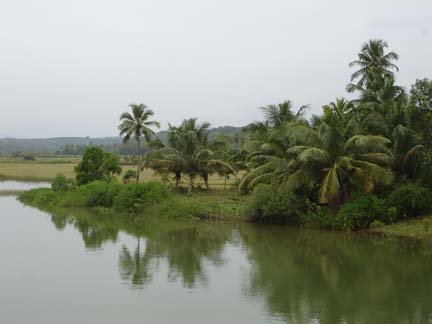
Holegadde near Honavar,Uttara Kannada dist, Karnataka
Copy? Right - but kindly remember to acknowledge!

" tulu-research.blogspot." ತುಳು ರಿಸರ್ಚ್. ಬ್ಲಾಗ್ಸ್ಪಾಟ್. ಇನ್

Have a nice day !