The word ‘patna’ represents a town in many of the Indian languages. The city in Jharkhand (and former capital of Bihar) is known as ‘Patna’. Besides, there are towns called ‘patna’ in Gujarat. In southern India, the word appears to have been applied to ancient port towns: Machalipatna, Nagapatna, Visakapatna etc. In Tulunadu context, the word is mostly applied to coastal colonies of Mogavir fishermen. In the olden days the fishing colonies were generally associated with port towns. Thus the word ‘patna’ was interchangeably used for port towns and the associated fishery colonies. People from the Tulu fishing community were used to be addressed as 'patnadakulu' (=fishermen) or 'pattaldi' (=fisher woman) by other communities.
On the other hand, the ancient towns and capitals were initially built around the port towns, as the ports were the major centers of trade and revenue.
Moolara patna
However, the word is not exclusively used for port towns or fishery colonies even in Tulu context. Moolara-patna on the bank of River Palghuni (Gurupur) is an example. Moolara patna as the name reveals is a colony of ‘Moola’ or ‘Moolya’ people. The word ‘moola’ represents origin and thus the word ‘moolya’ stands for aborigine.
Bokka patna
Bokka-patna is an example for an ancient port town associated with fishery colony. Bokkapatna is presently a lesser known civic extension in western part of Mangalore city. However, only few can visualize and realize that once it was a major port town representing Mangalore, especially during 12th to 15th Centuries CE. Reconstruction of geological history of the area reveals that the River Phalguni (Gurupur) was joining the Arabian Sea between Kudroli and Bolar. And the Kings of Vijayanagar who occupied Mangalore during 14th Century CE, developed port on the bank of river estuary and named it as “Bokkapatna” in honour of the Vijayanagar King Bukka (or Bokka).Therefore the Bokkapatna was the official Mangalore port during that historical period.
Patna: Let us analyze the word ‘patna’ ( pron: paTNa ) to gain some insights into the evolution of our words and languages. The origin of the word appears to be:
paTT + Na. (‘paTT’=colony or nest, aNa, aNe=area.)
There are at least four similar sounding roots related to the word patna: (1) patt 1(2) patt 2(3) pat, or pata and (4) pada and (5)padu.
1. Patt 1= a nest, a group or a colony.
2. Patt 2= to distribute among people.
3. Pata= a cloth, a curtain or a flag or a stretch of land. Also pictures, portraits or maps (drawn on a canvas, cloth piece or a paper) or a kite.. Examples: bhupata (=Map), chitrapata, galipata etc.
The Sanskrit word ‘path’(=linear path, road) appears to be related and /or derived from the old word ‘pata’
4. Pada=(pron: paDa) The word ‘paDa’ (pron: short pa+Da. Pa=low lying; Da=area) represents (1) a beach area demarcated for drying fish along the coast, or (2) a mat knitted from coconut fibers and used for drying fish. The word ‘paDa’ also means (3) to take a turn or (4) a large boat (‘paDavu’).
5. Padu =(pron: paDu) = West. (pa=(1).Sea margin, beach, (2) low lying; Du=area, possibly refers to the direction of Arabian Sea or coastal low lying area).
** **
There are some more related words for comparison in Tulu language:
Padil : PaDil represents a barren or waste land.
Patla: Patla (pron: paTla) means a low-lying marshy land alongside a river. [Origin: pa+T+la. ‘paT’=low lying +strip of land+ covered by ‘ala’(=water) ]. A ‘paTla kanDa’ means a wet, water-logged rice field, near a river, yielding only one crop per year In ‘patla kanda’, flooding is a common feature in rainy season rendering it unfit for rainy season's paddy cultivation of 'yenel' crop. ['Yenel' (yene+al) as ‘water from the sky’ (=rains)]. In these days of building constructions, these marshy lands are reclaimed and made habitable with modern type of buildings. Hence the Tulu idiomatic expression/usage: “Patla pOdu uru aanD” (=The marshy land has become village).
Patti: Patti (pron: paTTi) is a strip of cloth, metal or wood. It also developed into a linear strip like colony of houses or a village habitation.. The word ‘patti’(=habitation) became ‘hatti’ in medieval Kannada, with transformation of p> h.
Patti2 was a strip of cloth wherein records were written in the historical past, before the invention of paper.
Patta: The word ‘patta’ (pron: paTTa) means authority, throne or royal power. In other words it is power over a stretch of land.
Men of high positions (masters or authorities), landed gentry living in palatial buildings are called 'pattadakulu' in Tulu parlance.
Thus a ‘Patel’ represents a village chairman or head. The word ‘Patel’ has become ‘Pātil’ in northern Karnataka and Maharastra areas. Patel is also current in Gujarat as surname and profession. Possibly the word ‘Patel’ was brought to Tulu and Kannada region by the immigrants from north.
In interior Karnataka and Maharashtra, the word Patel has transformed to 'Patil or Pateela', meaning landlord, hence a man of high position.
Patte: The word ‘patte’ originally means a silken cloth. It was customary to preserve land records in a 'patte' (invariably in red colour). Hence, the word ‘patte’ it came to mean a 'registered land record', showing rightful entitlement. 'Patte kudtale' also means a record of ownership of land or landed property with registered right of paying land revenue tax. So the word: 'pattedār or pattadāre' (land-owner, possessing valid record of rights). 'Pattevaali' also means a striped silk cloth.
Patawari: Note this nomenclature current in Hindi-spaking belts. Meaning is similar to 'Patele, Patel, Pattedare, Pattadaare' (Tulu), Pātil (Maharashtra, Karnataka), Patel (Gujarat) and so on in other areas.
Patavardhan: This surname or title common in Maharashtra and Karnataka also relates to root word 'Pata'.
Pata Parivartan: meaning 'Change of flag,curtain', refers to change of circumstances in different points of time. In History, it means stages of different events, rise and fall of monarchies, governments, social and religious upheavals and new schools of thoughts.
Patasale (Padasale): Padsale means 'main living room of a house'. The word 'paDasale' possibly meant originally a west side living room.Kawdoor Narayana Shetty has pointed out that the word "saala" means a living room in Italian language.
Note: Pata and Pada are interchangeable words in Tulu.
-with Hosabettu Vishwanath.
®

A heritage blog by: Ravindra Mundkur & Hosabettu Vishwanatha
Showing posts with label Kudroli. Show all posts
Showing posts with label Kudroli. Show all posts
Tuesday, December 8, 2009


Saturday, September 6, 2008
146. Kudroli to Katapadi- Enagudde
Some of the ancient place-names have been deformed or misinterpreted with passage of time. Reader Ranjan pointed out how Kuduru-bottu hamlet on NH 17 has been mis-translated as Kudure-bottu. The Tulu word 'kuduru' referred to island with the river. But the word 'kuduru'(=island) was confused with 'kudure'(=horse) and consequently the original meaning was lost during translation of the place-name into Kannada.
Kudroli
Similar error has been made in case of the popular place known as Kudroli within Mangalore city. Some translators explained it as Kudure-oli or what they describe as 'a horse yard'. But the original meaning of the word Kudur+oli(=island+hamlet) has historical. and paleo-geographic significance. Several centuries ago the Kuduroli was an island village within a river that dried up during subsequent period. Geological evidences suggest that the historical changes and shifting of the river course rendered the place dry during the early centuries of the Common Era!.
Thus Kudroli is a fossil word that traces the forgotten past paleo-geography of the land that has not been documented otherwise for lack of historical documentation in the region!
Katapadi
While discussing the erroneous interpretation of place-names, Katapadi comes to the mind because of a hilarious misinterpretation. The word Katapadi in Tulu is a pun. The verb 'katapādi' means to tie down. Some people have visualized a fictious story involving a legendary King of Manipura, a small village south of Udupi, who presumably conducted an Ashwamedha (horse-sacrifice) ceremony to propitiate Gods and the place where the designated horse was tied down to a post was said to have named as 'Katapadi'.
However, the actual designation of the word Kāt+pādi (=wild farm) is different and unconnected to this anecdote. There are similar place name of Kaat-padi in Tamilnadu, suggesting that it was an ancient name during the early stages of civilization..
Enagudde
A connected place-name near Kat-padi is Enagudde. It has been misinterpreted as Hengudde, the hill of corpses! Again this is not the original meaning attributed to the place by our forefathers. Ena in place names such as Enakallu, Enagudde etc refer to vertically standing piece of rock. The word 'Ena' (=vertical pole like rock) or 'Eni' (=ladder) needs to be understood properly in the light of the existence of such place names in other parts of Karnataka, specifically with vertical pillar like rock structures. Due to changes in time and tides the vertical rock pole in Enagudde might have collapsed, but the name still reminds us of the pillar rock of the bygone days.
Kudroli
Similar error has been made in case of the popular place known as Kudroli within Mangalore city. Some translators explained it as Kudure-oli or what they describe as 'a horse yard'. But the original meaning of the word Kudur+oli(=island+hamlet) has historical. and paleo-geographic significance. Several centuries ago the Kuduroli was an island village within a river that dried up during subsequent period. Geological evidences suggest that the historical changes and shifting of the river course rendered the place dry during the early centuries of the Common Era!.
Thus Kudroli is a fossil word that traces the forgotten past paleo-geography of the land that has not been documented otherwise for lack of historical documentation in the region!
Katapadi
While discussing the erroneous interpretation of place-names, Katapadi comes to the mind because of a hilarious misinterpretation. The word Katapadi in Tulu is a pun. The verb 'katapādi' means to tie down. Some people have visualized a fictious story involving a legendary King of Manipura, a small village south of Udupi, who presumably conducted an Ashwamedha (horse-sacrifice) ceremony to propitiate Gods and the place where the designated horse was tied down to a post was said to have named as 'Katapadi'.
However, the actual designation of the word Kāt+pādi (=wild farm) is different and unconnected to this anecdote. There are similar place name of Kaat-padi in Tamilnadu, suggesting that it was an ancient name during the early stages of civilization..
Enagudde
A connected place-name near Kat-padi is Enagudde. It has been misinterpreted as Hengudde, the hill of corpses! Again this is not the original meaning attributed to the place by our forefathers. Ena in place names such as Enakallu, Enagudde etc refer to vertically standing piece of rock. The word 'Ena' (=vertical pole like rock) or 'Eni' (=ladder) needs to be understood properly in the light of the existence of such place names in other parts of Karnataka, specifically with vertical pillar like rock structures. Due to changes in time and tides the vertical rock pole in Enagudde might have collapsed, but the name still reminds us of the pillar rock of the bygone days.
Monday, January 14, 2008
74. Alupa kings

Map showing the locations of ancient 'Alupe' and 'Kulashekara' in the eastern part of present Mangalore city. Blue shade represents interpreted river water (fluvial courses) of Nethravathy during the cited historical period.
One of the questions ignored by historians so far relates to the actual location of the capital or headquarters of the Alupa Kings. It is generally presumed that they were ruling from Mangalore town. But the fact is that there was no town called Mangalur in the beginning of the Christian Era. The name ‘Mangalapura’ or ‘Mangaloor’ came into being only after the Malabar Queen Mangale, who was traveling through the town, during late Ninth/early Tenth century CE, died here by ill-health.
Then, what was the name of the town before Tenth century CE?
The Tulunad was ruled by Alupa Kings, possibly since the beginning of Christian era till the region was occupied by the rule of Vijayanagara Kings. Nature of the word ‘Alupa’ has been discussed by many of the earlier historians. One of the interpretations suggested that Alupa was indicative chieftain status of the rulers that were generally subservient to the Kannada Kings. (‘aaLu’ (=rule) + ‘upa’ (=subordinate) or subordinate ruler).Some have suggested that Alupa name came from the ‘aluve’(estuary) of Mangalore city.
Kudala
One of the important facts regarding the history of Mangalore town is that it has changed its geographic form several times during the last two thousand years! The two rivers Gurupur and Nethravathy joined together near the Sea, giving the name ‘Kudala’ to the town. The word Tulu word ‘Kudala’ means joined (= kooD ) rivers (=aala ).And these two rivers joined together near Kudroli in the past and not near Bengre and Ullal as it is at present!
Alupe Kings!
But the analysis of the available historical and spatial data shows that the Alupa Kings were not ruling from Kudala, but from Alupe! Yes, they were ruling from Alupe, so they were called Kings of Alupe. However, Kannada inscriptions and writers stylized the word ‘Alupe’ into ‘Alupa’. Consequently, the original Alupe town was totally ignored by the historians!
The ancient Alupe habitation still survives in eastern part of present Mangalore city, located between Kankanadi and Padil. The word Alupe, apparently, derived from Early Munda languages, means the town by the side of River.( Aal=river,+ upe=town, habitation. There are several similar sounding place names in the District: Alupe, Bajape, Didupe etc.).
Kulashekara
Two of the Alupa Kings were called Kulashekara I and Kulashekara II (early 14th century CE). The place Kulashekara, north of Alupe in the present Mangalore city, is named after the said Kings.
It is suggested that archeologists and historians should investigate these Alupe-Kulashekara and surrounding areas for any possible clues and evidences for reconstruction of the past history.
®
Friday, January 11, 2008
71. Barakur

Barakur is one the well known ancient States of Tulunad/Karavali. Under the reign of Vijayanagar kings the Karavali was divided into Mangalur and Barakur administrative units or States. Barakur is located near the confluence of Seetha and Swarna Rivers in Udupi district.
Baraha Kanyapura
What is the original meaning of the word and the place Barakur?
The Puranic style vogue in the region, explains the name as an abbreviation of the epithet ‘Baraha Kanyapura’ that translates glamorously into ‘the town of twelve virgins’. Naturally, there may be a matching anecdote in the Puranas to explain the exotic saga of the twelve virgins.
However, besides the Puranic lores, there is a more mundane explanation for the origin of this place name. It is simply Baraka + Ooru or the village of Baraka.
Baraka
The word ‘Baraka’ initially appears as an unusual or less used Tulu word. However, it is definitely an ancient word. The African word ‘Baraka’ means ‘blessing’. The word exists in Egyptian, Swahili, Hebrew and Arabic languages. Several African places in Oman, Libya, Sudan, Sierra Leone and Eritrea are called Baraka. Even a river between Eritrea and Ethiopia is named Baraka. The word ‘baraka’ has been used in the Bible in the sense of ‘lightning.’ In French language ‘baraka’ represents lucky.
In northern India, in Sanskrit/Hindi the ‘barka’ means ‘rains’, possibly related to the Prakrit/Tulu word ‘barsa’(=rains). A river in Manipur, northeastern India, is known as the Baraka River.
Baraka, the estuary
There is also a lesser known word ‘baraka’ in northwestern India, possibly of Prakrit origin that means the gulf or marine creek of a river or simply the estuary. Tulu immigrants, may have borrowed this word, while migrating southward through the northern India. This particular meaning has geographic/geomorphic connotations that Tulu ancestors were fond of. Some of the Tulu moolasthans like those of Bangera(<.bengare), Suvarna(<.swarna) are located on the banks of the rivers Seetha-Swarna and the proximal Bengare-Hoode beach.
The town of Barakur is located on the eastern side of the confluence and estuary of the Rivers Seetha and Swarna. The imposing majesty and charm of the natural environment may have prompted the immigrants to name this place as ‘a village on the banks of Estuary’ or Barak+Oor.
Barke
For the above explanation in terms of geomorphology, a further proof would be in order. We have places named ‘Barke’. (This Barke is not same as the barke’ (=solid, sturdy) variety of jack fruits).
The Barke is an adaptation of the word baraka, discussed above. One such ‘Barke’ is located between Bokkapatna and Kudroli in Mangalore. The confluence and the estuary of Gurupur and Netravathy rivers was actually near Kudroli region in Mangalore during the past period of Vijayanagara reigns in the Karavali and then Bokkapatna was the location of the Port.
®
Wednesday, April 18, 2007
17. Historic Mangalore: Port of Bukkapatna
The geography of Mangalore city has changed quite a lot through the historic times. The famous two rivers Nethravathi and Phalguni (Gurupur) that gave the name Kudla to Mangalore city have changed their drainage courses several times in the past. The numerous valleys within the city are mute testimonials to the river courses that have been shifted many times like in delta areas. Italian tourist Piyatro Delavale who visited Mangalore during 1623AD reported that Mangalore is surrounded by water on three sides. Such a geographic feature was visible when the two rivers were joining the
While geological evidences like remnants of river valleys and pebble rich sediments indicate the ancient drainage courses of the two rivers, the historical place names corroborate the other half of the story.
Mangalore was under the rule of Vijayanagar Empire during 1336-1650 AD. Hakka and Bukka brothers ruled Vijayanagar at Hampi. Vijayanagar kings established a port at Mangalore for the purpose trade and exports. The port they constructed was not near the present
On the southern side of Bukkapatna is Kudroli, where the presently famous artful
Tippu Sultan ruling from Sriranagpatna, constructed at Mangalore a battery for storing armaments and explosives, known as Sultan battery during ca. 1775 AD for warfare against enemies entering from the
Before the Vijayanagar Empire, the Alupa chieftains of Pandya dynasty were ruling Mangalore (ca 4th century to 13 century AD). It appears that their township was at Pandeswar which was on the banks of Nethravathi at that time. On the southern bank of Nethravathi was the
Somewhere during the end of 18th century AD, the river Phalguni (Gurupur) adapted a drastic change in its course. Until then, the river was bending near Panjimogaru and Marakada and flowing into Kottara and Kudroli areas. It took a westerly turn near Kulur flowed up to Tannirbavi and then adopted a southerly course and joined River Nethravathi. From then onwards, Rivers Gurupur and Nethravathi debouch into
Subscribe to:
Posts (Atom)
A Coastal estuary
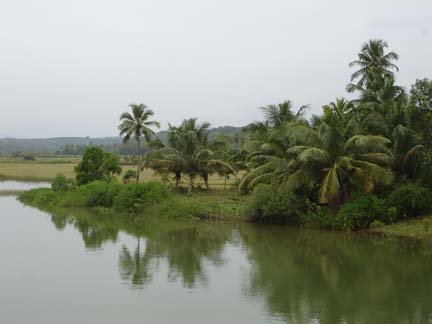
Holegadde near Honavar,Uttara Kannada dist, Karnataka
Copy? Right - but kindly remember to acknowledge!

" tulu-research.blogspot." ತುಳು ರಿಸರ್ಚ್. ಬ್ಲಾಗ್ಸ್ಪಾಟ್. ಇನ್

Have a nice day !