A place on the northern bank of River Seetha close to NH 17 in Udupi taluk is known as MabukaLa. The significance of the place name Mabukala lies in the fact that it is different from Mayikala or Ayikala we discussed previously.
kaDa.>kaLa
The suffix 'kaDa' in Tulu is an abbreviated form of the word 'kadapu' or 'kadapu kariya' (the ferry or ferry bank), the place used by people in the olden days to cross the river on boats. The Marakada for example was an ancient ferry point.
However, in the parts of Karavali, north of Udupi, Kannada became the prevalent official language especially during and after the rule by Vijayanagar Kings. Consequently many of the original Tulu words and place-names got translated into Kannada.Under the spell of Kannada, the original Mabukada became Mabukala!.
Mābu
The ferry was named after Mābu, probably the boat-man who used to ferry people across the river. Mabukala is located in a historically significant region that encompasses the ancient State of Barkur and several Moolasthanas on the banks of Rivers Seetha and Swarna and their confluence near Hoode-Bengare beach.
Mābu, the boatman who ferried people across the river must have been a popular person during a specific period in the early history as the place has been cited in some of the paD-danas.
®

A heritage blog by: Ravindra Mundkur & Hosabettu Vishwanatha
Showing posts with label River Seetha. Show all posts
Showing posts with label River Seetha. Show all posts
Thursday, September 4, 2008


Friday, January 11, 2008
71. Barakur

Barakur is one the well known ancient States of Tulunad/Karavali. Under the reign of Vijayanagar kings the Karavali was divided into Mangalur and Barakur administrative units or States. Barakur is located near the confluence of Seetha and Swarna Rivers in Udupi district.
Baraha Kanyapura
What is the original meaning of the word and the place Barakur?
The Puranic style vogue in the region, explains the name as an abbreviation of the epithet ‘Baraha Kanyapura’ that translates glamorously into ‘the town of twelve virgins’. Naturally, there may be a matching anecdote in the Puranas to explain the exotic saga of the twelve virgins.
However, besides the Puranic lores, there is a more mundane explanation for the origin of this place name. It is simply Baraka + Ooru or the village of Baraka.
Baraka
The word ‘Baraka’ initially appears as an unusual or less used Tulu word. However, it is definitely an ancient word. The African word ‘Baraka’ means ‘blessing’. The word exists in Egyptian, Swahili, Hebrew and Arabic languages. Several African places in Oman, Libya, Sudan, Sierra Leone and Eritrea are called Baraka. Even a river between Eritrea and Ethiopia is named Baraka. The word ‘baraka’ has been used in the Bible in the sense of ‘lightning.’ In French language ‘baraka’ represents lucky.
In northern India, in Sanskrit/Hindi the ‘barka’ means ‘rains’, possibly related to the Prakrit/Tulu word ‘barsa’(=rains). A river in Manipur, northeastern India, is known as the Baraka River.
Baraka, the estuary
There is also a lesser known word ‘baraka’ in northwestern India, possibly of Prakrit origin that means the gulf or marine creek of a river or simply the estuary. Tulu immigrants, may have borrowed this word, while migrating southward through the northern India. This particular meaning has geographic/geomorphic connotations that Tulu ancestors were fond of. Some of the Tulu moolasthans like those of Bangera(<.bengare), Suvarna(<.swarna) are located on the banks of the rivers Seetha-Swarna and the proximal Bengare-Hoode beach.
The town of Barakur is located on the eastern side of the confluence and estuary of the Rivers Seetha and Swarna. The imposing majesty and charm of the natural environment may have prompted the immigrants to name this place as ‘a village on the banks of Estuary’ or Barak+Oor.
Barke
For the above explanation in terms of geomorphology, a further proof would be in order. We have places named ‘Barke’. (This Barke is not same as the barke’ (=solid, sturdy) variety of jack fruits).
The Barke is an adaptation of the word baraka, discussed above. One such ‘Barke’ is located between Bokkapatna and Kudroli in Mangalore. The confluence and the estuary of Gurupur and Netravathy rivers was actually near Kudroli region in Mangalore during the past period of Vijayanagara reigns in the Karavali and then Bokkapatna was the location of the Port.
®
Subscribe to:
Posts (Atom)
A Coastal estuary
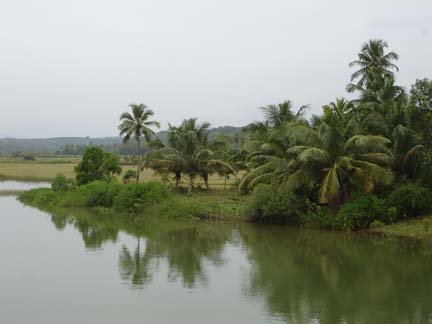
Holegadde near Honavar,Uttara Kannada dist, Karnataka
Copy? Right - but kindly remember to acknowledge!

" tulu-research.blogspot." ತುಳು ರಿಸರ್ಚ್. ಬ್ಲಾಗ್ಸ್ಪಾಟ್. ಇನ್

Have a nice day !