A place on the northern bank of River Seetha close to NH 17 in Udupi taluk is known as MabukaLa. The significance of the place name Mabukala lies in the fact that it is different from Mayikala or Ayikala we discussed previously.
kaDa.>kaLa
The suffix 'kaDa' in Tulu is an abbreviated form of the word 'kadapu' or 'kadapu kariya' (the ferry or ferry bank), the place used by people in the olden days to cross the river on boats. The Marakada for example was an ancient ferry point.
However, in the parts of Karavali, north of Udupi, Kannada became the prevalent official language especially during and after the rule by Vijayanagar Kings. Consequently many of the original Tulu words and place-names got translated into Kannada.Under the spell of Kannada, the original Mabukada became Mabukala!.
Mābu
The ferry was named after Mābu, probably the boat-man who used to ferry people across the river. Mabukala is located in a historically significant region that encompasses the ancient State of Barkur and several Moolasthanas on the banks of Rivers Seetha and Swarna and their confluence near Hoode-Bengare beach.
Mābu, the boatman who ferried people across the river must have been a popular person during a specific period in the early history as the place has been cited in some of the paD-danas.
®

A heritage blog by: Ravindra Mundkur & Hosabettu Vishwanatha
Showing posts with label Kadaba. Show all posts
Showing posts with label Kadaba. Show all posts
Thursday, September 4, 2008


Monday, June 16, 2008
119. Kadaba to Kalavar
The Karavali Tulunadu belt has numerous place names that are vestiges of ancient tribes that inhabited in the region. These tribal groups are known for migrations along and across the peninsular India during the historical space and time. In the process many of the tribes have undergone evolutionary changes in terms of their culture language and identity.
Kadaba
Kadaba is a town in Puttur taluk that retains the vestigial name of a tribal group. The Gadaba tribes are a part of the Munda tribes now predominantly distributed around the Chotanagapur region. The Kadaba tribes are not presently traceable in Tulunadu as they have been assimilated with the native population with passage of time. However, vestiges can be traced. The KaDamba is a surname among Jains of Tulunadu. The Kadamba kings of Banavasi in Sahyadri are said to be derived from a tribal group. Many of the Munda tribes were traditionally known to worship the Kaim/Kadamba tree which became insignia for the Kadamba dynasty. The Kadam surname can be traced further north in Maharastra.
Kadava
Shambaa Joshi traces journey of an ancient tribe of Karnataka known as Kadava(ru).They were physically strong, rustic tribes. Some of them migrated to Tamil areas where they were called Kalavar. Possibly, some of these tribes were involved in stealing that imparted the name Kalavar.
The Kalavar were a dynamic and enterprising group in Tamilnadu. With time they founded a dynasty known as Kalabhra. The Kalabhra were known in the history for introducing Aryan cultural elements in Tamilnadu. Similar Aryanization works were done by Kadamba in Karnataka.
Kalavar
The Kalavar tribes were also wandering in southern India. Some of them migrated to Karavali region and settled in places between Surathkal and Bajpe in Mangalore taluk. The Kalavara is now a village near MRPL petroleum complex on the Bajpe road. There is also another Kaalavara in Kundapur taluk.
The story of Gadaba /Kadaba- Kadamba-Kadam and Kadaba-Kadava- Kalavar- Kalabhra tribal successions might be a representative string that helps us to visualize the multiple layers of socio-cultural evolution in time and space in India.
®
Kadaba
Kadaba is a town in Puttur taluk that retains the vestigial name of a tribal group. The Gadaba tribes are a part of the Munda tribes now predominantly distributed around the Chotanagapur region. The Kadaba tribes are not presently traceable in Tulunadu as they have been assimilated with the native population with passage of time. However, vestiges can be traced. The KaDamba is a surname among Jains of Tulunadu. The Kadamba kings of Banavasi in Sahyadri are said to be derived from a tribal group. Many of the Munda tribes were traditionally known to worship the Kaim/Kadamba tree which became insignia for the Kadamba dynasty. The Kadam surname can be traced further north in Maharastra.
Kadava
Shambaa Joshi traces journey of an ancient tribe of Karnataka known as Kadava(ru).They were physically strong, rustic tribes. Some of them migrated to Tamil areas where they were called Kalavar. Possibly, some of these tribes were involved in stealing that imparted the name Kalavar.
The Kalavar were a dynamic and enterprising group in Tamilnadu. With time they founded a dynasty known as Kalabhra. The Kalabhra were known in the history for introducing Aryan cultural elements in Tamilnadu. Similar Aryanization works were done by Kadamba in Karnataka.
Kalavar
The Kalavar tribes were also wandering in southern India. Some of them migrated to Karavali region and settled in places between Surathkal and Bajpe in Mangalore taluk. The Kalavara is now a village near MRPL petroleum complex on the Bajpe road. There is also another Kaalavara in Kundapur taluk.
The story of Gadaba /Kadaba- Kadamba-Kadam and Kadaba-Kadava- Kalavar- Kalabhra tribal successions might be a representative string that helps us to visualize the multiple layers of socio-cultural evolution in time and space in India.
®
Saturday, December 15, 2007
59. The less evolved ancient tribes

Some of the Early tribes resisted development and remained in forest phase or hunter-gatherer phase for a prolong time, leading to gaping socio-cultural differences between the evolved and the poorly evolved. These less evolved tribes constitute the scheduled castes and scheduled tribes of present generation.
The District Gazetteer of South Kanara (1973) enlists the following scheduled castes and tribes in Dakshina Kannada (formerly South Canara).
The scheduled castes: (1) AdiAndhra, (2) AdiDravida, (3) AdiKarnataka, (4) Ajila, (5) Arunthathiyar, (6) Baira, (7) Bakuda, (8) Bandi, (9) Bellara/i (10) Chakkaliyan, (11) Chalavadi, (12). Chamar (Muchi), (13) Chandala, (14) Cheruman, (15) Devendra, (16) Kulathan , (17) Godagali, (18) Godda, (19) Gosangi , (20) Holeya , (21) Jaggali, (22) Jambuvulu, (23) Kadaiyan, (24) Kalldi, (25) Karimpalan, (26 ) Koosa, (27) Kuduban, (28) Kuruvan, (29) Madrai, (30) Madiga, (31) Maila, (32)Mala, (33) Mavilan (34) Moger, (35) Mundala, (36) Nalke, (37) Nayadi, (38) Pagadi, (39) Pallan, (40) Pamabada, (41) Panchama, (42) Pannaiandi, (43) Paraiyan, (44) Puthinai Vannan, (45) Rancyar, (46) Samagar, (47) Sambai (48) Sapayi (49) Seman (50) Thoti (51) Tiruvalluvar, (52) Valluven , ( 53) Bathada, (54) Hasti , (55) Paravan.
The following are the scheduled tribes enlisted:
(1)Adiyan, (2) Aranadan (3) Irular (4) Kadar (5) Kammara (6) Kattunayakan (7) Konda kapu (8 ) Konda reddis (9) Koraga (10) Kota (11) Kudiya/ Malekudiya (12 ) Kurichchan (13 ) Kuruman (14) Mahamalasar (15) Malasar (16) Maleya kandi (17 ) Maranthi (18) Mudugar (19) Palliyan (20) Paniyan (21) Pulavan (22) Shologa (23) Toda .
Similar list of tribes exist in the neighbouring Kerala also.( Madhava Menon et al (2002) People of India : Kerala : Volume XXVII.Anthropological Survey of India)
Notes on Early Tribes/languages
1. The ‘Koosa’ tribe may be ‘Kosar’ tribes of Karavali described in the Tamil Sangam literature.
2. The Karavali ‘Bakuda’ and 'Bathuda' tribes may be equivalent/variants of ‘Bathudi’ tribe of Chotanagpur.
3. The ‘Bellari’ language, originally might have been a variant of the Munda language, but apparently changed with time by induction of Tulu words and was later considered as a variant of Tulu rather than Munda.(Refer Manjunath’s post on Bellari). There are several places in Karavali and Karnataka mainland having names such as ‘Bellara’ or ‘Bellari’.
4. Several tribal/sub-language names have remained as place names. These ancient cultural vestiges include Bellara/Bellari, Parenki, Gadaba (Kadaba), Kharawar, etc.
5. Many place names with unknown or unexplainable meanings in the current languages in Karavali and other parts of Karnataka/southern India may have been inherited from the Early Munda substratum language and culture that existed earlier.
The native Early Munda languages prevalent in southern India before ca.800-600BC, appear to have merged with the Early Dravidian and Early Tulu languages. The vestiges of these native languages in southern India are on the way to gradual extinction due to overprinting impact of cultural changes.
®
Subscribe to:
Posts (Atom)
A Coastal estuary
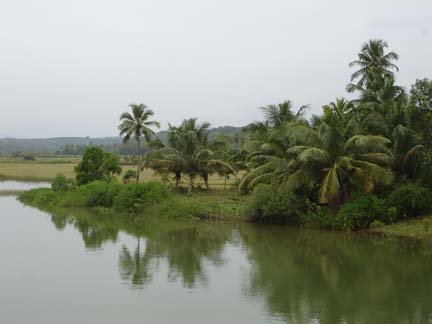
Holegadde near Honavar,Uttara Kannada dist, Karnataka
Copy? Right - but kindly remember to acknowledge!

" tulu-research.blogspot." ತುಳು ರಿಸರ್ಚ್. ಬ್ಲಾಗ್ಸ್ಪಾಟ್. ಇನ್

Have a nice day !