The present delimitation of Tulu speaking areas along the Karavali especially to the south of Udupi appears to be a feature imposed on the region after the Vijayanagar administration (ca 14 century CE and thereafter) centered on Barakur that fostered administrative support for the growth of Kannada in the region around and north of Barakur. Before Vijayanagar era in the Karavali, Kadamba rule centered on Banavasi ca. 4th century CE laid the foundation for growth of (old) Kannada in the northern Karavali.
A few words still prevail in the northern Karavali in support of the above claim. And Airodi is one such place name.
Airodi
Airodi (pronounced AayiroDi) is a village close to the northern banks of River Seetha near Hangarkatta in Udupi taluk. Hangarkatta was a traditional boat building centre in the Karavali.
Ayere in Tulu stands for river bank. Possibly the word originated as aa+ere meaning the other edge of river.(Compare 'ayere' with Attavara, Aamai etc words that refer to the place on the other side of the river.)
Therefore the place name Airodi literally represents an Odi (village) on the Ayere (the river bank).
Airoli
A similar sounding village Airoli exists in coastal Maharastra. The Oli (pronounced OLi) is a Prakrit/ Marati word generally representing a village or habitation and the word is also found in Tulu.(Note the Tulu village names like Kudroli, Maroli, Budoli etc). The existence of names like Airoli in Maharastra suggests that the word 'ayere' was more widespread in the earlier days along the west coast.
It is possible that the Tulu word -Odi is an variant of the word -OLi or vice versa.
Written with: Hosabettu Viswanath
®

A heritage blog by: Ravindra Mundkur & Hosabettu Vishwanatha
Showing posts with label Kadamba. Show all posts
Showing posts with label Kadamba. Show all posts
Saturday, October 25, 2008


Monday, June 16, 2008
119. Kadaba to Kalavar
The Karavali Tulunadu belt has numerous place names that are vestiges of ancient tribes that inhabited in the region. These tribal groups are known for migrations along and across the peninsular India during the historical space and time. In the process many of the tribes have undergone evolutionary changes in terms of their culture language and identity.
Kadaba
Kadaba is a town in Puttur taluk that retains the vestigial name of a tribal group. The Gadaba tribes are a part of the Munda tribes now predominantly distributed around the Chotanagapur region. The Kadaba tribes are not presently traceable in Tulunadu as they have been assimilated with the native population with passage of time. However, vestiges can be traced. The KaDamba is a surname among Jains of Tulunadu. The Kadamba kings of Banavasi in Sahyadri are said to be derived from a tribal group. Many of the Munda tribes were traditionally known to worship the Kaim/Kadamba tree which became insignia for the Kadamba dynasty. The Kadam surname can be traced further north in Maharastra.
Kadava
Shambaa Joshi traces journey of an ancient tribe of Karnataka known as Kadava(ru).They were physically strong, rustic tribes. Some of them migrated to Tamil areas where they were called Kalavar. Possibly, some of these tribes were involved in stealing that imparted the name Kalavar.
The Kalavar were a dynamic and enterprising group in Tamilnadu. With time they founded a dynasty known as Kalabhra. The Kalabhra were known in the history for introducing Aryan cultural elements in Tamilnadu. Similar Aryanization works were done by Kadamba in Karnataka.
Kalavar
The Kalavar tribes were also wandering in southern India. Some of them migrated to Karavali region and settled in places between Surathkal and Bajpe in Mangalore taluk. The Kalavara is now a village near MRPL petroleum complex on the Bajpe road. There is also another Kaalavara in Kundapur taluk.
The story of Gadaba /Kadaba- Kadamba-Kadam and Kadaba-Kadava- Kalavar- Kalabhra tribal successions might be a representative string that helps us to visualize the multiple layers of socio-cultural evolution in time and space in India.
®
Kadaba
Kadaba is a town in Puttur taluk that retains the vestigial name of a tribal group. The Gadaba tribes are a part of the Munda tribes now predominantly distributed around the Chotanagapur region. The Kadaba tribes are not presently traceable in Tulunadu as they have been assimilated with the native population with passage of time. However, vestiges can be traced. The KaDamba is a surname among Jains of Tulunadu. The Kadamba kings of Banavasi in Sahyadri are said to be derived from a tribal group. Many of the Munda tribes were traditionally known to worship the Kaim/Kadamba tree which became insignia for the Kadamba dynasty. The Kadam surname can be traced further north in Maharastra.
Kadava
Shambaa Joshi traces journey of an ancient tribe of Karnataka known as Kadava(ru).They were physically strong, rustic tribes. Some of them migrated to Tamil areas where they were called Kalavar. Possibly, some of these tribes were involved in stealing that imparted the name Kalavar.
The Kalavar were a dynamic and enterprising group in Tamilnadu. With time they founded a dynasty known as Kalabhra. The Kalabhra were known in the history for introducing Aryan cultural elements in Tamilnadu. Similar Aryanization works were done by Kadamba in Karnataka.
Kalavar
The Kalavar tribes were also wandering in southern India. Some of them migrated to Karavali region and settled in places between Surathkal and Bajpe in Mangalore taluk. The Kalavara is now a village near MRPL petroleum complex on the Bajpe road. There is also another Kaalavara in Kundapur taluk.
The story of Gadaba /Kadaba- Kadamba-Kadam and Kadaba-Kadava- Kalavar- Kalabhra tribal successions might be a representative string that helps us to visualize the multiple layers of socio-cultural evolution in time and space in India.
®
Thursday, March 13, 2008
102. Legends of Parashurama

Most of the myths in Indian culture are quite ancient in origin and have evolved in multiple chronological stages over the years in tune with the periodic phases of cultural renaissances mostly sponsored by various regalities. In other words the same set of myths have been polished, reedited and repackaged several times in the history to suit the demands of the environment and time of the reprocessing.
The legend of Rama is an example. An ancient folk-lore theme of primitive Bhil archer hero was enriched and updated by Valmiki; it was either re-edited or recomposed subsequently by numerous other bards in several ‘renaissance’ stages. The original composition conceived by Valmiki based on older folk-lores as well as the revised versions by bards of successive generations have altogether enriched the overall cultural fabric of India for centuries.
Another example for the chronological evolution of legends relates to the indefatigable hero Parashurama, the Rama with an Axe.
Parashuramas
There are evidences of heroes with axe in the ancient history in the Mediterranean area like Storm God. The axe was an ancient implement in terms of human evolution. In the Stone Age, stone axes were in use, which were later replaced by iron axes. The original folk-lores of an axe wielding indefatigable hero Parashurama (‘Axe- Rama’; or ‘Rama with an axe’; Parashu =axe) was apparently repeated or revived several times in the early literary history by several generations of bards with deliberate addition of doses of supernatural myths. Thus, we find the Parashurama re-appearing in Ramayana, Mahabharata and other ancient works representing distinctly different time periods.
Vedic Parashurama
The Parashurama renowned in Vedic age was the son of sage Jamadagni and his wife Renuka. In a fit of anger on his wife, the short tempered Jamadagni ordered his son Parashurama to chop of his mothers head! Parashurama obligingly carried out his order which pleased his father. Parashurama was allowed to ask for a boon in return for the deed he accomplished; and Parashurama immediately asked his father to revive his mother!
The couples, Jamadagni and Renuka had in their possession, Kamadhenu, a mythical cow that gave whatever is wished. One mythical, fantasy character of King Kartha Veerarjun, endowed with one thousand arms (!) intervened and desired that this Kamadhenu should belong to him. He carried the Kamadhenu against the wishes of Jamadagni couple, which enraged Parashurama to pursue the fellow, subdue him and chop of his extra arms.
The legends of Vedic Parashurama may have originated around the northwestern India as these are to be popular in this region. Temples dedicated to Renuka, mother of Parashurama can be found in Himachal-Punjab region.
These legends of Vedic period appear to have been developed on an ancient platform of folk-lores that prevailed around the Mediterranean-Central Asian region.The cult and imagery of Parashurama evidently was an influential one at that time and that prompted Vedavyasa to include it as one of the ten incarnations of Lord Vishnu.
Kadamba Parashurama
The Parashurama legends reappeared and were evidently repackaged during the Kadamba period ca. 4 to 6th century CE.
Mayura Sharma (later Varma) during early part of fourth century CE, founded a new dynasty at Banavasi, near Sirsi (present Uttara Kannada district) under the mast of Kadamba (a wild flowering tree, traditionally considered as pious by the ancient Munda tribes of India).The young Mayura went to Kanchi, the ancient Tamil capital of Pallavas, in order to pursue (Vedic) studies. A guard of Pallava king somehow insulted Mayura which forced him to abandon studies and build an army to subdue the haughty Pallavas. He succeeded in recruiting local people at Banavasi into an army and staging armed attacks on the Pallavas.
The story of Kadamba Mayura Varma bears striking similarity to the legends of Parashurama who subjugated the ruling class (Kshatriya).Therefore it can be deduced that Mayura Varma or one of his descendants commissioned court bards to compose the updated myth of Parashurama. Or a few official bards, who equated the Kadamba Kings to incarnation of Parashurama, composed the legends in praise of the Kadamba rulers. The Parashurama legend now popular in the West Coast of India is a part of Sahyadri Chapter (Kanda) of Skaanda Purana. The composition of Sahyadri chapter can be related to Kadamba Kingdom at Banavasi, which is an integral part of Sahyadri or the Western Ghats.
On the basis of these circumstantial evidences, the Sahyadri Kanda and the composition of Parashurama Shristi (creation of land) legend can be dated at ca 350-500 CE. Temples dedicated to mother Renuka also popular as ‘Ellamma’ are found in northwestern Karnataka, in the region of ancient Kadamba kingdom.
Parashurama Srishti
The Sahyadri Kanda visualizes that Parashurama threw his axe into the Sea and retrieved as much land as the Axe flew from the King of Sea. A marvellous fantasy that has inspired and mesmerized the coastal folks for hundreds of years! The retrieved coastal land is called ‘Parashurama Srishti’ (creation) or Kshetra (land). Further Parashurama allocated the newly retrieved lands to Brahmins to settle down comfortably. This again is in tune with the works and ethics of Kadamba Kings, who provided lands to immigrated Brahmins to settle down in Karavali and Sahyadri.
Marine transgressions & regressions
The most curious anecdote the Kadamba/Sahyadri bards weaved into the legend is the retrieval of land from the Sea. Infact the transgression (onward march of Sea into the land) and regression (withdrawal of Sea from the land) are periodical natural phenomenon controlled by several factors connected with the earth movements.
From the standpoint of logic and geological science it needs to be clarified that no human being can ever modify or induce such regressions by wielding his modest tools in front of the mighty powers of nature. Infact, there has been several episodes of marine transgressions and regressions in the geological history of the Earth.
However, we may predict that this event of retrieval of land from the Sea visualized in 'Sahyadri Kanda' was based on an actual event of marine regression witnessed by folks that occurred in the past before the Kadamba period. The regression event by all means was a stunning imagery for the innocent folks; and it was described in detail to their kids for several generations.
Thus inclusion of the Parashurama legend in 'Sahyadri Kanda' served to explain a seemingly unexplainable past natural event to the innocent folks and at the same time it glorified one of the mythical (Parashurama) while the Kadamba King was indirectly projected as an incarnation of the mythical element.
Parashurama’s marine regression
The marine regression (retreat event) attributed to Parashurama along the West Coast of India must have actually happened sometime before the composition of the Kadamba Parashurama myths. The historical records of Srilanka discuss a marine regression that took place in the region ca. 300BC.The event must have been a regional one that affected Srilanka and southern India. Apparently the Arabian Sea receded by a distance of a kilometer or two. Since there are evidences of many regressions in West Coast, the actual affect of this particular event (the Parashurama’s regression) needs to be studied in terms of actual geological data.
Natha Parashurama
Parashurama legend did not end with Kadamba-Sahyadri episode during ca. fifth to sixth century CE. Further during tenth century CE, the Natha bards slightly modified and repackaged the Sahyadri legends of Parashurama in Kadali Mahatmye in Bharadwaja Purana to add glory and aura to the Buddhist-Natha-Shaiva center at Kadire, Mangalore.
According to the modified legends, Parashurama retrieved lands around Kadire, Mangalore and handed over to Natha Jogi monks to maintain the temple.
®
Monday, March 3, 2008
100. Kadamba Dynasty

An image of Halmidi inscription with Buddhist wheel at the top.
The period of Mayura Sharma (later he was known as King Mayura Varma), who established possibly the first Kannada dynasty and his successors (ca.345-525 CE) at Banavasi (near Sirsi in the present Uttara Kannada district) is a significant milestone for both Kannada and Tulu history. There is a viewpoint that he came from northern India and settled in Banavasi area.
Kadamba tree
The traditional accounts describe him as a Brahmin turned Kshatriya. However there are claims that he hailed from an ancient tribe known as ‘Kadambu’ tribe, who worshipped Kadamba tree. The early Munda civilization that was prevalent in peninsular India since ca.3000BC had a cult of worshipping Kadamba trees. The Kadamba trees are worshipped as apart of festivals even today by the Munda tribes presently living in Chotanagapur areas.
It is possible that the selected from brighter students from the population were trained in Vedic studies and made priests (Brahmins).It is possible that Mayura thought high of an educated priestly career but could not accomplish it because of the humiliation he suffered.
Mayura Sharma/Varma
His background is quite interesting. He was said to be a student and went to Kanchi, (now a part of Tamilnadu), a major educational centre of that time for pursuing Vedic studies. On an occasion, he was slighted and insulted by Pallava guard at Kanchi. The young Mayura could not bear the humiliation and vowed to avenge for it. He returned to his place, organized the people and built an army. He fought against the ruling Pallava Kings and retrieved the Kannada areas around Banavasi and other areas. The Alupas of Tulunadu were chieftains under the Kadamba Kings.
Obviously the Mayura Varma was influenced by the Tamil language and literary activities. He was impressed by the use of Tamil script for documenting literary works and temple culture of the Tamils. The Tamils had a flourishing temple culture at that time.
Introduction of Script for Kannada
Therefore when he established a new kingdom at Banavasi, he introduced a script for the archaic form of Kannada (now known as old Kannada) prevalent at that time. The script was based on the Brahmi script but was deeply influenced by the Tamil script of that time.
Halmidi inscription
The Kadamba period is a datable event since the Halmidi inscription (ca.450CE) belongs to the reign of Kakusthavarma. Possibly, he can be credited for laying the foundation for evolving and popularizing the initial form of Kannada script. The script used in Halmidi (near Belur, Hassan district) used Brahmi characters but was influenced by Tamil script. Interestingly, a wheel has been sculpted at the top of the Halmidi inscription. The wheel is a symbolic of existence of Buddhism and the King who installed the Halmidi inscription (Kakustha varma?) may have been a Buddhist in faith. However, some have interpreted the wheel as ‘Sudarshan Chakra’ of Lord Vishnu.It seems that the Kadamba kings favoured all religious cults including Jainism and Buddhism.
Introduction of Temples and Brahmins
Mayura Varma, influenced by the Tamil temple culture, initiated the temple culture in Karnataka and Tulunadu. He built several new temples and organized people to run the temples in an orderly manner. This necessitated the immigration of priests (Brahmins) to regularly carry out the ceremonial pooja in the temples. He is said to have brought Brahmins (those trained in Vedic studies) from Ahicchatra and granted 144 villages (agrahara) for Brahmins to settle in the area. The exact location of Ahicchatra has been disputed with opinions ranging from banks of Godavari River to parts of Uttar Pradesh.
Until then the spirit cult was the dominant form of religious faith in both Karnataka and Tulunadu. The Spirit cult was largely centered on families and landlords, whereas the temple cult became a community affair that involved the people of the whole village or cluster of villages. New communities like Sapaligas were introduced to play musical notes in the Karavali temples. Devadiga were introduced to look after sundry works in the temple premises.
Parashurama cult
The cult of Parashurama was re-introduced during Kadamba period. The story of Mayura Sharma and his conquest of Pallava kings bear similarity to the legend of Parashurama.. Moreover the legend is a part of ‘Sahyadri Kanda’, the Sahyadri being the environs of Banavasi, the Kadamba capital. It was probable that myths of his time considered Mayura Varma to be an incarnation of Parashurama the saviour of sages and priests (Brahmins) from the tyranny of the ruling class (Kshyatriyas).
Consequent upon the introduction of Parashurama cult and the associated myths, the coastal Karavali, Malabar, Konkan people were made to believe that their land was retrieved from the Sea.
®
Sunday, February 3, 2008
84.The Mogaveera Community
The Mogaveeras (also spelt, 'Mogavira') represent the native fishing community of the Karavali Karnataka. In the Udupi area they are also known as Marakalas.To the south of Ullal they are known as Bovis. In the southern Karavali from Brahmavara southward they speak Tulu and in the north they speak Kannada or Konkani towards Karawar.
Edgar Thurston describes them as Mogers, the Tulu speaking fishermen of South Canara (Thurston & Rangachari, 2001, p.65). Buchanan(1807) reported that ‘these fishermen are called Mogeyar and are a caste of Tuluva origin.. The Mogeyar are boatmen, fishermen, porters and palanquin bearers … Some Mogers are… taken to agriculture, oil pressing and playing on musical instruments.’ “The ordinary caste title for Mogers is 'Marakaleru'.. in Kundapura taluk, the title ‘Naicker’ is preferred.”(Buchanan, cited in Thurston & Rangachary, 2001).
In Uttara Kannada mostly Kannada or Konkani speaking fisher-folk are known as Harikantra, Kharvi and Bovi. In the interior Karnataka, they are Kannada speaking fisher-folks known variously as Ganga-mathastha, Besta, Ambiga or Koli. In Kerala fishing community is known as ‘Mukkuvan’. In Andhra fishing communities are known as Agnikula-kshatriya, Vadabalija, Suryavamsi, and Pallekaru etc. Fishing communities living in different areas may not be related owing to geographic and ethnologic separations.
I. A historical –evolutionary outline
Fish in Indus seals: It appears that a cult of Fish God worship existed during the Indus valley civilization. Seals recovered from the excavation of Indus valley (3000-1900 BC) contain pictograms of fish that have been variously explained. Asko Purpola proposed that these pictograms possibly represent the cult of Fish God. Later in the history (ca.500 BC) the Fish-God (Matsya) was adopted as the first incarnation of Lord Vishnu.
Apart from the theological implications, the fish pictograms point to the familiarity of the fish in the Indus society. Fish catching as well as consumption of fish as a food appears to have been in vogue during the Indus period.
Migration of Tulu tribes: Presence of Tulu words in Rigveda point to the existence of Tulu tribes in Pirak region of Northwestern Indian subcontinent during ca.1900-1500 BC. Following adverse environmental conditions, ca. 800 BC, Tulu tribes along with many others migrated into Indian mainland. The Moolasthana concept originated or prevailed in the NW Indian subcontinent, as evidenced by existence of places like Multan (mool-taan >.Moolasthana).
Daasha Raja: During the composition of Mahabharata, ca.500BC, fisher-folks were conspicuous by their presence. The writer-composer of Mahabharata, Veda-Vyasa was the grandson of Daasha Raja, a fisherman who ferried people across the River Yamuna. (The surname ‘Dasa’ still exists among some of the Tulu Mogaveera.).
1. Early historical period
Moolasthanas: The Tulu tribes immigrated into Karavali ca.700-600 BC and settled along beaches and river banks. The initial places of settlements became their new Moolasthanas in Karavali. Thus many of the surnames of Tulu communities including Mogaveeras refer to location of their initial settlements (Moolasthanas) like Bangera (<. Bengare), Suvarna(<.River Swarna),etc.
Lineage surnames: There is common a saying that the major Tulu communities of Karavali-Bunts, Billawas and Mogaveeras- are the children of sisters of a single family. This notion is verified based on the fact that many of these communities originally shared common Moolasthanas and common lineage surnames like Bangera, Suvarna etc. Members of the same Moolasthana, with passage of time pursued divergent professions that led to formation of different communities in the course of time.
Mogaveeras follow the Moolasthana system of Tulu lineages (Bari system). The origin of Moolasthana notion dates back to some ca.800 BC or earlier corresponding with the migration of Tulu tribes in the Pirak region of NW Indian subcontinent. Mogaveera families have acquired lineage surnames based on Moolasthana or the place of their original settlement. The following lineages based surnames are commonly found among the Mogaveera group of communities (in alphabetical order):
Amin, Bangera, Chandan, Gujaran, Kanchan, Karkera, Kotian, Kunder, Maindan, Mendon, Naika, Pangal, Puthran, Rao, Salian, Sapaliga, Shriyan, Suvarna,Thingalaya, and Tholar
Some of Mogaveera of earlier generation had the word ‘Tulu’ in the name/surnames, suggestive of their ancient Tulu heritage that migrated from North.
Prior Natives: While projecting the immigrant nature of Tulu tribes (ca. 750-500 BC), it should be clarified that a component of the present Mogaveera community is made up original inhabitants of the Karavali. Some of the ancient surnames may have vanished with time, yet surviving Mogaveera surnames like Tholar, suggest derivation from one of the Early Munda tribes, who were natives to the Karavali since ca.3000BC. Assimilation of native and immigrant fishing tribes occurred in the historical past.
2.Early Alupa period
Barakur: Barakur region appears to be one of the early settlements of immigrant Tulu tribes and Mogaveeras in particular. Many of the Moolasthanas are located on the sea coast of Barkur, around Hoogde and Bengare. The island of Benne-Kuduru, near Barakur, formed one of the centres of Mogaveeras. The temple of chief deity of Mogaveera community Kula Mastree Amma is located at Benne-Kuduru.
Barakur was a center of royal administration since remote historical dates. Some of the Kings/chieftains that ruled from Barakur could have been from Mogaveera community. Rich Mogaveera merchants owned merchant boats/ships in the earlier days. The ‘pandi’ was the usual word that referred to large boats used for carrying goods in the sea. The owner of a pandi is likely to have been called a ‘Pandia’ or ‘Pandya’. Several ‘Pandya’ chieftains ruled Barakur and Mangalore during the period 2nd to 14th century CE.
Alupe Kings: One of the questions frequently posed is whether the Alupe (Alupa) Kings were fishermen in origin. What is known about these kings is scanty. Earlier the word Alupa was analysed in a number possibilities. Now, it is deduced that they belonged to and ruled from Alupe, a cosy suburb near Kankanady in the Eastern Mangalore. Community background of these chieftains is not known. However, it has been deduced that the surname Alva (now a part of Bunt-Nadava community) has been derived from the word Alupa.
Mogera: It appears that the fisher-folks of the Karavali Tulunadu were originally known as ’Mogera’. Manjeswara Govinda Pai had suggested that the word ‘mogera’ was derived from the word ‘mudgara’. Conversely, it also may be true that mudgara is a subsequently Sanskritized version of the original word ‘moger’ or ‘mogera’, (since the Sanskrit was introduced into the region during Kadamba period after 4th century CE.)
Francis Buchanan (1807) has used the term ‘Mogeyar’ in his description of castes of south India.. The word was used in the literature of British period to represent the fisher-folks of Canara (Karavali) and Malabar (Kerala). Buchanan reported that Mogeyar people worship Shiva, Vishnu or Mastriamma (<.Maha Stree Amma).
The Tulu word ‘moger’ represents the low lying flood plains by the side of rivers. Possibly, the term was applied to people who initially inhabited in riverbanks and side plain lands and pursued professions of fishing and boating. Most of the original settlements or the ‘Moolasthanas’ of ‘Mogaveera and other related Tulu people, are located on the river banks, estuaries or beaches. Alternately, the word may be related to the verb ‘mogepu’ that means to swish or paddle in water.
‘Mogeyar’ is essentially a Kannada word possibly coined during the Vijayanagar reign of Barkur a region of Tulunadu. There is a view that the northern part of Karavali were originally Tulu speaking areas that became Kannada areas partly during the regime of Kadamba kings(Uttara Kannada) and later during Vijayanagar kings(Udupi to Kundapur area). The word ‘Mogeyar’ represents those who swish or paddle in the water. Incidentally, the Malayalam equivalent word for the community, ‘Murukkan’ also has the similar meaning.
Now, consequent upon socio-political changes over the years, the Mogaveera of Dakshina Kannada speak Tulu, whereas those in areas North of Kalyanpur and Brahmavar speak Kannada.
3.Kadamba period
Sapaliga: During 4th century CE, a new Kannada dynasty was established based on Banavasi (now part of Uttara Kannada) by Kadamba King Mayura Varma. He established new temples in Tulunadu dedicated to Shiva, Ganesha etc within his territory that included Tulunadu. At that time the culture of temples was new to Tulunadu and only different forms of spirit worship and the cult of Buddhism prevailed until then. The Alupe Kings who ruled Tulunadu, were chieftains under the Kadamba king.
The newly established temples were manned by Brahmins brought from Ahicchatra. The location of Ahicchatra has been disputed; it may be either on the banks of Godavari or near Bareily, in Uttar Pradesh. The temple proceedings demanded musical artists to orchestrate the pooja and other ceremonies. A set of Mogaveera youth were trained, in parts of ancient temple towns of ancient Tamilnadu like Kanchi and Madhurai, to play instruments like Nadaswara, drums and other musical instruments, now vogue in the temples. These musical artists were later designated ‘Sapaliga’ or ‘Sapalya’. The word ‘sappala’ means sound. The families of these musical artists were settled around agrahars around the temples and these with time became a sub-community known as Sapaliga-s.
Early Brahmins: Kadamba King imported male Brahmin Priests from Ahicchatra to conduct Pooja rituals in the newly built temples of Karavali Tulunadu. Some of the immigrants were uncomfortable in the new environs and wanted to return. Therefore, the King allowed them to marry with the Tulu tribes and settle in the agraharas around temples. Oral anecdotes among the Mogaveera people, suggest that the young Brahmin priests were married to girls of fisher-folk community.(Shriyan,2005; Ramachandra Baikampadi,2006). Sturrock (1894) has reported this event in his manual of Madras District. Dr Gururaja Bhat, (reprinted in Tulu Sahitya Charitre, 2007), while reviewing castes cited in the manual of Sturrock, opined that girls for marriage were drawn from the Bunt community. Consequent on the event, the descendants of earlier generation of Tulu Brahmins acquired lineage surnames characteristic of native Tulu communities. The event may be of relevance to human genetic haplotype studies and interpretations.
Ganiga: (pronounced gaaNiga). The Karavali being a region replete with coconut palms, the extraction of coconut oil was a special profession, some of the Mogaveeras ventured into since early history. The oil extraction unit was known as gaaNa; hence those worked with gaaNa became Ganiga-s. These have become an independent sub-community but maintain equivalent relations with Sapalya sub-community.
Bovi: During the regime of ancient Kings and chieftains, one of the menial professions was carrying palanquins of royal persons. Fishermen adapted to this job were known as Bovis. Now the members of Bovi sub-community are concentrated in the Ullal to Manjeswar region in the southern part of Karavali.
Similarly, in Uttara Kannada, there are Konkani speaking members of Bovi sub-community under Harikantra and Kharvi fisher folks.
4.Vijayanagar Period
Marakala: A sub-community of Mogaveera, especially around Udupi area is known as Marakala. Origin of the word ‘Marakala’, the caste name used for a subgroup of Mogaveera people in the Udupi area has an interesting history.
During the time of ancient regal wars, the Mogaveera youth were employed as soldiers in the advance force in the Vijayanagar army. These were specialized in the art of breaking fortified wooden main doors of the enemy forts. They were called marakala The origin of the word is ‘mara’ (=wood, ~wooden fort door) and ‘kalapuni’ (=removing; Tulu usage special to Udupi sector). Thus, the experts in the art of ‘mara-kalapuni’ were designated as ‘Marakala’. The word mara-keela (‘keeL’, means to remove, in Kannada) was also in some usage in earlier days. (Narayana A Bangera, Mitrapatna, 2007). The special professional word was said to have prevailed during the period of Vijayanagar reign over Tulunadu (14 Century AD). It is also possible that the profession existed before the Vijayanagar rule, during the reign of Alupa chieftains.
Matti Brahmins: During the fourteenth Century CE, it is said that Vadiraja Acharya of Udupi Mutt converted Mogaveera families of Mattu village into Brahmins (Buchanan, 1807). The descendants of the community continued to follow some of the marriage practices native to Mogaveera heritage. Buchanan reports that these Matti Brahmins have a Bobbariya gunda in their village like other Mogaveeras.
5.Abbakka to British Period
Abbakka’s army: During the 14th Century CE, Queen Abbakka was ruling at Ullal. Once she was at Surathkal beach to worship at Sadashiva temple. After pooja at the temple she visited the nearby beach. The sea was ferocious and she was almost about to be drowned in the sea. Local Mogaveera youths saved her in time. She applauded their bravery and took some of the youths with their families to Ullal, where she employed them in her navy and army. Mogaveera youth were known for their bravery. Queen Abbakka could confront Portuguese army because of her faithful navy and army.
The word Mogaveera: Hoige-bazar Mohanappa Tingalaya, a freedom fighter, is credited with. Coining the new word ‘Mogaveera’, in the early years of twentieth century, to replace the old fashioned ‘Mogera’ or ‘Mogeyar’.(Ramachandra Baikampadi, 2006). Accordingly, the Mumbai Sangha was named as Mogaveera Vyavasthapaka Mandali (MVM), registered in the year 1929. The first Kannada monthly published from Mumbai, from the house of MVM was named ‘Mogaveera’. Now the name Mogaveera has almost completely replaced the old words Mogera and Mogeyar.
II. The community institutions
Oral traditions describe that the early Tuluvas could be found as navigators on all the seven seas (‘Sapta Sagaras’) or literally all over the world. The traditional marine fishing is a valiant profession that demands energy, skill, perseverance and above all boldness. In the earlier days when shipping technology were in nascent stage, marine fishing on country boats entailed exceptional bravery. The adversities of the profession made Mogaveera community a well knit and organized society that respected brotherhood and community feelings.
Pattana: Mogaveera fishing communities traditionally lived in coastal habitations called ‘Pattana’ (=town). The self governed fishery townships or Pattana may be an ancient feature of common to Dravida culture, since even the coasts of Tamilnadu have similar historically old habitations called Pattanas.
Ibn Battuta, a traveler from Morocco (ca. 1343 CE) mentions, alighting at a port called Pattana, for some time, while returning from Honavar, along the west coast of India. Ibn Battuta possibly was referring to Bokkapatna, the fishing village and port in Mangalore during the Vijayanagar regime of 14th Century.
Grama-sabha: The fishing communities at Pattana level are well organized into ‘Grama-sabha’ (village council) with a group leader called ‘Gurikara’. The Gurikara was a hereditary leader and traditionally wore a steel or gold bangle around his wrist and a single ring on his ear, as insignia of the leadership. The role and authority of Gurikaras is diminishing with rise of democratically elected bodies. The group leader of a fishing team is called ‘Tandela’. Under the masthead of Dakshina Kannada Mogaveera Mahasabha (established in 1923), there are 146 Gramasabhas that have been federated into ten Samyukta sabha-s. Earlier the three traditional centers of Karavali Mogaveeras were Bagwadi, Barkur and Mangalore. Subsequently, Gramasabhas of Mangalore and Udupi from Uppal to Kota joined to form the Dakshina Kannada Mogaveera Mahasabha. The Kannada speaking Mogveeras of Bagwadi formed a separate federation (Mogaveera Mahajana Sabha).
Kulaguru: Mogaveera had a Kulaguru or Mangala Poojari drawn from the Mogaveera community since antiquity. He was traditional chief priest of Benne-Kudur Kula Mastree Amma temple. In recent years, several leaders are advocating for the revival of Kula Guru Tradition.
Other Trivia: Buchanan reports that ordinary barber (Kelasi) does not shave Mogaveeras and they have their own community barber called ‘Melantavam,’ who is entitled to have a share in the catch of fish.
III. Religious faiths
The nature of the religious faiths has changed among the Mogaveeras during the evolutionary period of past 2700 years in the Karavali Tulunadu. In the beginning Mogaveeras worshipped exclusively spirit deities like Bermer, Panjurli etc. Subsequently, several spirits were added to the list like Bobbariya, Korathi, and Haiguli etc.
Spirit worship: Mogaveera worship a number of spirits like Bermer, Panjurli, Bobbariya, Korathi and Haiguli. Some of the places of worship, interestingly also contain idols of Vedavyasa and Atharva Muni.
Bobbariya: Bobbariya spirit was a benevolent Muslim merchant who was amicable with fishermen. Folk-lores suggest that Bobber was an influential trader married to a Tulu Shetty lady. He commissioned merchant boats and conducted sea-trade in the ports of West Coast. He was popular in the Mogaveera Pattana of Kapu. Folklores suggest that died fighting with pirates at the Sea.
Most of the Mogaveera Pattanas have Bobbariya gunda in them. Mogaveera traditionally believe that the benevolent Bobbariya spirit brings them good luck and ensures safety in a wild Sea.
Vedavyasa and Atharvamuni : Some of the Mogaveera worship centres, contain idols of Vedavyasa and Atharva Muni. It is an historically interesting feature since Vedavyasa, born to Matsyagandhi or Satyavathi, was a product of the fishing community.
The exact character of Atharva Muni is not clear, since it is believed that the Atharva Veda was compiled by sage Bhrughu and his clan, with inputs from sages of the Angirasa clan.
The fact that Mogavirs hold these ancient sages (ca.700-.500BC) in esteem suggests that they were connected in some way in the remote historical past. This may also be suggestive of the migration of Mogaveeras from northwestern India.
Vishnu and Shiva:.With advent of mainstream Hindu Gods into Tulunadu during (4th century CE) and after Kadamba period, Mogaveeras adapted to the worship of Shiva, Vishnu.
Mangala Poojari
Mogaveeras have a caste priest known as Mangala Poojari.(Uchila,2004) The Mogaveera families pay prescribed amount to Mangala Poojari to maintain the temple of Ammanor or Mastiamma.(Buchanan,1807). The designation of Mogaveera Kulaguru, or the caste priest ‘Mangala Poojari’ helps us to understand the evolution through the ages. The designation ‘Poojari’(=priest) was imported along with the Tulu immigrants. Earlier Poojaris were the priests for Spirit worship. Later on, Poojaris separated and formed a component of Billawa Group, while Mogaveeras retained a few Poojaris exclusively for Pooja purposes within the community.
Mangala is a word commonly used in Buddhist Pali literature and the adoption of the designation ‘Mangala Poojari’ for the community priest of the temple, implies the broad temporal relationship to the Buddhist period ca. 2nd to 8th Century CE.
Kula Maha Stree Amma
During the early centuries of CE, when Buddhism prevailed in Tulunadu, worship of Tara Bhagavathi was in vogue. Several locally prominent ladies were deified and worshipped during the period. Mogaveeras built a temple for a deified lady known as Kula Maha Stree Amma at Benne Kuduru near Barkur and worshipped her. The temple, recently renovated, is an important centre of worship for the Mogaveeras. Buchanan states that according to some Mastiamma is the Maari, the Godess of small pox and others say that she is Mohini, a spirit (Buchanan has used the word ‘female devil’ for spirit).
Mahisha-mardini & Mahalaxmi
Shankara Acharya revived Hinduism along the Karavali and most of the former Tara-Bhagavthi temples were converted to temples of Shakti worship. Under the influence of regional Shakti worship in the Karavali , Mahisha-mardini (Kundapura) and Mahalaxmi temples (Ucchila) were constructed and consecreted.
Association with Kadri
Kadri temple at Mangalore represents fusion of Buddhism into Shaiva Natha cult, founded by Macchendra Natha. Macchendra Natha has been considered to be from a fisher community of Bengal.
Mogaveera community has associated with the Kadri temple festivities during the past thousand years. They actively participate in the flag hoisting ceremony (dwaja-arohana) of the temple. On the initial day of marine fishing season, every year, Mogaveeras invite the Natha chief of Kadri Mutt to conduct the Samudra pooja and pray for their welfare.
*
Acknowledgement:
The post is written in collaboration with Hosabettu Viswanath, Pune.
*
References
Buchanan, Francis (1807) A Journey from Madras through the Countries of Mysore, Canara and Malabar . T. Cadell and W. Davies, London.
Gururaja Bhat.P. Reprinted in ‘Tulu Sahitya Charitre’, Kannada University, Vidyaranya, Hampe.2007.
Gururaja Budhya and SolomonBenjamin(2000 )The politics of sustainable cities: The case of Bengare, Mangalore,in coastal India. Environment and Urbanization, vol.12, No2.www.bvsde.paho.org/bvsacd/cd26/enurb/v12n2/27.pdf
Narayana A Bangera, Mitrapatna, 2007 ‘Mogaveera’ Mumbai ,2007,
Ramachandra Baikampadi. (2006).’Tulunadina Adi Brahmanaru moolata Mogaveerare?’ ‘Mogaveera’,(monthly) Mumbai, November 2006, Mumbai.pp.23-25
Shriyan,T.C. ( 2005) The Mogaveeras. ‘Mogaveera’, Mumbai, March 2005. pp 19-23
Sturrock,J:(1894) South Canara District Manual, vol. I. Madras .
Thurston, Edgar and K. Rangachari (2001) Castes and Tribes of Southern India. Asian Educational Services. p.3366. Original Edition published in 1909.
Venkataraja Punimchattaya.(1993)“Mogaveerara Sanskriti”. Karnataka Sahitya Academy, Bangalore, 157p
Uchila, S.K (2004) ‘Mogaveera Kulaguru’. Mogaveera. Mumbai, November, 2004. pp.17-43.
Uchila, S.K (2005) ‘Mogaveera Institutions’. Mogaveera. Mumbai, December, 2004.pp.37.
Edgar Thurston describes them as Mogers, the Tulu speaking fishermen of South Canara (Thurston & Rangachari, 2001, p.65). Buchanan(1807) reported that ‘these fishermen are called Mogeyar and are a caste of Tuluva origin.. The Mogeyar are boatmen, fishermen, porters and palanquin bearers … Some Mogers are… taken to agriculture, oil pressing and playing on musical instruments.’ “The ordinary caste title for Mogers is 'Marakaleru'.. in Kundapura taluk, the title ‘Naicker’ is preferred.”(Buchanan, cited in Thurston & Rangachary, 2001).
In Uttara Kannada mostly Kannada or Konkani speaking fisher-folk are known as Harikantra, Kharvi and Bovi. In the interior Karnataka, they are Kannada speaking fisher-folks known variously as Ganga-mathastha, Besta, Ambiga or Koli. In Kerala fishing community is known as ‘Mukkuvan’. In Andhra fishing communities are known as Agnikula-kshatriya, Vadabalija, Suryavamsi, and Pallekaru etc. Fishing communities living in different areas may not be related owing to geographic and ethnologic separations.
I. A historical –evolutionary outline
Fish in Indus seals: It appears that a cult of Fish God worship existed during the Indus valley civilization. Seals recovered from the excavation of Indus valley (3000-1900 BC) contain pictograms of fish that have been variously explained. Asko Purpola proposed that these pictograms possibly represent the cult of Fish God. Later in the history (ca.500 BC) the Fish-God (Matsya) was adopted as the first incarnation of Lord Vishnu.
Apart from the theological implications, the fish pictograms point to the familiarity of the fish in the Indus society. Fish catching as well as consumption of fish as a food appears to have been in vogue during the Indus period.
Migration of Tulu tribes: Presence of Tulu words in Rigveda point to the existence of Tulu tribes in Pirak region of Northwestern Indian subcontinent during ca.1900-1500 BC. Following adverse environmental conditions, ca. 800 BC, Tulu tribes along with many others migrated into Indian mainland. The Moolasthana concept originated or prevailed in the NW Indian subcontinent, as evidenced by existence of places like Multan (mool-taan >.Moolasthana).
Daasha Raja: During the composition of Mahabharata, ca.500BC, fisher-folks were conspicuous by their presence. The writer-composer of Mahabharata, Veda-Vyasa was the grandson of Daasha Raja, a fisherman who ferried people across the River Yamuna. (The surname ‘Dasa’ still exists among some of the Tulu Mogaveera.).
1. Early historical period
Moolasthanas: The Tulu tribes immigrated into Karavali ca.700-600 BC and settled along beaches and river banks. The initial places of settlements became their new Moolasthanas in Karavali. Thus many of the surnames of Tulu communities including Mogaveeras refer to location of their initial settlements (Moolasthanas) like Bangera (<. Bengare), Suvarna(<.River Swarna),etc.
Lineage surnames: There is common a saying that the major Tulu communities of Karavali-Bunts, Billawas and Mogaveeras- are the children of sisters of a single family. This notion is verified based on the fact that many of these communities originally shared common Moolasthanas and common lineage surnames like Bangera, Suvarna etc. Members of the same Moolasthana, with passage of time pursued divergent professions that led to formation of different communities in the course of time.
Mogaveeras follow the Moolasthana system of Tulu lineages (Bari system). The origin of Moolasthana notion dates back to some ca.800 BC or earlier corresponding with the migration of Tulu tribes in the Pirak region of NW Indian subcontinent. Mogaveera families have acquired lineage surnames based on Moolasthana or the place of their original settlement. The following lineages based surnames are commonly found among the Mogaveera group of communities (in alphabetical order):
Amin, Bangera, Chandan, Gujaran, Kanchan, Karkera, Kotian, Kunder, Maindan, Mendon, Naika, Pangal, Puthran, Rao, Salian, Sapaliga, Shriyan, Suvarna,Thingalaya, and Tholar
Some of Mogaveera of earlier generation had the word ‘Tulu’ in the name/surnames, suggestive of their ancient Tulu heritage that migrated from North.
Prior Natives: While projecting the immigrant nature of Tulu tribes (ca. 750-500 BC), it should be clarified that a component of the present Mogaveera community is made up original inhabitants of the Karavali. Some of the ancient surnames may have vanished with time, yet surviving Mogaveera surnames like Tholar, suggest derivation from one of the Early Munda tribes, who were natives to the Karavali since ca.3000BC. Assimilation of native and immigrant fishing tribes occurred in the historical past.
2.Early Alupa period
Barakur: Barakur region appears to be one of the early settlements of immigrant Tulu tribes and Mogaveeras in particular. Many of the Moolasthanas are located on the sea coast of Barkur, around Hoogde and Bengare. The island of Benne-Kuduru, near Barakur, formed one of the centres of Mogaveeras. The temple of chief deity of Mogaveera community Kula Mastree Amma is located at Benne-Kuduru.
Barakur was a center of royal administration since remote historical dates. Some of the Kings/chieftains that ruled from Barakur could have been from Mogaveera community. Rich Mogaveera merchants owned merchant boats/ships in the earlier days. The ‘pandi’ was the usual word that referred to large boats used for carrying goods in the sea. The owner of a pandi is likely to have been called a ‘Pandia’ or ‘Pandya’. Several ‘Pandya’ chieftains ruled Barakur and Mangalore during the period 2nd to 14th century CE.
Alupe Kings: One of the questions frequently posed is whether the Alupe (Alupa) Kings were fishermen in origin. What is known about these kings is scanty. Earlier the word Alupa was analysed in a number possibilities. Now, it is deduced that they belonged to and ruled from Alupe, a cosy suburb near Kankanady in the Eastern Mangalore. Community background of these chieftains is not known. However, it has been deduced that the surname Alva (now a part of Bunt-Nadava community) has been derived from the word Alupa.
Mogera: It appears that the fisher-folks of the Karavali Tulunadu were originally known as ’Mogera’. Manjeswara Govinda Pai had suggested that the word ‘mogera’ was derived from the word ‘mudgara’. Conversely, it also may be true that mudgara is a subsequently Sanskritized version of the original word ‘moger’ or ‘mogera’, (since the Sanskrit was introduced into the region during Kadamba period after 4th century CE.)
Francis Buchanan (1807) has used the term ‘Mogeyar’ in his description of castes of south India.. The word was used in the literature of British period to represent the fisher-folks of Canara (Karavali) and Malabar (Kerala). Buchanan reported that Mogeyar people worship Shiva, Vishnu or Mastriamma (<.Maha Stree Amma).
The Tulu word ‘moger’ represents the low lying flood plains by the side of rivers. Possibly, the term was applied to people who initially inhabited in riverbanks and side plain lands and pursued professions of fishing and boating. Most of the original settlements or the ‘Moolasthanas’ of ‘Mogaveera and other related Tulu people, are located on the river banks, estuaries or beaches. Alternately, the word may be related to the verb ‘mogepu’ that means to swish or paddle in water.
‘Mogeyar’ is essentially a Kannada word possibly coined during the Vijayanagar reign of Barkur a region of Tulunadu. There is a view that the northern part of Karavali were originally Tulu speaking areas that became Kannada areas partly during the regime of Kadamba kings(Uttara Kannada) and later during Vijayanagar kings(Udupi to Kundapur area). The word ‘Mogeyar’ represents those who swish or paddle in the water. Incidentally, the Malayalam equivalent word for the community, ‘Murukkan’ also has the similar meaning.
Now, consequent upon socio-political changes over the years, the Mogaveera of Dakshina Kannada speak Tulu, whereas those in areas North of Kalyanpur and Brahmavar speak Kannada.
3.Kadamba period
Sapaliga: During 4th century CE, a new Kannada dynasty was established based on Banavasi (now part of Uttara Kannada) by Kadamba King Mayura Varma. He established new temples in Tulunadu dedicated to Shiva, Ganesha etc within his territory that included Tulunadu. At that time the culture of temples was new to Tulunadu and only different forms of spirit worship and the cult of Buddhism prevailed until then. The Alupe Kings who ruled Tulunadu, were chieftains under the Kadamba king.
The newly established temples were manned by Brahmins brought from Ahicchatra. The location of Ahicchatra has been disputed; it may be either on the banks of Godavari or near Bareily, in Uttar Pradesh. The temple proceedings demanded musical artists to orchestrate the pooja and other ceremonies. A set of Mogaveera youth were trained, in parts of ancient temple towns of ancient Tamilnadu like Kanchi and Madhurai, to play instruments like Nadaswara, drums and other musical instruments, now vogue in the temples. These musical artists were later designated ‘Sapaliga’ or ‘Sapalya’. The word ‘sappala’ means sound. The families of these musical artists were settled around agrahars around the temples and these with time became a sub-community known as Sapaliga-s.
Early Brahmins: Kadamba King imported male Brahmin Priests from Ahicchatra to conduct Pooja rituals in the newly built temples of Karavali Tulunadu. Some of the immigrants were uncomfortable in the new environs and wanted to return. Therefore, the King allowed them to marry with the Tulu tribes and settle in the agraharas around temples. Oral anecdotes among the Mogaveera people, suggest that the young Brahmin priests were married to girls of fisher-folk community.(Shriyan,2005; Ramachandra Baikampadi,2006). Sturrock (1894) has reported this event in his manual of Madras District. Dr Gururaja Bhat, (reprinted in Tulu Sahitya Charitre, 2007), while reviewing castes cited in the manual of Sturrock, opined that girls for marriage were drawn from the Bunt community. Consequent on the event, the descendants of earlier generation of Tulu Brahmins acquired lineage surnames characteristic of native Tulu communities. The event may be of relevance to human genetic haplotype studies and interpretations.
Ganiga: (pronounced gaaNiga). The Karavali being a region replete with coconut palms, the extraction of coconut oil was a special profession, some of the Mogaveeras ventured into since early history. The oil extraction unit was known as gaaNa; hence those worked with gaaNa became Ganiga-s. These have become an independent sub-community but maintain equivalent relations with Sapalya sub-community.
Bovi: During the regime of ancient Kings and chieftains, one of the menial professions was carrying palanquins of royal persons. Fishermen adapted to this job were known as Bovis. Now the members of Bovi sub-community are concentrated in the Ullal to Manjeswar region in the southern part of Karavali.
Similarly, in Uttara Kannada, there are Konkani speaking members of Bovi sub-community under Harikantra and Kharvi fisher folks.
4.Vijayanagar Period
Marakala: A sub-community of Mogaveera, especially around Udupi area is known as Marakala. Origin of the word ‘Marakala’, the caste name used for a subgroup of Mogaveera people in the Udupi area has an interesting history.
During the time of ancient regal wars, the Mogaveera youth were employed as soldiers in the advance force in the Vijayanagar army. These were specialized in the art of breaking fortified wooden main doors of the enemy forts. They were called marakala The origin of the word is ‘mara’ (=wood, ~wooden fort door) and ‘kalapuni’ (=removing; Tulu usage special to Udupi sector). Thus, the experts in the art of ‘mara-kalapuni’ were designated as ‘Marakala’. The word mara-keela (‘keeL’, means to remove, in Kannada) was also in some usage in earlier days. (Narayana A Bangera, Mitrapatna, 2007). The special professional word was said to have prevailed during the period of Vijayanagar reign over Tulunadu (14 Century AD). It is also possible that the profession existed before the Vijayanagar rule, during the reign of Alupa chieftains.
Matti Brahmins: During the fourteenth Century CE, it is said that Vadiraja Acharya of Udupi Mutt converted Mogaveera families of Mattu village into Brahmins (Buchanan, 1807). The descendants of the community continued to follow some of the marriage practices native to Mogaveera heritage. Buchanan reports that these Matti Brahmins have a Bobbariya gunda in their village like other Mogaveeras.
5.Abbakka to British Period
Abbakka’s army: During the 14th Century CE, Queen Abbakka was ruling at Ullal. Once she was at Surathkal beach to worship at Sadashiva temple. After pooja at the temple she visited the nearby beach. The sea was ferocious and she was almost about to be drowned in the sea. Local Mogaveera youths saved her in time. She applauded their bravery and took some of the youths with their families to Ullal, where she employed them in her navy and army. Mogaveera youth were known for their bravery. Queen Abbakka could confront Portuguese army because of her faithful navy and army.
The word Mogaveera: Hoige-bazar Mohanappa Tingalaya, a freedom fighter, is credited with. Coining the new word ‘Mogaveera’, in the early years of twentieth century, to replace the old fashioned ‘Mogera’ or ‘Mogeyar’.(Ramachandra Baikampadi, 2006). Accordingly, the Mumbai Sangha was named as Mogaveera Vyavasthapaka Mandali (MVM), registered in the year 1929. The first Kannada monthly published from Mumbai, from the house of MVM was named ‘Mogaveera’. Now the name Mogaveera has almost completely replaced the old words Mogera and Mogeyar.
II. The community institutions
Oral traditions describe that the early Tuluvas could be found as navigators on all the seven seas (‘Sapta Sagaras’) or literally all over the world. The traditional marine fishing is a valiant profession that demands energy, skill, perseverance and above all boldness. In the earlier days when shipping technology were in nascent stage, marine fishing on country boats entailed exceptional bravery. The adversities of the profession made Mogaveera community a well knit and organized society that respected brotherhood and community feelings.
Pattana: Mogaveera fishing communities traditionally lived in coastal habitations called ‘Pattana’ (=town). The self governed fishery townships or Pattana may be an ancient feature of common to Dravida culture, since even the coasts of Tamilnadu have similar historically old habitations called Pattanas.
Ibn Battuta, a traveler from Morocco (ca. 1343 CE) mentions, alighting at a port called Pattana, for some time, while returning from Honavar, along the west coast of India. Ibn Battuta possibly was referring to Bokkapatna, the fishing village and port in Mangalore during the Vijayanagar regime of 14th Century.
Grama-sabha: The fishing communities at Pattana level are well organized into ‘Grama-sabha’ (village council) with a group leader called ‘Gurikara’. The Gurikara was a hereditary leader and traditionally wore a steel or gold bangle around his wrist and a single ring on his ear, as insignia of the leadership. The role and authority of Gurikaras is diminishing with rise of democratically elected bodies. The group leader of a fishing team is called ‘Tandela’. Under the masthead of Dakshina Kannada Mogaveera Mahasabha (established in 1923), there are 146 Gramasabhas that have been federated into ten Samyukta sabha-s. Earlier the three traditional centers of Karavali Mogaveeras were Bagwadi, Barkur and Mangalore. Subsequently, Gramasabhas of Mangalore and Udupi from Uppal to Kota joined to form the Dakshina Kannada Mogaveera Mahasabha. The Kannada speaking Mogveeras of Bagwadi formed a separate federation (Mogaveera Mahajana Sabha).
Kulaguru: Mogaveera had a Kulaguru or Mangala Poojari drawn from the Mogaveera community since antiquity. He was traditional chief priest of Benne-Kudur Kula Mastree Amma temple. In recent years, several leaders are advocating for the revival of Kula Guru Tradition.
Other Trivia: Buchanan reports that ordinary barber (Kelasi) does not shave Mogaveeras and they have their own community barber called ‘Melantavam,’ who is entitled to have a share in the catch of fish.
III. Religious faiths
The nature of the religious faiths has changed among the Mogaveeras during the evolutionary period of past 2700 years in the Karavali Tulunadu. In the beginning Mogaveeras worshipped exclusively spirit deities like Bermer, Panjurli etc. Subsequently, several spirits were added to the list like Bobbariya, Korathi, and Haiguli etc.
Spirit worship: Mogaveera worship a number of spirits like Bermer, Panjurli, Bobbariya, Korathi and Haiguli. Some of the places of worship, interestingly also contain idols of Vedavyasa and Atharva Muni.
Bobbariya: Bobbariya spirit was a benevolent Muslim merchant who was amicable with fishermen. Folk-lores suggest that Bobber was an influential trader married to a Tulu Shetty lady. He commissioned merchant boats and conducted sea-trade in the ports of West Coast. He was popular in the Mogaveera Pattana of Kapu. Folklores suggest that died fighting with pirates at the Sea.
Most of the Mogaveera Pattanas have Bobbariya gunda in them. Mogaveera traditionally believe that the benevolent Bobbariya spirit brings them good luck and ensures safety in a wild Sea.
Vedavyasa and Atharvamuni : Some of the Mogaveera worship centres, contain idols of Vedavyasa and Atharva Muni. It is an historically interesting feature since Vedavyasa, born to Matsyagandhi or Satyavathi, was a product of the fishing community.
The exact character of Atharva Muni is not clear, since it is believed that the Atharva Veda was compiled by sage Bhrughu and his clan, with inputs from sages of the Angirasa clan.
The fact that Mogavirs hold these ancient sages (ca.700-.500BC) in esteem suggests that they were connected in some way in the remote historical past. This may also be suggestive of the migration of Mogaveeras from northwestern India.
Vishnu and Shiva:.With advent of mainstream Hindu Gods into Tulunadu during (4th century CE) and after Kadamba period, Mogaveeras adapted to the worship of Shiva, Vishnu.
Mangala Poojari
Mogaveeras have a caste priest known as Mangala Poojari.(Uchila,2004) The Mogaveera families pay prescribed amount to Mangala Poojari to maintain the temple of Ammanor or Mastiamma.(Buchanan,1807). The designation of Mogaveera Kulaguru, or the caste priest ‘Mangala Poojari’ helps us to understand the evolution through the ages. The designation ‘Poojari’(=priest) was imported along with the Tulu immigrants. Earlier Poojaris were the priests for Spirit worship. Later on, Poojaris separated and formed a component of Billawa Group, while Mogaveeras retained a few Poojaris exclusively for Pooja purposes within the community.
Mangala is a word commonly used in Buddhist Pali literature and the adoption of the designation ‘Mangala Poojari’ for the community priest of the temple, implies the broad temporal relationship to the Buddhist period ca. 2nd to 8th Century CE.
Kula Maha Stree Amma
During the early centuries of CE, when Buddhism prevailed in Tulunadu, worship of Tara Bhagavathi was in vogue. Several locally prominent ladies were deified and worshipped during the period. Mogaveeras built a temple for a deified lady known as Kula Maha Stree Amma at Benne Kuduru near Barkur and worshipped her. The temple, recently renovated, is an important centre of worship for the Mogaveeras. Buchanan states that according to some Mastiamma is the Maari, the Godess of small pox and others say that she is Mohini, a spirit (Buchanan has used the word ‘female devil’ for spirit).
Mahisha-mardini & Mahalaxmi
Shankara Acharya revived Hinduism along the Karavali and most of the former Tara-Bhagavthi temples were converted to temples of Shakti worship. Under the influence of regional Shakti worship in the Karavali , Mahisha-mardini (Kundapura) and Mahalaxmi temples (Ucchila) were constructed and consecreted.
Association with Kadri
Kadri temple at Mangalore represents fusion of Buddhism into Shaiva Natha cult, founded by Macchendra Natha. Macchendra Natha has been considered to be from a fisher community of Bengal.
Mogaveera community has associated with the Kadri temple festivities during the past thousand years. They actively participate in the flag hoisting ceremony (dwaja-arohana) of the temple. On the initial day of marine fishing season, every year, Mogaveeras invite the Natha chief of Kadri Mutt to conduct the Samudra pooja and pray for their welfare.
*
Acknowledgement:
The post is written in collaboration with Hosabettu Viswanath, Pune.
*
References
Buchanan, Francis (1807) A Journey from Madras through the Countries of Mysore, Canara and Malabar . T. Cadell and W. Davies, London.
Gururaja Bhat.P. Reprinted in ‘Tulu Sahitya Charitre’, Kannada University, Vidyaranya, Hampe.2007.
Gururaja Budhya and SolomonBenjamin(2000 )The politics of sustainable cities: The case of Bengare, Mangalore,in coastal India. Environment and Urbanization, vol.12, No2.www.bvsde.paho.org/bvsacd/cd26/enurb/v12n2/27.pdf
Narayana A Bangera, Mitrapatna, 2007 ‘Mogaveera’ Mumbai ,2007,
Ramachandra Baikampadi. (2006).’Tulunadina Adi Brahmanaru moolata Mogaveerare?’ ‘Mogaveera’,(monthly) Mumbai, November 2006, Mumbai.pp.23-25
Shriyan,T.C. ( 2005) The Mogaveeras. ‘Mogaveera’, Mumbai, March 2005. pp 19-23
Sturrock,J:(1894) South Canara District Manual, vol. I. Madras .
Thurston, Edgar and K. Rangachari (2001) Castes and Tribes of Southern India. Asian Educational Services. p.3366. Original Edition published in 1909.
Venkataraja Punimchattaya.(1993)“Mogaveerara Sanskriti”. Karnataka Sahitya Academy, Bangalore, 157p
Uchila, S.K (2004) ‘Mogaveera Kulaguru’. Mogaveera. Mumbai, November, 2004. pp.17-43.
Uchila, S.K (2005) ‘Mogaveera Institutions’. Mogaveera. Mumbai, December, 2004.pp.37.
Friday, November 2, 2007
53. More on Munda influence on Tulu.
The substratum of Munda language and culture that prevailed in the Karavali region has been amalgamated with the overall Tulu culture during passage of some past 2500 or more years of recent history. Yet the present Tulu language and culture has still hidden vestiges of Munda words and culture that can be deciphered. I have compiled some of the Munda words and cultural characteristics from online sources.
The Munda words cited here below are adopted from Munda Kharia lexicon compiled by Patricia J.Donegan and David Stampe (2004) base on field studies in present day Chotanagapur region in North-Central India. Apart from the chance of missing many original ancient words in the cited dictionary, it should be remembered that Munda words also have evolved regional variations like Dravidian or other languages. Some of the actual original, ancient proto-Munda words of south India may have been more nearer to present Tulu and other Dravidian words. And there could be many more words missing in this list that were eventually absorbed by Tulu language.
Tulu words adopted from older Munda language
Ajja ( aja=grandfather), aeri (aer =ridge), ajao (ajo’D =dry up), appa(apa=father), anDu (anDu =testicle), arka(arkhi=liquor), baar(ba), bala (bha=come on), batti (bati=wick), bave (bav=brother-in-law), churi (churi=knife), aena (ena=what,for), anjov (anDia=male), kanile (karil=bamboo shoot), sapura (sakura=thin), saal(sa:l=year), muDi (muDhi=puffed rice), pura (pura=complete), punnime (puni=fullmoon), Samudra (Samudra=sea), purku (purkha=generation), satyo(sat=truth), suru (suru=begin), Taari (ta:R,taaRi=palm), ter(=temple car)<(ter=to prepare, apply)>tayar., theriya( =round, necklace like)( theriya =plate, round necklace), tiga (tiG=to weave (hive?),toppi (Topi=cap), tuj / duj (tuj(=arrow), umma (um=no), ulTa,(ulTa =topsy turvey, upside down), urdu (urid=black gram), tude (tuDa=to float, water)
Munda based Tulunad place names!
Tulunadu has several villages with odd sounding or unintelligible place names whose meanings cannot be ascertained in present Tulu language! Meanings of many of these puzzling names can be solved by tracing their Munda roots.
Sirwa (=red thread), Parkala (=mirror), Parengi (= a variant of Munda tribe/language, meaning unknown presently), Nagori (= a variant of Munda tribe/language, means Naga settlement), Ubar (=two) For two-rivers? Uphe (=three) > Uppinangadi?. Bold words above indicate Munda words.
Some village names of Tulunadu are similar to Telugu words and earlier were considered to have been derived from the latter. For example: Rayi and Manchakal. It has to be verified whether these words came from Telugu or from proto-Munda, that gave words to both Tulu and Telugu.
Munda inspired Tulu month names!
In traditional Tulu calendar, the year start with the month ‘paggu’, beginning someday in January or February. The word ‘paggu’, apparently, does not have any understandable meaning in the current Tulu. ‘Phagu’ is an annual Munda festival celebrated at the beginning of Munda New Year, during Jan-Feb every year! So, some of the unusual or seemingly odd sounding month-names in the Tulu calendar may have been borrowed from the precursor language of Munda!
Munda inspired Tulu festivals
Origin of some of the traditional Tulu (also Malayali and Kodava) festivals may have roots in the ancient Munda culture. The Munda ‘Karam’ festival may have influenced the ‘Koral parba’/’Posatt’, ‘Onam’ and ‘Huttari’ festivals! The Munda word ‘Karam’ also known as ‘kaim’ or ‘kaddam’ refers to Kadamba tree. The Munda Karam festival begins with bringing flowers from the Kadamba tree. (Mitragyne parvifolia).The festival has similarity with ‘Kural’(=‘posatt’) festival of Tulu people that starts with bringing home new ‘Kural’ (fresh ear of paddy grains).
The Kadamba tree was considered auspicious during the earlier historical days. The Kannada dynasty founded (5th Century AD) by Mayura Sharma/Varma was known as Kadamba dynasty. It is said there was a Kadamba tree in front of Mayura Sharma’s residence at Banvasi.
Direction names in Tulu and Kannada?
The roots of two direction indicators in Tulu, Kannada and other Dravidian languages are derived from Munda language. muDu and paDu. Mudu =east .< (mu=come out), paDu (=west) .<(puD=jump, sink?).
The data relating to the origin of other two directional words: ‘baDa’(=north) and ‘tenka’(=south) is not available at present.
Munda words in Kannada
Early Kannada and early Tulu languages during and before Kadamba period were very similar to each other except for local variations and local influence of proto Munda words in Tulu and Kannada areas.
Note that the following Kannada words are of Proto-Munda origin.
Ajja (aja), aeri(aer=ridge), anDu (anDu),Hege (ighay=how?) enu (ena=what?), banda (banDa=castrated), churi (churi), bava (bav), baa (bha=come), baDagi (baDhi=carpenter), appa (apa), bhaga(bhag=share), bati (bati=wick), dhoti (dhoti), iswi (iswi=year), joru (joar, johar=greet), kamba (=pillar), kumbar(=potter), kaRba (karba=plough handle), mudhaliar (mudha=village head), suru(suru=begin), suley(suley=hot), ter (ter=to prepare, apply)>tayar, toppi(Topi=cap), turtu (turte=quick), ele(ula=leaf),Ri,re (re,ri =form of address).
Debatable origin of few Sanskrit words?
Some of the words are currently commonly used in Sanskrit and we generally assume them to be original Sanskrit words. However, there is need to verify whether these could be the words borrowed into Sanskrit from earlier Munda roots. For example:
Puja (=sacrifice), balidaan (=sacrifice), dharama (=supreme spirit), sa:t (=truth, seven). The word ‘Puja’ has previously been suggested to of non-Sanskrit origin. ‘Balidaan’ is a special word. Bali is a common Munda name. It is also the name of a righteous legendary Munda king, who sacrificed all of his territories in favour of a dwarf (Vamana) only to ensure his promise of Gift. It may not be surprising if this word ‘balidaan’ (=gift of Bali) has originated from that legendary/historical event.
The Tulu word ‘parba’ is generally assumed to be derivative of Sanskrit word ‘parva’. Could the Munda parab (=festival) be the original word from which Tulu ‘parba’ and Sanskrit ‘parva’ were evolved?
The Munda words cited here below are adopted from Munda Kharia lexicon compiled by Patricia J.Donegan and David Stampe (2004) base on field studies in present day Chotanagapur region in North-Central India. Apart from the chance of missing many original ancient words in the cited dictionary, it should be remembered that Munda words also have evolved regional variations like Dravidian or other languages. Some of the actual original, ancient proto-Munda words of south India may have been more nearer to present Tulu and other Dravidian words. And there could be many more words missing in this list that were eventually absorbed by Tulu language.
Tulu words adopted from older Munda language
Ajja ( aja=grandfather), aeri (aer =ridge), ajao (ajo’D =dry up), appa(apa=father), anDu (anDu =testicle), arka(arkhi=liquor), baar(ba), bala (bha=come on), batti (bati=wick), bave (bav=brother-in-law), churi (churi=knife), aena (ena=what,for), anjov (anDia=male), kanile (karil=bamboo shoot), sapura (sakura=thin), saal(sa:l=year), muDi (muDhi=puffed rice), pura (pura=complete), punnime (puni=fullmoon), Samudra (Samudra=sea), purku (purkha=generation), satyo(sat=truth), suru (suru=begin), Taari (ta:R,taaRi=palm), ter(=temple car)<(ter=to prepare, apply)>tayar., theriya( =round, necklace like)( theriya =plate, round necklace), tiga (tiG=to weave (hive?),toppi (Topi=cap), tuj / duj (tuj(=arrow), umma (um=no), ulTa,(ulTa =topsy turvey, upside down), urdu (urid=black gram), tude (tuDa=to float, water)
Munda based Tulunad place names!
Tulunadu has several villages with odd sounding or unintelligible place names whose meanings cannot be ascertained in present Tulu language! Meanings of many of these puzzling names can be solved by tracing their Munda roots.
Sirwa (=red thread), Parkala (=mirror), Parengi (= a variant of Munda tribe/language, meaning unknown presently), Nagori (= a variant of Munda tribe/language, means Naga settlement), Ubar (=two) For two-rivers? Uphe (=three) > Uppinangadi?. Bold words above indicate Munda words.
Some village names of Tulunadu are similar to Telugu words and earlier were considered to have been derived from the latter. For example: Rayi and Manchakal. It has to be verified whether these words came from Telugu or from proto-Munda, that gave words to both Tulu and Telugu.
Munda inspired Tulu month names!
In traditional Tulu calendar, the year start with the month ‘paggu’, beginning someday in January or February. The word ‘paggu’, apparently, does not have any understandable meaning in the current Tulu. ‘Phagu’ is an annual Munda festival celebrated at the beginning of Munda New Year, during Jan-Feb every year! So, some of the unusual or seemingly odd sounding month-names in the Tulu calendar may have been borrowed from the precursor language of Munda!
Munda inspired Tulu festivals
Origin of some of the traditional Tulu (also Malayali and Kodava) festivals may have roots in the ancient Munda culture. The Munda ‘Karam’ festival may have influenced the ‘Koral parba’/’Posatt’, ‘Onam’ and ‘Huttari’ festivals! The Munda word ‘Karam’ also known as ‘kaim’ or ‘kaddam’ refers to Kadamba tree. The Munda Karam festival begins with bringing flowers from the Kadamba tree. (Mitragyne parvifolia).The festival has similarity with ‘Kural’(=‘posatt’) festival of Tulu people that starts with bringing home new ‘Kural’ (fresh ear of paddy grains).
The Kadamba tree was considered auspicious during the earlier historical days. The Kannada dynasty founded (5th Century AD) by Mayura Sharma/Varma was known as Kadamba dynasty. It is said there was a Kadamba tree in front of Mayura Sharma’s residence at Banvasi.
Direction names in Tulu and Kannada?
The roots of two direction indicators in Tulu, Kannada and other Dravidian languages are derived from Munda language. muDu and paDu. Mudu =east .< (mu=come out), paDu (=west) .<(puD=jump, sink?).
The data relating to the origin of other two directional words: ‘baDa’(=north) and ‘tenka’(=south) is not available at present.
Munda words in Kannada
Early Kannada and early Tulu languages during and before Kadamba period were very similar to each other except for local variations and local influence of proto Munda words in Tulu and Kannada areas.
Note that the following Kannada words are of Proto-Munda origin.
Ajja (aja), aeri(aer=ridge), anDu (anDu),Hege (ighay=how?) enu (ena=what?), banda (banDa=castrated), churi (churi), bava (bav), baa (bha=come), baDagi (baDhi=carpenter), appa (apa), bhaga(bhag=share), bati (bati=wick), dhoti (dhoti), iswi (iswi=year), joru (joar, johar=greet), kamba (=pillar), kumbar(=potter), kaRba (karba=plough handle), mudhaliar (mudha=village head), suru(suru=begin), suley(suley=hot), ter (ter=to prepare, apply)>tayar, toppi(Topi=cap), turtu (turte=quick), ele(ula=leaf),Ri,re (re,ri =form of address).
Debatable origin of few Sanskrit words?
Some of the words are currently commonly used in Sanskrit and we generally assume them to be original Sanskrit words. However, there is need to verify whether these could be the words borrowed into Sanskrit from earlier Munda roots. For example:
Puja (=sacrifice), balidaan (=sacrifice), dharama (=supreme spirit), sa:t (=truth, seven). The word ‘Puja’ has previously been suggested to of non-Sanskrit origin. ‘Balidaan’ is a special word. Bali is a common Munda name. It is also the name of a righteous legendary Munda king, who sacrificed all of his territories in favour of a dwarf (Vamana) only to ensure his promise of Gift. It may not be surprising if this word ‘balidaan’ (=gift of Bali) has originated from that legendary/historical event.
The Tulu word ‘parba’ is generally assumed to be derivative of Sanskrit word ‘parva’. Could the Munda parab (=festival) be the original word from which Tulu ‘parba’ and Sanskrit ‘parva’ were evolved?
Friday, April 6, 2007
13. The Tulu Script: Origin and Revival

Hosabettu Viswanath, a resident of Pune and a well wisher impressed with my fathers book, ‘Tulu Patero’, has kindly sent me a copy of the article written by Ramchander Baikampadi published in ‘Mogaveera’, a Kannada monthly published from Mumbai.
The Kannada article entitled “Malayalam bhashege lipi neeDidavaru naavu tuluvaru” (=Script to Malayalam language was given by we Tuluvas) discusses the adoption of the Tulu script by the Raja of Travancore (Kerala), for writing in Malayalam during 12th century AD.
For a long time during the last century, our people lamented that Tulu did not had any script. But later a large number of taalegari - palmyra leaf- manuscripts written in Tulu script were unraveled and presently more than 2000 of these are in the collection of Dharmasthala Cultural Research Trust. Many of these are reported to be about 800 year old. Venkataraja Punimchattaya (2001) brought out a booklet on Tulu script. Karnataka Tulu Sahitya Academy
Mayura Sharma, during 5th century AD, revolted against the Pallava kings and established the earliest known Kannada kingdom of Kadamba
The southern India
The relationship between Tulunad and Kerala was harmonious even in those time and Tulu Brahmins were traveling to Kerala for further studies in agama shastras or for conducting rituals in temples. The Tulu Brahmins used to write down the slokas on palmyra leaves (taalegari), which were used then for writing, in a curvy, floral style of script. Earlier it was considered as a variant of Malayalam script. But recent studies showed that this was the script used by the Brahmin scholars and later was adopted by the Kerala kings in their land.
It is well known that Malayalam had no independent script till 12th century AD. The present Malayalam script came into usage only after the 12th century. Thus the Tulu script used by the Tulu scholars for writing in Kerala at that time evolved into the present Malayalam script. Additional new information provided by Ramachander Baikampadi that Tulu script was adopted by the King of Travancore during the 12th century AD, for writing in Malayalam, further asserts the antiquity of the Tulu script.
Origin of Tulu script
Now, where did the Tulu scholars found the script? The Tulu script was not a newly invented script. It was adapted from the alphabets that were in usage in that region at that time in the history. Variants of Brahmi and Grantha scripts were in usage in southern India at that time. It is said that Mayura Sharma himself went to Kanchi for education.It is possible that Mayura Sharma was using a version of Grantha script that was prevalent in southern India.
Since Kadamba period Kannada script was gradually evolving. It was developed based on earlier scripts like brahmi. We call the Kannada of that early period as Hale-Kannada (=Old Kannada). But then the Old Kannada apparently was not standardized yet. Halmidi epigraph (5th century AD) is the oldest Kannada inscription found so far.
The Tulu scholars had knowledge of Devanagari as well as the state language (old) Kannada. I use the term State language because Tulu people were under the rule of Kannada kings, like Kadambas and Chalukyas, even in those times.
Thus Tulu scholars were using scripts which were mixtures of Devanagari and early Kannada. Besides, the Tulu and the old Kannada were quite similar languages, more like the dialectical variants of the same language at that time. (Kannada language evolved differently during the subsequent historical period.)
Thus the Tulu script has some of the alphabets comparable to that of Sanskrit and others are analogous to the Old Kannada and Grantha alphabets prevalent that time. The initial ‘ah’ and ‘aah’ alphabets of the Tulu script are distinctly the smoothened, curvy variants of the Sanskrit ‘ah’ and ‘aah’. The ‘cha’ ,‘zha’, ‘jna’, ‘ya’, ‘la’ are similar to that of the old Kannada script. Several other Tulu alphabets are similar to those of Grantha script.
Thus, clearly the Tulu script was the general script used by scholars at that time, in Tulunad region, say between 5th and 12th century AD. It is possible that at that time there might have been local variations in Kannada script within various parts of the Kannada state mainly because of absence of standardization and paucity of scholars.
Thus, in view of the importance of study of the historical evolution of Kannada and Tulu scripts, it is necessary that the original taalegari Tulu scripts should be thoroughly studied evaluated scientifically. First, these palmyra leaves can be carbon dated to ascertain their age. Secondly, the variants in the script should be critically analysed with reference to the epigraphs of different times and regions and the chronological evolution of the script in Tulunad can be delineated. These studies are likely to have far-reaching bearing on the evolution of not only Tulu, but other south Indian scripts like Kannada, Telugu and Malayalam.
It is pertinent to mention here that the Telugu script was developed based on the Kannada script of the Chalukya period of 7th to 8th century AD. During that period, the Chalukya kings ruled part of Andhra Pradesh and they introduced the Old Kannada script for writing in Telugu.
Now, we are witnessing a general awareness regarding towards revival of the old Tulu script. I use the term old Tulu script, just to signify that the Tulu language has also grown and evolved with time. We are already using the modern Kannada script for writing in Tulu. Our old Tulu script was based on old Kannada; similarly it is but natural that modern Tulu script should be based on modern Kannada script. After all, all languages have grown by borrowing from other neighboring languages and we should not feel embarrassed about using modern Kannada script.
Instead of enforcing the forgotten old script afresh on old and new learners of the language alike, is it not wise that we should continue to adapt the modern Kannada script for Tulu? We can modify the modern Kannada script to suit and accommodate the special nuances of the Tulu language.
*
Subscribe to:
Posts (Atom)
A Coastal estuary
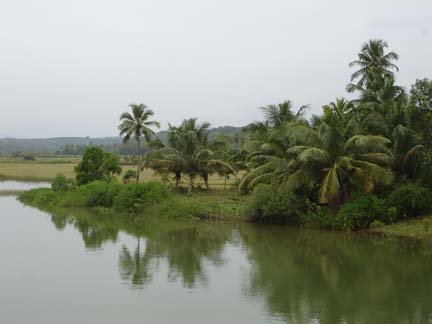
Holegadde near Honavar,Uttara Kannada dist, Karnataka
Copy? Right - but kindly remember to acknowledge!

" tulu-research.blogspot." ತುಳು ರಿಸರ್ಚ್. ಬ್ಲಾಗ್ಸ್ಪಾಟ್. ಇನ್

Have a nice day !