The present delimitation of Tulu speaking areas along the Karavali especially to the south of Udupi appears to be a feature imposed on the region after the Vijayanagar administration (ca 14 century CE and thereafter) centered on Barakur that fostered administrative support for the growth of Kannada in the region around and north of Barakur. Before Vijayanagar era in the Karavali, Kadamba rule centered on Banavasi ca. 4th century CE laid the foundation for growth of (old) Kannada in the northern Karavali.
A few words still prevail in the northern Karavali in support of the above claim. And Airodi is one such place name.
Airodi
Airodi (pronounced AayiroDi) is a village close to the northern banks of River Seetha near Hangarkatta in Udupi taluk. Hangarkatta was a traditional boat building centre in the Karavali.
Ayere in Tulu stands for river bank. Possibly the word originated as aa+ere meaning the other edge of river.(Compare 'ayere' with Attavara, Aamai etc words that refer to the place on the other side of the river.)
Therefore the place name Airodi literally represents an Odi (village) on the Ayere (the river bank).
Airoli
A similar sounding village Airoli exists in coastal Maharastra. The Oli (pronounced OLi) is a Prakrit/ Marati word generally representing a village or habitation and the word is also found in Tulu.(Note the Tulu village names like Kudroli, Maroli, Budoli etc). The existence of names like Airoli in Maharastra suggests that the word 'ayere' was more widespread in the earlier days along the west coast.
It is possible that the Tulu word -Odi is an variant of the word -OLi or vice versa.
Written with: Hosabettu Viswanath
®

A heritage blog by: Ravindra Mundkur & Hosabettu Vishwanatha
Showing posts with label Vijayanagara. Show all posts
Showing posts with label Vijayanagara. Show all posts
Saturday, October 25, 2008


Monday, April 7, 2008
107. Nagara at Panambur
Ancient Temples that contain preserved epigraphs provide interesting historical information during the study of the inscriptions etched in the past in order to perpetuate the celebration of rituals connected with the Temples.
One of such interesting historical tidbit is that Panambur, now the site of New Mangalore harbour was once also known as ‘Nagara’ from Tenth Century upto the beginning of Fourteenth Century CE.
Nagaresvara
The ancient temple of Nandanesvara located inside the Port area at Panambur was preserved intact during the construction of New Mangalore Port that involved massive displacement of the habitations in the area during the construction of the man-made harbour. The Temple also has been renovated due to dedicated involvement of local people in the recent years.
An inscription in the Temple dated 1305 CE (pre-Vijayanagar period) has described it as Nagaresvara Temple. It means that the area was popularly known as ‘Nagara’ or the city. Between the period of 10th and 14th Century CE, the coastal zone near Panambur must have been well developed as a city judging by the standards of those times. Alupa and Hoysala Kings were ruling the Karavali at that time. Since, Alupa had headquarters around Alupe, Maroli and Kulashekara areas of Mangalore, it can be surmised that Hoysala Kings contributed to the growth of Nagara around Padu Nambur. Murulidhara Upadhya and Narasimhamurthy (2000) suggest that the Panambur Nagara was an important commercial centre during the Hoysala period.
Nandanesvara
The Nagaresvara Temple may have been renamed as Nandanesvara Temple during the Vijayanagara period. During the Vijayanagara period the and township and the port was shifted southwards to Bokkapatna( Bolur) and Urwa area.
Padu Nambur
The place has been recorded as Nambur in inscriptions connected with Kadire Manjunatha Temple, Mangalore. The stone inscription in the courtyard of the Kadire temple dated ca.1386 CE corresponding to the period of Chieftain Banki Alupendra,who was ruling under the Vijayanagara King Harihararaya .The inscription mentions place names like Nambur (Panambur), Turithakali (Suratkal), Yedeya (Iddya), Kollia (Kulai) and Chitrapura (Gururaja Bhat, 1974.)
The Nambur village might have been a large village in the past and the western portion of it was designated later as Padu Nambur. The word ‘Padu’ stands for the 'West'. The word Padu Nambur has become Panambur with passage of time.
References:
Gururaja Bhat, P. (1974) “Kadri Shri Manjunatha Devalaya: Kshetra Mahatme mattu Itihasa” (Kannada).Published by: trustees of the Kadri Manjunatha temple.73p.
Murulidhara Upadhya Hiriyadaka & Narasimhamurthy,P.N. (Editors)(2000) ‘Dakshina Kannadada Devalayagalu’.(Kannada). Publication Committee of Shri Janardhana and Mahakaali Temple, Ambalapadi, Udupi, .472+76 p.
®
One of such interesting historical tidbit is that Panambur, now the site of New Mangalore harbour was once also known as ‘Nagara’ from Tenth Century upto the beginning of Fourteenth Century CE.
Nagaresvara
The ancient temple of Nandanesvara located inside the Port area at Panambur was preserved intact during the construction of New Mangalore Port that involved massive displacement of the habitations in the area during the construction of the man-made harbour. The Temple also has been renovated due to dedicated involvement of local people in the recent years.
An inscription in the Temple dated 1305 CE (pre-Vijayanagar period) has described it as Nagaresvara Temple. It means that the area was popularly known as ‘Nagara’ or the city. Between the period of 10th and 14th Century CE, the coastal zone near Panambur must have been well developed as a city judging by the standards of those times. Alupa and Hoysala Kings were ruling the Karavali at that time. Since, Alupa had headquarters around Alupe, Maroli and Kulashekara areas of Mangalore, it can be surmised that Hoysala Kings contributed to the growth of Nagara around Padu Nambur. Murulidhara Upadhya and Narasimhamurthy (2000) suggest that the Panambur Nagara was an important commercial centre during the Hoysala period.
Nandanesvara
The Nagaresvara Temple may have been renamed as Nandanesvara Temple during the Vijayanagara period. During the Vijayanagara period the and township and the port was shifted southwards to Bokkapatna( Bolur) and Urwa area.
Padu Nambur
The place has been recorded as Nambur in inscriptions connected with Kadire Manjunatha Temple, Mangalore. The stone inscription in the courtyard of the Kadire temple dated ca.1386 CE corresponding to the period of Chieftain Banki Alupendra,who was ruling under the Vijayanagara King Harihararaya .The inscription mentions place names like Nambur (Panambur), Turithakali (Suratkal), Yedeya (Iddya), Kollia (Kulai) and Chitrapura (Gururaja Bhat, 1974.)
The Nambur village might have been a large village in the past and the western portion of it was designated later as Padu Nambur. The word ‘Padu’ stands for the 'West'. The word Padu Nambur has become Panambur with passage of time.
References:
Gururaja Bhat, P. (1974) “Kadri Shri Manjunatha Devalaya: Kshetra Mahatme mattu Itihasa” (Kannada).Published by: trustees of the Kadri Manjunatha temple.73p.
Murulidhara Upadhya Hiriyadaka & Narasimhamurthy,P.N. (Editors)(2000) ‘Dakshina Kannadada Devalayagalu’.(Kannada). Publication Committee of Shri Janardhana and Mahakaali Temple, Ambalapadi, Udupi, .472+76 p.
®
Friday, February 29, 2008
98. Changes in Gurupur River mouth, 1887
 A reconstruction of Mangalore, without barrier spit, before the year 1887
Do you know that the barrier spit west of Mangalore city, known as Bengare, was formed by the shifting of Gurupur river mouth, only 120 years ago?
The shape of a river is formed by its usual flow channel. Do you have an impression that the present shape (morphology) or the location of flow path of rivers is a permanent feature of landmark?
Changing river morphology
The rivers and their shapes are guided by the nature of surrounding landforms and these are bound to change in response to any earth movements. The coastal rivers of India have changed their shapes several times in their life history!
The rivers of Tulunadu or coastal Karnataka are not an exception to this rule! Especially the Gurupur River that surrounds Mangalore has changed several times during the last three millennia.
Sultan battery
Interestingly, one such change occurred in 1887 during the British rule of Mangalore. Tippu Sultan conquered Mangalore during the late eighteenth century and built a battery at Mangalore, known as Sultan’s Battery to store ammunitions to be used against invaders from the Sea. The battery was built facing the mouth of or entrance to Gurupur River from the Arabian Sea at that time. (The Mangalore port was near Bokkapatna during the Vijayanagara period).
Shifting of River mouth
One fine rainy day in the year 1887, the Gurupur River decided to change the way it was flowing into the Sea till then. Instead of flowing into the Sea directly near Tannirbavi, opposite Sultans battery, it changed its fluvial course, flowed straight south towards the mouth of River Nethravathy some five kilometers south and joined the Sea along with Nethravathy. The whole change occurred instantaneously, without advance notice, in response to an earth movement! Thus, consequently a sand spit was newly formed between Mangalore city and the Arabian Sea.
Bengare
And this event occurred in the year 1887.The historical change of river mouth produced a new barrier spit parallel to the coastline, bordering the Sea, now known as Bengare.
®
Reference: Mangalore City Municipality Centenary Souvenir 1866-1966.
An anonymous compiler in the Centenary souvenir of Mangalore city Municipality (1966) has enlisted this notable event, possibly based on an older (British) version of the District gazetteer
Acknowledgement: Thanks to Shri Sheena Moolya for providing the reference material.
Subscribe to:
Posts (Atom)
A Coastal estuary
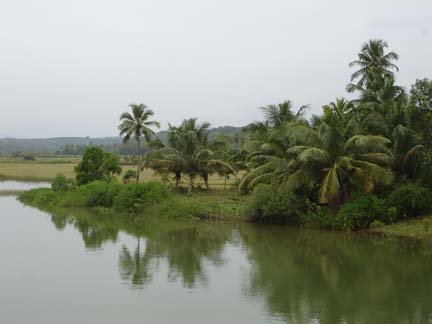
Holegadde near Honavar,Uttara Kannada dist, Karnataka
Copy? Right - but kindly remember to acknowledge!

" tulu-research.blogspot." ತುಳು ರಿಸರ್ಚ್. ಬ್ಲಾಗ್ಸ್ಪಾಟ್. ಇನ್

Have a nice day !