Another significant, though controversial, toponym attributed to the ancient Mangalore is Nitra or Nitria that have been cited in the ancient Greek travel reports.
Nitra - Nitria
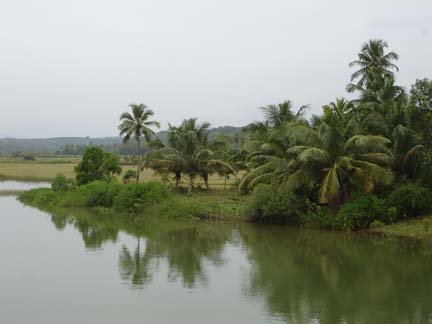
Greek writers Pliny (ca.23-29 CE) has mentioned Nitria and Ptolemy (ca. 150 CE) cited Nitra in their descriptions of Indian ports in the geographic accounts they compiled from their contemporary sailors. Yule and subsequently Govind Pai and others have considered these place names as old names of Mangalore because of the affinity to the name of River Netravati that flows in Mangalore.
Thus it can been considered that the name Netra or Netriya (Nitra or Nitria in Greek versions) was the old original name of the river Netravati and the adjacent port town on the bank of River Netravati.
..A Map of ancient Mangalore to be added
Netra means eye in Sanskrit. Possibly the Sanskirt language had permeated to the southern India by ca. 500 BC.
The Phalguni River was flowing in Kodialbail and Netravathi was flowing in Attavara Pandeshwara valleys during the beginning of CE.(Posts 253,254). The resultant morphology or shape of the island like land mass between Phalguni and Netravati appeared like an eye shaped peninsula, giving it the name of ‘Netra’. Thus it appears that the River Netravati derived its name from the eye shape of the land (Netra =eye) during early years of the Common Era.
Apparently the the name Netra for the port land was abandoned after the migration of said rivers and concurrent loss of the netra (eye) shape of the land. Thus the river beside Netra must also have been named ‘Netra’ or ‘Netriya’ which was later in the due course modified to ‘Netravati’.
The only connected vestigial name preserved along the river course happens to be ‘Netra-kere’ near Maripalla to the East of Mangalore.
Alupas from Alupe vilage
The merchant kings who ruled Tulunadu probably during the first fourteenth centuries of the CE were known as Alupa Kings. The origin of the word Alupa has been widely debated. They ruled parts of larger parts of Tulunadu probably from the beginnig of 4th CE upto 14 century CE,as evident from various inscriptions of the period, until taken over by Vijayanagar Kings, It appears that it is logical to assume that the name suggest the name of their hometown ‘Alupe’ a village on the banks of river Netravati in Eastern part of Mangalore (Post .74 ). It can be recalled that Govinda Pai + and Gururaja Bhat++ while discussing the various possibilities on the origin of the word, ‘Alupa’, have also felt independantly in their respective works whether Alupa was connected with the village Alupe.
Besides the village name, there are additional proofs cited below to confirm that Alupas were from Alupe village.
Aluvakheda
(1) The territory of Alupa kings has been described as ‘Aluva-kheda’ or ‘Aluvakheda 6000’ in several inscriptions. Ptolemy described the ‘Olokhoira’ which has been interpreted as Greek version of the word ‘Aluva-kheda’.
It is interesting to note that ancient suffixes –pe (as in village names Alupe, Didupe, Bajape etc) as well as –va (as in village names Shirva, Kakva etc) represent village areas. Therefore, we can deduce that the ‘Alupe’ village was also known as ‘Aluva’ village sometimes.
The word ‘Kheda’ means a gorge like depressed area bounded by steep cliffs. (Compare ‘kheDa’ with ‘kheDDā’, a large pit used traditionally to trap and tame wild elephants.). The description of the word ‘kheda,’ can be rightfully applied to the village of Alupe and Maroli, that are located in a large depressed gorge area bordered with steep cliffs.Thus it appears that the word ‘Aluvakheda ‘ was originally applied to the geography of Alupe, the hometown of Alupa Kings.
(2). The rare Sun temple of Mangalore is located within the gorge of Aluva-kheda described above.
(3).The ‘Kulashekara’ area named after one of the later Alupa Kings, called Veera Kula Shekara, is close to the Alupe- Maroli region.
Alupa Emblem
The royal seal on the Belamnnu copper plate inscription of Aluvarasa II (dated 730-760 CE) as well as Alupa coins display an emblem of twin fishes. A single fish was the emblem of Tamil Pandya Kings.The fish emblems of Pandya and Alupa Kings appear to have been inspired by earlier civilizations of Sindhu Saraswati (Harapa Mohenjodaro) where a large number of fish symbols have been discovered. The fish was a divine symbol for early marine merchant cultures as evident from the adoption of Matysa as the first incarnation of Lord Vishnu by Veda Vyasa.Thus it appears that the fish was a symbol of divinity among the ancient marine traders of India since the period of Sindhu-Saraswati civilization.
 |
| Alupa coin samples. (after: Govindaraya Prabhu & Nityanand Pai, 2006) |
Pandya Dhanajaya
Alupa Kings designated themselves as ‘Shri Pandya Dhanajaya’ in the coins minted during their regime.The phrase ‘Sri Pandya Dhanajaya’adopted by the Alupa kings in their coins apparently compared themselves to the Arjuna, the hero of Mahabharat. The surname ‘Pandya’ has also been adopted by the Pandya Kings of Tamilnadu.The Tamil Pandya Kings were considered by several authors as progeny of Pāndavas of Mahabharat. However, it seemly logical that the word ‘Pandya’ or ‘Pandi-ya’ was connected to ‘Pāndi’ rather than Pandavas. The large boats used for marine trade in ancient south India were known as Pandi boats. Thus, an owner of a pāndi boat would be known as a Pāndiya or Pāndya.This explanation seems appropriate in view of the fact that Alupa Kings were Pāndi based marine traders. Probably, this explanation also applies to the origin of ancient Tamil Pandya kings.The place name ‘Pondichery’ has preserved the vestiges of Pandi marine merchant culture in the East Coast as well.
Alupas deserted Mangalore
Epigraphic inscriptions have suggest that Alupa Kings ruled ancient Mangar(u) or Mangarur from ca. 425 CE to ca. 750 CE. ** Epigraphic data for the period prior to ca. 425 CE has not been available so far, hence the earlier period is rather hazy. During ca. 750 CE Alupas abruptly changed their capital from home town Mangalore to Udyavara for historically unexplained reasons.
It appears that Alupas abruptly changed their venue due to intimidating earthquakes and consequent migration of rivers that affected ancient Mangalore ca. 750 CE.
The Netravati River was flowing through the valleys of Attavara and Pandeshwara probably till beginning of 8th Century CE. Probably, during ca. 750 CE due to sudden earth movements the Netravati changed its course and began to occupy the present path. Consequently, due to southward migration of ancient River Netravati, the port of Pandeshwara was closed down. Thus Alupa rulers abandoned Pandeshwara port of ancient Mangalore and migrated northward and settled in Udyavara, which was a upcoming port at that time ( Post ).The Alupas further returned to hometown Mangalore from Udyavara during the beginning of Tenth Century CE.
One interesting place name has preserved this hereto undocumented historic change or migration of flow path of the ancient River Netrāvati for the benefit of posterity. That wonderful place name is Jeppu!
Jappu, Jappina Mogaru
The place name ‘Jeppu’ or ‘Jeppina Mogaru’, as is known now, has been much abused and misunderstood. It should be ‘Jappu’ or ‘Jappina Mogaru’. The Tulu word ‘Jappu’ means to decline representing the historical lowering of water level in the river. (On the contrary, the erroneous usage, ‘Jeppu’ means to sleep). And ‘mogaru’ represents a river bank. Hence Jappina Mogaru represents the name adopted by the people to the river bank where the water level declined abruptly during the history.
There is one more mysterious aspect connected with the geological history of the village Jappina Mogaru. The revenue survey maps prepared by the surveyors of British regime during 1894, show two halfs of Jappina Mogaru divided by the river Netravati. It means that the original village of Jappina Mogaru has been bifurcated into two pieces during the last century , separated by the present flow position of River Netravati.
Ancient Temples of Mangalore
Apart from the Mangaladevi we discussed in the previous post, atleast ancient seven of the well known temples in Mangalore were installed before 10th Century CE. All these temples were originally installed on the banks of ancient rivers or perennial water Springs of Mangalore.
Mangalapura
Badami Chalukya epigraphs of 7th Century CE cited the name of ancient Mangalore as Mangalapura*.The name Mangalapura is popular among our Malayali neighbours even today.
To begin with, Mangalore was under the spell of Naga and Spirit worship cults since the ancient agricultural phase.Sun worship was evident during pre-Dravidian Munda cultural phase.Footprints of Buddhism were evident in the old place name ‘Mayi-kala’ for ancient Mangalore (Post 65,70). Early Skanda- Shiva- Ganesha cults collided with Buddhist cult. Bhagavathi cult evolved as a consequence of assimilation of Spirit cult and Buddhism. Rennaisance of Hinduism by Shankara led to the transition of Bhagavathi cult into widespead Durga cult.
Mayi-kala
With the advent of Arabs and later Bearys Islam made its presence in Mangalore.Some of the oldest Mosques of Mangalore (like Bunder, Kandathapalli) were also originally established during the period of 8-10 century CE. One of the old Buddhist names of Mangalore, ‘Mayikala’, has been preserved especially among the Muslim Beary community. One of the possible reasons for this could be that Mayikala existed in the Bunder region which was a major business area in the early history of Mangalore.Bearies, being a business community, frequented Mayikala area of Mangalore.
Kudupu
Kudupu appears to be an ancient village of ancient Kudu agricultural phase.It probably was an ancient center of Naga (serpent) worship. With advent of the Kumara-Skanda cult in the early centuries of CE it was developed into a temple dedicated to Kumara (Subramanya) worship. The old rivers flowing beside Kudupu changed its course with passage of time, leaving behind the evidences in the form of old river valleys that characterize the area around Kudupu.
Pandeshwara
In the olden days the large merchant boats engaged in trading rice, cereals and spices were known as ‘PānDi’ and the boat harbour was known as ‘PānDela’. River Netravati was flowing along Attavara- Pandeshwara valleys and joining the Sea near present Goodshed area where the ancient PanDela and the temple and township were located.
An Ishwara (Shiva) temple was built by the Alupa merchants in the PanDela (ancient port) area ca 4-5 century CE, and it was eventually known as PānDeshwara.
Another similar port place-name of ’PānDeshwara’ representing another ancient Alupa port exists near Hangārkatta, located between the coasts of Udupi and Kundapur.
Neere Shivalaya
The Neere-shivalaya Somanatha temple was originally an ancient Alupa temple devoted to Trimurtis- Brahma, Vishnu and Mahesha according to epigraphs found near Gollarkeri.* Neere Shivalaya is located near the ancient, Alupa period, PānDela of Mangalore.Neera Shivalaya, (neer=water) as the name suggests, was a Shiva temple (on an island) surrounded by waters of ancient River Netrāvati.
Sharavu
The Sharavu village, now part of heart of the Mangalore city area is known for an ancient temple dedicated to Lord Shiva and Ganapati. The place name Sharavu has been interpreted as ‘shara’ (=arrow) +’pura’ (=town) by legend creators of Stala-purana. However, the available geological evidences suggest that area could have been ‘Saravu’ (sara =lake, vu=village) to begin with. The waterworn pebble bearing sediments covering the Sharavu-Suchitra-Prabhat valley area suggest that area was under water (lake), connected with Phalguni river of Kudu and Kudla phase (post 253).
The original ancient temples appear to have been renovated during 10th to 11th century CE as evident from the study of idols in the temple.
Kadire
Kadire means ear or corn of paddy.It was customary to distribute corns of paddy (‘Kadire’) during ‘New crop’ (‘Posatt’, Puddar, Puttari, Onam) festival among the farming communities since ages.Now, the area is known as ‘Kadri’. During the course of history, some of the legend writers have modified the place-name also to ‘Kadali’ (=banana) or ‘Kadali-vana’ (orchard of banana).
Earthquakes resulted in upheaval of Kadri plateau ca.400-600 CE. After the earth movements, the flow path of Kudla segment of river Phalguni was diverted to new path. And a few new perennial water springs originated on the escarpment side of the Kadire cliff. The village on the top of the Kadire cliff was called ‘Nantur’ (Post 175).
Kadire was a Buddhist monastery till being occupied by the Natha sages Macchendra and Gorakha Naths. Natha sages revived Hinduism and led the transition of Buddhist to Natha/Shaiva cults during 10 th Century CE. The date of installation of the Lokeshwara bronze idol at Kadire that evinces features indicative of transition from Buddhism to Hinduism has been reported as 968 CE.
The unique name ‘Manjunatha’ for Lord Shiva was created at Kadire.Later when a Shiva Linga was taken from Kadire temple to Dharmastala (ancient name ‘Kuduma’) another abode of Manjunatha was created.Origin of the word ‘manju’ in ‘Manjunatha’ has been debated.The word manju means beautiful (Prakrit)or mist (Tulu); the Tulu word ‘manja’ also means an elevated plateau like region. However, Manja or Manju (as in Manjanna) was also an ancient male proper name among Dravidians and pre-Dravidians. It appears that Macchendra had a son named Manju who incidentally expired in the area and Macchendra erected a memorial shrine in his memory in the tradition of Spirit worship vogue in the region.The name was extended to the form of Shiva with the signature suffix ‘Natha’ that represented the cult popularized by Macchendra Natha.The Manjunatha Temple of Alupa period has been renovated further during Vijaynagar rule (14th Century CE) and subsequent periods.
Maroli
Maroli village, originally named after the ancient Marava tribes (Mara+Oli), is proximal to Alupe village, the home town of Alupa Kings. In this village there is a rare ancient temple, built by Alupa rulers and dedicated to the worship of Sun God (Surya-narayana).
The temple is located in a large circular valley formed after the migration of river path in the Maroli-Alupe villages.The structure of temple is said to be of ca. 11-12 century CE.
The origin of Sun worship in India dates back to ancient Munda tribal people.The cult of Sun worship (Singbonga) was also the tradition among Munda cultures that predated Tulu-Dravida civilization in the Karavali.
Attāvara
The Netravati River was flowing through the valleys of Attavara and Pandeshwara probably till 7th Century CE. Afterwards due to sudden earth movements the Netravati changed its course and began to occupy the present path.
There are two ancient temples in Attavara: One Uma Maheshwara, another Chakrapāni. The Uma Maheshwara temple is located on the banks of the old river course suggesting that originally it was built on the southern bank of the old river.Dr Gururaja Bhat suggested that the Ganapati idol of Attavara displays sculptural styles of Seventh Century CE. The original temples were renovated during subsequent periods.
Later Temples
Hanuman temple in the Gollarkeri, Mangalore was established in the 14th Century*. After the advent of Saraswaths from Portuguese Goa (ca. 16-17th Century CE), The Venkataramana (Dongarakeri, Car Street) and Mahamayi temples were installed in Mangalore. Māri temples (Halekote, Bolar and Urwa) were established during the regime of Keladi Nayaka Kings (15-17th Century CE).
Seventeenth Century also witnessed advent of Portuguese, German, French and British into Mangalore and the establishment of some of the oldest missions and churches in Mangalore like Basel Mission, Milagres and Rosario.
The Brahma Baidarkala Garodi at Kankanādi was established in the year 1874. The Kālikāmba temple, maintained by Vishwakarma community, was shifted from Mahakāli-paDpu, Jappu, to Car Street area.
Kudroli Gokarnatha temple was installed originally by Narayana Guru during the year 1912*.The name ‘Kudroli’ has been analysed by some as Kudure+Oli (a village of horse). However, the geological data suggest that it was a ‘kuduru+Oli’ (a village of river islands) as the region was covered by the estuary of the ancient river Phalguni in the historical past.
Kudroli Gokarnatha temple has been renovated in recent years into a beautiful structure such that it constitutes presently a major tourist attraction in the city of Mangalore.The annual Navaratri/Dasara celebrations centered in this temple has been known widely as Mangalore Dasara.
-
References:
Manohara Prasad. ’Nammuru’: (Serial articles on historical aspects of Tulunadu). Udayavani (Kannada Daily). Manipal.
*Temples of Dakshina Kannada (in Kannada) Ed: Murulidhar Upadhya Hiriyadaka & P.N. Narasimha Murthy. (2000). Ambalapādi. Udupi. 436 p.
**Govindaraya Prabhu, S. & Nityananda Pai, M (2006). The Alupas: Coinage and History.Sanoor, Karkala.200 p.
+ Manjeshwara Govinda Pai ( )
++Dr. Padur Gururaja Bhat (1963) Tulunadu. 228 p. Reprinted in 2009 by Dr Padur Gururaja Bhat Memorial Trust, Udupi.
®