In an earlier post I suggested that the original name of the locality, the environs of the temple of Manjunatha in Mangalore was Kadire. The present corrupted form of ‘Kadri’ may be a modification consequent of Portuguese or British period of rule in the region.
Kadire
The word ‘kadire’ in Tulu (and local Kannada) means spike of paddy corns. The locality was designated Kadire because the tradition of distribution of auspicious paddy spikes during annual Puddar festival. The name Kadire can be found in the inscriptions available in the area. Dr. P. Gururaja Bhat (1974) has provided the transliteration of inscriptions available at Kadire Manjunatha temple. Italian traveler Della Valle had also visited Kadire during 1624CE.
968 CE. The famed Lokeswara (Avalokiteswara) bronze idol of Kadire dated 968 CE contains an inscription at the base. It describes that it was installed by King Kundavarma Alupendra in the Kadarika Vihar. The word ‘Kadarika’ is a Sanskritized version of the Kadire. Secondly, at the time of installation of this idol, the place was a ‘Vihara’, a Buddhist monastery.
1386.CE. The stone inscription in the courtyard of the Kadire temple dated ca.1386 CE, belongs to the period of chieftain Banki Alupendra. and King Harihararaya (at Vijayanagar). The line 6 mentions… ‘bhogikkadaliya’, line 8 and 17 mentions Mangalur (coins).
Line 23 cites: ’.Kadiru nekkilu.’.as one of the boundary of the Manjunatha temple. The ‘bhogikkadali’ has been interpreted as Jogi Kadali by Dr.Gururaja Bhat.
1475.CE Inscription dated ca.1475 was made by Vitarsa Odeyar, a governor Mangalore and Barakur provinces, under the King Veera Pratapa Prouda Virupaksha of Vijayanagara. Jogi Mangala Natha was the chief of Jogi Mutt. The place name Kadire is mentioned twice in the inscription. The Jogi Mangala Natha was declared as Ruler (Arasa) of the Kadire. Kadire is described as the central area (headquaters) of Mangalore province.
1624 CE - P.Della Valle, an Italian traveler who visited Mangalore and Ullal during (1624) Portuguese period (Abbakka was ruling at Ullal) reports that he met Batinata, the King of Jogis at a place called ‘Cadira’(Kadira).
Manjunatha
It is said that the Manjunatha is not in the traditional list of Lord Shiva’s names. Therefore it appears that the name Manjunatha was coined specifically at Kadire, Mangalore for the first time in the history. Earlier writers have visualized that the name Manju-natha was derived from Macchendra Natha, in the order of Macchendra>Mancho>Manju.
But, the ‘Kadali Manjunatha Kshetra Mahatme’ describes that Macchendra had twelve wives from whom he had twelve sons. The son of the last wife was called Manjunatha. Another account describes that Macchendra’s youngest son was known as Manju-Natha, who was installed as the ruler of Kadire by Macchendra Natha. Thus, it follows that the name of the deity Manjunatha was derived from the name of son of Macchendra Natha.
The Natha chief traditionally calls the installed 'God'Manjunatha as 'beta'!One story recounted by Jogi Ananda Nath cites an event when one of the (later period) Natha chief was sidelined by the Brahmin Tantri in charge of temple during a car festival. The temple car(chariot) did not move forward. Finally the the Natha chief(Arasu) was brought in and he said Aao Beta! And the car rolled forth!
The 'beta' legend suggests that the installed 'God' was originally the son of the founder Natha, the Macchendra.
Manjarur
One of the interesting facts somehow ignored so far by scholars is that Mangalore was known as Manjarur for some time, possibly till the arrival of Vijayanagar rulers. It may have been ignored under the impression that foreign Arab travelers may have failed to note down the name of this properly. But at least two Arab travelers Rashiduddeen (1300 CE) and Ibn Battuta (1342 CE) have unmistakably recorded the name of the city as Manjarur. Rashiduddeen uses the phrase: the country of Manjarur. Ibn Battuta has used both the ‘Manjarur’ and ‘Budufattan’ (<.Bokkapatna), the port at the beautiful estuary or simply ‘Pattan’ (Bokkapatna).
If we analyze the word Manjara +Ooru =Manjarur, it follows that the Manjarur was named after the Manju Natha, the youngest son of Macchendra Natha who ruled Kadire, after his father. Manja-ra stands for the respectable form of Manja.
It is possible that Manju Natha was deified after his life and worshipped in the tradition of Spirit worship. It may be recalled that the recluse queen Pingala (who became ‘Mangala’ after death) was worshipped in the similar style and the area around her temple was named after her (Mangalapura). In honour of Manju Natha the area was called Manjarur.
Om-Manjur
There is one more Manju-oor in Mangalore. A minor suburb in the outskirt on the way to Mudabidri is known as Vamanjur. This place probably was originally known as Om- Manjur. It is customary to add the word ‘Om’ to sacred names, as in the case of Om Namah Shivaya.
®
Reference:
Gururaja Bhat, P. (1974) “Kadri Shri Manjunatha Devalaya: Kshetra Mahatme mattu Itihasa” Published by: trustees of the Kadri Manjunatha temple.73p.

A heritage blog by: Ravindra Mundkur & Hosabettu Vishwanatha
Showing posts with label Dr Gururaja Bhat. Show all posts
Showing posts with label Dr Gururaja Bhat. Show all posts
Wednesday, February 6, 2008


Tuesday, October 9, 2007
41. Origin of the word Tulu -I
Origin and meaning of the word Tulu has been disputed in literary circles since pre-Independance days. Dr. Palthadi Ramakrishna Achar(1999) has compiled the available historical information on the word ‘Tulu’ in his book ‘TuLu naaDu- nuDi’. Most of the appraisals, as remarked by Dr Achar, have been made considering Tulu as a character of the territory or the people rather than the language.
1.In ‘Rajatha Peethapura Mahatme’(1913) it is described that a chieftain of Udupi called Ramabhoja offered Tulābhāra to the deity, to amend for the sin of killing a serpent. Tulābhāra is the offering of gold or other material (according to the status of the worshipper) equivalent to ones body weight. Thus the word Tulu has been suggested to have been derived from the Tulābhāra. The theory has not been accepted by experts since Rama bhoja appears to be an imaginary ruler unsubstantiated in the actual history of the land.
2.Another similar legend in ‘Keralotpatti’, an ancient work that originated from Kerala, describes the rule of one ‘Tuluban Perumal’ from Koteswara, Kundapaura area, who gave the name Tulunad for the area.This is again a figment of fertile imagination since there is documented evidence of any Tuluban Perumal ruling Tulunad.
3. Dr B. A. Salettur derived the word ‘Tulu’ from the Kannada root ‘tooL’ which means to attack. Dr. Gururaja Bhat had discounted this suggestion since Tulu people were never attacked anyone nor had any expansionist ideals.
4. Manjeswara Govinda Pai proposed that the word Tulu has been considered to have derived from the Tamil word ‘Tulai’ which means to row or play with water.
5. Kudkadi Viswanatha Rai (cited in Dr Achar,1999) suggested that the Tulu has been derived from the phrase ‘Tullal naadu’, wherein ‘tullal’ means to wriggle or to dance. Native Mera or Muger tribes describe their marriage ceremony as 'tullal'.
6. Dr. Gururaja Bhat proposed that the word Tulu is modified form of the term ‘turu’ that refers to cattle. Cattle herding and grazing is considered to be one of the earliest known professions in India. Cow-herders of Gujarat, also known as Yadavas are considered to be one of the early settlers in Tulunad. Haritha of Yadava clan was said to have ruled in Tulunad according to Harivamsha. However there are no solid evidences in favour of turu>tulu word conversion .
7. ‘Tolahars’ were a royal clan that ruled a part of Tulunad. Tola>Tulu conversion has been thought of by some workers.
8. J.Sturrock in his South Canara Manual ( Vol.I ) inferred that word Tulu possibly refers to the ‘soft’ nature of the local people, since the adjective “tuluve” is applied to the soft pulpy variety of jack fruit. However, this argument has not been accepted by experts like Dr. Gururaja Bhat.
9. Sediyapu Krishna Bhat has pointed out that the word ‘Tulu’ is connected with water. ‘Tuluve’(jack fruit) also means ‘watery’ and that should be considered instead of the ‘soft’ implication. The other water related words in Tulu are talipu, teli, teLi, teLpu, tuLipu, tulavu, tamel and additionally in Kannada are tuLuku and toLe. In Tamil tuli means water drop and tulli means the same in Malayalam.
Interestingly, earlier Manjeswar Govinda Pai also had suggested that the term Tulu is derived from the Tamil word tulai which means to row, dive or play in water.
Thus it can be concluded that the word Tulu implies ‘related to water’.
10. The term ‘Tulu’ was also used as a clan name, as recorded in the Honnali inscription of Shimoga district, dated 1203AD. Dr. Gururaja Bhat has cited several personal names with Tulu as affixes like Tuluveswara, Tuluva Chandiga, Tulu Senabova, Tuluvi Setti, Tuluvakka Heggadati,Tulu Alva, Tulai Amma etc. as have been recorded in the inscriptions. In the Basrur (in Kundapur taluk) inscription dated 1401 AD, mentions a Tuluvi Setti donating land to maintain the routine expenditures of the Tuluveswara temple of Basrur. Besides, Krishnadevaraya, the famous emperor of Vijayanagar was said to be hailing from the ‘Tuluva’ dynasty.
Thus we can conclude that the word ‘Tulu’ means ‘that connected with water’ and it is also name of a clan or group.
However the word Tulu is more global than we ordinarily imagine!
(..to be continued)
1.In ‘Rajatha Peethapura Mahatme’(1913) it is described that a chieftain of Udupi called Ramabhoja offered Tulābhāra to the deity, to amend for the sin of killing a serpent. Tulābhāra is the offering of gold or other material (according to the status of the worshipper) equivalent to ones body weight. Thus the word Tulu has been suggested to have been derived from the Tulābhāra. The theory has not been accepted by experts since Rama bhoja appears to be an imaginary ruler unsubstantiated in the actual history of the land.
2.Another similar legend in ‘Keralotpatti’, an ancient work that originated from Kerala, describes the rule of one ‘Tuluban Perumal’ from Koteswara, Kundapaura area, who gave the name Tulunad for the area.This is again a figment of fertile imagination since there is documented evidence of any Tuluban Perumal ruling Tulunad.
3. Dr B. A. Salettur derived the word ‘Tulu’ from the Kannada root ‘tooL’ which means to attack. Dr. Gururaja Bhat had discounted this suggestion since Tulu people were never attacked anyone nor had any expansionist ideals.
4. Manjeswara Govinda Pai proposed that the word Tulu has been considered to have derived from the Tamil word ‘Tulai’ which means to row or play with water.
5. Kudkadi Viswanatha Rai (cited in Dr Achar,1999) suggested that the Tulu has been derived from the phrase ‘Tullal naadu’, wherein ‘tullal’ means to wriggle or to dance. Native Mera or Muger tribes describe their marriage ceremony as 'tullal'.
6. Dr. Gururaja Bhat proposed that the word Tulu is modified form of the term ‘turu’ that refers to cattle. Cattle herding and grazing is considered to be one of the earliest known professions in India. Cow-herders of Gujarat, also known as Yadavas are considered to be one of the early settlers in Tulunad. Haritha of Yadava clan was said to have ruled in Tulunad according to Harivamsha. However there are no solid evidences in favour of turu>tulu word conversion .
7. ‘Tolahars’ were a royal clan that ruled a part of Tulunad. Tola>Tulu conversion has been thought of by some workers.
8. J.Sturrock in his South Canara Manual ( Vol.I ) inferred that word Tulu possibly refers to the ‘soft’ nature of the local people, since the adjective “tuluve” is applied to the soft pulpy variety of jack fruit. However, this argument has not been accepted by experts like Dr. Gururaja Bhat.
9. Sediyapu Krishna Bhat has pointed out that the word ‘Tulu’ is connected with water. ‘Tuluve’(jack fruit) also means ‘watery’ and that should be considered instead of the ‘soft’ implication. The other water related words in Tulu are talipu, teli, teLi, teLpu, tuLipu, tulavu, tamel and additionally in Kannada are tuLuku and toLe. In Tamil tuli means water drop and tulli means the same in Malayalam.
Interestingly, earlier Manjeswar Govinda Pai also had suggested that the term Tulu is derived from the Tamil word tulai which means to row, dive or play in water.
Thus it can be concluded that the word Tulu implies ‘related to water’.
10. The term ‘Tulu’ was also used as a clan name, as recorded in the Honnali inscription of Shimoga district, dated 1203AD. Dr. Gururaja Bhat has cited several personal names with Tulu as affixes like Tuluveswara, Tuluva Chandiga, Tulu Senabova, Tuluvi Setti, Tuluvakka Heggadati,Tulu Alva, Tulai Amma etc. as have been recorded in the inscriptions. In the Basrur (in Kundapur taluk) inscription dated 1401 AD, mentions a Tuluvi Setti donating land to maintain the routine expenditures of the Tuluveswara temple of Basrur. Besides, Krishnadevaraya, the famous emperor of Vijayanagar was said to be hailing from the ‘Tuluva’ dynasty.
Thus we can conclude that the word ‘Tulu’ means ‘that connected with water’ and it is also name of a clan or group.
However the word Tulu is more global than we ordinarily imagine!
(..to be continued)
Subscribe to:
Posts (Atom)
A Coastal estuary
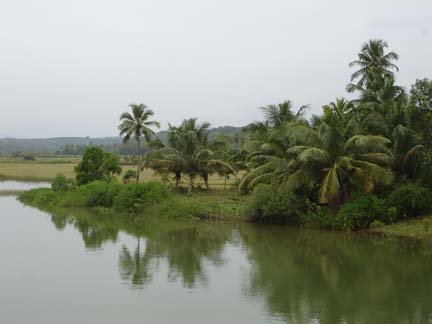
Holegadde near Honavar,Uttara Kannada dist, Karnataka
Copy? Right - but kindly remember to acknowledge!

" tulu-research.blogspot." ತುಳು ರಿಸರ್ಚ್. ಬ್ಲಾಗ್ಸ್ಪಾಟ್. ಇನ್

Have a nice day !