Showing posts with label Tulunadu. Show all posts

Sunday, February 13, 2011

270. Amara Mudnur


There is a strange heritage place name that belies mystery because of its similitude with a Sanskrit word, Amara. The word suggests a traditional practice of gift of land by Indian Kings  for perpetually maintaining military units under reliable military officers or the nayaks.
According to "Indian Epigraphical Golossary" (by Dineshchandra Sircar) Amara is a land or revenue granted by a ruler to his retainers for military service. It was the land assigned to Amara Nayaks ( traditonal military officers) who were entitled to collect only certain revenue with the obligation to raise a contingent of army for service.

Amara Mudnur, Amara Padnur
Amara was a large village set in the dense sylvan northern part of Sullia Taluk, Dakshina Kannada district. The’ Amara māgane’ was ruled by Tulu chieftains during the recorded history.The Amara ‘māgane’ (village cluster) was subsequently divided into western ‘Amara Padnur’ and eastern ‘Amara Mudnur’ villages, wherein ‘Padnūr’ (paDna+ūr) means western village and ‘Mūdnūr’ (mūDna+ūr) means eastern village.
The prefix ‘Amara’ in these place names at the first instance appears like a common Sanskrit word that means ‘immortal’. 
Amara Maagane was the traditional term used for the hereditary military grant lands or estates gifted to Amara Nayakas for raising and maintaining a unit of army in the service of the king or the ruler of the land.

ALTERNATE POSSIBILITIES
There are some alternate possibilities on the origin and source of this word .

Amara: An Ethiopian place name
Amara is also an Ethiopian African word used in Ethiopian place names as well.There are many places in Ethiopia that carry the place name prefix of Amara! Since there are several words of Ethiopian Afican origin in Tulu such as Tulu, Bantu, Kenya, Kola, Siri, Meru etc, the Amara could be another word from the same source that appears to have been brought here by the ancient African immigrants to Tulunadu.
Amhara tribes
The ‘Amara’ in the Sullia place name may also be a corruption of the African tribal name ‘Amhara’.
Ethiopia is also home to ancient Amhara nomadic tribes that speak a language known as Amharic. The Ethiopian word Amhara is usually analysed as free people (wherein am=people, hara=free or soldier).
Some suggest that African word Amara represents paradise. The latter meaning appears akin to the Sanskrit word Amara for the immortal.
There are other places along the West Coast that carry the place name Amara. For example, Amara-kantaka is a mountain peak in Vindhya/Satpura Range, giving birth to three rivers, viz. Narmada, Sone and Arvi. They drain into Arabian Sea, Ganga and Mahanadi respectively (Ganga and Mahanadi drain into  Bay of Bengal).  Word 'Amara' here is also noteworthy.

Amara in Sanskrit
Apart from the standard meaning of immortal (in Sanskrit), the term Amara was also a code for the number 33 which was supposed to be the total number of original Gods according to mythology.

Amar in Tulu
Apart from the above cited logical possibility of derivation of place name ‘Amara’ from an African root word, there are several shades of meanings attached to the widely used basic word Amar(u) in Tulu and other related Dravidian languages. Check the following range of meanings attributed to the word amar or amaru.
Amar 1=to shrink. or lag behind or stagger.
Amar 2= to adjust oneself or to arrange.
Amar 3= to settle, compose oneself.
Amar 4= to deposit (like sediment).
Amar 5=to hide or be hidden.
Amar 6= to seize, or hold or embrace.
Amar 7=twin or double
Amar 8= similar, to resemble.
Amar 9= appropriate or suitable.
Amar 10=to initiate or begin
Amar 11= wet soil or hedge of paddy field.
Amar 12= field canal.
 Also a  dividing hump or bund of a paddy field.  Note the related usages:
    (a) Amere kadpuni = Digging a shallow canal for he outflow of water for the paddy field.
    (b) Amare deepini  = Putting a dividing bund in a field or making a canal.
    (c) Amare Todu = A water canal in cultivation field.
Amar(ke) 13= space in between.
Amar 14= intimidate or threaten (Tamil, Malayalam)
Amara 15=immortal, without end or death. (Sanskrit).

-Ravi and Vishwanath.
®

Tuesday, September 14, 2010

252. Rediscovering Tulunadu

Strikingly odd conclusions or opinions, which go beyond ordinary understanding of a reader, attract a ridicule or disdain. More often than not, he (reader) is sceptical of the findings. This situation is more pertinent to the Posts, discussing Place-names of Tulunadu in this Blog. These place-names are a sort of riddles, hard to crack. The other day, I confronted Ravi with a teaser on Bijai and Bejja (Post-251). I observed, “Our obsession to ‘African Tribes’ should not be over-emphasised.” His quiet reply was very direct: “Many of the history items are obviously obscure. These aspects are not documented so far totally. I am only to thread through these strings, using logical evidences of migration patterns. I know that you are sceptical of these all. Naturally, anyone should be sceptical to begin with. But what makes a sense is that when deduced strings are logically matching with one another. Alternate explanation, if any, should correlate in space and time, to be realistic.” Yes, Ravi is ‘ploughing a lonely furrow’ when he is not following trodden path.

Evolved Language
It is difficult to sift, weigh and conclude when materials are scattered. These are available in the form of monuments, inscriptions, popular legends, historical writings (genuine or skewed), some loose strands of writings, i.e. superficial data, and fossil/archaic words, traceable in place-names but hinting to some base language, lost, assimilated or forgotten. Origin of such words is not clear. Evocative words or some other links tend to rouse some interest or impulse to search for some long-lost or forgotten materials of history.

Obelisks of Persepolis
Not so long, I chanced to glance through a Book: ‘A History of Babylonia and Assyria’, written in 1900 AD by Roberts William Rogers. He gives a vivid picture of how the strange language(s) used in inscriptions on the Obelisks or Pillars of Persepolis in Persia (erstwhile Iran) are deciphered. This involved several travellers and decipherers, spanning from 14th Century to 19th Century. They are all laymen in history and linguistics. Being ignorant about the history of these pillars, locals engaged in pillage of these structures for building purposes and/or in spoiling the ruins. Noting and observations of way-farers, led the group of learned men to decipher three languages. A simply small note by a European Friar, named Odorific(us), in his Travelogues in 14th C. inspired European travellers and instigated other European States to send ambassadors to Iran. They picked up the thread left by their predecessors. Method used by George F. Grotefend (a German born on June 9, 1775) was ridiculed as unscientific and his decipherment was rejected. Gottingen Academy of Sciences refused to publish his Paper, fearing of risking a bad name. His Paper saw the light of the day with the help of his personal friend A.H.L. Heeren, who published it in his book on Ancient World, as an Appendix. Others who followed Grotefend proved him to be correct.

Tulu Studies
Let the readers know that we are not historians in the real sense, i.e. learned ones, nor linguists. It is our inquisitiveness and interest that drives us to dabble.in the subject. It is for readers to reject or accept the postulations wholly or partially. Indifference by readers is discernible by the negligible comments or feed-backs coming forth. Note how the successive attempts to solve the mystery of inscriptions of Persepolis ruins culminated in adding up ‘materials in a new and substantially correct form’. It is a slow process but aimed at the purpose to leave materials for others to carry forward and improve. Consensus of opinion is possible only when a group of like-minded people – learned or otherwise – work together. The rediscovery of Babylonian and Assyrian languages (considered as ‘wonder of ages’) is made in Iran, away from those Lands. Let us rediscover our Land, called the Tulunadu, mention of which is found in place-names in travelogues of foreigners.

Hosabettu Vishwanath, Pune
13th September, 2010

Friday, March 7, 2008

101. Early dormant Jainism

Readers may have noted that the earlier posts in this blog have marshaled a few strings of evidences to assert that Buddhism was present in Karavali /Tulunadu since ca. 300 BC from the times of composition of Siri paDdana upto 10 or 11th century when Shaivism gradually overtook the Buddhism as mass favoured religious cults. While the evidences in favour of Buddhism are strong during the early period (ca.300 BC to 500 CE) similar evidences are not distinctly available in favour of early Jainism in Karavali/Tulunadu.

Jainism and Buddhism
Gautama Buddha and Mahavira were contemporaries and hailed from the same province. Buddhism was founded by Gautama Buddha ,but Jains, in general, believe that Jain philosophy was founded by the first Tirthankara known as Rishaba and Mahavira has been considered as the last TIrthankara in the sequence of 24th tirthankaras. This assertion of pre-Vedic antiquity possibly suggests to the existence of basic ascetism in pre-Vedic cultures. It can be b noted that the concept of Shiva, with tiger -skin loin cloth and ash covered body, which was subsequently developed into Shaivism during post-Vedic period, is also basically a primitive path of ascetism.
Jain tradition also believes that Chandragupta Maurya (grandfather of King Ashoka) adopted Jainism and travelled to Sravanbelagola along with Jain monk Bhadrabahu. These data suggest that Jainism was introduced to southern India before the introduction of Buddhism.
However, the available evidences in the Karavali are in favour of imprints of Buddhism rather than Janinism especially during the early centuries of the Christian Era.
Dormant Jainism in Early CE
This apparent paradox has been answered by scholars. The early Jainism (Nirgrantha) was highly ascetic that did not attract common people. The Buddhism and mainstream Hinduism followed paths of Bhakti to attract common people. The Jain monks had to compete with these devotional cults like Buddhism and mainstream Hinduism, which they resorted to after 5th century CE to enhance the mass appeal according to scholars and religious analysts like M.A.Dhaky and John E .Cort.
Thus we find proliferation of Jainism only after 5th century CE in different parts of southern India including Tulunadu/Karavali.
®

Friday, February 29, 2008

98. Changes in Gurupur River mouth, 1887

A reconstruction of Mangalore, without barrier spit, before the year 1887

Do you know that the barrier spit west of Mangalore city, known as Bengare, was formed by the shifting of Gurupur river mouth, only 120 years ago? The shape of a river is formed by its usual flow channel. Do you have an impression that the present shape (morphology) or the location of flow path of rivers is a permanent feature of landmark? 

Changing river morphology 
The rivers and their shapes are guided by the nature of surrounding landforms and these are bound to change in response to any earth movements. The coastal rivers of India have changed their shapes several times in their life history! The rivers of Tulunadu or coastal Karnataka are not an exception to this rule! Especially the Gurupur River that surrounds Mangalore has changed several times during the last three millennia. 
  Sultan battery 
Interestingly, one such change occurred in 1887 during the British rule of Mangalore. Tippu Sultan conquered Mangalore during the late eighteenth century and built a battery at Mangalore, known as Sultan’s Battery to store ammunitions to be used against invaders from the Sea. The battery was built facing the mouth of or entrance to Gurupur River from the Arabian Sea at that time. (The Mangalore port was near Bokkapatna during the Vijayanagara period). 
  Shifting of River mouth One fine rainy day in the year 1887, the Gurupur River decided to change the way it was flowing into the Sea till then. Instead of flowing into the Sea directly near Tannirbavi, opposite Sultans battery, it changed its fluvial course, flowed straight south towards the mouth of River Nethravathy some five kilometers south and joined the Sea along with Nethravathy. The whole change occurred instantaneously, without advance notice, in response to an earth movement! Thus, consequently a sand spit was newly formed between Mangalore city and the Arabian Sea. 
  Bengare 
And this event occurred in the year 1887.The historical change of river mouth produced a new barrier spit parallel to the coastline, bordering the Sea, now known as Bengare
 ® 

Reference: Mangalore City Municipality Centenary Souvenir 1866-1966. An anonymous compiler in the Centenary souvenir of Mangalore city Municipality (1966) has enlisted this notable event, possibly based on an older (British) version of the District gazetteer 

Acknowledgement: Thanks to Shri Sheena Moolya for providing the reference material.

Thursday, February 21, 2008

94. Antiquity of Siri

The living oral ballads in Tulu language known popularly as paDdanas are unwritten ancient documents that evolved along with the Tulu people, culture and language over a prolonged period of time. They not only reflect the poetic emotive talents of our ancestors, but are also mirrors of the changing culture, values and ethos of our people.

Evolved paDdanas
But the paDdanas that survived amidst us at present are the intensely evolved versions. Since paDdana are orally transmitted folk ballads generation to generation, it is logical to expect modifications over the years reflective of the environmental perspectives of the person reciting it. In the current digital parlance, they can be compared to the Microsoft Windows Vista or the Adobe Photoshop CS3. I take the liberty of this odd comparison just to convince you the difficulty of visualizing and reconstructing the earliest version of paD-danas using the current versions. And given the prolonged evolutionary history Tulu people incurred the oldest, original form of any paDdana is nebulous to decipher. Still there are some glowing indices in the current versions of paDdanas that through light on their antiquity and overall Tulu cultural evolution.

Ancient Siri paDdana
The evidences discussed below permit me to propose that the original version of the Tulu paDdana on Siri may have been orally composed during ca. 300 BC or earlier.

1.Satyanapura
The first proof: King Ashoka’s Girnar rock edict in Pali language (ca.300 BC) describes a southern State of ‘Satiyaputto’ that can be translated as Satyapura. The name of the palace in the Siri paDdana, Satyanapura is akin to Satyapura or Sati(y)aputto.
Now there are no towns having the name of Satyanapura in Tulunadu. However, it can be presumed that ‘Satyanapura’(.>Satiaputo) was a prominent Tulu City-State during the period of King Ashoka.

2.Siri -A Pali word
Second proof of the antiquity of Siri is the word itself. Siri is the heroine of the Siri paDdana. The name Siri is not commonly used name for present day Tulu females.
The word ‘Siri’ exists in Tulu language and it means tender leafy shoot of a plant like coconut palm. In Pali language the word Siri represented the Godess of luck.There is some parallelism between the two meanings: (1) tender shoot (Tulu) and (2).luck (Pali). The growth of tender shoot (Siri) is perceived as lucky.
Normally, we are taught in schools that the word ‘Siri’ is the derivative (‘tatbhava’) of the Sanskrit word ‘Shri’. But this is questionable and the truth may be the other way round, since the mythology of Lord Vishnu and his wife Shri (Lakshmi) evolved as late as 500BC or still later. The Pali and related Prakrit language existed before Vedas and it can be considered logically that Sanskrit (= refined) was a refined, evolved language after the older Prakrit (=natural) language. Since, it can be established that religious cults have borrowed from each other, it can be proposed that ‘Siri’, the Godess of luck of early Buddhist period, eventually evolved into ‘Shri’, the Godess of wealth.
To summarize: Siri.> Shri.
Thus the Pali word ‘Siri’ in the said PaDdana displays unmistakable shadows of early Buddhism in the early Tulu history dating back to ca.300 BC.

3. Ancient cult of Possession.
Third proof for the antiquity of the original Siri paDdana is the persistence of the ancient cult of possession attached to the Siri festivals.
The annual celebration of Siri festival is quite unique and unlike other kola, nema etc celebrations associated with other Tulu spirits. It is a celebration of the ancient art of trances or possessions. This cult was prevalent during the early history of the southern India and is well documented in Tamil Sangham literature that is estimated to have been compiled between the periods ca.200BC to 200AD.George Hart discusses some aspects of the cult of possessions described in Sangham literature.

4. Chenne mane: An ancient game
Peter Claus reports that Chenne Mane, a rural game associated with the Siri cult (or Mancala game as known in other parts of India and Srilanka) is known to have been played by rural folks since ca.200 BC. The game is prevalent in parts of Africa and Middle East, a fact suggestive of origin of the game in Africa-Mediterranean region. The game may have been brought to Tulunadu by the Early Tulu immigrants.

Evidently, the Siri paDdana has evolved extensively since its inception during early years of Buddhism in Tulunadu. The implicit indications of Jainism attached to it in the current versions of Tulu Siri paDdana are only reflective of the theological evolutions in the Tulunadu with the passage of times.
®

Friday, February 8, 2008

86. Samani

Glancing through the descriptions of foreign travelers to west Coast of India during the historical period, in Hobson Jobson dictionary, I chanced to stumble upon the word ‘Samani’ used by Rashidudeen during the end of thirteenth century CE.

Rashiduddeen
The entry on Rashiduddeen’s report on the West Coast of India during ca.1300CE is cited below:
c. 1300. -- "Beyond Guzerat are Konkan and Tána; beyond them the country of Malibár. . . The people are all Samanís (Buddhists), and worship idols. Of the cities on the shore the first is Sindabūr, then Faknūr, then the country of Manjarūr.

In the above passage, replace and read Gujarat (for Guzerat), Thana (for Tana), Malabar (for Malibar), Goa ( for Sindbur), Barakur (for Fakanur) and of course Mangalore (for Manjarur).The explanation for the word ‘Samanis’(=Buddhists) is presumably given by the editor of the dictionary.
The origin of the word ‘Samani’ is rather obscure with a random opinion that it is possibly of Polynesian origin. However, the Pali dictionary of proper names describes Samani as a princess. In Cambodia, neophytes to Buddhism were called Samanis or nens where as senior monks were designated as ‘bhikkus’. In Srilanka, the word Samani was applied to Buddhist nuns, specifically wandering female monks. Now the word Samani is also used by Jain nuns.
It appears that Rashiduddeen employed the word Samani to Buddhist monks in general.

A Surname: Samani
The significance of the word Samani lies in the fact that it is one of the surnames of a Tulu community, specifically the present day Bunts. Some surnames help us to trace episodes of historical evolution. It has been opined that during the course of time, the Buddhists of Karavali were not driven out but eventually assimilated with the local population.
The historical Jain-Bunt and vice-versa conversions in Tulunadu are rather well known so far. The present string of data adds to our knowledge that Tulu people also have vestiges of Buddhism in their historical heritage.
®

Friday, December 7, 2007

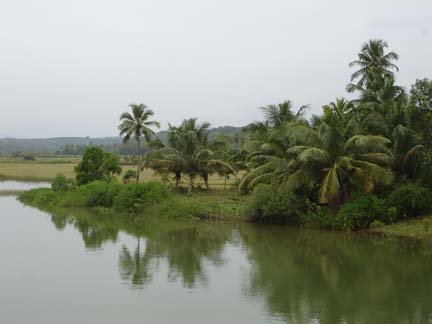
Nature-scape of Tulunadu 1


Gundya: foothills of Sahyadri
A charming nature-scape to break the monotony of textual posts.An image captured along the Subramanya-Gundya road.

Blog Archive

Books for Reference

  • A Comparative Study of Tulu Dialects By Dr. Padmanabha Kekunnaya. Govinda Pai Reserach Centre, UDupi. 1994
  • Koti Chennaya: Janapadiya Adhyayana. By Dr. Vamana Nandavar. Hemanshu Prakashana ,Mangalore.2001.
  • Male kudiyaru. Dr B. A.Viveka Rai and D.Yadupathi Gowda, Mangalore University,1996.
  • Mogaveera Samskriti By Venkataraja Punimchattaya. Karnataka Sahitya Academy.1993.
  • Mugeraru:Jananga Janapada Adhyayana. By Dr Abhaya Kumar Kaukradi.Kannada & Culture Directorate,Bangalore & Karnataka Tulu Academy, Mangalore,1997.
  • Puttubalakeya Pad-danagalu. Ed: Dr B.A.Viveka Rai,Yadupati Gowda and Rajashri, Sri Dharmasthala Manjunatheswara Tulu Peeta. Mangalore University.2004
  • Se'erige. Ed:Dr K.Chinnapa Gowda.Madipu Prakashana,Mangalagangotri,2000.
  • Studies in Tuluva History and Culture.by Dr P Gururaja Bhat (1975).Milagres College,Kallinapur,Udupi.
  • Taulava Sanskriti by Dr.B.A.Viveka Rai, Sahyadri Prakashana,Mysore 1977
  • TuLu naaDu-nuDi By Dr.PalthaDi Ramakrishna Achar, Puttur.
  • TuLu NighanTu. (Editor in Chief: Dr U.P.Upadhyaya, Govinda Pai Research Centre,Udupi. Six volumes. 1988 to 1997
  • Tulu Patero-A Philology & Grammar of Tulu Language by Budhananda Shivalli.2004.Mandira Prakashana Mangalore. p.317. (The book is in Tulu Language using Kannada script)
  • TuLunadina ShasanagaLa Sanskritika Adhyayana. By Shaila T. Verma (2002) Jnanodaya Prakashana,Bangalore, p.304.(Kannada)
  • Tuluvala Baliyendre. Compiled by N.A.Sheenappa Hegde,Polali,Sri Devi Prakashana,Parkala,1929/1999

A Coastal estuary

A Coastal estuary
Holegadde near Honavar,Uttara Kannada dist, Karnataka

Copy? Right - but kindly remember to acknowledge!

Creative Commons License
This work is licensed under a Creative Commons Attribution 3.0 License.

" tulu-research.blogspot." ತುಳು ರಿಸರ್ಚ್. ಬ್ಲಾಗ್‌ಸ್ಪಾಟ್‌. ಇನ್

" tulu-research.blogspot."  ತುಳು  ರಿಸರ್ಚ್.  ಬ್ಲಾಗ್‌ಸ್ಪಾಟ್‌. ಇನ್
Have a nice day !