There is a strange heritage place name that belies mystery because of its similitude with a Sanskrit word, Amara. The word suggests a traditional practice of gift of land by Indian Kings for perpetually maintaining military units under reliable military officers or the nayaks.
According to "Indian Epigraphical Golossary" (by Dineshchandra Sircar) Amara is a land or revenue granted by a ruler to his retainers for military service. It was the land assigned to Amara Nayaks ( traditonal military officers) who were entitled to collect only certain revenue with the obligation to raise a contingent of army for service.
According to "Indian Epigraphical Golossary" (by Dineshchandra Sircar) Amara is a land or revenue granted by a ruler to his retainers for military service. It was the land assigned to Amara Nayaks ( traditonal military officers) who were entitled to collect only certain revenue with the obligation to raise a contingent of army for service.
Amara Mudnur, Amara Padnur
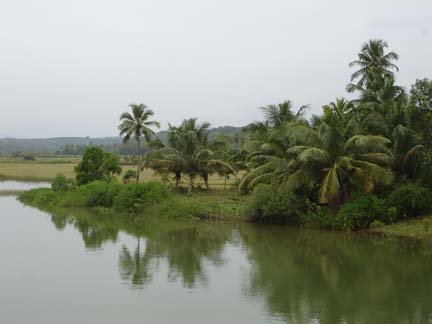
Amara was a large village set in the dense sylvan northern part of Sullia Taluk, Dakshina Kannada district. The’ Amara māgane’ was ruled by Tulu chieftains during the recorded history.The Amara ‘māgane’ (village cluster) was subsequently divided into western ‘Amara Padnur’ and eastern ‘Amara Mudnur’ villages, wherein ‘Padnūr’ (paDna+ūr) means western village and ‘Mūdnūr’ (mūDna+ūr) means eastern village.
The prefix ‘Amara’ in these place names at the first instance appears like a common Sanskrit word that means ‘immortal’.
Amara Maagane was the traditional term used for the hereditary military grant lands or estates gifted to Amara Nayakas for raising and maintaining a unit of army in the service of the king or the ruler of the land.
ALTERNATE POSSIBILITIES
There are some alternate possibilities on the origin and source of this word .
Amara Maagane was the traditional term used for the hereditary military grant lands or estates gifted to Amara Nayakas for raising and maintaining a unit of army in the service of the king or the ruler of the land.
ALTERNATE POSSIBILITIES
There are some alternate possibilities on the origin and source of this word .
Amara: An Ethiopian place name
Amara is also an Ethiopian African word used in Ethiopian place names as well.There are many places in Ethiopia that carry the place name prefix of Amara! Since there are several words of Ethiopian Afican origin in Tulu such as Tulu, Bantu, Kenya, Kola, Siri, Meru etc, the Amara could be another word from the same source that appears to have been brought here by the ancient African immigrants to Tulunadu.
Amhara tribes
The ‘Amara’ in the Sullia place name may also be a corruption of the African tribal name ‘Amhara’.
Ethiopia is also home to ancient Amhara nomadic tribes that speak a language known as Amharic. The Ethiopian word Amhara is usually analysed as free people (wherein am=people, hara=free or soldier).
Some suggest that African word Amara represents paradise. The latter meaning appears akin to the Sanskrit word Amara for the immortal.
There are other places along the West Coast that carry the place name Amara. For example, Amara-kantaka is a mountain peak in Vindhya/Satpura Range, giving birth to three rivers, viz. Narmada, Sone and Arvi. They drain into Arabian Sea, Ganga and Mahanadi respectively (Ganga and Mahanadi drain into Bay of Bengal). Word 'Amara' here is also noteworthy.
Amara in Sanskrit
Apart from the standard meaning of immortal (in Sanskrit), the term Amara was also a code for the number 33 which was supposed to be the total number of original Gods according to mythology.
There are other places along the West Coast that carry the place name Amara. For example, Amara-kantaka is a mountain peak in Vindhya/Satpura Range, giving birth to three rivers, viz. Narmada, Sone and Arvi. They drain into Arabian Sea, Ganga and Mahanadi respectively (Ganga and Mahanadi drain into Bay of Bengal). Word 'Amara' here is also noteworthy.
Amara in Sanskrit
Apart from the standard meaning of immortal (in Sanskrit), the term Amara was also a code for the number 33 which was supposed to be the total number of original Gods according to mythology.
Amar in Tulu
Apart from the above cited logical possibility of derivation of place name ‘Amara’ from an African root word, there are several shades of meanings attached to the widely used basic word Amar(u) in Tulu and other related Dravidian languages. Check the following range of meanings attributed to the word amar or amaru.
Amar 1=to shrink. or lag behind or stagger.
Amar 2= to adjust oneself or to arrange.
Amar 3= to settle, compose oneself.
Amar 4= to deposit (like sediment).
Amar 5=to hide or be hidden.
Amar 6= to seize, or hold or embrace.
Amar 7=twin or double
Amar 8= similar, to resemble.
Amar 9= appropriate or suitable.
Amar 10=to initiate or begin
Amar 11= wet soil or hedge of paddy field.
Amar 12= field canal.
Also a dividing hump or bund of a paddy field. Note the related usages:
(a) Amere kadpuni = Digging a shallow canal for he outflow of water for the paddy field.
(b) Amare deepini = Putting a dividing bund in a field or making a canal.
(c) Amare Todu = A water canal in cultivation field.
Amar(ke) 13= space in between.
Amar 14= intimidate or threaten (Tamil, Malayalam)
Amara 15=immortal, without end or death. (Sanskrit).
-Ravi and Vishwanath.
-Ravi and Vishwanath.
®