Glancing through the descriptions of foreign travelers to west Coast of India during the historical period, in Hobson Jobson dictionary, I chanced to stumble upon the word ‘Samani’ used by Rashidudeen during the end of thirteenth century CE.
Rashiduddeen
The entry on Rashiduddeen’s report on the West Coast of India during ca.1300CE is cited below:
c. 1300. -- "Beyond Guzerat are Konkan and Tána; beyond them the country of Malibár. . . The people are all Samanís (Buddhists), and worship idols. Of the cities on the shore the first is Sindabūr, then Faknūr, then the country of Manjarūr.
In the above passage, replace and read Gujarat (for Guzerat), Thana (for Tana), Malabar (for Malibar), Goa ( for Sindbur), Barakur (for Fakanur) and of course Mangalore (for Manjarur).The explanation for the word ‘Samanis’(=Buddhists) is presumably given by the editor of the dictionary.
The origin of the word ‘Samani’ is rather obscure with a random opinion that it is possibly of Polynesian origin. However, the Pali dictionary of proper names describes Samani as a princess. In Cambodia, neophytes to Buddhism were called Samanis or nens where as senior monks were designated as ‘bhikkus’. In Srilanka, the word Samani was applied to Buddhist nuns, specifically wandering female monks. Now the word Samani is also used by Jain nuns.
It appears that Rashiduddeen employed the word Samani to Buddhist monks in general.
A Surname: Samani
The significance of the word Samani lies in the fact that it is one of the surnames of a Tulu community, specifically the present day Bunts. Some surnames help us to trace episodes of historical evolution. It has been opined that during the course of time, the Buddhists of Karavali were not driven out but eventually assimilated with the local population.
The historical Jain-Bunt and vice-versa conversions in Tulunadu are rather well known so far. The present string of data adds to our knowledge that Tulu people also have vestiges of Buddhism in their historical heritage.
®

A heritage blog by: Ravindra Mundkur & Hosabettu Vishwanatha
Showing posts with label Bunts. Show all posts
Showing posts with label Bunts. Show all posts
Friday, February 8, 2008


Monday, January 7, 2008
67. Bunts and Nairs
Contributed by Narayana T.Shetty
The tulu proverb says ”mara puttinalpane, naramani poyinalpane” (tree remains where it grown, man remains anywhere he goes). But a curiosity to know our past, origin still remains in major parts of human beings, including Bunts.
According to paDdanas (oral tradition of tuluva legends) we came from aichatra maDastana. This ahichchatra according to “purananaama choodamani” is a city in uttara paamchaala country of Drupada, the father of Draupadi. This is in “Uttaranchala” state today which is surrounded by Tibet in north and Nepal on east. The city is now called “Ram Nagar”.
According to another legend ahikshetra was a place on the banks of Saraswati river. “ahi” means snake (chiefly serpent). It is believed that we Bunts were “naga or serpent worshipers prior to being buta/boota or spirit worshipers. Of course, we worship our ancestors in spirits (kule) too and thus have various ways/rituals to pray and remember them (agel to kulekulu, new dress to kulekulu, marriage of kule etc.). So there is reason to believe that bunts were mainly serpent worshipers and many groups of us might have come from north.
Nairs or Nayars and bunts belong to same cast. Like Bunts and Nadavas (and other tuluva people) Nairs too follow their own form of inheritance called Marumakkathayam, which is “ali katt”. Bunts have “Nayaranna bali” (bali = matriarchal lineage). Last ruler/king of Kanajar (a village in Karkala Taluk) was Nayar Hegde. In this village it was prohibited to take name of the king. So Kanajar folks always called the plough equipment commonly known as nayer/naver in tulu as guddal (from kannada ‘guddali’). The royal house (oMjane ill) of my village Kowdoor (adjacent to Kanajar) is “Naayara bettu”. Nayara is one of the 93 Bunts surname. Varma is a common surname of Nairs and Bunts.
According to K. M. Parinikar "The Nayars [Nairs] were not a caste, they were a race”. Some think nair is the honorific plural of nayan which is derived from the Sanskrit nayaka (leader).
Again “Nayak” is a Bunts surname, mainly from Nakre village in Karkala Taluk. Majority of Nadavas of North Canara have got surname Nayaka. Father of famous queen Chennamma was Siddappa Shetty and her husband was (Siva) Nayaka.
Others derive nair from the naga (snakes) which they worship. The Brahmin-inspired Keralolpathi regards them as the descendants of the Sudras who accompanied the Brahmin immigrants from outside Kerala. There is a theory that they came from the Nepal Valley, adjacent to Tibet. Some consider them to be early descendants of the Newars of Nepal. Serpent worship is one of common custom between the Newars and Nairs. Dr. Zacharias Thundy’s theory is that groups of Newars who were partially Aryanized and would be later Dravidianized joined the Munda exodus and finally settled down in Kerala after a long period of sojourn in the eastern plains of Tamil Nadu. The Nairs were in Kerala before the Brahmins arrived in the seventh century A.D. The Chera kings were Nairs, and the Nairs were also Dravidians and not Kshatriya Aryans; the Brahmins, in fact, considered them as Sudras.
If I am not wrong “Mundal” of Tulunadu and the “Munda” have same synonym.
There is also a belief that the Nairs are Nagas and were already present in Kerala when Namboodiris came to Kerala. Nairs were martial Dravidian Nagas who had migrated like them, from the North. Like Bunts, affinity of the Nair community to Serpents and Serpent worship is indisputable. The mythical version says that Nairs being Kshatriyas belonging to the Nagavansham who removed their “Janivara” (sacred thread) and escaped to south to evade Parasurama. In the old Tamil texts, the Nairs were mentioned as Naka (Naga) Lords who ruled as feudal lords in the Chera kingdom.
-Contributed by N.T.Shetty
Subscribe to:
Posts (Atom)
A Coastal estuary
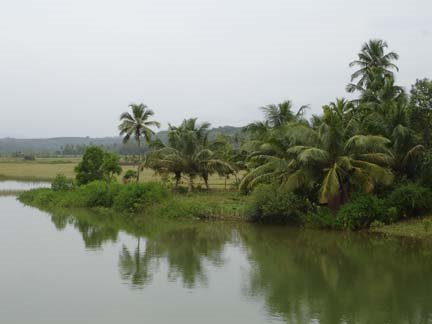
Holegadde near Honavar,Uttara Kannada dist, Karnataka
Copy? Right - but kindly remember to acknowledge!

" tulu-research.blogspot." ತುಳು ರಿಸರ್ಚ್. ಬ್ಲಾಗ್ಸ್ಪಾಟ್. ಇನ್

Have a nice day !