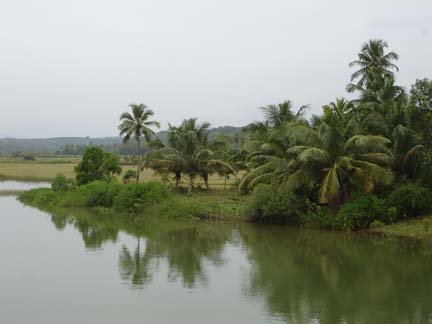
Belman (pronounced: ‘beLmaNN’) is a suburban village to the north of village Mundkur. It is located on the Padubidri - Karkala Road. Belman is known as Bolman (boLmaNN) in Tulu.
Belman
‘Bolman’ or ‘Belman’ simply translates to ‘white soil’. But if you look around the village you do not find any white soils or white clays. The whole village is reddish consisting of laterites and lateritic soils, dotted with dark granitic stocks. The issue confuses and leads you to infer that the ‘Bel’ in the Belman must be having some other esoteric meaning.
There are a number of villages that carry the prefix of Bel. These include Belle, Beladi, Belve, Belma,Beluvayi, Bellanje, Bellipadi, Bellarpadi, Bellara, Biliyur, Bilinele, Bellichar,Belur,Bellur etc. Outside Karavali we have several Bellara villages/hamlets, apart from Bellari,Belur and Belgaum. What is this prefix ‘bel ‘ stands for ? Apart from the obvious white, the ‘bel’ can be bright, fair or shining star (belli /bolli).
Bellarpadi
The village name ‘Bellarpadi’ clears our doubts. Bellarpadi is a village in Udupi taluk, located next to Perdur. The name Bellara padi clarifies it was a ‘padi’ (habitation) of tribes called ‘Bellar’. Thus ‘bel’ or ‘bol’ in these names represent the ‘Bell’ or ‘Bellar’ tribes. The name also signifies that these tribes were ‘whites’ or ‘fair skinned’.
Bellāra
The place name Bellāra, a town in Sullia taluk lends further support to this notion. Bellāra ( beLLa+ āra) was the village inhabited by these Bella tribes. Apart from the Bellara in Sullia taluk, there are several such villages in interior Karnataka that are called by the name Bellara. One such Bellāra in Tumkur district is known for gold mineralization. The well known Bellāri town, famous for iron ores is again a variant of Bellara. Linguists have recognized ‘Bellari’ language as a variant of Tulu.
Similarly the popular town Belgaum must have been ancient village of Bellar tribes.Besides,names like Belagola (as in Sravana-belagola),Bellur and Belur in different parts of Karnataka again point to the spread of these 'fair skinned' Bella /Bellar tribes in the past.
Bolāra - Bolūr
There are a number of villages or hamlets that are known as Bola,Bolār , Bolūr, Bolmann,Boliyāru,Boluvaru, Bolanthūr,Bolije etc. ‘Bol’ being the Tulu equivalent of ‘bel’ or ‘bili’ we can conclude these to be hamlets where fair skinned ‘Bellar’ or ‘Boller’ tribes resided once upon a time.
Vellars, Ballal
Hosabettu Viswanath reminded me that Bellar/Boller tribe scattered in historical Tulunadu and parts of Karnataka must the equivalent of Vellars described in Tamil literature.The absence of 'b' in Tamil alphabet, apparently converted the 'Bellar' phonetically into 'Vellar'. Similarly Vellals of Tamilnadu are apparently represented by Ballal which has remained only as a surname in Tulunadu.
Belman
‘Bolman’ or ‘Belman’ simply translates to ‘white soil’. But if you look around the village you do not find any white soils or white clays. The whole village is reddish consisting of laterites and lateritic soils, dotted with dark granitic stocks. The issue confuses and leads you to infer that the ‘Bel’ in the Belman must be having some other esoteric meaning.
There are a number of villages that carry the prefix of Bel. These include Belle, Beladi, Belve, Belma,Beluvayi, Bellanje, Bellipadi, Bellarpadi, Bellara, Biliyur, Bilinele, Bellichar,Belur,Bellur etc. Outside Karavali we have several Bellara villages/hamlets, apart from Bellari,Belur and Belgaum. What is this prefix ‘bel ‘ stands for ? Apart from the obvious white, the ‘bel’ can be bright, fair or shining star (belli /bolli).
Bellarpadi
The village name ‘Bellarpadi’ clears our doubts. Bellarpadi is a village in Udupi taluk, located next to Perdur. The name Bellara padi clarifies it was a ‘padi’ (habitation) of tribes called ‘Bellar’. Thus ‘bel’ or ‘bol’ in these names represent the ‘Bell’ or ‘Bellar’ tribes. The name also signifies that these tribes were ‘whites’ or ‘fair skinned’.
Bellāra
The place name Bellāra, a town in Sullia taluk lends further support to this notion. Bellāra ( beLLa+ āra) was the village inhabited by these Bella tribes. Apart from the Bellara in Sullia taluk, there are several such villages in interior Karnataka that are called by the name Bellara. One such Bellāra in Tumkur district is known for gold mineralization. The well known Bellāri town, famous for iron ores is again a variant of Bellara. Linguists have recognized ‘Bellari’ language as a variant of Tulu.
Similarly the popular town Belgaum must have been ancient village of Bellar tribes.Besides,names like Belagola (as in Sravana-belagola),Bellur and Belur in different parts of Karnataka again point to the spread of these 'fair skinned' Bella /Bellar tribes in the past.
Bolāra - Bolūr
There are a number of villages or hamlets that are known as Bola,Bolār , Bolūr, Bolmann,Boliyāru,Boluvaru, Bolanthūr,Bolije etc. ‘Bol’ being the Tulu equivalent of ‘bel’ or ‘bili’ we can conclude these to be hamlets where fair skinned ‘Bellar’ or ‘Boller’ tribes resided once upon a time.
Vellars, Ballal
Hosabettu Viswanath reminded me that Bellar/Boller tribe scattered in historical Tulunadu and parts of Karnataka must the equivalent of Vellars described in Tamil literature.The absence of 'b' in Tamil alphabet, apparently converted the 'Bellar' phonetically into 'Vellar'. Similarly Vellals of Tamilnadu are apparently represented by Ballal which has remained only as a surname in Tulunadu.
Belchada
Belchada or Thiyya are an ancient tribe living mainly in Northern Malabar region of Kerala and in parts of coastal Tulunadu. These are equivalents of Billawas in professions such as Spirit dancing, toddy tapping, native herbal healing,Kalari or martial art teaching etc.The origin of the term Belchada could have been coined because their fair skin colour at the time of their influx into West Coast and parts of Southern India...
Origin of the word Bela
Origin of the word “bela”
is disputed. However, there is a
suggestion that the word, Belarus means "White Russia". The term “bela” as well as “bili” means white in Kannada. In that case we may have a case of imported
word in Dravidian languages.
Then, it would mean that
the equivalents of bela in other
Dravidian languages (Bol, Bola in Tulu; Vel in Tamil etc) are later variations developed from the original “bela”.
Marker Event of Influx of fair skinned tribes
Overall analysis of numerous place names and ethnic names beginning with the prefixes bel, bol, vel etc suggests that there was a specific period in the early history when immigrant fair skinned tribes entered into the traditional domain of dark skinned people in various parts of India, especially the southern India.The fair skinned or white people could have originally from the Mediterranean or surrounding regions in Europe.The dark skinned natives at that time were distinctly surprised at the contrasting skin colour of the immigrants and consequently various immigrant fair skinned tribes and their colonies were denoted with prefixes of Bel, Bol or Vel etc.
®