Additional data from Hosabettu Viswanath provides some more material on the aspect of ancient prefixes in Tulu and Dravida languages.
Incidentally, 'Mu' was the name of hypothetical continent that allegedly existed in one of the Earth's oceans but disappeared at the dawn of history. However, this has no connection to our Tulu prefix 'mu'.
Prefix 'mun'
Prefix 'mun' appears as a derivative of the prefix mu.
mun=initial,beginning, frontal,the first etc.
'Mundu'(front); 'mungar :(mun+kar= initial season of rainy clouds) . Munnade (mun+naDe=go forward), 'mungurul' (mun+kurul= locks of hair on the frontal forehead). Munjāv (mun+jav= early time, early morning),
Similarly, the opposite prefix of 'mun' is 'hin' as in 'hingar' (hin+kar =next rainy season, winter rains, also winter crops).
Prefix 'muk' or 'muv'
'Muk/v' means 'three' (mukkal, mukkalige= three legged stool or small chair). Muvver (=three persons)
Prefix 'mei'
Possibly prefix 'me' (pronounced 'mei') =above or upper.
Consider the word 'medale'.
'mei' + tale (head or shoulder)> medale. i.e. end part of sāri taken to back side over the shoulder. .
Apparently the original 'mei' evolved into words like 'mel' (mei+l) = upper or above.
Prefixes 'Pa' and 'pā'
There is a shorter 'pa' prefix besides the 'pā' cited in previous post.
Possibly pa=rocky, pā= water
Panja p' or pa+anja (=rocky land), punja (p'+anja =rocky land)
Pā:(=water,river)
Pāngala pā+angala (land on the bank a river), Pāndi (pā+anDi). pā+ani=water
Bandar:
band+ar Enclosed or protected area, port. The port was a protected area within enclosures to protect goods since the historical days. However the word 'bandar'(=port) is apparently more widely spread.
.
In Maharastra, there is a place called 'Bandra' in the Western suburbs of Mumbai city, which was the centre of power of Portuguese in 16th/17th century before gifting away the Bombay islands to British as marriage gift. The word Bandra appears to be variant of the word bandar, the port. The Bandra is known as 'Vandra/Vandre' in Marathi.Earlier entire parts of the Mahim-Bandra Island was known as 'Salsette' Note the following lines on Bandra as gleaned from a Wikipedia page:
“Bandra is a possible adaptation of Bandar, a Persian word for Port. There are other views on the origin of the name: that it is derived from a Portuguese Princess for one, and another more plausible one that it is a corruption of 'Bandar-gah' in Persian (Bandar is a common word for Port in Iran), which means Port. May be Vandre in Marathi and Bandar in Persian both mean port and come from the same Sanskrit root word. This area was under Shilahar dynasty in 12th Century. It is referred to as 'Bandora' in gravestones in the cemetery of St. Andrews Church and in the writings of Mount Struart Elphinstone of the English East India Co., which describe the endeavours to acquire the island of Salsette”.
Similarities in place names of Maharastra and Tulunadu needs to be studied further.
Prefix 'ban'
The prefix 'ban' (pronounced as bun) stands for forest or wild area and the Sanskrit equivalent of 'van'(forest).[A case of b>v transition;.banga>vanga]
Examples for place names with ban- prefix: Bannanje, Bannadi,Banvasi,
Further, the 'banga-' words as in banga, bangarasu, bangawadi,bangal,bangera,bangar, bangere (<.bengare) and also the 'banna' words like 'bannngayi' etc. could have been derived from this prefix.
There is a coastal village name 'Bankot' in Ratnagiri District of Maharashtra.
*
Written with Hosabettu Viswanath
®

A heritage blog by: Ravindra Mundkur & Hosabettu Vishwanatha
Showing posts with label pa. Show all posts
Showing posts with label pa. Show all posts
Thursday, December 4, 2008


Saturday, November 29, 2008
162. Evolution of Tulu language
Languages prevalent in India have been broadly classified into groups like Indo-Aryan, Dravidian and Austro-Asiatic. The classifications somehow make us feel that language groups are water tight compartments.
However, like human beings,their gene structures, behaviour, skin colour and attitudes, languages have also evolved with passage of time. Tulu is one of the ancient world languages that has evolved in several stages in different parts of the globe in tune with the human evolution and migration patterns.
Formation of words
1.In Dravidian languages like Tulu, words appear to have been formed by the agglutination of smaller short words. Some examples have been enlisted here below to
show the features of agglutination. Earlier we have discussed some of these features especially in post No.141. Village Name Suffixes.
2.Some of the smaller words or their basic components have also been absorbed or adopted by Dravida and Sanskrit languages alike during the course of evolution. New independent words were formed from the basic word components. It appears that some of these short- basic-words borrowed by Dravida and Sanskrit languages may be older in origin than both.
3.Some of these small words evolved into prefixes and suffixes in some languages while some languages like Tulu have unknowingly discontinued the usage of prefixes, possibly because of absence of systematic or classified grammar during the course of its evolutionary history.
In other words, Tulu had prefix like short words in the earlier stages. This could be a feature absorbed from one of its precursor languages. However, some of these prefix structures were abandoned during the course of later evolution of Tulu language.
4. Analysis of ancient prefixes that prevailed (now buried in ancient words) in Tulu language is important and these prefixes can be resurrected to create new words to suit the demands of current usages.
Tulu/Dravida prefixes
Consider an ancient word like 'mudara'.
Mudara was a commonly used proper name of Tulu people in ancient days. There is a place called Mudarangadi near Padubidri. The word Mudara means fertile land or soil according to Tulu Nighantu.
Thus the word 'Mudara' can be analysed as mu+dara =fertile land. [mu =fertile, wet; dara=land].
Note that 'mu' has been used as an ancient short word or prefix in the construction of several other similar Tulu/ Dravida words, but its independent identity as short word or prefix has been lost with passage of time. That is to say that now we do not use (or are not aware of ) the usage of 'mu' as a prefix in present Tulu.
Word components
The other component word in Mudara, the 'dara' or 'tara', means land or earth.(Compare the Tulu words like: kanDada dara kaDpuni, dare laaguini, etc). The ancient word 'dara' has been absorbed by several Dravidian as well as Sanskrit during the course of evolution. Dara / tara (land) > 'da-re' (Tulu) earthen wall; 'dhare' (Sanskrit, =Earth). Uttara (Sanskrit, =north) is based on (ut + tara) the elevated land. Ettara ( Dravida word, =elevation) (et + tara ) originally meant elevated land/ place > (later simplified to) 'the elevation'.Note that the words 'ettara' and 'uttara' mean the same origin-wise but now they have different meanings. In the Gangetic plains of north India, the northern region (consisting of Himalaya and Siwalik ranges) were distinctly elevated compared to southern regions. Therefore in those areas where Sanskrit was the preferred language, the word 'uttara' meant north!
Note also some of the words derived from the base of 'tara' or 'dara' like 'taru'(= those grown on land; trees) 'tarakāri' (=grown on land,or plant products), 'darakās' (=own land, private land), 'darkār'(=right or authority over land), 'terige'(=tax on land), 'tiruve'(=tax/cess on land) etc.
Prefix mu
Consider some of the other Tulu words having a prefix of mu: mugal, mudel, etc.
Mugal. mu+gal/kal fertile sky > modified to rainy dark clouds. Kal was a variant of kār or gār. Mungar is a variant of mugal r>l transition and obliteration of m sound (anuswāra). kal/gal became kāl, the time. Ancient people used to study/watch sky ( and position of sun in the sky and resultant shadow) to ascertain time.
Kar and kār /kāl further also meant dark blue or black. Kariya, kargi, karmoda etc Dravida words were evolved. Note that Krishna, the Sanskrit word (k.r+sh+Na=dark skinned person ) was also evolved from 'kar'>k.r, the dark.
Mudel, Mudal mu + tal/dal.: 'mudal' or 'mudel' refers to bottom or initial part of a plant.[mu=good; tal /dal=bottom (tal >tala, bottom,lower part)]
The related word 'mudal' refers to the first or initial aspect . The mudal (=first) is derived from 'mudel' (= initial growing part of a plant).
Mudale(=crocodile).(mu+tale=pronounced head characteristic of crocodile).
Above illustrations suggest that mu was a short word or prefix in Tulu and Dravida languages in earlier days. Apparently the usage of prefix/short word 'mu' has been abandoned in present state of Tulu language.
Other Tulu prefixes
Mu is not the only prefix word in ancient Tulu We can find that there are many such lost prefixes. The expression 'lost' is used solely to suggest our present difficulty to trace the exact original meaning of some of these prefixes. Some of the 'lost' prefixes recognizable in Tulu include: Ku, Ko,Ti, Na, Pa , Ma, Mi etc.
Na
Naravi (na=our? ravi/rayi=stoney area)
Navur (na=our? oor=village)
Nakre (Na=?
Ku
Kuvettu,[ku=fertile? ku+bettu]
Note an ancient Queens of Sri Lanka was named: 'Kuveni'.
Kumara, [ku=young youthful?, Māra=god ; related to 'Marava' cult].
The prefix Ku as in Sanskrit later became suggestive of negative or bad character.
Ko
Koila< Kovil? [ko=divine? illu=house, kovila, koila=shrine]
Ma
Ma=elevated area? As in manja, manji
Mi
Mi= enclosed, inner part?
Examples: Miyar,( mi+ār= enclosed/inner field?); Mijar( mi+jār=interior sloping land?); Midal(<.mi+tal=inner part/organs of head); Miraj etc.
Ti
Ti =wet land?
Examples:Timār(= a wet paddy field, ti+mār), Timare(=an aromatic herb growing in wet fields,'Brāhmi'; herb grown in timār).etc.
Pā
Pā=water? Primitive form of ' paani'?
Examples: Pāngala, Pāndi etc.
I have jotted down some of the above thoughts I derived while analysing the Tulu words. Later, these may be refined further. In the meanwhile readers may offer their opinions on these and other primitive Tulu/ Dravida word forms.
®
However, like human beings,their gene structures, behaviour, skin colour and attitudes, languages have also evolved with passage of time. Tulu is one of the ancient world languages that has evolved in several stages in different parts of the globe in tune with the human evolution and migration patterns.
Formation of words
1.In Dravidian languages like Tulu, words appear to have been formed by the agglutination of smaller short words. Some examples have been enlisted here below to
show the features of agglutination. Earlier we have discussed some of these features especially in post No.141. Village Name Suffixes.
2.Some of the smaller words or their basic components have also been absorbed or adopted by Dravida and Sanskrit languages alike during the course of evolution. New independent words were formed from the basic word components. It appears that some of these short- basic-words borrowed by Dravida and Sanskrit languages may be older in origin than both.
3.Some of these small words evolved into prefixes and suffixes in some languages while some languages like Tulu have unknowingly discontinued the usage of prefixes, possibly because of absence of systematic or classified grammar during the course of its evolutionary history.
In other words, Tulu had prefix like short words in the earlier stages. This could be a feature absorbed from one of its precursor languages. However, some of these prefix structures were abandoned during the course of later evolution of Tulu language.
4. Analysis of ancient prefixes that prevailed (now buried in ancient words) in Tulu language is important and these prefixes can be resurrected to create new words to suit the demands of current usages.
Tulu/Dravida prefixes
Consider an ancient word like 'mudara'.
Mudara was a commonly used proper name of Tulu people in ancient days. There is a place called Mudarangadi near Padubidri. The word Mudara means fertile land or soil according to Tulu Nighantu.
Thus the word 'Mudara' can be analysed as mu+dara =fertile land. [mu =fertile, wet; dara=land].
Note that 'mu' has been used as an ancient short word or prefix in the construction of several other similar Tulu/ Dravida words, but its independent identity as short word or prefix has been lost with passage of time. That is to say that now we do not use (or are not aware of ) the usage of 'mu' as a prefix in present Tulu.
Word components
The other component word in Mudara, the 'dara' or 'tara', means land or earth.(Compare the Tulu words like: kanDada dara kaDpuni, dare laaguini, etc). The ancient word 'dara' has been absorbed by several Dravidian as well as Sanskrit during the course of evolution. Dara / tara (land) > 'da-re' (Tulu) earthen wall; 'dhare' (Sanskrit, =Earth). Uttara (Sanskrit, =north) is based on (ut + tara) the elevated land. Ettara ( Dravida word, =elevation) (et + tara ) originally meant elevated land/ place > (later simplified to) 'the elevation'.Note that the words 'ettara' and 'uttara' mean the same origin-wise but now they have different meanings. In the Gangetic plains of north India, the northern region (consisting of Himalaya and Siwalik ranges) were distinctly elevated compared to southern regions. Therefore in those areas where Sanskrit was the preferred language, the word 'uttara' meant north!
Note also some of the words derived from the base of 'tara' or 'dara' like 'taru'(= those grown on land; trees) 'tarakāri' (=grown on land,or plant products), 'darakās' (=own land, private land), 'darkār'(=right or authority over land), 'terige'(=tax on land), 'tiruve'(=tax/cess on land) etc.
Prefix mu
Consider some of the other Tulu words having a prefix of mu: mugal, mudel, etc.
Mugal. mu+gal/kal fertile sky > modified to rainy dark clouds. Kal was a variant of kār or gār. Mungar is a variant of mugal r>l transition and obliteration of m sound (anuswāra). kal/gal became kāl, the time. Ancient people used to study/watch sky ( and position of sun in the sky and resultant shadow) to ascertain time.
Kar and kār /kāl further also meant dark blue or black. Kariya, kargi, karmoda etc Dravida words were evolved. Note that Krishna, the Sanskrit word (k.r+sh+Na=dark skinned person ) was also evolved from 'kar'>k.r, the dark.
Mudel, Mudal mu + tal/dal.: 'mudal' or 'mudel' refers to bottom or initial part of a plant.[mu=good; tal /dal=bottom (tal >tala, bottom,lower part)]
The related word 'mudal' refers to the first or initial aspect . The mudal (=first) is derived from 'mudel' (= initial growing part of a plant).
Mudale(=crocodile).(mu+tale=pronounced head characteristic of crocodile).
Above illustrations suggest that mu was a short word or prefix in Tulu and Dravida languages in earlier days. Apparently the usage of prefix/short word 'mu' has been abandoned in present state of Tulu language.
Other Tulu prefixes
Mu is not the only prefix word in ancient Tulu We can find that there are many such lost prefixes. The expression 'lost' is used solely to suggest our present difficulty to trace the exact original meaning of some of these prefixes. Some of the 'lost' prefixes recognizable in Tulu include: Ku, Ko,Ti, Na, Pa , Ma, Mi etc.
Na
Naravi (na=our? ravi/rayi=stoney area)
Navur (na=our? oor=village)
Nakre (Na=?
Ku
Kuvettu,[ku=fertile? ku+bettu]
Note an ancient Queens of Sri Lanka was named: 'Kuveni'.
Kumara, [ku=young youthful?, Māra=god ; related to 'Marava' cult].
The prefix Ku as in Sanskrit later became suggestive of negative or bad character.
Ko
Koila< Kovil? [ko=divine? illu=house, kovila, koila=shrine]
Ma
Ma=elevated area? As in manja, manji
Mi
Mi= enclosed, inner part?
Examples: Miyar,( mi+ār= enclosed/inner field?); Mijar( mi+jār=interior sloping land?); Midal(<.mi+tal=inner part/organs of head); Miraj etc.
Ti
Ti =wet land?
Examples:Timār(= a wet paddy field, ti+mār), Timare(=an aromatic herb growing in wet fields,'Brāhmi'; herb grown in timār).etc.
Pā
Pā=water? Primitive form of ' paani'?
Examples: Pāngala, Pāndi etc.
I have jotted down some of the above thoughts I derived while analysing the Tulu words. Later, these may be refined further. In the meanwhile readers may offer their opinions on these and other primitive Tulu/ Dravida word forms.
®
Subscribe to:
Posts (Atom)
A Coastal estuary
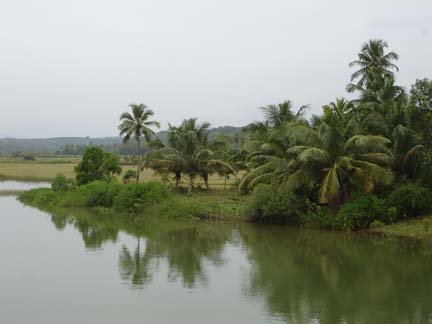
Holegadde near Honavar,Uttara Kannada dist, Karnataka
Copy? Right - but kindly remember to acknowledge!

" tulu-research.blogspot." ತುಳು ರಿಸರ್ಚ್. ಬ್ಲಾಗ್ಸ್ಪಾಟ್. ಇನ್

Have a nice day !