The character of Rama is one of the most influential ever portrayed in the history of India. The basic Indian ethics of righteousness is modeled on the legend of Rama. He has influenced the lifestyle and temperaments of many Indians, including the Mahatma Gandhi. In the words of Swami Vivekananda: “Rama, the ancient idol of the heroic ages, the embodiment of truth, of morality, the ideal son, the ideal husband, and above all, the ideal king.”
The original legend of Rama appears to be an ancient folk-lore, dating back to some thousands of years and was passed on orally from generations. The original story may also have evolved with spicy additions, of fantasy, when passing down the ages.
The Ramayana, built on the mass legend of Rama, is the first epic of India.. Based on the analysis of linguistic style of the text, Ramayana is considered to have been compiled between 500 BC and 200 AD. A portion of Ramayana was added even during 4th 12th century AD. But the core story could be as old as 700 BC considering reference to the kingdom of Kosala. The epic of has undergone numerous modifications and interpolations during the course time. A large number of fantasies have been added to increase the mass appeal of the product. So Ramayana as it is available now was not written by Valmiki alone. Sages of Bhrgu clan who composed AtharvaVeda also contributed to the text of Ramayana. The chief composer Valmiki is considered a descendant of Bhrgu. Apart from the Valmiki Ramayana there are also other versions.
As S.S.N.Murthy (2003) has summarized Ramayana was compiled and written when the cult the Brahma was held in high esteem in the pious society. The numbers four, seven and ten symbolic of the Brahma cult have been profusely used in the Ramayana compiled during that period. Besides, a lot of symbolism has been included. Sita (the word means furrow) is an symbol of agriculture. Similarly astrology and geographic details have been profusely added. However, archeological excavations so far have not confirmed any of the historical aspects cited in Ramayana. According to various scholars the places mentioned in the epic are from northwestern Indian subcontinent and the surrounding areas. Many scholars including Murthy have suggested that Lanka mentioned in Ramayana literally means an island and need not be the Srilanka of today.
In southern India many locations are describes as part of Rama legend. The Srilanka is described as the Lanka of Ramayana with the land connection between India and Srilanka as the ‘Rama Sethu’ built by Vanaras.
Pushkar Bhatnagar has dated Ramayana based on the digital analysis of position of stars and planets described by Valmiki and the date of birth of Rama arrived at is 10th January 5011BC.The date of birth looks accurate but does not tallies with the dates inferred by linguistic analysis. Simply it put Rama in an age older than Indus Valley Civilization.
Ancient folklore of Rama.
Rama was a simple ideal son who willingly took trouble of living in a forest for years just to ensure his fathers oral agreement. The Rama, however, is not of an infallible superman: he made mistakes like ordinary mortals. He ordered for his wifes ritual testing (agnipariksha) to appease his subjects. He killed Vali (or Bali) in an unrighteous manner. Had the legend been a creative masterpiece without factual basis, Rama would have been totally infallible in righteous judgments.
There are several interesting backdrops in the legend of Rama that indicate a primitive environmental setting.
1.Rama (the word means 'pleasant') has been described as blue-skinned. Either this is pure eulogy for the dark skinned charming young man. Or maybe at some point in the early history, almost gray-blue appearing men existed during the course of post-glacial evolution. The dark skinned Rama can be visualized as a primitive Indian young man.
2.He used primitive bow and arrows like those used by hunters and nomadic tribes.
3.The legend curiously describes Vanara tribes, the primitive homonids that were existing before the evolution of homo sapiens(‘Nara’)! It is possible that in the early history species of homonids (‘Vanara’) co-existed with homo sapiens.
4.The cart was a rare vehicle in those primitive days. The chariot used by the kidnapper Ravana, spelled wonders to the beholders.
5.The land bridge between India and Srilanka has been described. The land bridge in fact is a natural structure formed on the earth when the super Gondwana continent broke into several smaller continents some 90 million years ago. Since then India and Srilanka are attached through this natural continental link. The land area between India and Srilanka was evidently exposed during major recession of sea levels during major global droughts like those between 135,000-75,000 years and during the last glacial maxima some 10.000 years ago facilitating to and fro migration of human beings.
The continental connection is a natural structure of the earth. The rocks found at the top of the ‘Ram’s bridge’ zone, at present under the shallow sea (about 1 to 30m deep), consists of coral reefs. Some people have suggested that the light weighted coral reefs were carried to the sea and dumped to form the bridge by the homonid army. Coral reefs are built by living corals, a kind of primitive life forms, and do not grow on land; they grow naturally under favorable shallow marine conditions. The sandy formations reported by some geological studies in the ‘Rama Sethu’ link area indicate that it was an exposed land bridge in the historical past.
One possibility is that where only a small part of the continental connection was under water, it could have been filled by sundry material as a temporary measure.
6.Recent excavations and archeo-botanical studies have proved existence of early primitive men some 75,000 years ago in southern India. And in the Post Glacial Neolithic age,due to decrease in sea levels, the natural land bridge exposed and was accessible for journey to and fro between India and Srilanka by foot.Archeo-botanical studies have confirmed the existence of extensive agricultural habitations in various river valleys of India.
In the light of these it appears to me that the legend of Rama is a very ancient folk lore (paD-dana) built on the original story of a dark, righteous,primitive, unassuming young man whose wife was abducted to Srilanka through the natural land bridge during the Early Neolithic age. And with the help of Vanara hominid friends he fought with the kidnapper and brought back his devoted wife.
Valmiki, a hunter himself, representing the lineage of ancient Neolithic aborigines of India, made employed this folklore as a back ground story to compose the famed Valmiki Ramayana.Valmiki and numerous other later anonymous writers and editors have added and contributed their bits to blow up the simple, original legend into a fantasy filled Ramayana as we find today.

A heritage blog by: Ravindra Mundkur & Hosabettu Vishwanatha
Showing posts with label ramayan. Show all posts
Showing posts with label ramayan. Show all posts
Monday, October 22, 2007


Friday, September 7, 2007
34. Ten incarnations of Vishnu
A number of several older theological faiths and beliefs prevalent in the northern Indian society at that time in the history (ca.300 BC or later) were synthesized into a uniform model of incarnations. The ten divinities conceived by earlier civilization sects were recomposed and unified into the concept of ten avatāras of Lord Vishnu. The words ava (=downward) + tāra (=passage) refers to the descent of God into earth in human/animal forms. These include:
1. Matsya -The fish God
2 Koorma-The Tortoise
3. Varāha-The Boar
4. Narasimha- The Lion Man
5. Vāmana-The Dwarf
6. Parashurāma-The Axe Rama
7. Rāma
8. Krishna
9. Balarām/ Buddha and
10. Kalki.
All these incarnations are essentially adoption and mythification of ten different faiths that prevailed at different time periods of evolution of civilization in the Indian subcontinent.
The stories are also more or less, probably unknowingly, arranged according to evolution of life starting with the primitive vertebrate fish and culminating with most evolved human beings
1. The acceptance of ‘Matsya’ or The Fish God as an avatar throws light into one of the major disputes relating to the deciphering of Indus valley civilization. The seals unearthed from the archeological sites of Indus valley civilization, like Harapa and Mohenjodaro, contain a large number of images of fish pictograms. These fish symbols were interpreted as representing stars according to Iravattam Mahadevan (on the basis of dual meaning of the word “meen” in Dravidian languages); whereas Asko Parpola maintained that these represent the Fish God revered by the inhabitants of the Indus valley. It appears that the interpretation of Asko Parpola is more in order. The concept of the Fish God worshipped by the Indus valley people (mainly Dravidians?) remained in the mindsets of the people long after the destruction of Indus valley civilization. Later in the history, the same concept/myth was adopted into Vaishnavism (Vishnu cult) as Matsya avatār, the initial incarnation of Lord Vishnu.
2. The role of the Giant Tortoise, the Koorma avatār, is remembered in the occasion of mythological churning of the Sea (Samudra mathana) for obtaining the amrutha. The rivalry between the Sura (divine persons) and Asura (demons) groups manifested in this legend is an exaggerated version of churning of buttermilk for obtaining butter. During the early history cattle grazing and dairy activities were widespread in the subcontinent. Even Krishna belonged to the family of cattle keepers (Yadavs). The mythical legend visualizes Mount of Meru placed on the Koorma as the churning rod tied with Adishesha ( the serpent associated with Vishnu), as the churning rope pulled in a tug of war fashion by Sura and Asura groups on opposite ends. The whole churning process is done in the sea (instead of buttermilk pot) and ‘amrutha’ (the elixir) is sought out of this churning instead of butter. The entire mythical fantasy glorifies the rivalry and animosity between Vedic Aryan and Jew tribes that shared similar and contemporaneous cultural evolution during the time.
3. Similarly the Great Boar was worshipped in northwestern subcontinent during the early historical period. The Boar spirit-god (‘daiva’) ‘Panjurli’ worshipped by Tulu tribes must have been the original source of this myth. According the legend of ten incarnations, the Boar God (Varaha) rescued the Earth from the fury of the Sea and it also eliminated Hiranyaksha, the brother of Hiranyakashipu.
4. The Narasimha (the Lion-man or the half man-half lion avatār) represents the story of an innocent boy Prahlada rescued from the clutches of the tyrant father Hiranyakashipu, but with lot of fantasies attached to it. According to legends, Hiranyakashipu and Hiranyaksha were the Asura brothers born to sage Kashyapa, the grandson of Lord Brahma. Sage Kashyapa had four wifes namely Diti, Aditi, Vinita and Kudroo. Diti and Aditi were sisters of Gauri, the wife of Lord Shiva. Hiranyakashipu and Hiranyaksha were born to Diti. The Sura class (Gods) were born to Aditi. Vinita gave rise to Garuda (the Eagle), the carrier of Vishnu. Kudroo gave rise to Nagas, the serpent class. The Naga worship was in vogue since earliest days of civilization.
The Garuda (eagle) concept itself is interesting. Abraham, the prophet, was traveling on horse-back. The original Brahma derived from Abraham, was also horse mounted. (However, the Brahma’s configuration subsequently changed with time.) In the fashion of original Brahma, it became a convention later to depict swift carrier animals (sole vehicles of that time) for all Gods. Incidentally the eagle is also the killer of snakes. Thus myth creators chose Garuda as vehicle for the Vishnu, maybe also to subjugate the dominance of the Naga cult.
We can see amalgamation of several myths in these legends. The origin of Gods (Sura class), Demons (Asura class), Naga class and Garuda were theologically explained in these fantasies. The word ‘daitya’ (=giant) has come from Diti. Apparently, the daityas (the Asura class), were huge in build: possible connotation to tall Caucasian race.
5. The story of Vamana, the dwarf, is somewhat perverse. It demonstrated the glorification of the mischievous demand of a dwarf who asked land for placing three steps and cunningly subjugated the righteous King Bali, who was a very popular king respected and loved by his subjects. The respect for King Bali continued among his subjects even after he was vanquished to ‘Patala’. Tulu and Malayali people since ages traditionally celebrate a special night of lights, in honour of King Baliyendra, during every Deepavali. Thinking in terms of natural justice, there was no fault on the part of King Bali except that he belonged to the so called Asura class.
6. The Parashurama was a determinant, powerful man who killed many Kshatriya kings to avenge the insult done to his family. To distinguish from the Rama proper of Ramayana, this man was called Parashu-ram, the word ‘parashu’ referring to the weapon which he carried with him, the axe.
But the real fantasy attached to the Par ashram in the West Coast of India, Konkan Karavali and Malabar, is that he retrieved the coastal land from the Lord of Sea. He made agreement with the (Arabian) Sea that land upto where he can throw his axe, be vacated by the Sea. This is an interesting story of retreat of the Sea attributed to a fantasy superhuman character. Regression and transgression of the Seas is a phenomenon that has occurred all over the globe at during the historical past. The most recent regression documented in the West coast is about 6000 years ago, according to geologists. People living during the time of regression of the Sea, witnessed the dumbfounding phenomenon and the story was passed down the history through oral transmission from older to younger generations. After a few generations the story was attributed to this hero Parashurama, who they imagined could do this kind of feat using his superb axe.
7. The story of Rama may be a prehistoric pre-Vedic folk-tale told and retold to generations from elder members to younger ones. The characteristic presence of monkeys or primitive human beings (apes or ape-like hairy men) puts the date to prehistory. The story was blended with mild doses of fantasy and was repackaged by Valmiki, a hunter turned poet approximately during the period 500 to 800 BC. At the time of re-composition of the Ramayana, the concept of Brahma was evolving from the primitive concept of horse-mounted tribal hero based on the life of Abraham (Tulu Brahma: the Bermer) to four headed God of creation. Brahma was eulogized and blown into a fantasy of greatness as analysed in detail by S.S N. Murthy. He was also pictured as a ten-headed deity. It is interesting to note that much of the geography of southern India and Srilanka have been described in Ramayana. People must have been freely traveling by foot at that time in these areas.
8. The Krishna again was a mass hero, popular since his childhood days. The epic of Mahabharata is an unbelievably expansive canvas of blow-ups and fantasies built around an actual late to post-Vedic war of ten kings, as analysed by S.S.N.Murthy and others.
Both Rama and Krishna are hailed as blue-skinned (eulogy for the pleasantly dark- skinned) God incarnates. The emphasis on ‘blue skin’ reveals that there were light skinned people at that time. It also indicates that these Rama and Krishna were from the dark-skinned natives of that time.
9. Balarām, Krishna’s brother, was considered as one of the incarnations in the beginning but later was replaced by Buddha, who was more popular at the time of synthesis of the concept of ten incarnations.
10. Kalki is the futuristic fantasy of the ten incarnations that hopefully wishes that God shall come again to set things right, if bad continues to prevail on the world. It was an empty slot reserved for the unseen future mass Hero.
The Balaram-Buddha changes suggest that the list of incarnations were compiled at the time of Buddha and peak of Buddhism.
I have recounted the simplistic analysis of the sociological growth and evolution of theological concepts in our land. For theological documentation of the ten incarnations of Vishnu, kindly peruse Guru Vishwanath’s blog posts dated August-September 2005.
In Tulunadu and Kerala, initially, at least from ca. 500 BC, it was the dominance of spirit worship that has continued to sway even today. Shiva and Ganesha temples were introduced after 5th Century AD by Kadamba Kings, who dominated over local Alupa chieftains. The Kadamba Kings followed Shiva cult possibly under the influence of Pallava Kings.
By the time of Acharya Shankara (ca 9th Century AD), the Krishna cult spread to Tulunadu and Kerala. According to legends, the Krishna was the deity in the family of Shankara. Madhvacharya of Udupi further popularised the Krishna cult during the 12th century in the West Coast.
®
1. Matsya -The fish God
2 Koorma-The Tortoise
3. Varāha-The Boar
4. Narasimha- The Lion Man
5. Vāmana-The Dwarf
6. Parashurāma-The Axe Rama
7. Rāma
8. Krishna
9. Balarām/ Buddha and
10. Kalki.
All these incarnations are essentially adoption and mythification of ten different faiths that prevailed at different time periods of evolution of civilization in the Indian subcontinent.
The stories are also more or less, probably unknowingly, arranged according to evolution of life starting with the primitive vertebrate fish and culminating with most evolved human beings
1. The acceptance of ‘Matsya’ or The Fish God as an avatar throws light into one of the major disputes relating to the deciphering of Indus valley civilization. The seals unearthed from the archeological sites of Indus valley civilization, like Harapa and Mohenjodaro, contain a large number of images of fish pictograms. These fish symbols were interpreted as representing stars according to Iravattam Mahadevan (on the basis of dual meaning of the word “meen” in Dravidian languages); whereas Asko Parpola maintained that these represent the Fish God revered by the inhabitants of the Indus valley. It appears that the interpretation of Asko Parpola is more in order. The concept of the Fish God worshipped by the Indus valley people (mainly Dravidians?) remained in the mindsets of the people long after the destruction of Indus valley civilization. Later in the history, the same concept/myth was adopted into Vaishnavism (Vishnu cult) as Matsya avatār, the initial incarnation of Lord Vishnu.
2. The role of the Giant Tortoise, the Koorma avatār, is remembered in the occasion of mythological churning of the Sea (Samudra mathana) for obtaining the amrutha. The rivalry between the Sura (divine persons) and Asura (demons) groups manifested in this legend is an exaggerated version of churning of buttermilk for obtaining butter. During the early history cattle grazing and dairy activities were widespread in the subcontinent. Even Krishna belonged to the family of cattle keepers (Yadavs). The mythical legend visualizes Mount of Meru placed on the Koorma as the churning rod tied with Adishesha ( the serpent associated with Vishnu), as the churning rope pulled in a tug of war fashion by Sura and Asura groups on opposite ends. The whole churning process is done in the sea (instead of buttermilk pot) and ‘amrutha’ (the elixir) is sought out of this churning instead of butter. The entire mythical fantasy glorifies the rivalry and animosity between Vedic Aryan and Jew tribes that shared similar and contemporaneous cultural evolution during the time.
3. Similarly the Great Boar was worshipped in northwestern subcontinent during the early historical period. The Boar spirit-god (‘daiva’) ‘Panjurli’ worshipped by Tulu tribes must have been the original source of this myth. According the legend of ten incarnations, the Boar God (Varaha) rescued the Earth from the fury of the Sea and it also eliminated Hiranyaksha, the brother of Hiranyakashipu.
4. The Narasimha (the Lion-man or the half man-half lion avatār) represents the story of an innocent boy Prahlada rescued from the clutches of the tyrant father Hiranyakashipu, but with lot of fantasies attached to it. According to legends, Hiranyakashipu and Hiranyaksha were the Asura brothers born to sage Kashyapa, the grandson of Lord Brahma. Sage Kashyapa had four wifes namely Diti, Aditi, Vinita and Kudroo. Diti and Aditi were sisters of Gauri, the wife of Lord Shiva. Hiranyakashipu and Hiranyaksha were born to Diti. The Sura class (Gods) were born to Aditi. Vinita gave rise to Garuda (the Eagle), the carrier of Vishnu. Kudroo gave rise to Nagas, the serpent class. The Naga worship was in vogue since earliest days of civilization.
The Garuda (eagle) concept itself is interesting. Abraham, the prophet, was traveling on horse-back. The original Brahma derived from Abraham, was also horse mounted. (However, the Brahma’s configuration subsequently changed with time.) In the fashion of original Brahma, it became a convention later to depict swift carrier animals (sole vehicles of that time) for all Gods. Incidentally the eagle is also the killer of snakes. Thus myth creators chose Garuda as vehicle for the Vishnu, maybe also to subjugate the dominance of the Naga cult.
We can see amalgamation of several myths in these legends. The origin of Gods (Sura class), Demons (Asura class), Naga class and Garuda were theologically explained in these fantasies. The word ‘daitya’ (=giant) has come from Diti. Apparently, the daityas (the Asura class), were huge in build: possible connotation to tall Caucasian race.
5. The story of Vamana, the dwarf, is somewhat perverse. It demonstrated the glorification of the mischievous demand of a dwarf who asked land for placing three steps and cunningly subjugated the righteous King Bali, who was a very popular king respected and loved by his subjects. The respect for King Bali continued among his subjects even after he was vanquished to ‘Patala’. Tulu and Malayali people since ages traditionally celebrate a special night of lights, in honour of King Baliyendra, during every Deepavali. Thinking in terms of natural justice, there was no fault on the part of King Bali except that he belonged to the so called Asura class.
6. The Parashurama was a determinant, powerful man who killed many Kshatriya kings to avenge the insult done to his family. To distinguish from the Rama proper of Ramayana, this man was called Parashu-ram, the word ‘parashu’ referring to the weapon which he carried with him, the axe.
But the real fantasy attached to the Par ashram in the West Coast of India, Konkan Karavali and Malabar, is that he retrieved the coastal land from the Lord of Sea. He made agreement with the (Arabian) Sea that land upto where he can throw his axe, be vacated by the Sea. This is an interesting story of retreat of the Sea attributed to a fantasy superhuman character. Regression and transgression of the Seas is a phenomenon that has occurred all over the globe at during the historical past. The most recent regression documented in the West coast is about 6000 years ago, according to geologists. People living during the time of regression of the Sea, witnessed the dumbfounding phenomenon and the story was passed down the history through oral transmission from older to younger generations. After a few generations the story was attributed to this hero Parashurama, who they imagined could do this kind of feat using his superb axe.
7. The story of Rama may be a prehistoric pre-Vedic folk-tale told and retold to generations from elder members to younger ones. The characteristic presence of monkeys or primitive human beings (apes or ape-like hairy men) puts the date to prehistory. The story was blended with mild doses of fantasy and was repackaged by Valmiki, a hunter turned poet approximately during the period 500 to 800 BC. At the time of re-composition of the Ramayana, the concept of Brahma was evolving from the primitive concept of horse-mounted tribal hero based on the life of Abraham (Tulu Brahma: the Bermer) to four headed God of creation. Brahma was eulogized and blown into a fantasy of greatness as analysed in detail by S.S N. Murthy. He was also pictured as a ten-headed deity. It is interesting to note that much of the geography of southern India and Srilanka have been described in Ramayana. People must have been freely traveling by foot at that time in these areas.
8. The Krishna again was a mass hero, popular since his childhood days. The epic of Mahabharata is an unbelievably expansive canvas of blow-ups and fantasies built around an actual late to post-Vedic war of ten kings, as analysed by S.S.N.Murthy and others.
Both Rama and Krishna are hailed as blue-skinned (eulogy for the pleasantly dark- skinned) God incarnates. The emphasis on ‘blue skin’ reveals that there were light skinned people at that time. It also indicates that these Rama and Krishna were from the dark-skinned natives of that time.
9. Balarām, Krishna’s brother, was considered as one of the incarnations in the beginning but later was replaced by Buddha, who was more popular at the time of synthesis of the concept of ten incarnations.
10. Kalki is the futuristic fantasy of the ten incarnations that hopefully wishes that God shall come again to set things right, if bad continues to prevail on the world. It was an empty slot reserved for the unseen future mass Hero.
The Balaram-Buddha changes suggest that the list of incarnations were compiled at the time of Buddha and peak of Buddhism.
I have recounted the simplistic analysis of the sociological growth and evolution of theological concepts in our land. For theological documentation of the ten incarnations of Vishnu, kindly peruse Guru Vishwanath’s blog posts dated August-September 2005.
In Tulunadu and Kerala, initially, at least from ca. 500 BC, it was the dominance of spirit worship that has continued to sway even today. Shiva and Ganesha temples were introduced after 5th Century AD by Kadamba Kings, who dominated over local Alupa chieftains. The Kadamba Kings followed Shiva cult possibly under the influence of Pallava Kings.
By the time of Acharya Shankara (ca 9th Century AD), the Krishna cult spread to Tulunadu and Kerala. According to legends, the Krishna was the deity in the family of Shankara. Madhvacharya of Udupi further popularised the Krishna cult during the 12th century in the West Coast.
®
Sunday, June 3, 2007
26 Origin of the concept of Brahma
The story of Brahma, the deified hero who is considered as the creator and one of the Trinity (Trimurthy) and ultimately the generally forgotten God, is a very interesting episode in the origin and evolution of culture and religious beliefs in the Indian subcontinent as well as
Brahma is also one of the earliest Gods in
The Brahma worship initiated in the present northwestern
The Tulu Bermer (e in bermer is pronounced as initial e in ‘eligible’) [‘berme’(< brahma) is the singular form and ‘bermer’ is the plural or respective form of address] is a dialectical corruption of the Vedic word Brahma. This leads to the suggestion that Tulu tribes then living with Vedic scholars were mostly ‘illiterate’ folks, who modified the high sounding Vedic words to suit their preferred pronunciation styles. The possible coexistence of Tulu tribes with Vedic scholars at Pirak during Rigvedic times is suggested in the previous posting (No. 25) on Pala and antiquity of Tulu words.
We go back in the timeline to about 1900 BC in search of the origin of Brahma. Then
The educated few (Vedic tribes) initially composed hymns of Veda in their native Indo-Aryan language. Similarity of Indo-Aryan Vedic hymns and hymns of Iranian Avesta have lead experts like Michael Witzel to suggest that Indo Aryans might have migrated from
The character of Abraham has been described in the Bible (Genesis) and later retold in the Anacalypsis. Abraham (or the Brahma) was actually a mass hero, an uncommon leader of early tribes, born ca. 1900 BC, more or less during the chaotic time of earth movements, migration of major rivers and mass exodus of tribes from the
Abraham is said to have been lived for a period of 175 years. (The cited lifespan appears to be an exaggerated figure, characteristic of hero worship societies, nevertheless may imply that Abraham was a strong, dynamic character and had considerably long healthy lifespan.) Different tribes called him slightly differently depending upon the style of pronunciation native to them. He was called Abraham by Jews and subsequently by Christians. Arabs called him ‘Ibrahim’ whereas IndoAryans referred to him as Brahma. His father, ‘Terah’ originally came from a place known as Ur of Chaldees or Culdees, a part of
Terah had a beautiful daughter called ‘Sara’ (or ‘Saraswati’ for Indo- Aryans and cohabitants of Pirak and northwest
At that time, the present day Asia minor-Indian subcontinent region consisting of
The people of Pirak worshipped him as a hero, the creator of the tribes. Thus original Brahma as worshipped by Tulu tribes was a hero straddling on a horse. This leads me to suggest that Abraham was a horse rider. The original concept of horse seated Brahma was transported by migrant proto-Tulu tribes from Pirak to Tulunad. (see postings 4 and 5).The Bermer idol in garodis of Tulunad even today consist of idol of brahma (abraham>berme) in the form of soldier seated on a horse. The garodis, the ancient institutions of Tulunad, established to propagate the art of body building, physical development and techniques of warfare, continue to have brahma as worshipping idols. The legendary Tulu heroes Koti and Channayya worshipped the Bermer according to the paD-dana folklore. There were many brahmasthans in Tulunad in olden days that have been dilapidated or destroyed on the wake of people changing over to Shiva, Shakti or
Vedic tribes venerated his legends as Brahma, the almighty, the creator of universe and incorporated the concept into Vedas. The word ‘Brahma’ gave rise to ‘braahman’(=educated person), ‘brahmaanDa’ (=universe), ‘brahma kalasha (=the holy pot used in the installation of temples and also the connected ceremony)’, brahma-ratha (=large temple chariot), brahma-rakshsa (= a huge demon), brahma-sthana (=temple of brahma) etc. The words root ‘brih’ to mean big or great was developed as a consequence of Brahma worship.
Brahma worship was at its peak during the composition and writing of Ramayana (ca.300 BC to 200AD). Then Brahma became a fusion of a creator deity with the impersonal absolute Brahman in a more popular and personalized form according to indology experts. S.S.N.Murthy (2003) of
However, the subsequent ascent of Shiva and later Vishnu worships sent the initial God Brahma into the background.
Thus the Tulu concept of horse riding Brahma may be older than the ten or four headed Brahma depicted in Ramayana and the Tulu tribes were not aware of the transformation of initial horse riding Brahma into four headed God. In that case, it appears that Tulu tribes migrated from Pirak and northern
Subscribe to:
Posts (Atom)
A Coastal estuary
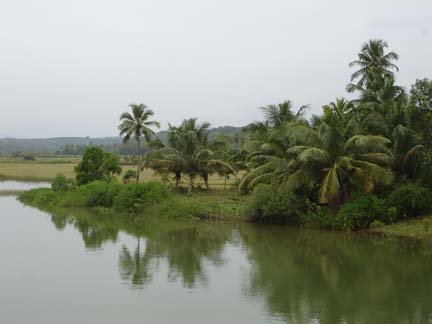
Holegadde near Honavar,Uttara Kannada dist, Karnataka
Copy? Right - but kindly remember to acknowledge!

" tulu-research.blogspot." ತುಳು ರಿಸರ್ಚ್. ಬ್ಲಾಗ್ಸ್ಪಾಟ್. ಇನ್

Have a nice day !