Sunday, March 17, 2019

416. Mogaru: villages on the river plain

 In several parts of Tulunadu we can find a specific place name of geographic significance designated for villages and hamlets located on the river plains or river banks. The toponym is Mogaru. Alternately the toponym is Muger in Tulu. Though both of these are Tulu words, Kannada speaking people preferentially have adopted “Mogaru” (ಮೊಗರು)  into their diction. The alternate Tulu word “Muger(u)” (ಮುಗೇರ್), somehow,  is missing in the mighty work Tulu Nighantu (1997).
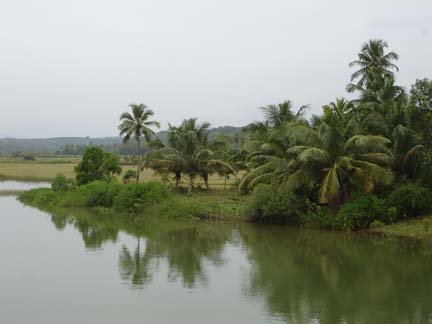
Geography of a Mogaru (river plain): River Netravati plains viewed from Ullal, Mangaluru.


Mogaru/Muger Villages
Some of the Mogaru villages or hamlets are enlisted below:
  
§  Ajila mogaru, near Maninalkur, Bantwal Taluk, on the northern bank of R.Netravati.
§  Ambla mogaru,(Ambala Mogaru) near Konaje Mangaluru , on southern bank of R.Netravathi.
§  Jeppina mogaru Mangaluru, on the bank of R Netravathi
§  Kallimogaru. (Location to be traced).
§  Kodla mogaru, near East of Manjeshwara, Kasargodu district, Kerala
§  Kolla mogaru, near Subramanya, Sullia Taluk on the banks of a tributary to River Kumardhara
§  Kuduta mogaru,(Kudta-mogaru) Bajal, Mangaluru, on the northern bank of Netravathi
§  Mogaru ( Muger) hamlet of  Mundkur village, on banks of R. Shambavi (Mulki)
§  Mogaru, near Muthur, Mangaluru taluk; on the bank of Gurupur River
§  Mogralputhur (Mogral Puttur) in Kasaragod dt Kerala on Madhuvahini River East bank.
§  Nari mogaru,(Nari Mogaru), near Uppinangadi, Puttur Taluk, on the banks of R. Kumardhara
§  Panji mogaru, near Kulur, Mangaluru on the southern bank of R.Gurupur

Etymology of  Mogaru and Muger
The toponym Mogaru can be analysed as moga+aru, wherein “moga” means face or literally the plain or bank facing the river.; “aru” means the edge or the bank of the river. Therefore mogaru means a (river) facing plain.
There is a related word “ara” (plain or open area) which occurs as a common suffix in place names such as avara (av+ara) as in place names: Attavara, Brahmavara, Pejavara, Neelavara, etc. The suffix   aru also might have been a alternate or derived form of ara the plain or open area.
The alternate Tulu toponym Muger can be analysed as muga+er, wherein muga means face (an alternate form of moga) and er means eri or the ridge or slightly raised or elevated area.
The two parallel but equivalent words “Mogaru” and “Muger” could have come from two different tribal sources of antiquity to present form of Tulu. However, nowadays the toponym “Mogaru” is usually considered to be a Kannada word and “Muger” as its Tulu equivalent.

Etymology of Associated words
In many of the Mogaru/Muger toponyms cited above, we can find an associated word  occurring in the beginning part of the place name. 
“Ajila” in Ajila mogaru refers to an ancient tribe probably that inhabited the river plain referring to. “Ajila”, now is also a lineage surname among Jain/Bunt families.
“Ambala” in Ambala Mogaru possibly refers to an temple (Ambala) that existed during the past historical period. “Am” can also refer to a past tribe that inhabited these areas. (These aspects can be discussed later in another post in detail)
 “Jeppina” or” jappina” in Jeppina Mogaru in general refers to slope of the land. It can also mean fall in the level of river or precisely a shifting of the river plain. In fact there are specific geological evidences in this area for earlier existence of  a river (Netravati) which has changed its course further southwards (as found now) due to geological and tectonic  causes in the past history.
“Kuduta” in Kuduta-muger represents horse gram (kuḍu in Tulu; huruli in Kannada) which was one of the earliest type of agricultural crops cultivated in Tulunadu as well as in south India.

“Kodla” in Kodla Mogaru appears to be an alternate form of ‘Kudla’. The term ‘kudla’ is sometimes explained as variant of “koodla” or river confluence. However, if the location does not have a confluence of river it can have an etymology such as: kudu+ala, wherein kudu means horse gram ( earliest grown agricultural crop in these regios)  and “ala” refers to habitations on the bank of water bodies or rivers.

“Kolla” in Kollamogaru relates to an ancient tribe of Kols, (a) versed in metal smelting and /or (Kolli tribes)(b) adapted to fishing.

Kalli in Kallimogaru represents an alternate form of “kallu” which means rocky or stony land surface on the river plain. We find “kallu “ in place names like: Kallamundkur, Kallya, etc.  The Tulu word “kalli” can have alternate explanations as we find in Tulu Noghantu such as (1) a network bag made of the coir fibres, usually used by fisher folks for carrying food/meals in olden days.(2)A measure of length for threads or (3) A cactus plant. However none of these explanations suit the environs of the place name. For example cactus being xerophyte   plant  usually grows in dry lands; however stony surfaces are usual along the coastal terrain.

Mogral in Mogral Puthur is again a compound word ( Mogaru+ala) , etymology of these words/word units  has been explained above sections.

“Nari” in Nari-Mogaru can be (1) a  jackal or (2) tiger. See Post:410
“Panji” in Panji-mogaru refers to pig or hog. Incidentally Panjurli is a reverent Spirit deity in Tulunadu.


Homonyms of Muger
While analysing the “mogaru/muger” place names, one should be aware of the homonyms of the word “Muger”. A homonym is a similar sounding term but having a differing meaning. Tulu language has many homonyms, possibly due its prolonged existence and contact with many tribal groups.

The known homonyms of the term mugger(u) are as follows:
Muger(u)1: Mogaru (described above)
Muger(u)2/Mugger/Muyyer/Mer(u) : A rabbit; hare
Mugger/Muggera/Muggeru/Muger(u)3: refers to (1) members of Mugera (or Mera) tribe or (2) the martyred tribal heroes Mudda and Kalala worshipped by Muggera/Mera community. This is an different word
Though generally some of these alternate term are  pronounced with emphasis on “g”, some regional variants are pronounced very similar to Mugera (ie equivalent of Mogaru/Muger1). Therefore these alternates should not be confused with Muger1.

Geographic significance
Since the place name Mogaru or Muger, specifically addresses an area on the river plain, we can use it for identifying places where the ancient rivers have changed their courses along the historical timeline. For example the Mogaru village, near Muthur  (East of Gurupur Kaikamba) cuts across the Gurupur River. This possibly suggests shifting of the river course since the formation of administrative boundaries of the villages about 200 years ago. Similarly we find that the Narimogru village is found away from river bank which indicates shifting in the course of River Kumardhara in that area. Similarly near the  Kodlamogaru village we do not find any  river now as it has been  shifted. 
The shifting of Netravati River by the side of  Jeppina Mogaru, near Mangaladevi area, Mangaluru, has been discussed in earlier posts in this blog.
The village of Mogral, near Kasargodu, Kerala, is found on the bank of Mogral/Madhuvahini River. Into this old village, the newly grown village area was added subsequently as Mogral-puthur (new village of Mograu+ala) which has grown towards Eastward and consequently we find a large part of the village now  existing away from the flank of river Mogral (or Madhuvahini river). 


Borrowed words
 We have given only a list of Mogaru place names existing in Tulunadu which gives an impression that Mogaru or its variant Mugeru  is an exclusive Tulu word.
In that case, you will be surprised to know that there are about a hundred different places in India that carry the tag of Mogar or any of its variants. How that can be possible? The fact that there exists many such place names all over India suggests that (1) Mogaru is a borrowed word in Tulu and (2) place names in Tulu are not unique to Tulunadu as assumed by some but are part of the pan Indian evolution of languages and culture.
Before Tulu took up a place of pride in Tulunadu there were other languages in these areas, like variants of Prakrit and Munda languages. 
Words along the timeline of prolonged history have  survived   like resistant coins and have been reused by later introduced languages with or without minor changes.

 In this case it appears that Tulu has borrowed these words from Prakrit language that prevailed in the land up to the early centuries of the Common Era.


Related place names
Patla-kanda (ಪಟ್ಲ ಕಂಡ).
Ala (as spatial suffix or prefix).

- Hosabettu Vishwanath
  With  Ravindra Mundkur

Sunday, March 3, 2019

415. Uma-Maheshwara at Attavara

Temples in India have a regular traditional system of renovation usually in a period of twelve years and this is known as Brahma-kalasha ceremony.  Most of the temples have thus been and are being subjected to this classical process of renovation and updating, and as a consequence,   it is but natural that   specific evolutionary features of historical significance embodied   in the ancient temples since their initiation are likely to be modified or subdued. This issue is further complicated by absence or lack of systematic preservation of historical data relating to temples. Dr. Padur Gururaja Rao (19xx ) has made an extensive study of idols installed in temples of Tulunadu and attempted to roughly date them according to the characteristic sculptural features displayed . However, still lot of further work is needed to be done to refine what has been already contributed by Gururaja Bhat. One of the issues faced by researchers appears to be is the lack of access to the idols. To assist genuine students of history those in charge of these sacred renovation ceremonies may (1) provide opportunities for gathering data directly and/or (2)  provide or publish historical information available at their disposal.
This year a number of temples in the region have undergone Brahma-kalasha ceremonies with active participation of the devout public. The temples of Mundkur, Palimar, Polali and Attavara (Mangaluru) have recently have undergone the brahma-kalasha ceremonies.
Uma Maheshwara Temple (renovated)


 Uma Maheshwara
The poster advertisement put up in newspapers on the brahma-kalasha celebration of ceremony of Uma Maheshwara temple at Attavara, Mangaluru, contained an interesting piece of information. It reported that about 200 years ago, while excavating for the construction of District Collectors office in Mangaluru (near the present site of Deputy Commissioners Office) they recovered an idol of Shiva. The idol was shifted to Attavara and was installed in a temple dedicated to Uma-Maheshwara. It is interesting to note that the ancient coastal village around DC office and old port/ Bunder area in Mangaluru was known as Nireshwalya (ie. Neere-Shivalaya)  in old records. (The village name has almost been obsolete and forgotten as people are calling the  locality simply as “ Bundar”.) Anyway, the piece of information suggests that the idol could be a part of the ancient Shiva temple in the ancient  Neere Shivalaya village. Shivālaya means a temple dedicated to Lord Shiva and Neere means the water or the tidal reach between the village and the Arabian Sea. Thus the original idol of Shiva apparently was reinstalled at Attavara as Uma Maheshwara as per the popularity of the deity during the time of reinstallation. Unfortunately, we do not find any temporal analysis or allied information on the idol in Gururaja Bhat’s famous work on Tulunadu temples. Therefore anyone who has additional information on the issue may kindly share it in this blog.

Uma Maheshwara Temple


 However this piece of information may be useful for students of history as it reveals how several  ancient idols and even temples might have been shifted during the course of (unfortunately unrecorded) history. Similar local information on Bappanadu temple, Mulki, suggests that original Bappanadu temple was near the bank of Mulki port which is about 500 meters interior of the present location of the temple.
Since most of the ancient temples have been updated every 12 years, as per the prevalent custom of brahma - kalasha ceremonies, basically designed for stabilization of temples apart from other issues, it is obvious that many of the original aspects of historical significance might have been lost over the years.

Sri Uma Maheshwara Temple Attavara, Mangaluru


Sapaliga-Ganiga community
A note on the Sapaliga –Ganiga community that manages the temple at Attavara, Mangaluru, evidently, since last two centuries appears pertinent here. The interesting note apparently throws light on the tidbits of traditional aspect on how the initial “ bari“ lineages were converted into castes or communities and how the castes in turn were bifurcated into subdivisions  during the past history in our country.
The temple of Uma Maheshwara at Attavara is managed by people of Sapaliga- Ganiga community, probably since last two centuries since the idol was brought from Nireshivalaya (near old Bunder /DC office area, Mangaluru) and installed here.
Members of Sapaliga community are associated with temple music activities in Tulunadu since several centuries, probably dating back to the ancient days of Kadamba king Mayura Sharma (ca. 400 CE), who is credited with rejuvenation of Hinduism and initiating a popular culture of temple based worship. The word “sappaliga” means one who makes sounds (“sappala”) or the music.
The Ganigas in Tulunadu  are traditional  oil extractors, known for drawing oil from coconuts  abound in the coastal region.
The common association of Sapaligas and Ganigas especially popular in Mangaluru and Bantwal region suggests that members of these communities shared professions in the historical past.

Offshoot of Mogaveera community
However it is interesting to note that matrimonial alliances between members of Sapaliga and Marakala (Mogaveera) communities are commonly accepted even today, especially in Udupi-Karkala and northern part of Mangaluru   regions. Old people in the community used to report   that during olden days volunteers for the temple service, as  Sapaligas, were drawn from the members of Marakala/Mogaveera community during the historical period. And as a vestige of the old custom even today matrimonial relationships continue among these community members. It can be seen that members of these communities share similar and common bari lineages which are older in historical perspective than the castes proper.
R

Wednesday, January 30, 2019

414. Tulu Koota in Pimpri-Chinchwad, Pune


Tulu koota, 27 th January 2019,Chinchwad, Pune (Photo courtesy: Shri.Shekhar Poojary, Chitrapu)

There is a surge of Tulu speaking diaspora coming together and forming Tulu Koota, a Congregation of Tuluvas, in many parts of the land. This is a new nomenclature for ‘Tulu Chavadi’ (= Tulu Meeting Hall), which are active in some cities of Karnataka.   This enthusiastic Tuluva Pride was enkindled by the first ‘Tulu Vishwa Sammelana-2009’ (Tulu International Conference) held between December 10 and 13, 2009 at Ujire near Dharmasthala in Dakshina Kannada District.  Blogs in Tulu and Kannada are proliferating, bringing out Tulu Psyche in writings and pictures.   Age-old tradition of Divine Spirit worship (Bhootaaraandhane), temple festivals, Yakshagana and pastimes are depicted in YouTubes.  Enthusiastic participation of youth is noteworthy.  Traditionally, Tuluva culture encompasses all class, caste and creed of Tulu Nadu, now known as Dakshina Kannada District and Udupi District.

Being a sort of recluse, I rarely attend social functions, that too late night programmes.  As an exception, I attended perforce a Tulu Koota in Chinchwad on an open invitation on 27th January.   By a very long and continuous stay, I am a Maharashtrian by domicile.  Things change in ones life.  Circumstances in my life need my presence more in native place.  That is why I used the word ‘perforce’ as I wanted to be an audience being at Pune.

Tulu Koota is vibrant in Pimpri-Chinchwad Municipal Corporation area for the last seven years as a Wing of the Tulu Koota Pune City. It was arranging Sports & Games and helping other needy persons.   First one of such Koota is attended by me.  The Annual Gathering held on 27th January at Ramakrishna More Sabhagriha, Chinchwad is unique and eventful.  It is eventful because it is now working as a self-luminous mantle under the name “Tulu Koota Pimpri-Chinchwad”. 
The honourable guests, who decorated the dais along with President Shri Harish Shetty and other office-bearers of Tulu Koota, are: Sarvashri Santosh Shetty (President of Bunts Sangha, Pune and guiding force behind the construction of Bunts Bhavan along National Highway near Balevadi), Raghupati Bhat (sitting MLA of Udupi), A. Gopala Anchan (Member of Tulu Sahitya Academy, Mangalore) and Kudhi Vasant Shetty (Principal of Kudhi Vishnumoorthi High School and President of India Awardee for Best Teaching at the hands of Hon. Pranav Mukherjee).

The highlights of the Programme are:
1. Show of Tuluva culture at the entrance.
2. Welcoming the Guests with much fanfare.  The procession is led by Chande-beating team (in Tuluva style) and trumpeters (in Maharashtrian garb), followed by Kalash-holding ladies’ group and four children in traditional Yakshagana attire.
3. Programme started on lighting of the lamp around 4 pm with Invocation Prayer to Lord Ganesha, Rasa Manjari of Singing, and variety entertainments by members. Nutan Suvarna interviewed threeShetty-housewives Jaya-Jyoti-Prema.  They shared their life experience, blend with duty and patience, with their enterprising husbands, who are also doing social activities. 
4. Last was the performance of award-winning Tulu Nataka ‘Manni’  by Mumbai Party.It was with a theme of motherly love.  It moves around an obscure mother of a girl baby, abandoned by her family.  The baby suffers at the hands of her grand-mother and grows with specially-abled body.  The hapless mother becomes a surrogate mother to an NRI couple and gives birth to another special baby girl due to infirmity in donor mother.  Donor mother forsakes the child and goes back to foreign land.  Hospital doctor asks surrogate mother to take care of the child or otherwise they would have to give the baby to Anathashram whereupon she readily accepts to shower her motherly love to the hapless, irrespective of safe-guarding the child with financial help by donor mother. The drama happily ends with the hospital doctor-couple adopting the child.

5. Raghupati Bhat spoke about the endearing qualities of the Tuluvas and honied Tulu Language, which attracts a Tuluva wherever he is to another Tuluva.  He appreciated the Tuluva Diaspora who create a Mini Tulu Nadu to uphold the age-old traditions.  He urged the necessity of brushing shoulders with Tulu diaspora by main-land Tuluvas.He showered all praise to the Tulu Drama.

6. Gopala Anchan gave a brief sketch how Tulu Sahitya Academy is striving to popularise Tulu Lipi and teaching of Tulu in Schools and colleges.  He pinpointed the divergent ways in observing Tuluva rites an exhorted them to do a heart-searching and to eschew glorification in worship of Daiva-Devas.  He tried to bring home the point of difference in ‘Moola Aradhana Paddhati and Andhashradde.

7. Vasanta Shetty spoke about originality of Tuluva faith and belief, agro-based nature-worship and culture, family bond and worship of manes.  He spoke about confusions created by Sanskritisation of names of Divine Spirits.  He gave some examples of what are superstitions and what are not.

8. The specially invited Guests Santosh Shetty and his wife Divya were honoured as the Achievers of the year.


The Programme ended (around 10.30 pm or so) with honouring of some other guests, Thanks giving and Sneha Bhojan.

Tail-Piece
Salutation to you, the Tuluva Mother!   It would not be out of place if we reproduce a Tulu Poem (Post-24/29.07.2017), published earlier in our Tulu Blog: poomaale.


ಓಲಗ ಓಲಗ ತುಳುವಪ್ಪೆಗ್

ಪೂರ್ವ ರಂಗ – ಜಯಕಾರ
ಬಲ್ಲೆ ಓಲಗವಾಲೆ ತುಳುವಪ್ಪೆ  (ಪಲ್ಲ)
ಈರೆ ಜೋಕುಲೆನು ತೂಲೆ ಎಂಕೆಲೆ ಅಪ್ಪೆ
ಪತ್ತುದೆರ್ ತುಳುನುಡಿ  ಬಾವುಟೆ ಕೈಟ್ ಪೂತ ಮಾಲೆ  (ಅನುಪಲ್ಲ)

ಬೊಮ್ಮನ ರಾಣಿ ಸರಸ್ವತಿ ಕುಳ್ದೆರು  ಸಾರ ಎಸಳುದ ತಾಮರೆಡು
 ಆರೆಗು ಜೋಕುಲು  ದಿಂಜ  ಎಸಳುದ ಕೊಡಿದಂಚ
ಸಾರುವರ್ ಆರೆನ ಮೈಮೆನು ಆಕಲಕೆನ  ಬಾಲ ಬಾಸೆಡು
ಆ ಸಾರ ದನಿಕು ಪಣ್ಪೆರು ಸರಸ್ವತಿ ಸೇವೆ ಸ್ವರ ಸ್ವರ ಕೂಡಿನಂಚ              || 1 ||

ಬಲ್ಲೆ ಓಲಗವಾಲೆ ತುಳುವಪ್ಪೆ 
ಈರೆ ಜೋಕುಲೆನು ತೂಲೆ ಎಂಕೆಲೆ ಅಪ್ಪೆ
ದೆರ್ತು ಪತ್ತುದೆರ್ ತುಳುನುಡಿ ಬಾವುಟೆ ಕೈಟ್ ಪೂತ ಮಾಲೆ 

ನಮ ನಾಡುಗು ಪಣ್ಪೆರು ತುಳು ನಾಡು  ಪಚ್ಚೆಪೈರುದ ಪೊರ್ಲು
ಮಿತ್ತ್ ತುಂಗ ಸಹ್ಯ ಶೃಂಗ ತಿರ್ತ್ ಕಡಲು ಜಲತರಂಗ
ಬಡಕಾಯಿಡ್ ಭೃಗುಮಂಡಲ ತೇಂಕಾಯಿ ಕಣ್ವ ಮಂಡಲ
ಓಲಗ ಓಲಗ ಭಾರತಿ ಕುಮಾರ್ತಿಗು ತುಳುವಪ್ಪೆಗು                                 || 2 || 

ಬಲ್ಲೆ ಓಲಗವಾಲೆ ತುಳುವಪ್ಪೆ 
ಈರೆ ಜೋಕುಲೆನು ತೂಲೆ ಎಂಕೆಲೆ ಅಪ್ಪೆ
ದೆರ್ತು ಪತ್ತುದೆರ್ ತುಳುನುಡಿ ಬಾವುಟೆ ಕೈಟ್ ಪೂತ ಮಾಲೆ  

ಸರಸ್ವತಿ ಜ್ಞಾನ ಸರಿತ್ಸಾಗಾರ  ಆರೆ ನಂದಿನಿ ಈರು ಬಂಗಾರ
ಕಡಕಡಲು ಸಾರ ತುದೆ ಕಡತುದು ಬತ್ತೆರು ಎಂಕೆಲ ಹಿರಿಯಾಕುಳು
ಈರೆ ನುಡಿ ಪತ್ತುದು ಉಂತಿಯೆರ್ ಈ ಕೆಂಪು ಮಣ್ಣುಡು ದಿಂಜಿದುನು ಸಾರ
ಕಾಡು ಕಡ್ತೆರು ನಾಡು ಮಲ್ತೆರು ಬೆನ್ನಿಯೆರ್ ಒಡಿ ದಾಂತಿನಿತ್ತಿನ ಕಂಡೊಡು     ||3||

ಬಲ್ಲೆ ಓಲಗವಾಲೆ ತುಳುವಪ್ಪೆ 
ಈರೆ ಜೋಕುಲೆನು ತೂಲೆ ಎಂಕೆಲೆ ಅಪ್ಪೆ
ದೆರ್ತು ಪತ್ತುದೆರ್ ತುಳುನುಡಿ ಬಾವುಟೆ ಕೈಟ್ ಪೂತ ಮಾಲೆ  

ಜಯತು ಜಯ ಜಯತು ಜಯ ಈರೆಗು ಪನ್ಪ ಜಯಕಾರ
ಈರೆ ಬಂಜಿಡ್ ಬತ್ತಿನೆಕೆಳೆನ ನುಡಿ ನಮನ ಮಮಕಾರ
ಜಯಜಯತು  ಅಪ್ಪೆ ಈರೆನ  ಮಂಗಳಾಚರಣ
ಈರೆ ಪೆರ್ಮೆನು ಪದ ಕಟ್ಟುದು ಪಣ್ದು  ತುತಿಪೆರ ಕೊರ್ಲೆ ಎಂಕುಲೆಗ್ ತ್ರಾಣ

ಬಲ್ಲೆ ಓಲಗವಾಲೆ ತುಳುವಪ್ಪೆ 
ಈರೆ ಜೋಕುಲೆನು ತೂಲೆ ಎಂಕೆಲೆ ಅಪ್ಪೆ
ದೆರ್ತು ಪತ್ತುದೆರ್ ತುಳುನುಡಿ ಬಾವುಟೆ ಕೈಟ್ ಪೂತ ಮಾಲೆ                  ||4||

--- ಕರ್ತವೆ:  ಹೊಸಬೆಟ್ಟು ವಿಶ್ವನಾಥ್ (ಪುಣೆ)
Hosabettu Vishwanath, Pune

Monday, January 7, 2019

413. Milestones in the evolution of Mulki region


The region around Mulki has been significant historically since ancient times. However we do not find the place Mulki in very old historical documents! The actual position of the Western coastline has eventually changed during the Holocene geological period due to gradual regression of the sea.

The oldest recognizable cultural core in the region at present happens to be the land of legendary Siri, surviving in Tulu folk-lores (Siri pāḍ’dana). It is  located to the East of Mulki town. The ancient home land of Siri, as documented in the folklores, consists essentially of villages and hamlets of Bola, Sacheri(pete), Kotrupadi and Kadandale.

It is difficult to conclude now whether Siri pāḍ’dana was based on an actual event or a fiction. However, the essential geographic data embodied in the pāḍ’dana, coupled with its indirect cross reference to the Satiyaputo in the emperor Ashoka’s Girnar rock edict,  makes it a historically momentous document.

The River Shambavi that flows by the North side of Mulki, is connected etymologically to Udyavara, in the North represented by the historically significant Shambu-kallu hillock.

In the modern times, Karnad Sadashiva Rao was a prominent freedom fighter from the West Coast who brought laurels to the place Karnad, a suburb of Mulki.  Recently there has been a good article on the historical aspects of Mulki in Kannada by Dr. Vamana S.S, entitled  ನಮ್ಮೂರು ಮೂಲಿಕೆ (ಮೂಲ್ಕಿ)” published in the Mumbai monthly “Mogaveera” (September 2018).  At this juncture let us collate and review the available historical and geological data.

GEOGRAPHY: PRESENT AND PAST

Presently, we do not find Mulki port town right on the coast but slightly inland being guarded by two rivers namely Shambhavi and Pavanje that join and debouch their fluvial contents into the Arabian Sea near Sasihitlu.   Two barrier spits extend from the sandy coastal banks of R. Shambhavi (Mulki River) and R. Pavanje (Nandini), in opposite directions, parallel to the beach-line that terminate near the estuary of Sasihitlu. (Earlier in this blog a post (Post 305) was written on Mulki the emergent land.)

The  geomorphology of the West Coast has evolved with time. In the past the features were much different!
Before a few centuries, the rivers Shambhavi and Pavanje were joining the Arabian Sea independently like other coastal rivers at that time. Then, Shambhavi river had a direct access to the Sea and  the of old Mulki port was located close to the sea mouth or the estuary.  Further with passage of time, as the sea receded westward, the position of the old sea port of Bappanadu, Mulki, remained inland.
Current geography of the region around Mulki, with ancient Siri homeland located to the East (click to enlarge).

There are a few evidences preserved in the local place names corroborating   the geographic changes in the flow channels of the Shambhavi/Mulki River during the past history. A note on the place name ‘Olalanke’ is pertinent here:

Olalanke: The ancient place name Ola-lanke is an interesting geographic toponym, as it suggests (1) the presence of an island within the river Shambhavi. (Ola =inner, inside river; lanke=island) in the past and (2)  shifting of the old river course such that the old river island was transformed into a land area. In other words, the locality Olalanke originally represented a kuduru or an island within the river. Due to subsequent changes in river geomorphology such as migration of river flow path, it became part of the mainland, as it exists now.
(However, there are a few legendary anecdotes in the area attempting to connect the place name ‘Olalanke’ with the renowned “Lanke” of Ramayana.)

Westward emergence of coastal land concurrent with regression of sea
The sea coast has gradually receded during the past, revealing the land of Mulki around 2nd to 3rd century CE. In fact, similar   recession of the Arabian Sea occurred all along the West coast and consequently, the original sea front locations of the ancient ports became inland with regression of the Sea.   Thus presently we find the ancient ports of not only Mulki but also Basrur, Barkur, Udyavar  and Alape (Mangaluru East) in inland locations (For corroborative documentary evidences,  on spatio-temporal changes in Gurpur river, read our Post  98).

The regression of the West Coast was a gradual and continuous event and if travel backwards in the history,  we find that whole Mulki and the region East of it was under the Sea.

 In retrospection, if we go back further in time some 2500 years or more, we find that then the Sea coast existed somewhere near Sacheripete (Mundkuru) and Bola ! That is to reiterate that then all the land now to the West of Sacheripete/Bola were covered under the Sea.

In Siri pāḍ’dana, there is glaring absence of present coastal place names such as Mangaluru, Mulki, Malpe, Udupi and Kundapura etc. Since these land parts were recovered from the sea as a result of marine regression,  the absence of current coastal places in the folk lore corroborates  the event of marine retreat  of the Arabian Sea. The regression of the sea is also documented in the legend of creation and retrieval of land from the Sea, popularly attributed to legends of Parashurama.(Post. 102)

About 2500 years ago: Satiyaputo/Satyanapura

In fact the places, Sacheripete and Bola, were the places of center of action described as “Satyanapura” in Siri pāḍ’dana  which appears to date back to some 2000 years.

Ashoka’s rock edict
 The rock edict of Girnar, attributed to King Ashoka ( ca 304-232 BCE) mentioned “Satiyaputo” along with other (neighboring) ancient South Indian States like Chola, Pandya, and Keralaputo.  The rock edict declares that in these regions ( implying that even though not included in his kingdom),    King  Ashoka provided the people with or arranged for  necessary medicinal herbs, roots and edible fruits along with providing facility of drinking water wells as popular welfare measures. The region mentioned as Satiyaputo in the rock edict has been considered to represent the ancient Tulunadu by several historians. (Budhananda Shivalli, 1982).

Ancient land of Siri - East of Mulki
 A perspective analysis of the places associated with Siri pāḍ’dana (as shown in the map) suggests that “Sacheri (-pete)” happens to be the modern equivalent place cited as “Satiyaputo”.
It appears that the Satyanapura was on the sea coast some two millennia ago. In other words, during the period of Satyanapura and Siri pāḍ’dana, there was no Mulki and the relevant land was under the sea!
Some of the relevant inferences in this regard are enlisted here below:

1. In the folk lore of Siri we find the name of Satyanapura near Bola, as the home of legendary brave woman Siri, popularly known as Tulunada Siri.  The homeland of Siri and her father Birumalva was ‘Satyanapura’ in Bola village according to pāḍ’dana.

2. The Satyanapura described in Siri pāḍ’dana can be matched with the  Prakrit equivalent term of Satiyaputo cited in the King Ashoka's rock edict.  The reference to Satiyaputo in the rock edict suggests that the region was well known by the time of Ashoka.

3. Presently, there is no place specifically known as ‘Satyanapura’ or ‘Satiyaputo’  in the West coast of India. However, south of Bola village and West of Kadandale village (both villages mentioned clearly in Siri pāḍ’dana) there is a hamlet known as "Sacheripete". 
The alternate Prakrit/Pali word ‘sach’(=truth)  in Sacheri (sach+yeri= mound of truth) corresponds to “satya” (=truth)   and “satiya” (=truth)   of Siri pāḍ’dana and King Ashoka edict respectively. 
In fact, the ‘satya’ (or ‘satyolu’, plural) is the usual term used in Tulunadu since antiquity to refer to the eternal aspect of the divine spirits.
Thus the hamlet presently known as Sacheri-pete (now within Mundkur village) near Bola village holds key to the mystery of the elusive Satiyaputo.

4. In case the,  Satiyaputo in Ashoka's edict refers to the Satyanapura of Siri pāḍ’dana, then it takes the date of Siri pāḍ’dana to an older period in the time frame of 250-100 BCE.

5. Siri pāḍ’dana mentions only one God or divinity known as “Bermer”, which was the ancient form of worship  that existed in several parts of ancient India, rudiments of which still prevail in Tulunadu. (There is a reference to the dilapidated shrine of Bermer, on which, Birumalva ,Siri’s father,  focuses his attention to repair it.)

6. In Siri pāḍ’dana, we find reference to only those places lying  around and to the East of Bola-Sacheri-Kadandale. Basrur port in the North is mentioned (as Siri’s husbands place) but the current well known coastal towns such as Mangaluru, Mulki, Udupi, Udyavara, Kundapura etc are not found. Note that  Karla (Karkal) town located to the NE of Bola finds mention as a major town where one could buy wedding saris !

7. Based on the presence of abundant Prakrit derived words in Tulu and Kannada it has been   suggested that the Prakrit was the administrative language during early part of the common Era.(Shettar, 2014). Thus it is possible that the original version of the Siri epic could have been composed in Prakrit and later translated into Tulu pāḍ’dana (folklore) form.

8. The epic qualities of the Siri pāḍ’dana resemble Sangam literature of Tamil. Thus the folk lore appears to have been inspired from the Sangam literature and we may recognize it as a product of  “Tulu Sangam” literature that ran parallel to Tamil Sangam.


The glaring absence of present coastal place names such as Mangaluru, Mulki, Malpe, Udupi and Kundapura etc in the Siri pāḍ’dana further corroborates an major event of marine regression. It is also corroborated in the popular legend of creation of land retrieval of land from the Sea attributed to sage Parashurama is a real and natural geological event !

Early centuries of Common Era: Siri alaḍe
Many of the Tulu moolastānas that represent the original settlements (or ancient tribal settlements of primary order) of the immigrant Tulu tribes, have been attached or equated to alaḍes. 

Since most of the narrations in Siri pāḍ’dana are realistic social events, we may assume that the epic was based on a natural incident. Following the popularization of the Siri pāḍ’dana, a number of “Alaḍe” (ancient centers of worship) were developed around the Siri land centered on Bola village. (Alaḍe: āla = water ḍe =place; or, holy place beside water body). 

Usually these Siri Alaḍe are referred to as Adi Alaḍes suggesting their historical antiquity.  Thus Siri alaḍe were established in villages around Bola such as Kavatar, Nandalike, Hiriadka, Pangala, Kandevu (Chellair) and Nidigal (Kanyadi).

Two of these places - Nandalike (Karkal Taluk) and Kavatar (Mangaluru Taluk) are close to the original Siri homeland, where as Pangala ( near Udyavara,  Udupi Taluk) and Kandevu (Chellairu near Surathkal, Mangaluru Taluk) are proximal to the coast. Hiriadka must have been an ancient center of traditional worship in those times. Only Nidigal (Kanyadi village, near Dharmastala, Beltangadi Taluk) on the banks of River Netravati is a relatively far off place from the Siri homeland. Notably there are no popular Siri shrines in Kundapura/Basrur region which was Siris first husband's place according to the pāḍ’dana. (Please correct me if any reader has more information on this aspect).
Location of Siri Alades in Dakshina Kannada & Udupi districts, Karnataka (Click to enlarge)


The Siri alade are characterized by a different  pattern of worship compared to other Spirit worships. Besides impersonation of characters in Siri pāḍ’dana such as Siri and Kumara, the festive congregation also witnesses convulsions of mass effects of possession and or trance.

Birumalva:  
In the Siri pāḍ’dana the name of the Siri’s father is given as Birumalva. Note that the term “Biruma” represents alternate form of the word Berma or Bermer. The basic doubt historians may get is whether Birumalva was an Alupa chieftain or connected to the Alupa dynasty of rulers?  We have no corroboratory data on this as there are no mention of  places like Alupe or Mangaluru or any hints on Alupa rulers in the available texts of Siri pāḍ’dana. It could be that the suffix Aluva in Birumalva’s name  possibly refers merely to his status as a member of a past ruling family and may have been added by the pāḍ’dana reciters later on. It may or may not have any connection with the Alupa ruling families.

However, the setting of the Siri pāḍ’dana clearly evinces that Satyanapura as well as the shrine of Bermer gunḍa were in dilapidated form when the original narration of Siri pāḍ’dana was going on, and thus, indirectly suggesting that once upon a time  these were in good shape. 
This setting further prompts us to infer that there were past days of glory of Satyanapura (or Satiyaputo) before the Siri pāḍ’dana event. 
The earlier period of  glory probably prompted King Ashoka to include reference to Satiyaputo in his rock edict. 
It is possible that after the period of installation of the cited rock edicts (ca. 250 BCE), Satiyaputo/Satyanapura saw bad days and then the main events of Siri pāḍ’dana occurred. This inference would place the date of Siri pāḍ’dana  events somewhere between 250 BCE and 100 CE.

Alupa rule at Udyavara
Members of Alupa family (of chieftains) ruled major parts of Tulunadu and parts of Malenadu (Humcha, Banavasi) for some 1000 years,  probably between the years ca.400 and 1400 CE. However, established inscriptional evidence of their reign begins around 650 CE, when Aluvarasa I was associated with Kadambas at Banavasi (Gururaja Bhat, 1975). Banavasi is located in Uttara Kannada district.
 It has been considered that Alupas migrated from Alupe / Mangalapura to Udyavara early 7 th century. There are known inscriptions relating to Alupa rulers in Udyavara have been dated to ca. 730 CE and later up to about 10th century CE.
So far there have been no inscriptions related to Alupas at Mulki or East of Mulki. However, a historical word clue on Shambu and Shambhavi possibly unites the area of Mulki with Udyavara.

Alupa period: Shambu and Shāmbhavi: 
River Mulki is traditionally known as Shāmbhavi, a name of the mother goddess, which is the feminine form of Shambhu. Note the suffix –avi (=mother) in the word Shāmbhavi. River Shambhavi originates near Alladakyār in Karkal Taluk. Two tributaries, namely Goldendi stream from Irvattur and Renjala stream from Renjala,  join to form the initial source of River Shāmbhavi.
The name Shambhu representing Lord Shiva, though relatively less common in usage we find it applied to  a dome shaped granite rock, hosting an ancient (8th century CE temple dedicated to Shiva)  named as Shambhu-kallu in Udyavara, located about 20 km to the north of Mulki. This provides clues to infer that Mulki to Udyavara was a contiguous political-administrative unit during the early history of the terrain.

Bappanadu Durga Parameshwari Temple
Legends and lore abound in the region describe that one day during the undated early history  ship of a Muslim merchant by name Bappa was stranded near the Mulki port due to inclement weather. Locals advised him to pray to the Goddess of the region for relieving the stranded boat. Accordingly, after due prayers and physical help from the natives, the merchant Bappa was able to retrieve the stranded boat and its merchandise successfully. It is said that merchant Bappa arranged for the construction of a temple dedicated to the Goddess Durga Parameshwari near the port. In honor of the merchant Bappa, the locality was named as Bappanādu, which popular place-name is prevailing even today. Based on the history of other Durga temples in the West Coast, the original Durga temple of Bappanadu can be dated between 8th and 10th centuries CE.
The local people describe that the original Durga temple was near the old Mulki port before it was shifted to its current position on account of the dilapidation of the ancient structure.

Vestiges of Buddhism
Similarly, vestiges of evidences of Buddhism in the region, such as involvement of the members of  Thiyya/Belchada community in the traditional temple car festival celebrations even now, suggest that the temple was originally  an ancient shrine of Bhagavati worship  which was transformed into Durga temple under the profound influence of revivalist sage Shankaracharya (788-820 CE) probably during the early part of 9th century CE. Before recent renovation of the Bappanadu temple, there were wheel symbols in the front stone facade of the old temple. Such symbolic wheel designs are commonly associated with Buddhism in the temple architecture.

Administrative structure: 
Dr Vaman (2018) begins with introductory notes on earlier pattern of administration vogue in ancient Tulunadu. Earlier, typically the States in Tulunadu were the principal   administrative divisions, with each State made of ten “māgaNe (ಮಾಗಣೆ). Each māgaNe” traditionally consisted of four to five contiguous villages. Each village had four   leaders known as “Gurikars” (ಗುರಿಕಾರ).
The village level administrative structure altered after the Jain chieftains took over. A Jain Ballāl or Heggaḍe was appointed as the administrative head of each māgane. Further, each village had two ‘bhāva’, one ‘bālike’ and a ‘parāri’. In this case, the old Mulki State consisted of nine māganes.

Samantha chieftains, 15-16th century 
Rulers of Samantha dynastic family occupied Mulki town during  circa 16th century. Before adopting Mulki they were residing and ruling from  Shimanthur village, located to the East of Mulki. The Kotekeri (koţe=fort; keri= residential zone) area in Eastern Mulki contains relics of the fort built by Samantha rulers of Mulki. Chandranatha basadi and Hanuman temple located in the area are also attributed to the Samantha rulers.
Samantha chieftains defended Mulki   from the Portuguese and the Keladi invaders within their means. Keladi  Venkatappa  Nayaka seized the fort from the Samantha chieftains. Later Haider Ali and Tippu Sultan have occupied the fort from Keladi Nayaks. Subsequently, the Samantha chieftains shifted their base to Panambur located to the South of Mulki.

Mulki Port: It is interesting to note that the old sea port of Mulki is situated about a km East of the coastline near Kadavina-bāgilu (“ferry gate”) and Mānampadi, on the southern bank of River Shāmbhavi. The old Mulki port, built around the year 1705 CE, was used in the past for international marine trade involving Arabs, Dutch and Portuguese merchants. However, the old Mulki port existed several centuries before the arrival of Portuguese, and then the port was at the earlier estuary of River Shambhavi.
During the post-Vijayanagar phase, early 18th Century CE, the Portuguese collected tax on the merchandise in the port under permission from the Keladi rulers of the period. During the period larger ships could not enter the Mulki port on the banks of Shāmbhavi, hence the ships used to anchor in the Arabian Sea west of Mulki and the merchandise was transported inland to the port by boats with the help of native Mogaveera workers.

The Portuguese by virtue of constructing the port dock, in early 18th century CE, collected taxes on the merchandise, with permission from the Keladi rulers of the time. Though the available record mentions the construction of the Mulki port on 1705, other circumstantial evidences suggest that the port existed there before the Keladi /Portuguese period. 

ORIGIN OF THE PLACE NAME :  MULKI

Herbs.. or new land ?
 Dr. Vaman, suggests that the place name “Mulki” was derived from: “moolike” (=herb); it was also known as “moolikapura” which on translation means the town of herbs. People believe that the Moolikapura later became Moolike and further later on Mulki. Several other earlier authors have also expressed similar interpretation on the origin of this place name.

Emergent land
However, we can trace the real origin of the place name to a Prakrit /Munda word “mulk “ (or > “mulki”), which simply means the land or more specifically connotes to the new land emerged from the Sea, possibly during the early centuries of the common era.

Prakrit/Munda was the administrative language of this coastal land during the early centuries of Common Era (CE) (see also Shettar, 2014) , as is explicitly evident in the presence of numerous place names of Prakrit/Munda origin in Tulunadu (as also in other parts of India). Thus, the place name Mulki can be traced to the beginning centuries of the CE when the new land emerged by the regression of the Arabian Sea.

Mulki= land;   derived from “mulk”,  a Prakrit/ Munḍa word.

Indirectly, the place name Mulki suggests that Prakrit/Munda were the common administrative languages in the region when the land of Mulki was emerged from the Arabian  Sea in the early centuries of CE.
 Incidentally, the Tulu word muluku (muruku; murunku) (=to sink or submerge) also sounds close to the Prakrit word mulk, as suggested by Hosabettu Vishwanath.

Prakrit/ Munda words in Tulu, Tulunadu
There are a plethora of ancient words in Tulu language as well as in place names Tulunadu. Several years ago we pointed out strange sounding place name words in Tulunadu, whose meanings are either not known or wrongly interpreted because of confusion! With further analysis and interpretations we found most of these strange words in Tulu are of Prakrit / Munḍa origin.
Note that even today we commonly use the Prakrit word “barsa” (ಬರ್ಸ) for rain; we have almost forgotten the original Dravida/Tulu word for rain: “mare” (ಮರೆ) - incidentally, which later became “male” (ಮಳೆ ) in Kannada.  Also note that the Dravida/Tulu word ‘mare(ಮರೆ) still survives in the Tulu word ‘mariyala(ಮರಿಯಾಲ) for the rainy season!
Saraswath settlers
During the ruling period of Samantha Dugganna, (17th Century CE) witnessed the exodus of many members of Saraswaths and Gowda Saraswaths communities from Goa towards South, owing to persecution of  Hindus by Portuguese occupants of Goa. Many of the immigrants settled in and around Mulki and Karnad. The installation of Ishvara temple at Kotekeri and Venkataramana temple at Olalanke are attributed to the Saraswath and Gowda Saraswath settlers in Mulki.


REFERENCES

Budhananda Shivalli (1982). “Tulu Patero”. (in Tulu language).  Mandira Prakashana, Mangaluru-575001, 2004, p.317.
Gururaja Bhat, P.( 19 75 ) Studies in Tuluva culture and history. P. Reprint 2014. Padur Gurauraja Bhat memorial trust, Udupi-576101.p.452+plates 448+xxxvii
Shettar,S (2014) Halegannda: Lipi, lipikara, lipi vyvasaya, p.528. Abhinava, Bengaluru.
Vamana, S.S, Dr.(2018) “Nammuru Moolike(Mulki). ”ನಮ್ಮೂರು ಮೂಲಿಕೆ (ಮೂಲ್ಕಿ)” (In Kannada), Mogaveera, Kannada monthly, Andheri (East), Mumbai, September 2018, vol 79, no.3, pp.44-47.

R

Blog Archive

Books for Reference

  • A Comparative Study of Tulu Dialects By Dr. Padmanabha Kekunnaya. Govinda Pai Reserach Centre, UDupi. 1994
  • Koti Chennaya: Janapadiya Adhyayana. By Dr. Vamana Nandavar. Hemanshu Prakashana ,Mangalore.2001.
  • Male kudiyaru. Dr B. A.Viveka Rai and D.Yadupathi Gowda, Mangalore University,1996.
  • Mogaveera Samskriti By Venkataraja Punimchattaya. Karnataka Sahitya Academy.1993.
  • Mugeraru:Jananga Janapada Adhyayana. By Dr Abhaya Kumar Kaukradi.Kannada & Culture Directorate,Bangalore & Karnataka Tulu Academy, Mangalore,1997.
  • Puttubalakeya Pad-danagalu. Ed: Dr B.A.Viveka Rai,Yadupati Gowda and Rajashri, Sri Dharmasthala Manjunatheswara Tulu Peeta. Mangalore University.2004
  • Se'erige. Ed:Dr K.Chinnapa Gowda.Madipu Prakashana,Mangalagangotri,2000.
  • Studies in Tuluva History and Culture.by Dr P Gururaja Bhat (1975).Milagres College,Kallinapur,Udupi.
  • Taulava Sanskriti by Dr.B.A.Viveka Rai, Sahyadri Prakashana,Mysore 1977
  • TuLu naaDu-nuDi By Dr.PalthaDi Ramakrishna Achar, Puttur.
  • TuLu NighanTu. (Editor in Chief: Dr U.P.Upadhyaya, Govinda Pai Research Centre,Udupi. Six volumes. 1988 to 1997
  • Tulu Patero-A Philology & Grammar of Tulu Language by Budhananda Shivalli.2004.Mandira Prakashana Mangalore. p.317. (The book is in Tulu Language using Kannada script)
  • TuLunadina ShasanagaLa Sanskritika Adhyayana. By Shaila T. Verma (2002) Jnanodaya Prakashana,Bangalore, p.304.(Kannada)
  • Tuluvala Baliyendre. Compiled by N.A.Sheenappa Hegde,Polali,Sri Devi Prakashana,Parkala,1929/1999

A Coastal estuary

A Coastal estuary
Holegadde near Honavar,Uttara Kannada dist, Karnataka

Copy? Right - but kindly remember to acknowledge!

Creative Commons License
This work is licensed under a Creative Commons Attribution 3.0 License.

" tulu-research.blogspot." ತುಳು ರಿಸರ್ಚ್. ಬ್ಲಾಗ್‌ಸ್ಪಾಟ್‌. ಇನ್

" tulu-research.blogspot."  ತುಳು  ರಿಸರ್ಚ್.  ಬ್ಲಾಗ್‌ಸ್ಪಾಟ್‌. ಇನ್
Have a nice day !