Contributed by Hosabettu Viswanath
Since my contribution on ‘Bailare’ (Post 120), I was thinking about the irretrievable damage done to ‘Bailare of Hosabettu (Olden name ‘Posodi’ ) and onwards. For that matter, such wanton damage is also true to Bailares elsewhere.
Genesis
Genesis of degradation of this Bailare starts from the time of construction of feeder road to Hosabettu (in late fifties) and other areas in early sixties to mitigate the difficulties of coastal people during monsoons and the creation of artificial harbour at Panambur in early seventies. This is the irony of development. Analogy may be drawn to the present-day craze of authorities in having Special Economic Zones on fertile lands. The then Prime Minister of India late Shri Lal Bahadur Shastri, who coined the slogan of “Jai Kisan, Jai Jawan”, expressed his surprise, while laying the foundation stone for the new harbour, on the sanity of choosing that fertile agricultural land to go under sea water.
Emotional attachment
Bailare is a vast low lying arable land, fed by natural water course, i.e. storm water from adjoining elevated areas around Hosabettu. This Bailare, alongside NH-17 on the West, starts from Hosabettu and now extends upto Chitrapur/Baikampady, where it is by-passed to Arabian Sea through a man-made outlet. Earlier this Bailare stretched right upto Panambur/tip of Kulur (West) before joining Gurupur River naturally. In the casuarinas’ grove (chauri pady), skirting the beach, of Pancha Catte (P.C.) House in Panambur we had a Citizenship Educational Camp (Nagarika Shikshan Shibira) some time in 1953-54. I have connection to four sons of this House. Two scions were my teachers at Iddya Vidyadayinee School, of whom I was the favourite of late PC Vasudeva Rao, third - my SSLC mate (brother of PC) and the fourth was my colleague at Century Enka (brother of Ratnakara Rao Kavoor - amateur dramatist in Mangalore). I ensconced my emotional attachment to this Bailare in a poem (Ondu Bayala Kate) to keep it for myself and tried afterwards to get it published but in vain.
Wholesale Plunder
As the adage goes, “A wilful waste makes a woeful want.” The present wretched condition of ‘Bailare’ is a burning example of how unscrupulous people cause irretrievable damage to the Nature. We hear of flooding in monsoons in all upcoming Apartment neighbourhoods in South Kanara. There are outcries and appeals by residents to stop the indiscriminate land filling of the expanse of the ‘Bailare’. Natural water courses and water-bodies are disappearing, leaving no relics. It is a wholesale plunder. It is an eye-sore to see some water-logged pockets of fertile paddy fields here and there in the midst of unplanned cluster of apartment buildings.
Note on Posodi
The old name of Hosabettu is Posodi, which is still alive in conversations among local people. But the fact, that the present day generation is not knowing, is that part of Iddya-Suratkal is also known as Posodi in records. This is vindicated in its finding an entry in the Tulu Lexicon (Vol.5, page 2152). This is further corroborated by what my chikkamma was saying. The Vidyadayinee Primary School was started at Iddya Shri Mahalingeshwar Temple in Nov 30, 1916. When own buildings for Primary & Higher Elementary and High Schools were envisaged in the present site, there were building fund raising campaigns. The team which visited Mumbai was cajoling people from Hosabettu to donate munificently as these schools are their own as it is located in Hosabettu. This is a fact that Vidyadayinee is within the precincts of Hosabettu. The house of our teacher late Shri H. Rama Rao is just touching the school premises. This information has some historical relevance and hence the disclosure. It should not be considered in a different hue, i.e. as a statement of glorification. When Iddya is considered as part of Suratkal, it came to be believed that Vidyadayine is in Suratkal. It is customary to apply the name of important place name to entire stretch of adjoining areas, eg. Mukka is now considered as part of Suratkal.
Contributed by Hosabettu Viswanath
*

A heritage blog by: Ravindra Mundkur & Hosabettu Vishwanatha
Showing posts with label Bailare. Show all posts
Showing posts with label Bailare. Show all posts
Tuesday, August 12, 2008


Tuesday, June 17, 2008
120. Bailare
Most of the Tulu words are becoming dead, mainly because of disuse. When elderly people speak, we feel like hearing a classic language. Words like 'Madipu' (both request made to the Spirit and assurance of faith given by the Spirit Oracle in annual Spirit-worship ( Nemas / Kolas' ) show the richness of Tulu language. The mammoth Tulu Lexicon has done a great favour to Tuluvas by documenting and preserving many of the forgotten words. Tulu is vibrant in spite of onslaughts - then and now.
A Stream
On the western part of NH 17 we find a modest seasonal stream running parallel to the beach along the fields between Surathkal and Chitrapura. This stream was debauching into Gurupur River near Panambur before it was by-passed to sea near Chitrapur (Baikampadi) at the time of creation of artificial all-weather harbour at Panambur.The stream is called Bayalare in local parlance. The origin and meaning of this word is quite interesting. The frequently used Tulu word ‘bailu’, the low lying arable field, is equivalent of the Kannada word ‘bayalu’.
Ar(a)e, aruve
In the word 'Bailare', the suffix 'arae' does not mean ‘stone’, as in common Kannada. It is a shortened form of 'aruve' that has been reduced to 'are', i.e. bayala+aruve > bayala+are. 'Are' also means brim, border, side and edge. Considering the 'Bailu/Bayalu' as expanse or vastness of low lying wet land (water-holder), 'are' means sides of it. 'Aruve' means flow of water, which has a natural course. There is a 'aruve kola' where channelised rain water enters Hosabettu Bayilu. 'Aruve' may also be a modified form of the word 'Aluve' that means an estuary or arm of the river in the proximity of Sea.
Here it is Gurupur River, which joins the sea soon thereafter. Before the interference of man, the 'aruve' would have been a natural course ('sariya/ sarita' ) for rain water, which formed a lake because of 'aruve kattuni', which is caused by blockade by land-mass or sand dunes near the bend of the River Gurupur before flowing southward (at Panambur). This bund might have breached by the force of water or might have been removed by man when water dried up in summer. Early settlers might have made canal in middle of the Bailu to run through upto Panambur in order to reclaim land for cultivation and to conserve receding water.
Farmers used to dig up or block this canal (passing near their fields) to store water (after monsoon) to irrigate by using "kontu". A ' kontu' is a contrivance for lifting water from a water-body. This contrivance is made of three poles, which are tied crosswise (at the top) to form a tripod and a trough-like appliance is suspended so as to lift water from pond/reservoir for irrigating fields.
Note the following idioms under 'kontu' in the Tulu Lexicon:. "Suggida (i.e. second crop) aaja nir (drying up water), Kartida (Enelda - first crop) tale nir (pouring water from above), Kolakeda (third crop) aDi nir (oozing out water under the soil)."
Also consider the word: 'arachattu', which means a channel for irrigation.
'Bailare' is a time-honoured word, coined by first settlers of this land, when they found perennial source of water, though fed by seasonal streams. With the rapid growth of industries in Tulunadu and disappearance of 'bailare's, yielding place to concrete jungles, the word 'Bailare' may also go out of currency.
Contributed by Hosabettu Viswanath
A Stream
On the western part of NH 17 we find a modest seasonal stream running parallel to the beach along the fields between Surathkal and Chitrapura. This stream was debauching into Gurupur River near Panambur before it was by-passed to sea near Chitrapur (Baikampadi) at the time of creation of artificial all-weather harbour at Panambur.The stream is called Bayalare in local parlance. The origin and meaning of this word is quite interesting. The frequently used Tulu word ‘bailu’, the low lying arable field, is equivalent of the Kannada word ‘bayalu’.
Ar(a)e, aruve
In the word 'Bailare', the suffix 'arae' does not mean ‘stone’, as in common Kannada. It is a shortened form of 'aruve' that has been reduced to 'are', i.e. bayala+aruve > bayala+are. 'Are' also means brim, border, side and edge. Considering the 'Bailu/Bayalu' as expanse or vastness of low lying wet land (water-holder), 'are' means sides of it. 'Aruve' means flow of water, which has a natural course. There is a 'aruve kola' where channelised rain water enters Hosabettu Bayilu. 'Aruve' may also be a modified form of the word 'Aluve' that means an estuary or arm of the river in the proximity of Sea.
Here it is Gurupur River, which joins the sea soon thereafter. Before the interference of man, the 'aruve' would have been a natural course ('sariya/ sarita' ) for rain water, which formed a lake because of 'aruve kattuni', which is caused by blockade by land-mass or sand dunes near the bend of the River Gurupur before flowing southward (at Panambur). This bund might have breached by the force of water or might have been removed by man when water dried up in summer. Early settlers might have made canal in middle of the Bailu to run through upto Panambur in order to reclaim land for cultivation and to conserve receding water.
Farmers used to dig up or block this canal (passing near their fields) to store water (after monsoon) to irrigate by using "kontu". A ' kontu' is a contrivance for lifting water from a water-body. This contrivance is made of three poles, which are tied crosswise (at the top) to form a tripod and a trough-like appliance is suspended so as to lift water from pond/reservoir for irrigating fields.
Note the following idioms under 'kontu' in the Tulu Lexicon:. "Suggida (i.e. second crop) aaja nir (drying up water), Kartida (Enelda - first crop) tale nir (pouring water from above), Kolakeda (third crop) aDi nir (oozing out water under the soil)."
Also consider the word: 'arachattu', which means a channel for irrigation.
'Bailare' is a time-honoured word, coined by first settlers of this land, when they found perennial source of water, though fed by seasonal streams. With the rapid growth of industries in Tulunadu and disappearance of 'bailare's, yielding place to concrete jungles, the word 'Bailare' may also go out of currency.
Contributed by Hosabettu Viswanath
Subscribe to:
Posts (Atom)
A Coastal estuary
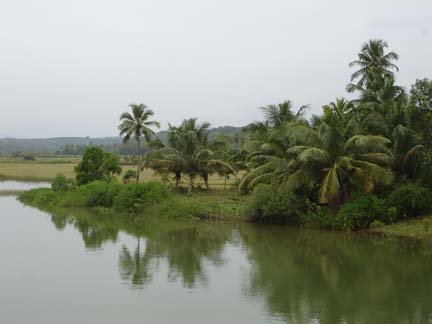
Holegadde near Honavar,Uttara Kannada dist, Karnataka
Copy? Right - but kindly remember to acknowledge!

" tulu-research.blogspot." ತುಳು ರಿಸರ್ಚ್. ಬ್ಲಾಗ್ಸ್ಪಾಟ್. ಇನ್

Have a nice day !