Contributed by Hosabettu Viswanath
Since my contribution on ‘Bailare’ (Post 120), I was thinking about the irretrievable damage done to ‘Bailare of Hosabettu (Olden name ‘Posodi’ ) and onwards. For that matter, such wanton damage is also true to Bailares elsewhere.
Genesis
Genesis of degradation of this Bailare starts from the time of construction of feeder road to Hosabettu (in late fifties) and other areas in early sixties to mitigate the difficulties of coastal people during monsoons and the creation of artificial harbour at Panambur in early seventies. This is the irony of development. Analogy may be drawn to the present-day craze of authorities in having Special Economic Zones on fertile lands. The then Prime Minister of India late Shri Lal Bahadur Shastri, who coined the slogan of “Jai Kisan, Jai Jawan”, expressed his surprise, while laying the foundation stone for the new harbour, on the sanity of choosing that fertile agricultural land to go under sea water.
Emotional attachment
Bailare is a vast low lying arable land, fed by natural water course, i.e. storm water from adjoining elevated areas around Hosabettu. This Bailare, alongside NH-17 on the West, starts from Hosabettu and now extends upto Chitrapur/Baikampady, where it is by-passed to Arabian Sea through a man-made outlet. Earlier this Bailare stretched right upto Panambur/tip of Kulur (West) before joining Gurupur River naturally. In the casuarinas’ grove (chauri pady), skirting the beach, of Pancha Catte (P.C.) House in Panambur we had a Citizenship Educational Camp (Nagarika Shikshan Shibira) some time in 1953-54. I have connection to four sons of this House. Two scions were my teachers at Iddya Vidyadayinee School, of whom I was the favourite of late PC Vasudeva Rao, third - my SSLC mate (brother of PC) and the fourth was my colleague at Century Enka (brother of Ratnakara Rao Kavoor - amateur dramatist in Mangalore). I ensconced my emotional attachment to this Bailare in a poem (Ondu Bayala Kate) to keep it for myself and tried afterwards to get it published but in vain.
Wholesale Plunder
As the adage goes, “A wilful waste makes a woeful want.” The present wretched condition of ‘Bailare’ is a burning example of how unscrupulous people cause irretrievable damage to the Nature. We hear of flooding in monsoons in all upcoming Apartment neighbourhoods in South Kanara. There are outcries and appeals by residents to stop the indiscriminate land filling of the expanse of the ‘Bailare’. Natural water courses and water-bodies are disappearing, leaving no relics. It is a wholesale plunder. It is an eye-sore to see some water-logged pockets of fertile paddy fields here and there in the midst of unplanned cluster of apartment buildings.
Note on Posodi
The old name of Hosabettu is Posodi, which is still alive in conversations among local people. But the fact, that the present day generation is not knowing, is that part of Iddya-Suratkal is also known as Posodi in records. This is vindicated in its finding an entry in the Tulu Lexicon (Vol.5, page 2152). This is further corroborated by what my chikkamma was saying. The Vidyadayinee Primary School was started at Iddya Shri Mahalingeshwar Temple in Nov 30, 1916. When own buildings for Primary & Higher Elementary and High Schools were envisaged in the present site, there were building fund raising campaigns. The team which visited Mumbai was cajoling people from Hosabettu to donate munificently as these schools are their own as it is located in Hosabettu. This is a fact that Vidyadayinee is within the precincts of Hosabettu. The house of our teacher late Shri H. Rama Rao is just touching the school premises. This information has some historical relevance and hence the disclosure. It should not be considered in a different hue, i.e. as a statement of glorification. When Iddya is considered as part of Suratkal, it came to be believed that Vidyadayine is in Suratkal. It is customary to apply the name of important place name to entire stretch of adjoining areas, eg. Mukka is now considered as part of Suratkal.
Contributed by Hosabettu Viswanath
*

A heritage blog by: Ravindra Mundkur & Hosabettu Vishwanatha
Showing posts with label Surathkal. Show all posts
Showing posts with label Surathkal. Show all posts
Tuesday, August 12, 2008


Wednesday, April 23, 2008
111. Swirling waves of Surathkal

A photo-montage of Torathakall beach west of NITK campus.
The place names often change with changes in the attitude and customs of the people living around the region. The place name Surathkal presently gives an impression as if it is ‘Surutha’ (=first) ‘Kall’ (=stone). People have often erroneously assumed that it perhaps once represented the first milestone towards Mangalore or something like that.
Vijayanagar period
An stone inscription found in the courtyard of the Kadire Manjunatha temple, Mangalore dated ca.1386 CE, belonging to the period of chieftain Banki Alupendra, who was ruling under the Vijayanagara King Harihararaya, has described the place Surathkal as Turithakali.The ‘kali’ end-form must be an writing error and possibly it was meant Turithakall.
Turithakall <.Torathakall
The inscription rather confirms that the place was known as ‘Turitha-kall’ during 14th century CE. This corresponds closely to the ancient Tulu name of the place Toratha-kall. Even today older folks designate this town as Toratha-kall! And the Turithakall form in the Kannada inscription is only a stylized version of the old Tulu word Torathakall.
As usual to understand the meaning of the place, you have to look into the natural setting of the town, devoid of modern concrete jungles that have been imposed upon it in the recent years.
Wave-washed Rocks
The Surathkal beach west of National Institute of Technology Karnataka (NITK; formerly known as KREC-Karnataka Regional College of Engineering, Surathkal) holds the key for the meaning of the word Torathakall.
On the NITK beach, we find several large to medium sized dome shaped exposures of gray granite-gneiss rocks that have been turned jet black on their exteriors due to onset of marine waves and coastal rains. On one large exposure we find an ancient temple dedicated to Lord Sadashiva. On another exposure, there is a modern light house built to guide the ships safely into the New Mangalore harbour.
There are other numerous smaller exposures of granite in the beach strip and in the littoral zone on which the proceeding and receding sea waves play with incessantly often swirling around the rock exposures. This particular scenery of play of waves with the rocks must have mesmerized our ancestors.
The name Toratha kall refers directly to the swirling action of waves on the rocks.
The Tulu place name Torathakall is often shortened to Torth-al.
Magic of ‘torapuni’
The words ‘Tere’ or ‘Sire’ refers to sea waves in Tulu language. But the meaning of the word ‘torapuni’ is far more meaningful in the context. The verb ‘torapu’ refers to the ancient practice of protection against evils: it is a primitive form of sorcery or psycho-somatic healing magic.
In the olden days, grandmothers used to conduct the art of ‘torapuni’ on children who were unusually afraid or sick due to psycho-somatic reasons. The art of ‘torapuni’ consists of taking a small stone in the fist and circling it around the head of the infected child, in clockwise direction, a few times, corresponding with chanting of spells that wished all that evils that affected the child should go away or vanish. Finally the stone use for ‘torapuni’ or ‘torat deepuni’ is thrown away and it is considered that all the evil effects are removed from the child. There are several other variants of the torapuni act which essentially is magical practice of the ancient Tulu people designed for the psycho-somatic well being of the children.
For those who stand and watch the play of waves on the beach it appears as if the swirling waves do the magic act of ‘torapuni ‘on the rock exposures strewn in the beach of Torathikall or the torat-kall.
Sire Kallina deva
Ramesh Puthran of Suratkal writes vachanas in 'Mogaveera' (magazine). He terminates the vachanas in the pen-name of 'Sira kallina deva' referring to Lord Sadashiva of Surathkal beach. ‘Sira’, ‘sire’ or 'tere' means sea waves. The Sadashiva temple is located on the rocky mound, which is washed perennially by the incessant waves of the Arabian Sea.
®
Acknowledgement
The post is written in collaboration with Hosabettu Viswanath
Subscribe to:
Posts (Atom)
A Coastal estuary
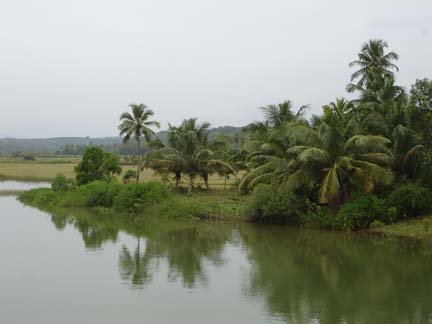
Holegadde near Honavar,Uttara Kannada dist, Karnataka
Copy? Right - but kindly remember to acknowledge!

" tulu-research.blogspot." ತುಳು ರಿಸರ್ಚ್. ಬ್ಲಾಗ್ಸ್ಪಾಟ್. ಇನ್

Have a nice day !