The place name Kundapura is quite interesting. The ‘Kunda’ is a Pali and Prakrit word signifying the gold. The word 'Kunda' also means 'lake' or 'pond'.There are also other meanings attached to the word such as melt,pillar,flower etc in different contexts.
Kundagrama
The historical significance is that it is the name of the village (known as Kundagrama or Kundapura) near Vaisali in Videha (part of present Bihar) where Mahavira was born. Thus evidently the place name Kundapura signifies the role of Jainism in the Karavali.
Jainism & Buddhism
Since Mahavira (ca.599-527 BC) and Buddha (ca.563- 483 BC) are contemporaries it can be considered that the Jainism and Buddhism flourished simultaneously. Jains, however, believe that Jainism was founded by Vrishabha the first of the twenty-four Tirthankars. Yet critics opine that during early period upto 5th century CE was not emphatically present. The usage of the word Jainism, like the word Hinduism, itself is said to be rather recent.
The antiquity of the place name Kundapura is historically significant as it may throw light on the ascent/spread of Jainism in the Karavali/Tulunadu.
Kundavarma
Because of the presence of the word ‘Kunda’ in Pali (Buddhist) and Prakrit (Jain) literature it is difficult to distinguish the exact religious connotation in the said word. The word ‘Kunda’ also exists in Tulu: it means either (a) pillar or (b) melt.
The Alupa King Kundavarma, who installed the idol of Avalokitesvara at Kadire, Mangalore, has been interpreted to be a Shaivaite by Dr. Gururaja Bhat. But his very name suggests that he was either a Buddhist or a Jain. It may also mean that religious affiliations were not emphatic in those days among the ruling class.
Kundaran
An interesting surname among Mogaveeras is Kundaran. In view of the significance of the word Kunda, the surname Kundaran possibly carries implications of the Jain/Buddhist heritage of a sect of Tulu Mogaveera people.
®

A heritage blog by: Ravindra Mundkur & Hosabettu Vishwanatha
Showing posts with label Kundapur. Show all posts
Showing posts with label Kundapur. Show all posts
Saturday, March 1, 2008


Thursday, October 11, 2007
44. The scale of human migration
Normally, our perceptions are based on the present environments and therefore we have difficulty in visualizing the scenarios from the past. Many people cannot digest the concept of migrations because they imagine whole massive population, in the scale they see now around, moving out from one place or region to the other.
One small event in the relatively recent history shall be useful to envisage the scale of migrations that occurred in the past history.
Nadava migration
About 500 years ago, five families of Nadavas from Kundapur taluk, left their original homeland due to differences with local people, travelled some 100 km distance northward crossing a number of coastal rivers to Ankola- Gokarna area of Uttara Kannada district and resettled there. Now, after passage of five centuries, the population of Nadava community in the Ankola- Gokarna region exceeds 10,000.
Five centuries have contributed significant changes to the language, culture and beliefs of the migrated Nadavas of present Uttara Kannada. Their language ‘Nadava Kannada’ now is slightly different from that of the present ‘Kundapur Kannada’. Their beliefs also have undergone minor changes: the cult of spirit worship has taken back seat and local influence of Lord Tirupati Venkataramana has taken over. The ‘moolasthana’ concept has almost vanished,but the ‘bari’ concept has become ‘balli’ concept.. The Bermer cult has been modified into an annual festival of Bommayya devaru.
One small event in the relatively recent history shall be useful to envisage the scale of migrations that occurred in the past history.
Nadava migration
About 500 years ago, five families of Nadavas from Kundapur taluk, left their original homeland due to differences with local people, travelled some 100 km distance northward crossing a number of coastal rivers to Ankola- Gokarna area of Uttara Kannada district and resettled there. Now, after passage of five centuries, the population of Nadava community in the Ankola- Gokarna region exceeds 10,000.
Five centuries have contributed significant changes to the language, culture and beliefs of the migrated Nadavas of present Uttara Kannada. Their language ‘Nadava Kannada’ now is slightly different from that of the present ‘Kundapur Kannada’. Their beliefs also have undergone minor changes: the cult of spirit worship has taken back seat and local influence of Lord Tirupati Venkataramana has taken over. The ‘moolasthana’ concept has almost vanished,but the ‘bari’ concept has become ‘balli’ concept.. The Bermer cult has been modified into an annual festival of Bommayya devaru.
Subscribe to:
Posts (Atom)
A Coastal estuary
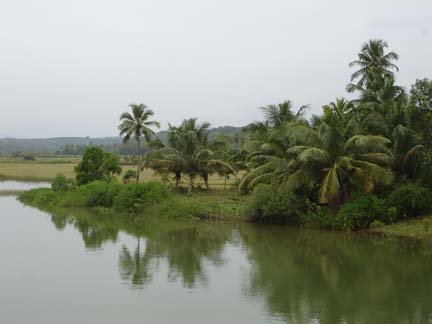
Holegadde near Honavar,Uttara Kannada dist, Karnataka
Copy? Right - but kindly remember to acknowledge!

" tulu-research.blogspot." ತುಳು ರಿಸರ್ಚ್. ಬ್ಲಾಗ್ಸ್ಪಾಟ್. ಇನ್

Have a nice day !