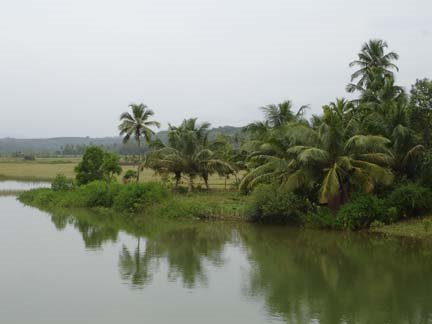
Jāra is a peaceful hamlet located
on a river valley that you encounter while you travel in the northeastern sector
of Mangalore city from Bondel Padushedde to Mudushedde along the sylvan and
circuitous interior route. You will not the see the name of this hamlet in the
list of villages of Mangalore Taluk. However, the hamlet must have been quite
famous once upon a time in the past history.
Jārandāya
The Kingly Spirit (‘Rajan daiva’)
of Tulunadu Jārandāya was said to be from the hamlet of Jāra. The term ‘Jārandāya’
means a man from the Jara. Note that the actual name of the Spirit is not
mentioned but the place from which hailed has been affirmed in the name of
Jārandāya. Thus the name of the place Jāra was quite known to the rural people
of that time, even though decidely could not recollect his actual proper name!
Jāra
Jāra is an interesting place name,
more so because it no longer has remained in our current vocabulary. Origin of
unusual sounding ancient place names surviving around us like fossils of the
past history continue to haunt, as vestigial reminders of bygone words from the
languages that once dominated these lands we have inherited. Jāra is one such ancient
place name surviving in Tulunadu, but surprisingly it is not an exclusive Tulu
word as we find similar analogous place names all over India and abroad.
Villages named Jāra exist not only in Tulunadu
but also in the States of Gujarath, Madhya Pradesh, Himachal Pradesh, Jammu
& Kashmir, Jharkhand, Uttar Pradesh and West Bengal. There are about 1000
villages in India having the name of Jara and its variants. Among variants commonly
we find are: Jar, (Jhar, Jarh) or Jaru or Jari or Jarai. Also find modifications
(with spatial suffixes) such as : Jaram, Jariya, Jarga, Jarige, Jar(a)ka,
Jaraki (as in Jarakihole), Jargi, Jargipara, Jarwa, Jarapa, Jarad, Jarada,
Jarasa, Jario, Jarkala, Jaroli, Jharwara, Jarara, Jaruha, Jaraila, Jarkheda, Jaronda,
Jaranga, Jarigada, Jaripada, Jariput, Jaripal, etc. The State of Jharkhand
carries the name ” Jhara” and besides a large number of Jāra named villages exist in
Jharkhand!
Jāra meaning
One possible way to understand
the word is to search for the known meaning of this word in languages around
us. Jara was a masculine name among Tulu tribes such as Jārappa. (Similarly in
the Western countries we find that Jára is a short name for Jarmila, Jaromir and Jaroslav.). In some countries, Jara is
a first feminine name.
Besides, some of the possible
related shades of usages in current Tulu, Kannada and Tamil languages are:
Jaripu , jariyu,jāru(Tulu)= 1.slide, slip, 2.insult;
Jāru, Jaragu (Tulu, Kannada)=1.slip,slide,move;
Jaragu 2.happen; occur.
JaraDi (Kannada )=sieve.
Ojjara (Tamil), ~Osar, uje, Uti (Tulu); Osaru, jzari (Kannada)=Spring,
fountain,oozing water;
In other languages the term Jāra means:
Jāra (Sanskrit) = 1.mistress; whore, 2. waterfall.
Jara (Pali) = aging; decay.
Jara (Rajastani) =rust.
Jara (Odisi/Oriya) =old, decrepit;
fever
Jara (Slavic languages) = spring.
Jara (Turkish ) = strong, spring.
Jara (Sindhi) =water.
Jara (Bulgarian) = air, glow, mirage.
Jara (Hebrew) = he enlightens, he shines.
Zāra (Arabic) = flower; shining, bright.
Jara (Australian/
aboriginal ) = seagull.
Jara names worldwide
Jara is the
name of a Nigerian language.
Jara River, is a tributary of the Şuşiţa
River, Romania.
Jara, Ethiopia ,
is a mountain near Wallaga.
La Jara, New
Mexico,
census-designated place in Sandoval County, United States.
La Jara, Colorado, a town
in Conejos
County, United
States
La Jara,
comarca in
western Spain.
Coincidence vs. inheritance
While some of you may like to
dismiss off the existence of analogous words in different parts of the world as
mere coincidence, the general logical explanation for such similarities is
that the primitive cultures inherited many of the basic words across the barriers
of language and cultures on account of migration and interactions.
Also there is a possibility that
there were several analogous words from diverse origins having different
meanings. Some of the basic meanings we
can attribute to the word based on analysis as above are:
Jāra = 1.Spring, oozing source of
water;waterfall.
Jāra =2.Sloping land; Sliding.
Jāra= 3. Sloppy morals, fallen man or woman.
Jāra =4.Shining, bright object
etc.
Jarā =5.Aging, sickness.
Jāra Villages
Based on the above discussions we
may infer that Jāra actually meant a valley zone endowed with water or simply a
village located on the banks of a river or stream. Thus in a sense the term Jāra was an alternate word for the
ancient word Ala which also means a
land on the bank of a river or stream.
In Tulunadu we also find compound
place names that contain Jāra with additional adjectives such as: Kenjār, Mijār, Kanajār, Kilinjar, etc.
For the time being, using the explanations
given in previous posts, we can understand the meaning of these villages as
follows:
Kenjar= Ancient Riverside Village
of ‘Red’ skinned (‘Kench’) immigrant tribes.
Mijar= Ancient riverside village
on an elevated plateau area.
Kanajar= Riverside village of
Kanna tribes.
Kilinjar= Riverside village on
the lower bank.
Chāra
Chāra is a village located on the
bank of River Seetha in Karkal Taluk, Udupi District. The place name Chāra
appears to be an alternate version of the term Jara. There
are several Chara village is located in different parts of India. The Ja>Cha
lingual variations may the source of these changes.
There
are several Chāra based villages in Karavali such as Kolchar, Paichar, Kodichar,
etc
Ancient place names remain mute
spectators to the drastic topographic changes in the land with the result we
find some of these Jāra villages currently located on the banks of dried up
river channels.
®