The worship of Bhagavathi is popular and widespread in Kerala and the southern part of Karavali areas traditionally dominated by matri-archial system of families. The cult of Bhagavathi often transcends the spirit worship and overlaps into the field worship of Mother Godess or the Shakti. Thus a fusion of the cults of the Spirits and Godesses can be seen. In Kerala, the Bhagavathi worship is a part of Teyyam (spirit) worship.
The word Bhagavathi has interesting connotations and history. It is said to be the product of Buddhist heritage of southern India. The word Bhagavathi appears as female equivalent (Godess) of the word Bhagavantha, the God. However, the word ‘Bhaga’ basically has dual meanings such as: (1) prosperity and (2) female genitalia. Thus, shades of primitive genital worship notions can be found in the word. Thus the ‘Bhagavathi’ essentially stands for honorable woman, the creator and a symbol of prosperity.
Tantric origin
The second meaning of the word, the allusion to genitalia, is remnant of the Tantric origin of the Bhagavathi concept. During the course of evolution, Mahayana Buddhism developed a branch known as Vajrayana. The Vajrayana philosophy revolved around the sexually oriented tantric yoga that emphasized the occult worship of generative (reproductive) organs. In this cult, codes were used to refer to the genitalia. The word ‘vajra’(=diamond scepter) was a code for phallus and ‘padma’(=lotus) for the vulva. The germinal Buddhist mantra ‘Om mani padme hum’ is explained as code for sexual union, where the term, ‘mani’(=jewel) represents the male organ.
Tara Bhagavathi
The Bhagavathi cult was in vogue during 9th century, since a specific reference to the cult appears in the writings of the Kannada poet Pampa (born.902 AD)
The Kodangallur in Kerala is considered to be one of the oldest Bhagavathi shrines. The area appears to be originally was a Buddhist shrine devoted to the worship of Tara Bhagavathi, a Buddhist Godess. Tara is Buddhist form of Kali .The Bhagavathi cult possibly, initiated as a part of the Tantric Vajrayana practice within the Buddhism. With the downfall of Buddhism in south India and under the dominant matriarchial setting, it was gradually sanctified and absorbed into the mainstream Hindu cult of Shakti and Spirit worship.
Padmavathi
In Jainism the mother Godess is worshipped in the form of Padmavathi. With the Padma (=lotus) being a code for feminine sexuality as in texts of Vajrayana Buddhism, it appears that Tantric sexual cults with passage of time evolved in to honorable Mother Godess worship in Hindu as well as Jain philosophies..
Parallel schools
The worship of Durga, Bhagavathi and Padmavathi in Hindu, Buddhist and Jain philosophies respectively shows that similar theologic concepts developed in these religions during the historical period of 7th to 10th centuries.
Template for Divinity
The post-Buddhist Bhagavathi is a divine concept. It is not a single identity, with a sequence of martyred women occupying the status of Bhagavathi-hood. Dr.Amrita Someswara has pointed out that it is a multiple identity consisting of many Bhagavathi-s consecrated during different time periods and backgrounds. Thus, the concept of Bhagavathi has perpetuated as a template for attribution of divinity or the spirit-hood to notable women after their death.
Multiple Bhagavathis
The Bhagavathi at present is not a single identity. Several forms of Shakti and numerous martyred women are being worshipped under the form of Bhagavathi in different parts of the south India. Some of the renowned Bhagavathis are Anka Kulangara Bhagavathi, Kodangallur Bhagavathi, Pullurali Bhagavathi, Agrasahala Bhagavathi, Karingali Bhagavathi, Ambala Kadavil Bhagavathi, Cheerumba Bhagavathi, Dayaramangala Bhagavathi, Kaapad Bhagavathi, Ponnakal Bhagavathi, Kannamangala Bhagavathi, Kalarathri Bhagavathi, Mucchalotu Bhagavathi, etc.
Forms of Shakti/Durga
Similarly there are numerous Bhagavathis inspired from or bearing relation to the Shakti or Durga cult like Agni Chamundi Bhagavathi, Rakta Chamundi Bhagavathi, Rudra Chamundi Bhagavathi, Veera Kaali Bhagavathi etc. Godesses like Chamundi, Kaali etc have been considered to be various form of the Godess Durga or the Shakti.
Convergence of Spirit & Deity worships
The Spirit worship in Karavali-Malabar region was introduced about 800-600 BC. Subsequently, during the reign of major Kings like Kadamba, Chalukya and other Kings the institutionalized (well-organized Temples) worship of several forms of Deities (Shiva-Ganesha-Vishnu-Durga) was introduced with effect from 4th century AD. Since then Deity and Spirit worships continued to survive at different social levels among the folks of West Coast.
Bhagavathi cult bridged the narrow gap between the two parallel schools of worship during post 10 century period, leading to distinct convergence of Deity and Spirit worships.

A heritage blog by: Ravindra Mundkur & Hosabettu Vishwanatha
Showing posts with label Shakti. Show all posts
Showing posts with label Shakti. Show all posts
Wednesday, January 16, 2008


Tuesday, September 4, 2007
33. Brahma-Vishnu-Mahesh
The historical evolution of theological concepts and pantheon in the Indian subcontinent is very interesting for the sociological studies. Primitive Indian societies believed in the special powers of the generative organs to procreate. Thus male and female sexual organs were ritually worshipped. The phallus (Linga) worship later was absorbed into Shaiva cult and the Linga became a representation of Shiva. On similar lines the primitive cult of vulva (Yoni) worship and Mother Godess worship amalgamated with Shakti/ Devi worship.
Brahma is probably the earlier major God in this subcontinent. Until then Vedic Aryans worshipped various elements of the nature in the form of Indra, Agni, Marut, Mitra, Varuna etc.
The legend of Abraham, the mass leader of Jews, who is also credited to have built the Kaaba at Mecca in association with his father, was so powerful in the region that any communities resorted to the worship of his spirit after his death. The Tulu settlers absorbed the Brahma legend in original form northwestern India, carried the concepts when they subsequently migrated south, still retain the vestiges of early forms of Brahma worship in the coastal Karavali Karnataka. The other migrant people also carried the concepts but these concepts changed with time and changes in the concept of Brahma. Apparently the ancient Jainism also adopted the concept of Brahma.
With ascendance of concept Brahma, the natures Gods were reduced to minor or lesser Gods. Brahma originally a horse mounted, bearded hero slowly evolved into a four headed creator, the four heads representing the four Vedas. Ramayana also showcased the ten headed Brahma. Myths and fantasy were added with detailed poetic imaginations and fantasies to elevate the status and power of the divine elements at popular level.
At the same time Shiva and Vishnu came into prominence among different cultural groups that made the Indian society at that period. Similar to Brahma, the original legends and characters of Shiva and Vishnu might have been based on the lives of exceptional mass heroes of that time. Incidentally both of these Gods were dark or black skinned like their natives of that time but were poetically called ‘blue skinned’ (Shyamala Varna).The dark skin indicates that these were Gods of dark skinned Dravida/ Munda tribes.
The Vedic Aryans when they moved out of their settlements into domains of various provincial kings they had serve under the Dravida/Munda kings for livelihood. Dravida/ Munda Kings who believed in their dark skinned Heroes turned to Gods rather than Vedic Gods (like Mitra, Varuna, Indra, Agni) or the white- skinned bearded Brahma (derived from Abraham). The Vedic Aryans then subsequently converted into Brahmins because of their knowledge of Vedas, had to switch over from Vedic Gods to native dark skinned Gods like Vishnu and Shiva (Mahesh).
At a point in the history, especially after witnessing development of three lines of divine concepts an effort was made to integrate the trilinear faiths into an unified concept of trinities: Brahma (the creator), Vishnu (the keeper) and Maheswara (the destroyer) were amalgamated into trinity. The famous Trimurthy sculptures of Elephanta caves, Mumbai is an example of this acceptance of merging of three faiths.
It is interesting that Tulu and the Malayali people were not influenced by these Gods in the beginning, especially the later-evolved four headed Brahma, the Vishnu and the Shiva.Shiva was being worshipped by Tamils,settled in Madurai, at least since the beginning of the Christian era (Sangam literatuire period).
Shiva temples were introduced in Tulunad during 5th Century AD, coinciding with Kadamba dynasty at Banavasi.And Vishnu and Krishna concepts came to Tulunad still later.
®
Brahma is probably the earlier major God in this subcontinent. Until then Vedic Aryans worshipped various elements of the nature in the form of Indra, Agni, Marut, Mitra, Varuna etc.
The legend of Abraham, the mass leader of Jews, who is also credited to have built the Kaaba at Mecca in association with his father, was so powerful in the region that any communities resorted to the worship of his spirit after his death. The Tulu settlers absorbed the Brahma legend in original form northwestern India, carried the concepts when they subsequently migrated south, still retain the vestiges of early forms of Brahma worship in the coastal Karavali Karnataka. The other migrant people also carried the concepts but these concepts changed with time and changes in the concept of Brahma. Apparently the ancient Jainism also adopted the concept of Brahma.
With ascendance of concept Brahma, the natures Gods were reduced to minor or lesser Gods. Brahma originally a horse mounted, bearded hero slowly evolved into a four headed creator, the four heads representing the four Vedas. Ramayana also showcased the ten headed Brahma. Myths and fantasy were added with detailed poetic imaginations and fantasies to elevate the status and power of the divine elements at popular level.
At the same time Shiva and Vishnu came into prominence among different cultural groups that made the Indian society at that period. Similar to Brahma, the original legends and characters of Shiva and Vishnu might have been based on the lives of exceptional mass heroes of that time. Incidentally both of these Gods were dark or black skinned like their natives of that time but were poetically called ‘blue skinned’ (Shyamala Varna).The dark skin indicates that these were Gods of dark skinned Dravida/ Munda tribes.
The Vedic Aryans when they moved out of their settlements into domains of various provincial kings they had serve under the Dravida/Munda kings for livelihood. Dravida/ Munda Kings who believed in their dark skinned Heroes turned to Gods rather than Vedic Gods (like Mitra, Varuna, Indra, Agni) or the white- skinned bearded Brahma (derived from Abraham). The Vedic Aryans then subsequently converted into Brahmins because of their knowledge of Vedas, had to switch over from Vedic Gods to native dark skinned Gods like Vishnu and Shiva (Mahesh).
At a point in the history, especially after witnessing development of three lines of divine concepts an effort was made to integrate the trilinear faiths into an unified concept of trinities: Brahma (the creator), Vishnu (the keeper) and Maheswara (the destroyer) were amalgamated into trinity. The famous Trimurthy sculptures of Elephanta caves, Mumbai is an example of this acceptance of merging of three faiths.
It is interesting that Tulu and the Malayali people were not influenced by these Gods in the beginning, especially the later-evolved four headed Brahma, the Vishnu and the Shiva.Shiva was being worshipped by Tamils,settled in Madurai, at least since the beginning of the Christian era (Sangam literatuire period).
Shiva temples were introduced in Tulunad during 5th Century AD, coinciding with Kadamba dynasty at Banavasi.And Vishnu and Krishna concepts came to Tulunad still later.
®
Subscribe to:
Posts (Atom)
A Coastal estuary
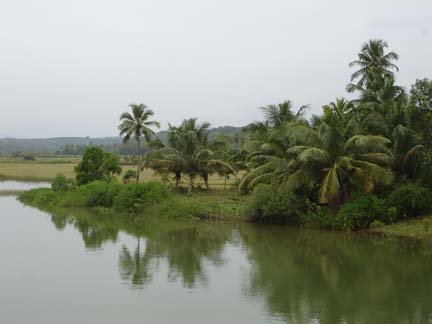
Holegadde near Honavar,Uttara Kannada dist, Karnataka
Copy? Right - but kindly remember to acknowledge!

" tulu-research.blogspot." ತುಳು ರಿಸರ್ಚ್. ಬ್ಲಾಗ್ಸ್ಪಾಟ್. ಇನ್

Have a nice day !