The sheer range of meanings the word Mangala carries provides us some insight into the nature of evolution it has undergone through the ages.
1. The word Mangala evidently began its career as a male name. Early Buddhists used it extensively. One of the incarnations of Buddha was known as Mangala. Later, several monks, Bhikkus, were also called Mangala as recorded in the Pali literature. In Srilanka, Mangala is a very frequently used name.
2. However the word Mangala is not exclusive property of Indians. Some of the African males carry the word ‘Mangala’ as part of their name or surname. The word may be of quite ancient origin having a remote African or Mediterranean heritage.
3. One of the Bantu languages is called Mangala. The Bantu word ‘Ngala’ possibly refers to language as there are related Bantu words signifying allied languages such as ‘Bangala’ and ‘Lingala’.
4.According to the folklore of Tanzania, Mangala is the first man created on Earth
5. Some towns in Africa are called either Mangala or Mangalane (Mozambique).
6. The original meaning of the word Mangala appears to be reddish coloured. The reddish planet Mars was called Mangala.
7. Cats having a reddish or mixed, variegated colour are called ‘mangu pucche’ or ‘mangle’ in Tulu.
8. The word Mangala was associated with war. The God of war Mars was named Mangala.
9. The military camping grounds during the regal wars were called Mangala. The war was waged with an aspiration of the success in the expedition. The name of Mangalur for the city of Mangalore came from the Mangala, the camping ground used by the armies of Pandyas and Chalukyas during early eighth century CE.
10. The Mangala was used for the forts built for security around King and his palace. Thus several fort towns in ancient India and Srilanka were called Mangala.
11. The aspiration of success in war possibly led to attachment of feeling of auspiciousness to the word Mangala. The Mangala came to be associated with the meaning of auspiciousness.
12. Auspicious marriage ceremonies were called Mangala in several of the Indian languages, like Malayalam, Kodava and Tulu. In Tulu Mangala was later distorted to Mangila, evidently to accommodate other meanings implied by the word.
13. Several religious or quasi religious ceremonies were known as Mangala. Buddhists ear piercing ceremony was called Mangala.
14. Tulu people use Mangala(m) to refer to safe and successful completion of missions, assignments or ceremonies. The concluding part of a traditional devotional singing (Bhajana) session or a folk drama (Yakshagana) play are called Mangala, meaning the end.The conclusive chant" Mangalam, Jaya Mangalam" in Tulu ceremonies appears to be derived from the Buddhist heritage in the past.
15. The followers of Natha cult extended the conclusive part of the ceremony to refer to the ceremonial obituary customs associated with Natha monks and nuns.
16. The word Mangala now generally represents a female name.
17. Mangaladevi became a form of Godess Shakti, possibly after the crusading missions of Shankaracharya, evidently evolved from the older Buddhist cult of Tara Bhagavathi and allied deified female spirit forms. Besides the well known Mangaladevi at Mangalore, there is another similar Mangaladevi in Idukki district of Kerala. This Mangaladevi of Kumili(Idukki) is a form of Shakti deified from the spirit of Kannaki, a heroine of Sangham age of Tamil literature.
Mangalam!
®

A heritage blog by: Ravindra Mundkur & Hosabettu Vishwanatha
Showing posts with label Tara Bhagavathi. Show all posts
Showing posts with label Tara Bhagavathi. Show all posts
Sunday, February 17, 2008


Sunday, January 27, 2008
80. Macchendra, Goraka and Pingala
The Natha cult represents the fusion of Buddhist Avalokiteswara and Shaivaite tantric (Kapalika, Kaula) cults. Macchendra Nath and his disciple Gorakh Nath were the prominent exponents of the Natha cult. The Natha cult eventually spread to different parts of India and Srilanka during eighth to tenth centuries. Subsequently, twelve subdivisions (bara-pantha) evolved in the cult. The Natha Jogis used to travel for long distances on foot. Influence of Nath cult can be seen in major Shaiva centres like Srishaila. The Natha is short for ‘Lokeswara Natha’, according to in the Buddhist literatures of Srilanka.
Macchendra Natha was able to acquire the goodwill of the ruling kings who awarded him the administration of lands around Kadri temple and the title of ‘Kadri Arasaru’.
Natha tantric philosophy
The practice of Yoga and Tantra was common to the Vajrayana Buddhism and (the Kapalika, Kaula and other) Shaiva cults. Natha cult was the result of the fusion of the two streams of rival cults, based on the common factor of Tantric yoga. Occult sexual practices and experiments were integral part of the Vajrayana and Kapalika Tantra philosophies.
The Natha cult advocated the physical and mental development of the individual (Yogi or Jogi). It consisted of a set of yogic techniques called Tantra for developing mental abilities through sustained control of physical activities and respiration (pranayama). The techniques were intended to activate the dormant power of Kundalini, hidden in the bottom of the spinal column of the individual; and redirecting that power upwards to the brain to attain a ‘samaadhi’ state of bliss. Experiments in retention and redirection of semen upward were conducted in achieving these goals. Exponents like Gorakh Nath apparently emphasized on the virtues of celibacy. Concentration of the mind on light leads to a state of’ ‘mindlessness’ (‘amanaskate’) or zero mental activity that is described as ‘brahmanubhava’. Attainment of this state is considered as elevation of the person to the state of God. The cult believes that God lies within the person, or that divine state can be reached by the individual. Philosophically, there is no concept of separate external God like in Advaita or Dwaita philosophies. Natha Jogis utter ‘aadesh’ while they greet each other, showing mutual respect.
Natha and other contemporary philosophies (like Vajrayana, Kapalika and Kaula) possibly influenced the growth of later philosophies like Varakari, Veerashaiva, Mahanubhava, Soofi, Kabir, Datta and Nanak cults.
Macchendra Natha
Macchendra (Matsyendra) Natha hailed from a fisher community of probably Bengal area. (However, the sculptures show him riding on fish and the legends metaphorically describe his birth from the semen of Shiva swallowed by a fish). The ‘maccha’ is a Pali word for ‘matsya’ or the fish. The Alupe kings of Mangalore probably adapted the emblem of fishes after Macchendra Nath. Macchendra Nath is the fertility God in Nepal and a national festival is celebrated in his honour.
Macchendra also had another disciple named Chourangi Nath.
Gorakha Natha
The Nath cult is alternately known as ‘Gorakh panthi’ or ‘Gorakh cult’. Gorakha (Goraksha) Natha, probably was native of Nepal. He was a discarded child and was collected from a gobar pit by Macchendra, according to the legends. Gorakh was renowned proponent of Natha cult all over India.
Nepal, also known as Gorakh-Desh or ‘the land of Gorakhs’ (>.Gorkhas, the tribe), adopted the Natha cult as official religion. Several towns in Northern India and Nepal have been named ‘Gorakhpur’ after him. Coins of Nepal carry emblem of Shiva Gorakh Nath.
Pingala
Pingala, a queen of all-women’s domain (Stri-rajya), desired to have male offspring and prayed to Lord Anjaneya. At this juncture, Macchendra travels to her place and meets her. They develop mutual attraction and in the due course they beget two male children. Macchendra forgets himself in her company settles there for several years. In the meanwhile Gorakha, Macchendra’s prime disciple, goes in search of his Guru and finds that he is lodged in a female-domain, where men were not permitted. So he dresses himself like a woman and beats a ‘maddale’ (a kind of drum), in a tune that sounds “Chal Macchendra, Gorak Aya”. Macchendra awakens from the marital pleasures and returns with Gorakha to pursue yogic practices.
On another occasion Pingala travels with Gorakh towards Triambakeswar, but expires on the way at Mangalore. The burial related 'concluding' obituary ceremony (‘mangala-acharane’) was conducted at Mangalore in the due Yogic tradition of Natha cult. Later, she was honoured as an incarnation of Tara Bhagavathi and the shrine erected in her memory became the Mangaladevi temple in the course of time.
From the point of reconstruction of history, the question that remains is whether the town was named Mangalore after her or the place name existed even before.
®
References:
Rahamath Tarikere (2006) “Karnatakada Nathapantha”(in Kannada). Prasaranga, Kannada University, Vidyaranya, Hampi.p.xii+348+xii
John Holt (1991) Buddha in the crown: Avalokitesvara in the Buddhist traditions of Srilanka. Oxford University Press. 304 p.
Macchendra Natha was able to acquire the goodwill of the ruling kings who awarded him the administration of lands around Kadri temple and the title of ‘Kadri Arasaru’.
Natha tantric philosophy
The practice of Yoga and Tantra was common to the Vajrayana Buddhism and (the Kapalika, Kaula and other) Shaiva cults. Natha cult was the result of the fusion of the two streams of rival cults, based on the common factor of Tantric yoga. Occult sexual practices and experiments were integral part of the Vajrayana and Kapalika Tantra philosophies.
The Natha cult advocated the physical and mental development of the individual (Yogi or Jogi). It consisted of a set of yogic techniques called Tantra for developing mental abilities through sustained control of physical activities and respiration (pranayama). The techniques were intended to activate the dormant power of Kundalini, hidden in the bottom of the spinal column of the individual; and redirecting that power upwards to the brain to attain a ‘samaadhi’ state of bliss. Experiments in retention and redirection of semen upward were conducted in achieving these goals. Exponents like Gorakh Nath apparently emphasized on the virtues of celibacy. Concentration of the mind on light leads to a state of’ ‘mindlessness’ (‘amanaskate’) or zero mental activity that is described as ‘brahmanubhava’. Attainment of this state is considered as elevation of the person to the state of God. The cult believes that God lies within the person, or that divine state can be reached by the individual. Philosophically, there is no concept of separate external God like in Advaita or Dwaita philosophies. Natha Jogis utter ‘aadesh’ while they greet each other, showing mutual respect.
Natha and other contemporary philosophies (like Vajrayana, Kapalika and Kaula) possibly influenced the growth of later philosophies like Varakari, Veerashaiva, Mahanubhava, Soofi, Kabir, Datta and Nanak cults.
Macchendra Natha
Macchendra (Matsyendra) Natha hailed from a fisher community of probably Bengal area. (However, the sculptures show him riding on fish and the legends metaphorically describe his birth from the semen of Shiva swallowed by a fish). The ‘maccha’ is a Pali word for ‘matsya’ or the fish. The Alupe kings of Mangalore probably adapted the emblem of fishes after Macchendra Nath. Macchendra Nath is the fertility God in Nepal and a national festival is celebrated in his honour.
Macchendra also had another disciple named Chourangi Nath.
Gorakha Natha
The Nath cult is alternately known as ‘Gorakh panthi’ or ‘Gorakh cult’. Gorakha (Goraksha) Natha, probably was native of Nepal. He was a discarded child and was collected from a gobar pit by Macchendra, according to the legends. Gorakh was renowned proponent of Natha cult all over India.
Nepal, also known as Gorakh-Desh or ‘the land of Gorakhs’ (>.Gorkhas, the tribe), adopted the Natha cult as official religion. Several towns in Northern India and Nepal have been named ‘Gorakhpur’ after him. Coins of Nepal carry emblem of Shiva Gorakh Nath.
Pingala
Pingala, a queen of all-women’s domain (Stri-rajya), desired to have male offspring and prayed to Lord Anjaneya. At this juncture, Macchendra travels to her place and meets her. They develop mutual attraction and in the due course they beget two male children. Macchendra forgets himself in her company settles there for several years. In the meanwhile Gorakha, Macchendra’s prime disciple, goes in search of his Guru and finds that he is lodged in a female-domain, where men were not permitted. So he dresses himself like a woman and beats a ‘maddale’ (a kind of drum), in a tune that sounds “Chal Macchendra, Gorak Aya”. Macchendra awakens from the marital pleasures and returns with Gorakha to pursue yogic practices.
On another occasion Pingala travels with Gorakh towards Triambakeswar, but expires on the way at Mangalore. The burial related 'concluding' obituary ceremony (‘mangala-acharane’) was conducted at Mangalore in the due Yogic tradition of Natha cult. Later, she was honoured as an incarnation of Tara Bhagavathi and the shrine erected in her memory became the Mangaladevi temple in the course of time.
From the point of reconstruction of history, the question that remains is whether the town was named Mangalore after her or the place name existed even before.
®
References:
Rahamath Tarikere (2006) “Karnatakada Nathapantha”(in Kannada). Prasaranga, Kannada University, Vidyaranya, Hampi.p.xii+348+xii
John Holt (1991) Buddha in the crown: Avalokitesvara in the Buddhist traditions of Srilanka. Oxford University Press. 304 p.
Subscribe to:
Posts (Atom)
A Coastal estuary
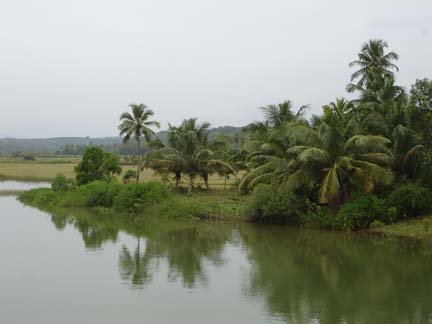
Holegadde near Honavar,Uttara Kannada dist, Karnataka
Copy? Right - but kindly remember to acknowledge!

" tulu-research.blogspot." ತುಳು ರಿಸರ್ಚ್. ಬ್ಲಾಗ್ಸ್ಪಾಟ್. ಇನ್

Have a nice day !