The formation of words from a root word is an interesting subject in any language. The simple word 'Okk’ or Okku' in Tulu language (of Pancha Dravida group) is such a root word from which many derivatives and compound words were formed. It is a verb but gives extended meanings in its derivatives. Tulu language has many such words, some of which are losing their usage in present generation, mostly exposed to urban culture.
Okku
'Okku’ or specifically ‘Okkunu', simply means to search, pick up, gather or look up for a thing from a heap or mass. As a corollary, it means digging or scratching soil and shuffling the earth all around aimlessly. For example, fowls, birds and pigs scatter earth with their fork like toes in search of food particles or worms. Picking up nit or lice from the hairs (‘Tare Okkuni’) applies to primates or human being.
Okku/Okkunu' in Tulu also means turning the sides (as in Baru okkuni). Paddy is soaked in water for a day and then boiled. It is then spread over in a court-yard to dry. It was customary to stir up these drying paddy grains every now and then to make it dry completely and fit for pounding in 'Barakalas' (=household pounding places for paddy in the olden days).
There are many sayings and idiomatic usages in Tulu related to 'okku’ or ‘okkuni:
1)'Korila Okkuni tan(na) kaaradite!': Hen too scrabbles earth under it legs only. This means, one strives for one's benefits only, i.e. The selfish nature of beings.
2)'Okkunaatu nakru tikkunda, panjilaa pakka pOvandu' (Means a pig goes on scrambling in one place if it finds more and more earthworms). It can be inferred that howsoever a work is difficult or dangerous, one is not tired of sticking to it if it is profitable.
Okka.1
Okka in general means one or one class. Eg. Okkai (=single handed), Okkannu or Okkanna (=one eye/eyed), Okkatteru (=persons belonging to one community, as is customary to address agriculturists of Tulunadu), Okkoota (=association of people with identical interests or professions), Okkuduve (=only one son), Okkaaru (=one leg), Okkoralu(=with one voice)etc.
Okka 2
Okka 2 means hip, waist or loin. This is a well known Tulu word identified by Michel Witzel in Rigveda to have been borrowed by Sanskrit of early Vedic period . More or less, similar meanings are found in other Dravidian languages.
Some of the derived words in Tulu are noteworthy:
1. Okkanul, Okkaderi: Okkanul means a string or a thin girdle, worn around a waist. With civilization and the development of sense of modesty human beings began to hide their private parts behind bunch of leaves in aboriginal state or later a piece of cloth tied with the help of this thin string. Affluent people started using silver or golden girdles known as ‘okkada nevala’. It was customary for elderly people to give such precious girdles to newly born wards. The traditional loin-cloths, which were common in yester years , naturally minimised the hernia type of problems. These are slowly becoming a thing of the past, with nowadays ’ jungas, briefs and panties taking their place.
Oracle of a Bhuta (Divine spirit) in Spirit worship wears an ornamental girdle, called 'okkaderi' around his waist.
2. Okkada-kuntu: It is a short cloth piece (‘tundu-kuntu’) worn around the waist in earlier years by elderly people in a village. The cloth worn by males was square in size and checquered. At times, they were using it as towel, while bathing in household ponds (These household ponds, dug mainly for watering coconut groves, etc, have disappeared, yielding place to borewells).
3.Tundu-kuntu, forerunner of present day gagras or petticoat, (oblong in shape/size with checks and mostly in red colour) were worn by females, wrapped around waists and downwards upto knee). These were preserver of their chastity and dignity.
There is a funny proverb related to ‘okkada kuntu’ : “ Okkada-kuntu gatti ittunduda, pakkodaye daane malpuve?” (If cloth piece is securely fastened, what can a neighbour do to outrage her modesty?)
At the southern end of Hosabettu village, there was a weaver family, engaged in weaving tundu-kuntu and okkada-kuntu and also cotton blankets. Senior weaver of that family used to vend his wares in the village and in other villages as well. Naughty boys of the village used to tease him by asking: Ireda iruver podepuna kamboli unde? (=Have you a blanket, which can wrap two persons)? He used to retort: “Yes, there is one, which can cover your mother and me (Hna, yanula ninnna appela ottugu podepuna kamboli undu).
4.Okkada panavu
(Money tied near waist). There was a system of father giving pocket money to a bride especially in affluent Bunts families, while she was going to her in-laws' house. She used to tie it in a corner of her saree on the waist. This money comes handy for her to give tips to servants of her in-laws house.
5.Okkada cheela
It is a cotton purse, traditionally stuck near waist by women.
Okku
As said earlier, Okku means 'to scatter earth to find out something'. Plough is used to till a field to grow paddy. Words related to Okku are: okkeltana (agriculture), Okkalige/Okkelme (People engaged traditionally in farming).
There is an 'Okkattur' village near Vitla, Bantval Taluk.
Okkelu, Okkele means a tenant of a farming land. According to the land tenancy system of yester years, a tenant occupies farm house (‘okkeladi’), given by a landlord, tills land and gives an agreed portion of yield to his landlord. Mark the sayings:
(1)Okkelu dani ave; Dani okkelu ave (Tenant may become landlord and landlord may become a tenant by quirk of fate). The acquired and general meaning of the term 'Okkelu' is 'occupier of a tenement', whether owned or rented. 'Il okkelu' = conducting house-warming ceremony before occupying
(2)Unandi brananula, undi okkelayanula kenakodchi: Means 'Do not irritate a starving brahmin and a well-fed farmer'. Brahmins, being Learned in scriptures, are known for cursing and farmers are used as soldiers in off crop-seasons by feudal lords if need arises. Hence these farmers are called as 'Bunts, meaning valiant fighters'.
Orgu
There is one more variant of Okka:
Okku = Orgu > Oggu means 'capable of, compatible, palatable or agreeable.
In a laissez-faire society, group or class of people were following traditional occupations. It was a principle of complete non-interference. This brought forth specialised groups, bound by their own moral rules and rituals. Economy was based on barter system. This can still be observed in Tulunadu by the word 'keka' and 'kekadil', 'kekadangadi'.
'Keka' means an agreement between two (professional) classes to exchange their produce, thus becoming a seller and buyer at the same time. With money unit becoming a means of exchange, supplier of goods becomes seller and one who buys these goods for a fixed price is a buyer. 'Kekadil' means an orally chartered arrangement on faith with the blessings of village divine spirit, to have permanent dealings with assigned houses in a village. This tacit arrangement cannot be transgressed (unless there is a specific permission from a vendor). This system is still current among fisher-women to sell fish bartering it to paddy with assigned houses away from coast.
What we want to stress here how from a root verb 'okku', 'okkelu', and Okkelme have come to stay for the traditional tilling groups, which later on came to be considered as a community, now popularly known as 'Bunts'. Designating communities by professions is a custom, evolved through course of time.
Okku- a slang
There is a naughty slang 'Okku' in a list of Srilankan Tamil slangs. It is swear word, meaning “to have intercourse”. 'Okku' in Tulu means ' to stir up or dig up and
scatter mud. The Srilankan Tamil word has got the acquired meaning of groping or fumbling as in a love-making act.
Dravidian Etymological Dictionary
Dravidian Etymological Dictionary (DED), compiled by T. Burrow & M.B. Emenean, has the following meanings (entries:564,926 and 927)
Tamil: Ukkam (waist), Ukkal (side), Ukklai (the hips), Okkal/Okkalai (hip, side of body).
Malayalam: Ukkam/Ukkal (Middle, hip, side), Okku (hip, loins), Okkil (waist, hip?).
Kodava: Uk (Part of waist-cloth on each hip).
Tulu: Okka (hip, waist)
Sanskrit: Ukha (a particular part of upper leg).
Malayalam: Okkuka (to indent or make furrows)
Prakrit: Okkendi, Okia (a dwelling, residence)
Kannada (Bark.): Okki (to scratch as fowls)
Tulu: Okkuni ((to scratch)
Kor.(T): Ogi (to cut)
Gond (M): Uhcana (To scratch)
Tamil: Ukir (to scratch).
Malayalam: Okkuka (verb) ( Cattle to trample upon sheaves of corn. Noun: Okkal.
Kodava: Ok/Oki (To drive - cattle – round in threshing. Okl (act of threshing one lot of grain completely.
Toda: Wik, Wiky (Bullocks go round in threshng)
*Kannada: Okku (To tread out corn, remove corn from the ears by treading of oxen or thresh with sticks.
*Telugu: Nokku (Verb) (to press, squeeze, pinch. Noun: dent, pressure, squeeze.
(*Note: This usage is in Tulu also).
- Hosabettu Vishwanath.
* *
In summary, we can decipher three root words possibly derived from three different ambient lingual sources:
1. Oku= one. Old form of ‘ek’ (=one).source Prakrit?
2. Okka=waist. Dravidian/Tulu. Early Vedic period. (>1500 BC)
3. Okku =(a) pick up, gather tubers (>3000 BC) . Munda word, later adopted by Dravidian.
Okku= (b) pick up, gather food grains (<.2500 BC).Munda word, later adopted by Dravidian.
Two ‘okku’ usages
Evolution of the two meanings of the ancient Munda word ‘Okku’ are interesting to visualize. Early human tribes, after the hunting stage, resorted to picking and gathering edible tubers from the soils. They applied the word ‘okku’ (as in Tulu) for this process of gathering tubers.In the next stage, especially in the south central peninsular India, they grew pulses like kudu(=horsegram),padengi (=green gram),togori(=redgram) etc.These grains had to be separated from their pods by thrashing on the floor. They re-applied the same word ‘okku’ (as used in Kannada, Telugu etc) for this process of gathering the grains.
Interestingly, the ‘okku’(b) usage is not there in Tulu language. Reason is simple to grasp. While pulses were grown in the Bellary-Andhra region of peninsular India, the same could not be adapted to coastal environs dominated by high rainfall! Rice suitable for high rainfall conditions was not introduced in southern India until ca. 800 BC! Therefore, the coastal tribes had to pursue their ‘okku' (a), tuber gathering habits, till the introduction of rice by the immigrant Tulu Dravidians!
And after the introduction of rice, probably a wooden device known as ‘paDi-manchav’ was also introduced that looked after the process of thrashing the grains.Therefore, the Okku(b) usage was not adopted by the coastal/Tulu tribes.
Okkel
The word Okkel (=farm house)and its equivalents were developed in the due course from the root 'Okku'.
In Tulu : Okkel=Okku+il. (Kannada: ‘Okkalu’)
In Prakrit : Okkiya=Okku+iya ; or Okkendi=Okku+andi.
Therefore, il=iya. . The suffix -iya is Prakrit equivalent of Dravida –il, the house or habitation. Or 'iya' is a variant of 'il'.There are numerous village names in Tulunadu that carry the suffix –iya. (Sullia, Murulia,Sampya etc. cf: Older posts). While Tulu has not taken in ‘Okkiya’ in place of ‘Okkel’, it is astonishing that many places in Tulunadu have spatial suffix of –iya, indicating the dominant influence of Prakrit speakers on Tulunadu during a specific period of time.
Thus we can infer that Prakrit speakers in Tulunadu were not farmers since ‘okkel’ has not changed to ‘Okkiya’! On the other hand, place names ending with –iya suffix connote the domination of Buddhism (who spoke Prakrit or Pali) in Tulunadu possibly during the period 3rd century BC to 4the century CE.
®

A heritage blog by: Ravindra Mundkur & Hosabettu Vishwanatha
Showing posts with label okka. Show all posts
Showing posts with label okka. Show all posts
Wednesday, January 20, 2010


Sunday, June 3, 2007
25. Pala and Antiquity of Tulu words
Strange it may seem,that the Jack fruit was the first edible fruit in use in antiquity in the Indian subcontinent. The nature of the word Pala, Phala or Pela to represent the Jack fruit even today suggests that the word (Pala / Pela/ Phala) was originally or since beginning was used to denote the common Jack fruit, arguably a native fruit of Indian subcontinent.
The basic word ‘phala’ stands for ‘fruit’ in Sanskrit. The presently commonplace word has been absorbed by most of the Indian languages, like phala (Kannada), phalam (Malayalam), etc.
Michael Witzel (1999) while analyzing words found in the Vedas concluded that some words in Rigveda (early part of Rigveda were estimated be ca.1700-1500 BC old) are not original Indo-Aryan (or early Sanskrit) words. He has given a list of words borrowed into middle compositions of Rigveda (ca.1500 BC or younger) which includes phala, mayur etc. These extraneous words must have been borrowed from contemporaneous languages that existed in the proximity of Vedic scholars and their settlements. He has stated that phalam is derived from the Tamil word ‘palam’ meaning ripe fruit.
Incidentally, apart from the word ‘palam’(=ripe fruit), the word ‘pala’ also means jackfruit in Tamil according to Dravidian Etymological Dictionary by T. Burrow, M. B. Emeneau. Similarly, in Tulu language word ‘pela’(>pelakai) or ‘pila’ (>pilakai) represents the jack tree/fruit. Earlier, in Tulu also the ‘pala’ version might have existed; since the wooden planks derived from the jack tree are called ‘palai’. However, presently the word palai in Tulu represents any wooden plank.
It seems that during the early historical period of composition of Rigveda, the proto-Tulu/Tamil word pala represented the jack fruit. Possibly, it was the most popular or common fruit at that time. It can be visualized that the Vedic scholars considered the pala (or pela or pila), the jack fruit, at that time of history as an important and popular edible fruit and adopted it in the form of ‘phala’. The word ‘phala’ incorporated into Sanskrit subsequently stood to represent the fruits. Maybe the mango, the king of Indian fruits, was not properly recognized at that time.
Thus, subsequently the word pala (>phala) represented any ripe fruit.
The jack fruit/trees may not have been common trees in Pirak region or Vedic scholars were initially not familiar with the Pala /Pela tree. Therefore it appears that the Vedic scholars picked up the word from proto-Tulu/Tamil tribes.
Similar words exist in Malayalam. The equivalent word for jack fruit in early Kannada was ‘palas’. Telugu equivalent word for jack is ‘panasa’.
The existence of similar words in Tulu and Tamil suggest (a) either their derivation from a common proto language or (b) coexistence of proto-Tulu and proto-Tamil tribes at a certain point of history dating back to the period of compilation of the Vedas. In other words, this coexistence or common heritage of Tulu-Tamil languages and exchange of words among these communities imply that some members of these tribes were living in the vicinity of Vedic tribes at the period of compilation of Vedas.
However, the Tulu tribes do not commonly use the word ‘pala’ or ‘phala’ to represent fruits in general. They employ the term “parn′d” to mean fruit. [The symbol ′ here represents the time delay in pronunciation; d as unaspirated th in English ‘the’]. The Tulu word “parn′d” also means ripe banana; alternately, it also means any ripe fruit. It is interesting to note that when Vedics adopted the ‘pala’, the jack, to represent edible fruits, Tulu tribes preferred the word ‘parn′d’, the banana, to signify fruits!
Apart from the intriguing pala/ pela in Vedas, Michael Witzel lists three extraneous words which he considers as words of uncertain origin in the early part of Rigveda. These are ukha(=hip), phalgu (=minute weak) and aaNi (=lynch pin). These words exist in Tulu and may be that Vedics borrowed them from proto-Tulu neighbours.
Ukha means hip in Tulu. Okka noolu in Tulu refers to ‘loin string’ or the thread tied around the hip in olden days. Phalgu has similarity to ‘palku’ in Tulu; palkuni (verb) in Tulu means becoming soft, like a ripe fruit. And aaNi in Tulu means nail. Another word of interest is mayUra (=peacock), which is also considered as an extraneous word in Rigveda. In Tulu ‘maira’ exists since olden days; the ‘Maire’(=peahen, the female pea fowl) was a favourite name kept for women among Tulu tribes in earlier days.
The existence of Tulu words in Rigveda, indicates the antiquity of Tulu language. It may also mean that proto-Tulu speaking people were living in the area where Vedas were composed.
Footnote on Pela and Peja
The English word ‘jack fruit’ was derived from the Malayalam word ‘chakku palam’. In an earlier note (24) I erroneously suggested that word came from ‘jakku palam’, based on a random reading. I must have misread it. Manjunath pointed out to me that he has not heard any ‘jakku palam’ in Malayalam. So I googled on this howler and found some interesting information provided by Julia F Morton (1987).
Jack fruit or Jakfruit or Jak or Jaca (botanical name: Artocarpus heterophyllum) is considered native to Western Ghats of India
Morton classified Kerala jack fruits into (1) Kooja chakku and (2) Kooja phazam (barke or Varika). The ‘kooja chakku’ is the jack fruit with soft, puply carpels, called ‘tuluve’ in Tulu. So we find the word ‘chakku’ here that became ‘jack’.
The Malayalam word ‘kooja’ is related to the Tulu word ‘gujje’, the jack fruit. The Tulu word ‘barke’ denoting soft jackfruit that can be opened with hand is found also in Malayalam. ‘Varika’(Malayalam), varukkai(Tamil) and ‘varaka’ (Srilanka) appear to be related to the ‘barke’.
The Sahyadri, Western Ghats and coastal hinterland has another species of Artocarpus genus (A.pubescens?-wild jack ) known as peja or pejakai. The fruit, is of the smaller size of orange with soft spiny exterior and contains smaller carpels of grape size that taste distictly different from jackfruit. Otherwise it is similar in features to jackfruit. This tree is not described elsewhere and hence may not be a common tree in other tropical forests. The village name Pejavara (=peja+avara) means an open ground containing peja trees. Note the similar sounding tree names: pela and peja in Tulu.
Early Kannada (or Old Kannada, ca.400 AD)) bloomed around Banavasi town (presently southeastern Uttara Kannada region), with establishment of the Kadamba dynasty by Mayur Sharma at Banavasi. The similarity of Tulu ‘pela/pala’ and Kannada ‘palas’ words, in the two languages that grew up in close proximity is significant.
Subscribe to:
Posts (Atom)
A Coastal estuary
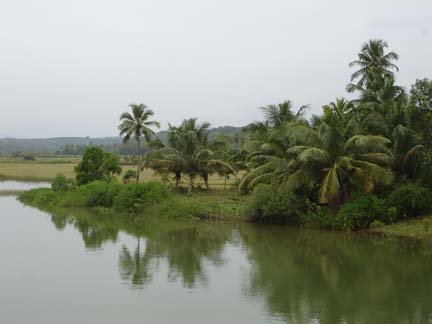
Holegadde near Honavar,Uttara Kannada dist, Karnataka
Copy? Right - but kindly remember to acknowledge!

" tulu-research.blogspot." ತುಳು ರಿಸರ್ಚ್. ಬ್ಲಾಗ್ಸ್ಪಾಟ್. ಇನ್

Have a nice day !