The parallel theological evolutions in Buddhism and mainstream Hinduism coupled with historical rivalries and interferences led to eventual assimilation of Buddhism especially in southern India.
The immigrant Indo Aryans who settled in northwestern Indian subcontinent are credited with the composition of earlier Vedas. Rigveda is known to have been composed by a set of about twelve sages of Indo-Aryan lineage. If we accept that the population of the Vedic poets is about a dozen or two, there is no meaning in the hypothesis of Indo-Aryan invasion. The small group of Indo-Aryans soon must have been absorbed into the Indian mainstream. Most of the remaining Vedas must have been composed by descendants of the Indo-Aryans and natives. This is evident by successive generations of sages of native origin.
Veda Vyasa
The sage Veda-Vyasa, the highly talented and creative writer of Mahabharata and the compiler/arranger of Vedas is a shining example. Veda-Vyasa, ca.500 BC, was clearly an educated native, born to sage Parashara and Satyavathi (Matysagandhi), the daughter of Dasharaja, a boatman who used to ferry people across River Yamauna.
Veda-Vyasa is also credited with the concept and compilation of ten incarnations of Vishnu. He obviously wanted to establish the greatness of Lord Vishnu, who was a minor God during the time of Rigveda. He assembled various ten legends that existed prior in different regions of the subcontinent and welded them into a continuous collage of incarnations of the Mahavishnu.
Gautama Buddha
Gautama Buddha entered the scene around the same time, with his revolutionary agnostic philosophy. Soon he was very popular and many people embraced the philosophies propagated by him. The popularity of Buddha was detrimental to the propagation of Vishnu cult. Therefore disciples of Veda-Vyasa, modified their original scheme of ten incarnations and adapted the legend of Buddha as ninth incarnation of Vishnu. This was in a way psychological rivalry of theologies and battle for supremacy. The conversion of Buddha into an incarnation was an effort to denigrate his status and supremacy.
Mahayana
Buddhas disciples retaliated by promoting incarnations of Buddha. Initially 24 to 28 incarnations of Buddhas were visualized. In the next stage, a number of Bodhisattas who would attain Buddha-hood in the future in future were visualized. In a way, it was an open invitation that any person can achieve Buddha-hood by following specific path laid by the Mahayana school.
One channel of mainstream Hinduism was glorifying Vishnu and other was promoting Shiva and Devi or Kali, yet another school propounded the virtues of Brahma. Buddhism tried to absorb the basic concepts of these deities into Buddhism. The Avalokiteswara, the Bodhisatta (Bodhisatva) of compassion was remoulded to embrace the virtues of Shiva. Manjusri, the Bodisatta of wisdom, was modified to represent attributes of Brahma. Padmapani was a variation of Vishnu. Similarly, parallel Dhyani Buddhas were created to represent other divine elements of the Vedic mainstream. Even the concept of a future Buddha, Maitreya, who would be born after 4000 years (shade of Kalki) was conceived.
Ajanta and Ellora (6-8 c CE) in Maharastra, Krishna valley in Andhra Pradesh, Kaveripatam and Nagapattanam in Tamilandu, Banavasi, Aihole, Mangalore in Karnataka, Ratnagiri in Orissa and Srimulavasam near Ambalapuzha in Kerala were major centres of Buddhism in southern India
Vajrayana
Vajrayana cult of Buddhism delved into Tantric rituals like various groups of tantric Shaivite Kapalika, Siddha and Shakta cults during 7th and 8th centuries. The parallelism and collaborations amongst these groups led to dissolution of thin boundaries that separated them. Natha cult is clearly a fusion of Buddhist and mainstream Hinduism.
The Buddhism was not blatantly driven out of southern India as made out by some analysts, but was eventually absorbed into the mainstream Hinduism. Only those sects that were denied entry to Hindu temples at that time, like Thiya (Malayalee Billawas), continued to practice a weakened form of Buddhism.
®

A heritage blog by: Ravindra Mundkur & Hosabettu Vishwanatha
Showing posts with label Rigveda. Show all posts
Showing posts with label Rigveda. Show all posts
Friday, February 1, 2008


Sunday, June 3, 2007
25. Pala and Antiquity of Tulu words
Strange it may seem,that the Jack fruit was the first edible fruit in use in antiquity in the Indian subcontinent. The nature of the word Pala, Phala or Pela to represent the Jack fruit even today suggests that the word (Pala / Pela/ Phala) was originally or since beginning was used to denote the common Jack fruit, arguably a native fruit of Indian subcontinent.
The basic word ‘phala’ stands for ‘fruit’ in Sanskrit. The presently commonplace word has been absorbed by most of the Indian languages, like phala (Kannada), phalam (Malayalam), etc.
Michael Witzel (1999) while analyzing words found in the Vedas concluded that some words in Rigveda (early part of Rigveda were estimated be ca.1700-1500 BC old) are not original Indo-Aryan (or early Sanskrit) words. He has given a list of words borrowed into middle compositions of Rigveda (ca.1500 BC or younger) which includes phala, mayur etc. These extraneous words must have been borrowed from contemporaneous languages that existed in the proximity of Vedic scholars and their settlements. He has stated that phalam is derived from the Tamil word ‘palam’ meaning ripe fruit.
Incidentally, apart from the word ‘palam’(=ripe fruit), the word ‘pala’ also means jackfruit in Tamil according to Dravidian Etymological Dictionary by T. Burrow, M. B. Emeneau. Similarly, in Tulu language word ‘pela’(>pelakai) or ‘pila’ (>pilakai) represents the jack tree/fruit. Earlier, in Tulu also the ‘pala’ version might have existed; since the wooden planks derived from the jack tree are called ‘palai’. However, presently the word palai in Tulu represents any wooden plank.
It seems that during the early historical period of composition of Rigveda, the proto-Tulu/Tamil word pala represented the jack fruit. Possibly, it was the most popular or common fruit at that time. It can be visualized that the Vedic scholars considered the pala (or pela or pila), the jack fruit, at that time of history as an important and popular edible fruit and adopted it in the form of ‘phala’. The word ‘phala’ incorporated into Sanskrit subsequently stood to represent the fruits. Maybe the mango, the king of Indian fruits, was not properly recognized at that time.
Thus, subsequently the word pala (>phala) represented any ripe fruit.
The jack fruit/trees may not have been common trees in Pirak region or Vedic scholars were initially not familiar with the Pala /Pela tree. Therefore it appears that the Vedic scholars picked up the word from proto-Tulu/Tamil tribes.
Similar words exist in Malayalam. The equivalent word for jack fruit in early Kannada was ‘palas’. Telugu equivalent word for jack is ‘panasa’.
The existence of similar words in Tulu and Tamil suggest (a) either their derivation from a common proto language or (b) coexistence of proto-Tulu and proto-Tamil tribes at a certain point of history dating back to the period of compilation of the Vedas. In other words, this coexistence or common heritage of Tulu-Tamil languages and exchange of words among these communities imply that some members of these tribes were living in the vicinity of Vedic tribes at the period of compilation of Vedas.
However, the Tulu tribes do not commonly use the word ‘pala’ or ‘phala’ to represent fruits in general. They employ the term “parn′d” to mean fruit. [The symbol ′ here represents the time delay in pronunciation; d as unaspirated th in English ‘the’]. The Tulu word “parn′d” also means ripe banana; alternately, it also means any ripe fruit. It is interesting to note that when Vedics adopted the ‘pala’, the jack, to represent edible fruits, Tulu tribes preferred the word ‘parn′d’, the banana, to signify fruits!
Apart from the intriguing pala/ pela in Vedas, Michael Witzel lists three extraneous words which he considers as words of uncertain origin in the early part of Rigveda. These are ukha(=hip), phalgu (=minute weak) and aaNi (=lynch pin). These words exist in Tulu and may be that Vedics borrowed them from proto-Tulu neighbours.
Ukha means hip in Tulu. Okka noolu in Tulu refers to ‘loin string’ or the thread tied around the hip in olden days. Phalgu has similarity to ‘palku’ in Tulu; palkuni (verb) in Tulu means becoming soft, like a ripe fruit. And aaNi in Tulu means nail. Another word of interest is mayUra (=peacock), which is also considered as an extraneous word in Rigveda. In Tulu ‘maira’ exists since olden days; the ‘Maire’(=peahen, the female pea fowl) was a favourite name kept for women among Tulu tribes in earlier days.
The existence of Tulu words in Rigveda, indicates the antiquity of Tulu language. It may also mean that proto-Tulu speaking people were living in the area where Vedas were composed.
Footnote on Pela and Peja
The English word ‘jack fruit’ was derived from the Malayalam word ‘chakku palam’. In an earlier note (24) I erroneously suggested that word came from ‘jakku palam’, based on a random reading. I must have misread it. Manjunath pointed out to me that he has not heard any ‘jakku palam’ in Malayalam. So I googled on this howler and found some interesting information provided by Julia F Morton (1987).
Jack fruit or Jakfruit or Jak or Jaca (botanical name: Artocarpus heterophyllum) is considered native to Western Ghats of India
Morton classified Kerala jack fruits into (1) Kooja chakku and (2) Kooja phazam (barke or Varika). The ‘kooja chakku’ is the jack fruit with soft, puply carpels, called ‘tuluve’ in Tulu. So we find the word ‘chakku’ here that became ‘jack’.
The Malayalam word ‘kooja’ is related to the Tulu word ‘gujje’, the jack fruit. The Tulu word ‘barke’ denoting soft jackfruit that can be opened with hand is found also in Malayalam. ‘Varika’(Malayalam), varukkai(Tamil) and ‘varaka’ (Srilanka) appear to be related to the ‘barke’.
The Sahyadri, Western Ghats and coastal hinterland has another species of Artocarpus genus (A.pubescens?-wild jack ) known as peja or pejakai. The fruit, is of the smaller size of orange with soft spiny exterior and contains smaller carpels of grape size that taste distictly different from jackfruit. Otherwise it is similar in features to jackfruit. This tree is not described elsewhere and hence may not be a common tree in other tropical forests. The village name Pejavara (=peja+avara) means an open ground containing peja trees. Note the similar sounding tree names: pela and peja in Tulu.
Early Kannada (or Old Kannada, ca.400 AD)) bloomed around Banavasi town (presently southeastern Uttara Kannada region), with establishment of the Kadamba dynasty by Mayur Sharma at Banavasi. The similarity of Tulu ‘pela/pala’ and Kannada ‘palas’ words, in the two languages that grew up in close proximity is significant.
Thursday, April 26, 2007
20. Earliest popular fruit in the Indian subcontinent
Which is the earliest popular fruit in the Indian subcontinent? In my opinion, it is the humble jack fruit which was the most popular and possibly earliest used fruit in the Indian subcontinent. The fruit was called the ‘pela’ in Tulu, ‘palas’ in Kannada or simply the ‘phala’ in Sanskrit. Micheal Wizel (1999) who made a detailed analyses of the words used in Rigveda, the earliest Veda dated around 1700 BCE (early part of Rigveda), concluded that it contains several extraneous words that do not belong to the word structure of Sanskrit sensu stricto. Sanskrit words derived from Indo-european roots have a specific structure. His list of extraneous words includes the term ‘phala’.
Obviously, the extraneous Sanskrit word ‘phala’ in Rigveda must have been derived from the Tulu words ‘pela’ or ‘pala’ or the early Kannada word ‘palas’. Since the borrowed Sanskrit word ‘phala’ (=fruit) itself stands for the jack fruit, it should have been the most common fruit in those days and in those areas.
In Tulu language, both the ‘pela’ and ‘pala’ word versions are there. The Tulu word ‘palai’ (=wooden plank) is derived from ‘pala’ or ‘pela’ (=jack tree). The jack tree trunk was used for making wooden planks that were called ‘palai’.
The borrowing of Tulu/ Kannada/Dravida words into Rigveda by early scholars of Vedic tribes suggest that all these (Vedic, Tulu and other Dravida) tribes were living together (coexisting) in the Pirak region ca.1700 BCE, where early Vedas are considered to have been composed orally.
Subscribe to:
Posts (Atom)
A Coastal estuary
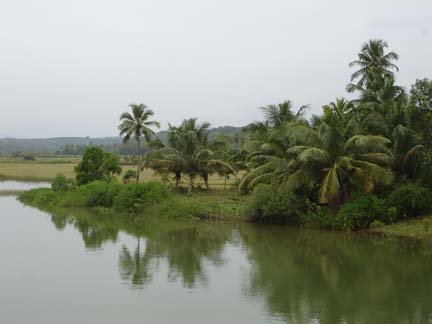
Holegadde near Honavar,Uttara Kannada dist, Karnataka
Copy? Right - but kindly remember to acknowledge!

" tulu-research.blogspot." ತುಳು ರಿಸರ್ಚ್. ಬ್ಲಾಗ್ಸ್ಪಾಟ್. ಇನ್

Have a nice day !