The parallel theological evolutions in Buddhism and mainstream Hinduism coupled with historical rivalries and interferences led to eventual assimilation of Buddhism especially in southern India.
The immigrant Indo Aryans who settled in northwestern Indian subcontinent are credited with the composition of earlier Vedas. Rigveda is known to have been composed by a set of about twelve sages of Indo-Aryan lineage. If we accept that the population of the Vedic poets is about a dozen or two, there is no meaning in the hypothesis of Indo-Aryan invasion. The small group of Indo-Aryans soon must have been absorbed into the Indian mainstream. Most of the remaining Vedas must have been composed by descendants of the Indo-Aryans and natives. This is evident by successive generations of sages of native origin.
Veda Vyasa
The sage Veda-Vyasa, the highly talented and creative writer of Mahabharata and the compiler/arranger of Vedas is a shining example. Veda-Vyasa, ca.500 BC, was clearly an educated native, born to sage Parashara and Satyavathi (Matysagandhi), the daughter of Dasharaja, a boatman who used to ferry people across River Yamauna.
Veda-Vyasa is also credited with the concept and compilation of ten incarnations of Vishnu. He obviously wanted to establish the greatness of Lord Vishnu, who was a minor God during the time of Rigveda. He assembled various ten legends that existed prior in different regions of the subcontinent and welded them into a continuous collage of incarnations of the Mahavishnu.
Gautama Buddha
Gautama Buddha entered the scene around the same time, with his revolutionary agnostic philosophy. Soon he was very popular and many people embraced the philosophies propagated by him. The popularity of Buddha was detrimental to the propagation of Vishnu cult. Therefore disciples of Veda-Vyasa, modified their original scheme of ten incarnations and adapted the legend of Buddha as ninth incarnation of Vishnu. This was in a way psychological rivalry of theologies and battle for supremacy. The conversion of Buddha into an incarnation was an effort to denigrate his status and supremacy.
Mahayana
Buddhas disciples retaliated by promoting incarnations of Buddha. Initially 24 to 28 incarnations of Buddhas were visualized. In the next stage, a number of Bodhisattas who would attain Buddha-hood in the future in future were visualized. In a way, it was an open invitation that any person can achieve Buddha-hood by following specific path laid by the Mahayana school.
One channel of mainstream Hinduism was glorifying Vishnu and other was promoting Shiva and Devi or Kali, yet another school propounded the virtues of Brahma. Buddhism tried to absorb the basic concepts of these deities into Buddhism. The Avalokiteswara, the Bodhisatta (Bodhisatva) of compassion was remoulded to embrace the virtues of Shiva. Manjusri, the Bodisatta of wisdom, was modified to represent attributes of Brahma. Padmapani was a variation of Vishnu. Similarly, parallel Dhyani Buddhas were created to represent other divine elements of the Vedic mainstream. Even the concept of a future Buddha, Maitreya, who would be born after 4000 years (shade of Kalki) was conceived.
Ajanta and Ellora (6-8 c CE) in Maharastra, Krishna valley in Andhra Pradesh, Kaveripatam and Nagapattanam in Tamilandu, Banavasi, Aihole, Mangalore in Karnataka, Ratnagiri in Orissa and Srimulavasam near Ambalapuzha in Kerala were major centres of Buddhism in southern India
Vajrayana
Vajrayana cult of Buddhism delved into Tantric rituals like various groups of tantric Shaivite Kapalika, Siddha and Shakta cults during 7th and 8th centuries. The parallelism and collaborations amongst these groups led to dissolution of thin boundaries that separated them. Natha cult is clearly a fusion of Buddhist and mainstream Hinduism.
The Buddhism was not blatantly driven out of southern India as made out by some analysts, but was eventually absorbed into the mainstream Hinduism. Only those sects that were denied entry to Hindu temples at that time, like Thiya (Malayalee Billawas), continued to practice a weakened form of Buddhism.
®

A heritage blog by: Ravindra Mundkur & Hosabettu Vishwanatha
Showing posts with label Vedavyasa. Show all posts
Showing posts with label Vedavyasa. Show all posts
Friday, February 1, 2008


Sunday, December 9, 2007
56. Assimilation of Indo –Aryans
The Indo-Aryan invasion hypothesis needs to be mended and modified in the light of recent scientific data! The fact is that Indo-Aryan immigrants did not invaded India as proposed earlier. The number of Indo-Aryans who immigrated was quite few.
The Y-chromosomal genetic data compiled by Sanghamitra Sahoo et al (2006) suggested a minor influx, of people of the Indo-Aryan language family from regions north and west of India. The Vedas were composed a group (about a dozen in number) of sages. With time the Vedic sages apparently had marital relations with natives and were gradually absorbed and assimilated into the pre-existing lingo-cultural fabric of India.
S. Sharma et al. (2007) in their recent paper (“The Autochthonous Origin and a Tribal Link of Indian Brahmins: Evaluation Through Molecular Genetic Markers “- abstract-cited in Dienekes anthropological blog) reported as follows:
“..we screened 621 Y-chromosomes (of Brahmins, Dalits and Tribals) with fifty-five Y-chromosomal binary markers and Y-microsatellite markers and compiled a data set of 2809 Y-chromosomes (681 Brahmins, 2128 Tribals and Dalits) for conclusions. Overall, no consistent difference was observed in Y-haplogroups distribution between Brahmins, Dalits and Tribals, except for some differences confined to a given geographical region.
A peculiar observation of highest frequency (upto 72.22%) of Y-haplogroups R1a1* in Brahmins, hinted at its presence as a founder lineage for this caste group. The widespread distribution and high frequency across Eurasia and Central Asia of R1a1* as well as scanty representation of its ancestral (R*, R1* and R1a*) and derived lineages across the region has kept the origin of this haplogroup unresolved. The analyses of a pooled dataset of 530 Indians, 224 Pakistanis and 276 Central Asians and Eurasians, bearing R1a1* haplogroup resolved the controversy of origin of R1a1*.
The conclusion was drawn on the basis of: i) presence of this haplogroup in many of the tribal populations such as, Saharia (present study) and Chenchu tribe in high frequency, ii) the highest ever reported presence of R1a* (ancestral haplogroup of R1a1*) in Kashmiri Pandits (Brahmins) and Saharia tribe, and iii) associated averaged phylogenetic ages of R1a* (~18,478 years) and R1a1* (~13,768 years) in India. The study supported the autochthonous origin of R1a1 lineage and a tribal link to Indian Brahmins.”
Brahmin-ization
The cited genetic study suggests that the native Indian tribes evolved in the land since 11 to 16 thousand years BC. The study also points to brahmin-ization of native tribes. And this could have happened ca.800-600BC, the magic period when Indo-Aryans and Early Dravidians entered the Indian mainland from the northwest. The Vedas were composed by a group of Indo-Aryan immigrants to NW Indian subcontinent ca 1900 to 800 BC. The Indo-Aryan immigrants were few in number as they immigrated into the Indian mainland and they gradually culturally assimilated with the natives. Select natives must have been absorbed into Vedic schools and were educated in Sanskrit.
The native tribes had evolved pockets of well developed religions and cultures. Some of them joined the Vedic tradition and contributed their talents in composing the great Puranas and Epics of India. Many examples exist in the legends in support of this theory. Valmiki who compiled and composed Ramayan was a bhil, a native archer. Sage Agasthya was a former washer-man (dhobi) from the fold of natives. Jabali was originally from the native tribes. Vedavyasa, the famed dark-skinned (‘Krishna’ Dwaipayana) and talented composer of Mahabharata was born to a woman of lower caste.
Therefore the Early Indian caste system (500-300 BC) was created out of the evolved fraction of native groups.
®.
The Y-chromosomal genetic data compiled by Sanghamitra Sahoo et al (2006) suggested a minor influx, of people of the Indo-Aryan language family from regions north and west of India. The Vedas were composed a group (about a dozen in number) of sages. With time the Vedic sages apparently had marital relations with natives and were gradually absorbed and assimilated into the pre-existing lingo-cultural fabric of India.
S. Sharma et al. (2007) in their recent paper (“The Autochthonous Origin and a Tribal Link of Indian Brahmins: Evaluation Through Molecular Genetic Markers “- abstract-cited in Dienekes anthropological blog) reported as follows:
“..we screened 621 Y-chromosomes (of Brahmins, Dalits and Tribals) with fifty-five Y-chromosomal binary markers and Y-microsatellite markers and compiled a data set of 2809 Y-chromosomes (681 Brahmins, 2128 Tribals and Dalits) for conclusions. Overall, no consistent difference was observed in Y-haplogroups distribution between Brahmins, Dalits and Tribals, except for some differences confined to a given geographical region.
A peculiar observation of highest frequency (upto 72.22%) of Y-haplogroups R1a1* in Brahmins, hinted at its presence as a founder lineage for this caste group. The widespread distribution and high frequency across Eurasia and Central Asia of R1a1* as well as scanty representation of its ancestral (R*, R1* and R1a*) and derived lineages across the region has kept the origin of this haplogroup unresolved. The analyses of a pooled dataset of 530 Indians, 224 Pakistanis and 276 Central Asians and Eurasians, bearing R1a1* haplogroup resolved the controversy of origin of R1a1*.
The conclusion was drawn on the basis of: i) presence of this haplogroup in many of the tribal populations such as, Saharia (present study) and Chenchu tribe in high frequency, ii) the highest ever reported presence of R1a* (ancestral haplogroup of R1a1*) in Kashmiri Pandits (Brahmins) and Saharia tribe, and iii) associated averaged phylogenetic ages of R1a* (~18,478 years) and R1a1* (~13,768 years) in India. The study supported the autochthonous origin of R1a1 lineage and a tribal link to Indian Brahmins.”
Brahmin-ization
The cited genetic study suggests that the native Indian tribes evolved in the land since 11 to 16 thousand years BC. The study also points to brahmin-ization of native tribes. And this could have happened ca.800-600BC, the magic period when Indo-Aryans and Early Dravidians entered the Indian mainland from the northwest. The Vedas were composed by a group of Indo-Aryan immigrants to NW Indian subcontinent ca 1900 to 800 BC. The Indo-Aryan immigrants were few in number as they immigrated into the Indian mainland and they gradually culturally assimilated with the natives. Select natives must have been absorbed into Vedic schools and were educated in Sanskrit.
The native tribes had evolved pockets of well developed religions and cultures. Some of them joined the Vedic tradition and contributed their talents in composing the great Puranas and Epics of India. Many examples exist in the legends in support of this theory. Valmiki who compiled and composed Ramayan was a bhil, a native archer. Sage Agasthya was a former washer-man (dhobi) from the fold of natives. Jabali was originally from the native tribes. Vedavyasa, the famed dark-skinned (‘Krishna’ Dwaipayana) and talented composer of Mahabharata was born to a woman of lower caste.
Therefore the Early Indian caste system (500-300 BC) was created out of the evolved fraction of native groups.
®.
Subscribe to:
Posts (Atom)
A Coastal estuary
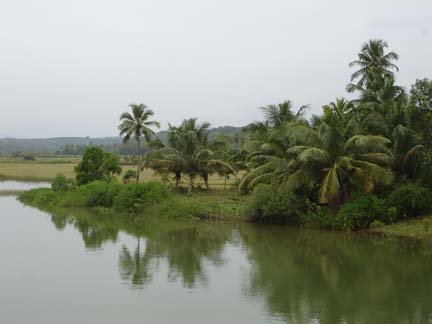
Holegadde near Honavar,Uttara Kannada dist, Karnataka
Copy? Right - but kindly remember to acknowledge!

" tulu-research.blogspot." ತುಳು ರಿಸರ್ಚ್. ಬ್ಲಾಗ್ಸ್ಪಾಟ್. ಇನ್

Have a nice day !