The word ‘patna’ represents a town in many of the Indian languages. The city in Jharkhand (and former capital of Bihar) is known as ‘Patna’. Besides, there are towns called ‘patna’ in Gujarat. In southern India, the word appears to have been applied to ancient port towns: Machalipatna, Nagapatna, Visakapatna etc. In Tulunadu context, the word is mostly applied to coastal colonies of Mogavir fishermen. In the olden days the fishing colonies were generally associated with port towns. Thus the word ‘patna’ was interchangeably used for port towns and the associated fishery colonies. People from the Tulu fishing community were used to be addressed as 'patnadakulu' (=fishermen) or 'pattaldi' (=fisher woman) by other communities.
On the other hand, the ancient towns and capitals were initially built around the port towns, as the ports were the major centers of trade and revenue.
Moolara patna
However, the word is not exclusively used for port towns or fishery colonies even in Tulu context. Moolara-patna on the bank of River Palghuni (Gurupur) is an example. Moolara patna as the name reveals is a colony of ‘Moola’ or ‘Moolya’ people. The word ‘moola’ represents origin and thus the word ‘moolya’ stands for aborigine.
Bokka patna
Bokka-patna is an example for an ancient port town associated with fishery colony. Bokkapatna is presently a lesser known civic extension in western part of Mangalore city. However, only few can visualize and realize that once it was a major port town representing Mangalore, especially during 12th to 15th Centuries CE. Reconstruction of geological history of the area reveals that the River Phalguni (Gurupur) was joining the Arabian Sea between Kudroli and Bolar. And the Kings of Vijayanagar who occupied Mangalore during 14th Century CE, developed port on the bank of river estuary and named it as “Bokkapatna” in honour of the Vijayanagar King Bukka (or Bokka).Therefore the Bokkapatna was the official Mangalore port during that historical period.
Patna: Let us analyze the word ‘patna’ ( pron: paTNa ) to gain some insights into the evolution of our words and languages. The origin of the word appears to be:
paTT + Na. (‘paTT’=colony or nest, aNa, aNe=area.)
There are at least four similar sounding roots related to the word patna: (1) patt 1(2) patt 2(3) pat, or pata and (4) pada and (5)padu.
1. Patt 1= a nest, a group or a colony.
2. Patt 2= to distribute among people.
3. Pata= a cloth, a curtain or a flag or a stretch of land. Also pictures, portraits or maps (drawn on a canvas, cloth piece or a paper) or a kite.. Examples: bhupata (=Map), chitrapata, galipata etc.
The Sanskrit word ‘path’(=linear path, road) appears to be related and /or derived from the old word ‘pata’
4. Pada=(pron: paDa) The word ‘paDa’ (pron: short pa+Da. Pa=low lying; Da=area) represents (1) a beach area demarcated for drying fish along the coast, or (2) a mat knitted from coconut fibers and used for drying fish. The word ‘paDa’ also means (3) to take a turn or (4) a large boat (‘paDavu’).
5. Padu =(pron: paDu) = West. (pa=(1).Sea margin, beach, (2) low lying; Du=area, possibly refers to the direction of Arabian Sea or coastal low lying area).
** **
There are some more related words for comparison in Tulu language:
Padil : PaDil represents a barren or waste land.
Patla: Patla (pron: paTla) means a low-lying marshy land alongside a river. [Origin: pa+T+la. ‘paT’=low lying +strip of land+ covered by ‘ala’(=water) ]. A ‘paTla kanDa’ means a wet, water-logged rice field, near a river, yielding only one crop per year In ‘patla kanda’, flooding is a common feature in rainy season rendering it unfit for rainy season's paddy cultivation of 'yenel' crop. ['Yenel' (yene+al) as ‘water from the sky’ (=rains)]. In these days of building constructions, these marshy lands are reclaimed and made habitable with modern type of buildings. Hence the Tulu idiomatic expression/usage: “Patla pOdu uru aanD” (=The marshy land has become village).
Patti: Patti (pron: paTTi) is a strip of cloth, metal or wood. It also developed into a linear strip like colony of houses or a village habitation.. The word ‘patti’(=habitation) became ‘hatti’ in medieval Kannada, with transformation of p> h.
Patti2 was a strip of cloth wherein records were written in the historical past, before the invention of paper.
Patta: The word ‘patta’ (pron: paTTa) means authority, throne or royal power. In other words it is power over a stretch of land.
Men of high positions (masters or authorities), landed gentry living in palatial buildings are called 'pattadakulu' in Tulu parlance.
Thus a ‘Patel’ represents a village chairman or head. The word ‘Patel’ has become ‘Pātil’ in northern Karnataka and Maharastra areas. Patel is also current in Gujarat as surname and profession. Possibly the word ‘Patel’ was brought to Tulu and Kannada region by the immigrants from north.
In interior Karnataka and Maharashtra, the word Patel has transformed to 'Patil or Pateela', meaning landlord, hence a man of high position.
Patte: The word ‘patte’ originally means a silken cloth. It was customary to preserve land records in a 'patte' (invariably in red colour). Hence, the word ‘patte’ it came to mean a 'registered land record', showing rightful entitlement. 'Patte kudtale' also means a record of ownership of land or landed property with registered right of paying land revenue tax. So the word: 'pattedār or pattadāre' (land-owner, possessing valid record of rights). 'Pattevaali' also means a striped silk cloth.
Patawari: Note this nomenclature current in Hindi-spaking belts. Meaning is similar to 'Patele, Patel, Pattedare, Pattadaare' (Tulu), Pātil (Maharashtra, Karnataka), Patel (Gujarat) and so on in other areas.
Patavardhan: This surname or title common in Maharashtra and Karnataka also relates to root word 'Pata'.
Pata Parivartan: meaning 'Change of flag,curtain', refers to change of circumstances in different points of time. In History, it means stages of different events, rise and fall of monarchies, governments, social and religious upheavals and new schools of thoughts.
Patasale (Padasale): Padsale means 'main living room of a house'. The word 'paDasale' possibly meant originally a west side living room.Kawdoor Narayana Shetty has pointed out that the word "saala" means a living room in Italian language.
Note: Pata and Pada are interchangeable words in Tulu.
-with Hosabettu Vishwanath.
®

A heritage blog by: Ravindra Mundkur & Hosabettu Vishwanatha
Tuesday, December 8, 2009


Friday, December 4, 2009
213. Kotrupādi
Village names like 'Kotrupadi'(pron:koTrupādi) open up windows into forgotten early chapters of the human evolution in the Tulunad. The Kotrupadi is a hamlet within Kallamundkur village, located on the Mulki-Mudabidri road in Mangalore taluk. There is one more ‘Kutrupadi’ near Bantra village in Puttur Taluk.
There may be many more such hamlets known by similar sounding names. What is the ‘Kotru’ or ‘Kutru‘ stand for in such place names? My casual enquiries with random people near such villages do not elicit any meanings worth pondering. There are some more such words: ‘Kottigehara’ near Charmadi, bordering Chikmagalur district, on the Western Ghats (Sahyadri ranges). ‘Kottur’ in Bellary district. ‘Kottara’, inside Mangalore city.etc.
Koytoors
Gond tribes now residents of Vidarbha region in Maharastra are known as ‘ Koytoor’ or ‘Koitur’ or simply ‘Koi’. Gonds are a hilly tribe (‘gond’ or ‘kond’=hill) who are cultivators or depend on forest products for their livelihood. Gonds are said to be Dravidian tribes. Some sociologists also include these tribes among pre-Dravidian Munda Group. These dual classification of Gonds suggest that these tribes could be representatives of the stages of evolutionary trends from the early Munda to Dravidian tribes. Sham.Baa. Joshi refers to Goddess “Kotturi” in some of his works. ‘Kotturi’ Goddess is probably related to Koitur or Gond tribes.
Books like “Socio-cultural study of scheduled tribes: the pardhans of Maharashtra” by Shashidhar Ramchandra Murkute and “Gonds of Vidarbha “by S.G. Deogaonkar throw better light on these tribes.
The presence of abundant place names with prefix ‘Koi’ or ‘Koitru’ or ‘Kotru’ in Karavali Tulunadu and other parts of Karnataka reveals that these tribes lived in these regions once upon a time. And due to various adverse reasons these tribes might have migrated north towards Vidarbha in Maharastra. Many of the ancient socio-religious customs of early Gond tribes have been assimilated into the cultural practices of subsequent Tulu and other Dravidian generations.
Ancient Gonds of Tulunadu
The existence of place names beginning with ‘Koi’- (Koikude, Koila etc) and ‘Kotru’-(Kotrupadi, Kottara, Kottigehar etc) in Tulunadu are the remnant signatures of ancient Koitur Gond settlements. The agricultural implement ‘Kottu’(hand showel) may be having origins with ‘Kotru’ tribes. The earlier Koi and Kotru tribes were possibly partly absorbed into later Dravidian communities as seen by the undercurrents of ancient Gond customs among us. Assimilation of tribes suggest that they were evolved enough to gain respectability by the immigrants.
Further, ‘Gondarannaya’ has remained as a ‘Bari’ (septa) and ‘Konde’(<.Gonde), ‘Kotari’, ‘Kotriyal’ etc have remained as surnames especially among Tulu Nadava people.
®
There may be many more such hamlets known by similar sounding names. What is the ‘Kotru’ or ‘Kutru‘ stand for in such place names? My casual enquiries with random people near such villages do not elicit any meanings worth pondering. There are some more such words: ‘Kottigehara’ near Charmadi, bordering Chikmagalur district, on the Western Ghats (Sahyadri ranges). ‘Kottur’ in Bellary district. ‘Kottara’, inside Mangalore city.etc.
Koytoors
Gond tribes now residents of Vidarbha region in Maharastra are known as ‘ Koytoor’ or ‘Koitur’ or simply ‘Koi’. Gonds are a hilly tribe (‘gond’ or ‘kond’=hill) who are cultivators or depend on forest products for their livelihood. Gonds are said to be Dravidian tribes. Some sociologists also include these tribes among pre-Dravidian Munda Group. These dual classification of Gonds suggest that these tribes could be representatives of the stages of evolutionary trends from the early Munda to Dravidian tribes. Sham.Baa. Joshi refers to Goddess “Kotturi” in some of his works. ‘Kotturi’ Goddess is probably related to Koitur or Gond tribes.
Books like “Socio-cultural study of scheduled tribes: the pardhans of Maharashtra” by Shashidhar Ramchandra Murkute and “Gonds of Vidarbha “by S.G. Deogaonkar throw better light on these tribes.
The presence of abundant place names with prefix ‘Koi’ or ‘Koitru’ or ‘Kotru’ in Karavali Tulunadu and other parts of Karnataka reveals that these tribes lived in these regions once upon a time. And due to various adverse reasons these tribes might have migrated north towards Vidarbha in Maharastra. Many of the ancient socio-religious customs of early Gond tribes have been assimilated into the cultural practices of subsequent Tulu and other Dravidian generations.
Ancient Gonds of Tulunadu
The existence of place names beginning with ‘Koi’- (Koikude, Koila etc) and ‘Kotru’-(Kotrupadi, Kottara, Kottigehar etc) in Tulunadu are the remnant signatures of ancient Koitur Gond settlements. The agricultural implement ‘Kottu’(hand showel) may be having origins with ‘Kotru’ tribes. The earlier Koi and Kotru tribes were possibly partly absorbed into later Dravidian communities as seen by the undercurrents of ancient Gond customs among us. Assimilation of tribes suggest that they were evolved enough to gain respectability by the immigrants.
Further, ‘Gondarannaya’ has remained as a ‘Bari’ (septa) and ‘Konde’(<.Gonde), ‘Kotari’, ‘Kotriyal’ etc have remained as surnames especially among Tulu Nadava people.
®
Thursday, November 19, 2009
212. PāDi

‘PāDi ‘is a familiar Tulu word representing an area with trees. The word ‘pāDi’ also occurs as suffix in place names like Gopādi, Bopādi, Katapādi, Bellarapādi, Kannarapadi, Bettamapadi, Talapadi, Talipadi, Baikampādi etc. Presence of place-names like Katpadi in Tamilanadu suggests that it is a common Dravida word. However, available data suggests that the word ‘pāDi’ was borrowed from pre-Dravidian Munda group of languages and culture.
For example, the bari or gotra (sept or clan) system is known as ‘pāDi’ among Gond tribes of Vidarbha. Gonds are members of Munda group of Austro-Asiatic tribes that were widespread in the peninsula in the antiquity.
Vanajaputta Manjunatta pointed out that the Gotra or Bari (sept or clan) system prevails among the Gond tribes and is known as ‘padi’ (pronounced ‘pāDi’). ‘Gonds of Vidarbha ‘ by S. G Deogaonkar gives outlines of the pādi system among Gond tribes.
Gonds are a group of ancient Austro- Asiatics or Munda tribes, who have evolved with passage of time and have assimilated socio-cultural features and customs from various immigrant communities and groups.
The word ‘padi’ at present means a group of houses in the Gond language.
Further, tThe old word pāDi has become hāDi in later Kannada after 10th Century CE, with transition of pa> ha.
ADi & pāDi
Compare the word ‘pādi’ with another related word namely ‘āDi’. Adi is also a suffix in place-names such as Nelyadi, Kalyadi, Kanyadi, Amtadi, Nekkiladi, Bannadi, Hemmadi, Hejmadi, etc.
As discussed in a previous post, it appears that the word ‘āDi’ originally represented shade of a tree. To begin with, in the primitive days of early civilization, the shade of a tree in sunny, tropical countries apparently constituted the comfortable habitation of early man. Hence the suffix –aDi was used to designate early habitation names. The root word ‘aD’ meant a tree as we notice in the derived words ‘aDar’ (=twig) and ‘aDavi’(=forest). In the early days of civilization, parts of dried tree (twigs etc) were used to ignite fire and to cook. Hence the root ‘aD’ also stood for the verb ‘ (to) cook’, from which words like ‘aDpini’(=cooking), ‘aDpil’(=kitchen), ‘aDDe’(=coked food), aDve(=forest) etc were derived.
paDi = pa+aDi
If ‘aDi’=shade of a tree, then ‘pāDi’= shade of group of trees or shady grove.
Thus in the due course of time, the word pāDi developed in scope to represent a comfortable residential area that consisted of a group of habitation of related people.
Prefix pa- occurs in a number of spatial names such as panja (pa+anja), pangala (pa+angala), pāndi (pa+anDi) etc. Usage of pa- as prefix in these words suggests that it carries shades of meanings such as water body,greenish area,or even good or comfortable.
Similarly there are two more suffixes namely ‘nāDi ‘(Pachanadi, Manjanadi) and ‘māDi’ (Hemmadi, Hejamadi,) that can be analysed as follows:
Na+aDi= =cultivated tree or na+aD+i= cultivated area.
Ma+aDi= elevated area.
pāDa
There is another suffix similar or equivalent to pāDi , namely pāDa.
Da= locality or area in Munda languages.
pa+Da. PāDa= Comfortable area or greenish ( sylvan) area.
There are several localities in Maharastra having a prefix of –pāDa, such as
AgripāDa (Mumbai), Dandpada etc.
The word 'pata'appears to be related to or derived from pada.
PaTa (=cloth piece),possibly >PaTan>PaTTana>PaTna. Variant of Pata is paDa (short vowel 'a'), a carpet of coir or cloth. PaDa, made of coir, is used for drying the cured fish.
VāDa
Another related word is spatial suffix -vada.
Va+Da. Both the words -va and- Da are spatial suffixes. Suffix -va (as in Shirva, Urva, Kolva, etc) has been extensively discussed in an earlier post.
There are several place names having suffix of vada in southern India, such as Vijayavada, Kolivada, etc. There are numerous –vada places near Karawar. KaDvaD, ZarivaDa, HarvaDa, DharvaDa,etc. The original name of the Karawar town is known to be ‘KaDvaDa’ (=village beside a river ferry; kaD= river bank or ferry, vaDa= habitation area).
VāDi
Like the pāDa and pāDi spatial word pair, we also have vāDi for vāDa!
Vādi occurs as an independent place-name (for example, VāDi , a Railway junction in Gulbarga district) [va+aDi = habitation area] or as a suffix in toponyms such as Belavadi, Tilakvadi, etc.
PāDa-pāDi, vāDa-vāDi, bāDa-bāDi
Apart from these there is one more related suffix, namely -bāDi ( as in Kodimbadi,Kedambadi, Kannambadi etc).Pairing with bāDi is another suffix bāDa which forms several place names especially in Uttara Kannada.
The analyses of these related spatial suffixes hint at the possibility of -aDi and -Da being regional variants of the same word from Munda languages. It appears that Dravidian languages picked up and assimilated some of the pre-existing Munda words in the region.
-With Hosabettu Vishwanath.
®
Friday, October 30, 2009
211. Gotra , Bari: Genetic tags
A comment from Purushotham Puthran rather innocently enquires: “May I also Know what to say when the Temple priest ask us for the GOTRA.”
Many of us who piously follow Hindu traditional worship patterns and customs, like Purushotham , may have encountered certain degree of embarrassment, especially if you are from non-brahmin lineages , when the temple priest asks you the name of your Gotra,.
Gotra system
The ‘Gotra’ is an ancient system (origin ca. 1700 BC or older) of identifying and classifying the individual. Then there were no genome studies. The individual hymns in the Vedas were said to have been composed by a set of (twelve or so) sages independently and then collated together as a consensus after presenting them in a like- minded group discussion forum or seminar.
Yadava : cow lineage
It seems the Vedic sages adopted a scheme of identification of families earlier used and adopted by pre-Vedic Yadava group (Idiya, Yedava etc equivalents) that specialized in cattle-herding. Or it could be that Yadava cattle camps in the due course adopted a Vedic sage or Guru for guiding them in various physical and metaphysical aspects of life. In other words ancient families were attached to specific cowsheds, since dairy products were one of the primary source of wealth in those days. It was designated Gotra system (go=cow, tra=line), since the classification was based on the name of the cowshed to which joint families were attached at that time.
One of the possibility is that the ‘tra’ (tra=thread; tara,dhara=flow) or lineage system was in vogue among civilized people and the Yadava tribes specially formulated a ’go-tra’ (cow- lineage) system to identify and distinguish persons from their community. The Vedic poet-sages were associated with or sponsored by camps of cattle-herders (Yadava) who depended on dairy products for their livelihood. With passage of time, when families in each camp grew in size, persons were identified by the cow-pen which was named after the priest (Guru) of the camp.
Thus then it was a convenient general practice to identify individuals based on the name of their camps. Subsequently, post-Vedic people of dominant communities (brahmin, kshatriya and vaishya groups) had also the option of joining or adopting any of the pre-existing set of ‘ gotra’ camps, and the opted ‘gotra’ tag was continued in their progeny from father to son.
Thus the gotra tag during the timeline was either innate or acquired. Some of the common ancient gotra were named after sages Agashtya, Angirasa, Athri, Brighu, Bharadwaja, Kashyapa, Vasishta, Vishwamitra etc. (The gotra system obviously evolved over a period of long time. For example Bhardwaja was said to be a descendant of Angirasa. Jamadagni was said to be a descendant of Bhrighu and so on).These sages were scholars of that time and it should be remembered that many of the sages like Valmiki, Vyasa and Markandeya during the history originated from so called backward classes.
Since the ‘gotra’ system was like an identity tag for individual that was perpetuated over the years for the purpose of matrimonial alliances etc, there are inheritors of this ‘gotra’ system even today. The temple priest who asks the name of your ‘gotra’ is only trying to identify you in terms of the original Vedic camps your forefathers possibly belonged to!
However, it should be remembered that were also other people in the antiquity who did not belong to any of these gotra camps or subscribed to their theories.
Bari system
However, there were similar wise systems of identifying persons from different groups was in vogue at that time in the subcontinent. Tulu-Dravida ancestors, for example, had adopted the ‘Bari’ system or the ‘Bali ‘system.
The word ‘bari’ specifically means a side or a flank. In an early civilized human settlement, there were several families residing in a colony and each house was designated specifically based on the origin of the senior persons/parents in the house.
The word ‘bali’ is said to be a variant of the word ‘bari’. However the word ‘bali’ specifically means a forest creeper that was used as thread or rope in the olden days. Therefore the word ‘bali’ means lineage, like the suffix ‘tra’ in gotra. Obviously in the later system there is no mention of 'gow' or the cow, which leads us to surmise that in the beginning this system probably was originally designed by non- Yadava sects and subsequently adopted by Yadavas as gotra system.
Therefore we can conclude that lineage (bali) or side (bari) system was probably prevalent in (at least) north-western India during pre-Vedic (ca. 1700 BC) and ensuing periods. The concept spread to other regions later along with migrating people.
Gotra or Bari
Now back to the dilemma posed by Purushottam Puthran. What to say when your priest asks the name of your Gotra? The answer basically depends on your convictions and beliefs. If you feel that following a ‘gotra’ of Vedic to post Vedic period elevates you, please select (adopt as many have done traditionally) a ’gotra’ name and utter it. Many priests spontaneously classify you as ‘Kashyapa’, ‘Viswamitra’ or ‘Markandeya’, when you are unable to tell your gotra.
Or if you are scientific in your temper, tell the Priest your actual ‘bari ‘. Note that Brahmin families in Tulunadu have adopted surnames based on the names of their family houses such as Kakkilaya, Pejathaya, Kalluraya etc. If the ancient ‘gotra’ system was ever enduring and satisfactory this kind of subsequent adoption of family names was not required.
If you are a ‘Puthran’ in terms of ’bari’ system, I suggest that you should adopt ‘Puthran’ tag as your both ‘bari’ and ‘gotra’.It would be more meaningful than adopting some unknown or unrelated genetic tags.
®
Many of us who piously follow Hindu traditional worship patterns and customs, like Purushotham , may have encountered certain degree of embarrassment, especially if you are from non-brahmin lineages , when the temple priest asks you the name of your Gotra,.
Gotra system
The ‘Gotra’ is an ancient system (origin ca. 1700 BC or older) of identifying and classifying the individual. Then there were no genome studies. The individual hymns in the Vedas were said to have been composed by a set of (twelve or so) sages independently and then collated together as a consensus after presenting them in a like- minded group discussion forum or seminar.
Yadava : cow lineage
It seems the Vedic sages adopted a scheme of identification of families earlier used and adopted by pre-Vedic Yadava group (Idiya, Yedava etc equivalents) that specialized in cattle-herding. Or it could be that Yadava cattle camps in the due course adopted a Vedic sage or Guru for guiding them in various physical and metaphysical aspects of life. In other words ancient families were attached to specific cowsheds, since dairy products were one of the primary source of wealth in those days. It was designated Gotra system (go=cow, tra=line), since the classification was based on the name of the cowshed to which joint families were attached at that time.
One of the possibility is that the ‘tra’ (tra=thread; tara,dhara=flow) or lineage system was in vogue among civilized people and the Yadava tribes specially formulated a ’go-tra’ (cow- lineage) system to identify and distinguish persons from their community. The Vedic poet-sages were associated with or sponsored by camps of cattle-herders (Yadava) who depended on dairy products for their livelihood. With passage of time, when families in each camp grew in size, persons were identified by the cow-pen which was named after the priest (Guru) of the camp.
Thus then it was a convenient general practice to identify individuals based on the name of their camps. Subsequently, post-Vedic people of dominant communities (brahmin, kshatriya and vaishya groups) had also the option of joining or adopting any of the pre-existing set of ‘ gotra’ camps, and the opted ‘gotra’ tag was continued in their progeny from father to son.
Thus the gotra tag during the timeline was either innate or acquired. Some of the common ancient gotra were named after sages Agashtya, Angirasa, Athri, Brighu, Bharadwaja, Kashyapa, Vasishta, Vishwamitra etc. (The gotra system obviously evolved over a period of long time. For example Bhardwaja was said to be a descendant of Angirasa. Jamadagni was said to be a descendant of Bhrighu and so on).These sages were scholars of that time and it should be remembered that many of the sages like Valmiki, Vyasa and Markandeya during the history originated from so called backward classes.
Since the ‘gotra’ system was like an identity tag for individual that was perpetuated over the years for the purpose of matrimonial alliances etc, there are inheritors of this ‘gotra’ system even today. The temple priest who asks the name of your ‘gotra’ is only trying to identify you in terms of the original Vedic camps your forefathers possibly belonged to!
However, it should be remembered that were also other people in the antiquity who did not belong to any of these gotra camps or subscribed to their theories.
Bari system
However, there were similar wise systems of identifying persons from different groups was in vogue at that time in the subcontinent. Tulu-Dravida ancestors, for example, had adopted the ‘Bari’ system or the ‘Bali ‘system.
The word ‘bari’ specifically means a side or a flank. In an early civilized human settlement, there were several families residing in a colony and each house was designated specifically based on the origin of the senior persons/parents in the house.
The word ‘bali’ is said to be a variant of the word ‘bari’. However the word ‘bali’ specifically means a forest creeper that was used as thread or rope in the olden days. Therefore the word ‘bali’ means lineage, like the suffix ‘tra’ in gotra. Obviously in the later system there is no mention of 'gow' or the cow, which leads us to surmise that in the beginning this system probably was originally designed by non- Yadava sects and subsequently adopted by Yadavas as gotra system.
Therefore we can conclude that lineage (bali) or side (bari) system was probably prevalent in (at least) north-western India during pre-Vedic (ca. 1700 BC) and ensuing periods. The concept spread to other regions later along with migrating people.
Gotra or Bari
Now back to the dilemma posed by Purushottam Puthran. What to say when your priest asks the name of your Gotra? The answer basically depends on your convictions and beliefs. If you feel that following a ‘gotra’ of Vedic to post Vedic period elevates you, please select (adopt as many have done traditionally) a ’gotra’ name and utter it. Many priests spontaneously classify you as ‘Kashyapa’, ‘Viswamitra’ or ‘Markandeya’, when you are unable to tell your gotra.
Or if you are scientific in your temper, tell the Priest your actual ‘bari ‘. Note that Brahmin families in Tulunadu have adopted surnames based on the names of their family houses such as Kakkilaya, Pejathaya, Kalluraya etc. If the ancient ‘gotra’ system was ever enduring and satisfactory this kind of subsequent adoption of family names was not required.
If you are a ‘Puthran’ in terms of ’bari’ system, I suggest that you should adopt ‘Puthran’ tag as your both ‘bari’ and ‘gotra’.It would be more meaningful than adopting some unknown or unrelated genetic tags.
®
Thursday, October 22, 2009
210. Palli

Some of the words have multiple meanings that introduce a degree of uncertainity and indecisiveness as to their originally intended exact meaning when encountered in the form of place names. The multiple meanings inherited by some of these words may have originated from divergent proto-language sources during the course of evolution, leading to perpetuation of dissimilar meanings for similar sounding words. Let us look into the word ‘palli’ for an illustration of this observation.
Palli (pronounced as paLLi or palli in different regions) is a common place name indicator in southern India. Madanapalli, Tiruchirapalli, Bellampalli, etc places suggest the prevalence of this word among Dravidian ancestors. However, the word is not geographically exclusive to southern India. We find place names ending with palli Sindhi and Baluchistan village names in Pakistan (Palli-Mas, Goth-Palli etc), Afghanistan and also in northern Africa and Mediterranean region. Palli is also the name of a settlement in Voru, Estonia. Palli an Israeli male surname. Palli is also name of a Sindhi tribe in Pakistan.Data from Vanniyars suggest that the South Indian royal group of Pallavas were also formerly referred to as Pallis.In mideval Kannada ‘palli’ became ‘halli’, while ‘palle’ and ‘palliya’ variants also exists in Andhra Pradesh.. In Maharastra and Gujarat, modified -valli suffix also exists.
It is suggestive of flow of the ancient words along with human migrants and possibly that traces the relics of history of past settlement and migration paths of Dravidian language speakers in the antiquity. The word could have been originated in ancient Sumerian environs and passed on to other regions along with ancient human migrants.
Palli in Karavali
Palli is a rocky village in Karkal Taluk, Udupi district. It is a continuation of the granite rock belt extending in the surrounding villages of Sooda, Nitte, Kalya, Kukkundur and Kawdoor. There are no major water bodies (palla=water pond) in this Palli village. Therefore this Palli is derived from Palla or water body. On the other hand, the abundant granitic, rocky outcrops in the village remind us of the word Palli (3) as also explained in Tamilnet and derived from the ancient rock-cut beds of Jain period. However, detailed historical studies may be required to confirm existence of any ancient Jain rock cut bed structures in the granites of Palli village, Karkal taluk. Now, since the granites of the region being quarried extensively for winning building material, chances of finding ancient archeological structures are also quite remote.
There are some more 'Palli's in Udupi region. Perampalli near Manipal, Parampalli near Kota,Varamballi near Brahmavara, Nayampalli near Udupi, Bairampalli and Nellampalli near Herga and so on.
Perampalli ( peram+palli) =A large village.There are villages called Perampalli in Tamilanadu also suggesting that it is an old Dravidian place name.
Parampalli (Param+palli) = An old ('para' or 'pala') village. Possibly, Parampalli, possibly, is a later modification of original place name Peramapalli. And it appears that the place name Varamballi is possibly a Sanskritized version of the word Peramaplli or the Parampalli.
Most of these Pallis in Udupi district could be of Buddhist or Jain heritage as most of these are located beside rivers and there are no large Palla (ponds) in any of these villages.
Comparatively, the villages having a suffix of 'palli' are rare in Dakshina Kannada district. Kandathapalli near Bolur in Mangalore city is suggestive of a Mosque ('Palli') located in an agricultural field ('kanDa'). Nidpalli ('niD' or 'neD'=to plant) in Puttur Taluk is suggestive of an ancient agriculture based village.
Palimar, Pallimar
Palimar village located to the southeast of Padubidri town is sometimes pronounced as 'Phalimar' or ‘Pallimar’ also. The word Pali-mār would mean sisters (‘pali’) agricultural field(‘mār’). However, there are no known legends in the village that connect to any of sister’s agricultural property. Therefore we can conclude that the original name possibly was ‘Pallimar’ instead of Palimar as usually pronounced at present.
Palli-mār means agricultural field(mār) located beside a Palli, where the word ‘palli’ possibly represented an ancient Buddhist (or even Jain) temple.
Palli 1, Pallava
The word ‘palli’ possibly originated as a human settlement by the side of a ‘palla’ (natural lake or pond). In inland regions away from natural streams the water ponds were the exclusive source of water for irrigation and domestic consumption. Thus villages, towns and temples were built by the side of large perennial water bodies. The word ‘Pallava’ also means the same: palla+va =an area or settlement by the side of a palla (pond). The word ‘Pallava’ was the name of a famous south Indian dynasty.
Palla, an unit
In inland regions away from the rivers and streams, in the earlier days of civilization, the ‘palla’ (water pond) was the exclusive source of irrigation. Like the ‘pola’(=agricultural field) that represented ‘poli’(=prosperity),in those days, the ‘palla’(water pond) eventually stood for the quantity or measure of grains produced. Thus the ‘palla’ became a volumetric measuring unit (made of wooden or metal vessel) for 100 seers of rice. In some areas (especially Kannada) the word was modified into ‘balla’.
The relevant word ‘palla’ also meant a heap of cooked rice during ceremonial mass feedings. The traditional Tulu words ‘pallada kotya’(=a room or cubicle where cooked rice for serving is stored) and ‘palla puje’(=the worship of ceremonial cooked rice) were customarily derived in these lines.
Pali, Palli 2
Palli2 or the second source of meaning for the word palli probably came as variant of the word pāli.
Pāli is also a place name in Western Rajasthan. The word Pāli apparently holds the key to the origin of the word Palli2.
The word Palli2 was used to designate ancient Buddhist shrines in southern India and Srilanka. Later the name was also extended to Jain temples and Christian churches. Further in Kerala and southern parts of Tulunadu, it represents Muslim shrines. The application of the word Palli2 for shrines appears to have changed during the passage of time.
Tamilnet records that the word Palli was adapted to represent Buddhist and subsequently Muslim shrines. Tamilnet explains that the word Palli was derived from the word ‘palla’ (depression) which was used to bury the dead bodies in the past. The word Pali was said to have been applied to Buddhist shrines these were repositories of dead bodies or relicts thereof.
However we feel that the origin of the Palli as a shrine was derived from another route.
Pali 2 =Older
Pāli was the ancient Indian language adopted by Buddhists to communicate and preach. The usage of the word Palli for Buddhist Chaitya might have been actually a modification of the word Pāli used by Buddhists. The meaning of the word Pāli is said to be line or text.
However it also should be considered that the word is related to another ancient Prakrit word pala/ para/ pali that is also preserved in Tulu till today. The word ‘pala’ (or its variant para) means old, mature or senior. Note the related and derived words for comparison: The word pali means elder sister. ‘Palaye’ (or ‘paraye’) represents elder brother. ‘Paratt’ (or ‘palatt’ ) means the old. ‘Parabe’ and ‘parabu’ represent an old man and an old woman respectively. ’ParakaTT ‘means old and torn (cloth).
A variant of the word ‘Pala’ was ‘Pela’ or Jack-fruit (and tree), the oldest fruit known in the subcontinent. It has been suggested in earlier posts that the word Pala was adapted into Sanskrit to represent fruits in general.
Thus the word Pāli could have been adapted to represent an older language and tradition. Similarly it appears that the word Pāli was also applied to represent older generation of shrines of Buddhist origin. Historical data suggests that the Buddhist temples and Chaityas were the forerunners of Hindu temples and architecture.
The name of the Southeast Asian island Bali is a simple variant of the word Pāli..
Palli3
Tamilnet explains that the word ‘palli’ also means a rock-cut bed used by early Jain monks. It also suggests that the word ‘palli’ meant a sleeping area, before being adopted as a village.
Apparently the word palla meant a sleeping or resting place in the older Prakrit/ Pali languages. The derived word ‘pallanga’ means a bed. Similarly, ‘pallenki’(Tulu) or ‘pallaki’ means a mane where a person can relax comfortably while being carried by two to four servants during early days. These words suggest that ‘palli’ derived from Prakrit source was a relaxing or sleeping area to begin with.
Palli4
The word ‘palli’ (pronounced with soft ‘l’) also means common household lizard.
Thus the ancient word ‘palli’ preserved in the Dravidian languages at present carries several meanings, such as: 1. Habitation beside a pond or water source. 2. A relaxing area or comfort zone (in contrast with zone of wilderness or business) and 3. A Shrine: Buddhist, Jain, Islamic or Christian.4. A common lizard.
Of these meanings, the word Palli as a habitation indicator can be considered as an very ancient root word that originated in the early civilizations of Mediterranean-Sumerian environs. Kawdoor Narayana Shetty (see comment section below),for example, rightly points out that the affinity between the Dravidian word 'palli'(village) and the Greek word 'polis'(city). It seems that both these words originated from a common root word (ancient Sumerian?) that meant civilized area.
In reality, the multiple senses the word palli conveys essentially reflect the interesting facets of socio-cultural interaction and evolution the people and the languages have undergone.
With -Hosabettu Vishwanath
®
Monday, October 19, 2009

Monday, October 12, 2009
209. Dravidian place-name cognates

In Post-186 (Traces of common regional lingual history in Tulu Place Names), we have just illustrated the affinities between Place- names in Tulunadu and other near and far States and far away countries. In the materialistic world, a layman is lukewarm about understanding the origin and meaning of Place-names. In the first place, affinities are not noticed in hurly-burly of one’s routine life. Secondly, relevance of these similarities is ignored as coincidence. Revelation of such similarities is misunderstood by parochial feelings and is construed as offensive.
Cognate place-names
Cognate place-names, spread all over India and neighbouring countries, do not neccessarily mean that one area was occupied by a later arrived other tribes. As the behavioural pattern of early mankind, each group/tribe lived in isolation side by side but they mingled at appointed days in a barter-economy society. Each group maintained their uniqueness, at the same time having some commonality with regard to languages and customs. This is because of some base language of a tribe, which branched off into different tribes in gradual evolution.
Dravidian languages
Dravidian languages are geographically distributed in and around India. There are around 26 to 27 languages in the family of Dravidian languages in India, out of which five languages, known as ‘Panch Dravida Bhasa’, have emerged prominent in South India, having more or less similar Brahmi Script in the beginning. They are Tamil, Kannada, Telugu, Malayalam and Tulu. Former four languages have rich literary tradition, which Tulu fails to measure up. Though Tulu is having a script of its own and some written literature, it fell into disuse on the political influence of Kannada overlords. Tulu is considered as a dialect of Kannada but it is not so. All the languages have branched out of the Proto-Dravidian language, which has a bearing on all the languages spoken in India. Tulu is still vibrant in Tulunadu in Tulu Folklores and PaDdanas. PaDdanas are oral poems about heroic deeds of the Tulu ancestors, who are later on deitified and are worshipped. These lengthy ballads have trickled down orally through ages.
In North India, Dravidian languages were lost through absorption of Prakrita and Sanskrit. In South India, in Marhatti (Marathi) area, Sanskrit engulfed the Dravidian language (B.M.Shri– ‘Poorvada Halegannada mattu Tamil’, p.168. Earlier Old Kannada & Tamil). Respected B.M.Shri opines in this article that Telugu was spilt first from Proto Dravidian language and then Tamil and Kannada.
Olden literary works are indicators of linguistic interactions. In ‘Puranaarooru’ (a literary work in Tamil of circa 2nd C), there are two poems describing Hoysala Dynasty (Source: Anthology of B.M. Shri’s writings p.302). I have read somewhere that Karnataka Bharata Kathamanjari, popularly known as Gadugina Bharata of Naranappa (Kumaravyasa), was translated into Marathi in those days itself.
There are many scholars and researchers conversant with many languages of the world who do research on comparative history of Dravidian languages. Robert Caldwell is the forerunner in the academic field of Dravidian linguistics. There are around 75 languages all over the world (including 27 languages spoken in India) with or without scripts.
The word ‘Dravidian’ refers to a peninsular region, surrounded by seas (Arabian and Indian Seas and Bay of Bengal) and is based on Sanskrit word: Dramila > Dramida > Dravida. It is a designation for the entire people, living in South India below the Vindhya ranges, and not a description of race.
Recent international genetic research has ruled out the postulations of Aryan and Dravidian races. The European imperialists perpetuated racial theories of European intellectuals of 18th -19th Century. In his article ‘The Aryan-Dravidian Controversy’, David Frawley writes: “The Nineteenth Century was the era of Europeans’ imperialism. Many Europeans did, in fact, believe that they belonged to a superior race and that their religion, Christianity, was a superior religion and all other religions were barbaric, particularly a religion like Hinduism, which uses many idols………..European thinkers of the era were dominated by a racial theory of man, which was interpreted primarily in terms of the colour. They saw themselves as belonging to superior ‘White’ or Caucasian Race. They had enslaved the Negroid or ‘Black’ race. As Hindus were also dark in or coloured, they were similarly deemed inferior. The British thus, not surprisingly, looked upon the culture of India in a similar way as having been a land of a light-skinned or Aryan Race (the North Indians), ruling a dark or Dravidian race (the South Indians).”
All traditional thoughts are based on powerful under-current of reality and its reflection in land and nature. Our remotest ancestors were emotionally integrated with nature with respect to their beliefs about Universe and their relationship with places, animals, plants and other people. (Source: Australian Aboriginal Personal & Place Names – John S. Ryan). So these people, as is evident in many place names, like to be called as ‘a man from……..’ (as reflected in ethnonyms, eponyms, euonyms and toponyms).
Legends give some input about historicity of place names but pure legends may not decide the origin of a place name. Archaeological findings help solving ‘mysteries of antiquity’. It is advocated that probes of linguists can give clues only when it is ‘relied on linguistic substrata, linguistic paleontology, dialectical geography and loan words’.
Tribes and migration
The recent researches talk of wandering tribes. The Nature’s fury displaces land mass – sometimes, devouring the entire civilisations, eg. Mayans, Atlantis, Lemuria, etc. Geographical and political upheavals and escapades of inhabitants with their lifestyle and languages are interesting, though pathetic.

Amitabh Sinha writes in The Indian Express (dated 6th October 2009, p. 1): ‘1 in 3 Indians a migrant, 1 in 7 wordwide’, based on Human Development Report of UNDP.” Further, “… Migration process, globally, has today become much bigger than that, though it has been mostly silent and spontaneous and largely beneficial to people, unlike the one that was forced by Partition.” Migration was a continuing process in bygone days as is the trend even today; HDR Report calls it a healthy trend.
In his Epilogue to his Book: ‘Search for Vedic India’, Devamrita Swami says, “Everything that has come down to us from heathendom is wrapped up in a thick fog. It belongs to a space of time we cannot measure. We know it is older than Christiandom, but whether by a couple of years or even by more than a millennium we can do no more than guess.” He tells about the surprises – both on the land and skies – in the year 2001, viz. (1) Discovery of two more planetary systems, not resembling each other nor anything else in the solar system, (2) Mystery of consciousness, i.e. medical research (at Caltech) that points to consciousness surviving after the brain ceases and a person is clinically dead, (3) New Discoveries by Russian and American Archaeologists of more than 4000 years old ancient civilization during the biggest quake of 2001 in Republics of Turkmenistan and Uzbekistan, in Central Asia. He writes, “The newfound civilization comprises settlements that cover an area of in Central Asia 300 to 400 miles long and 50 miles wide. Who the people were or what they called themselves is a mystery. Lacking a name for the culture, archaeologists call it the Bactria Margiana archaeology Complex (Bmac). Dr. Victor H. Mair, a specialist in ancient Asian languages and culture, stated that these ruins of an unknown advanced culture had emerged in a region where there was thought to be just space and emptiness. The discovery indicated that more than 4,000 years ago Asians were not as isolated as scholars thought, he said, but probably had continent-wide connections.”
When we glean lot of information for comparison, we observe a frenzied hanker for proving superiority. This is seen in some of the comments to Blogs/Articles. Unsubstantiated carping leaves ‘Q’ mark on toadyism, i.e. a servile sycophancy. Controversies in history are always there. However it should be realized that the history is written and rewritten based on surfacing of new facts.
Kol tribes
When available data is analysed, through insight, in an objective manner, it is naturally away from the trodden path. Our attempt is only to unravel the mystery of place names, made of archaic compound words, with comparable prefixes and suffixes. For example, mark these word parts: Koli/Karava (= fisherman), Kola/Kolli/Kula(m)/ Kolam(b)e (= Pond/tank/water body/bay/low land/marshy land). Some examples of place names are in Post-186), Kola/Kolla/Kolle (= man engaged in mining and smelting, i.e. blacksmith/ coppersmith/goldsmith – both kola/kole works with liquids or water, i.e. drava or rasa), kol (= iron/metal. So kolame means furnace > kolamekotya). Mark place names: Kolara, Kolluru, Kolnadu, Kolya, Kolchar, Kollamogaru, Kolivada, Kollam, and Kollegal.
Race and fossil words
What are we – a single race with intermingling but at the same time trying to maintain an identity? Vedanta teaches a Philosophy of ‘Samanya’ and ‘Asamanya’. It is a classification and is the secret of progress. In Vedanta, pre-state of Universe before creation is known as ‘Unknown or Unexpressed’. That nameless one-mass is ‘formless’ and hence ‘endless and limitless’. What has remained ‘unknown’ is Samanya (common) and what is known is Asamanya (not common and hence with special qualities or attributes). It is called ‘Prakriti’ , the Nature. It has an end and so limited and changeable. Changed part of ‘expressed whole’ (Asamanya) again becomes ‘special with epithets’ and that which remained unchanged is ‘Samanya’, e.g. Srishti , the Nature, expressed as Movable & Unmovable, Life & Lifeless. Lifeless is expressed as Earth & Water. Earth, in turn, is classified as ‘stones, soil, iron’. Life - in trees, animals, insects, mankind. These epithets again become common and we can understand their uniqueness by differentiation. One class but many people. This gives rise to origin, caste (based on profession), group, habitats, village, province, country, language – all traceable in ‘equal’ and ‘unequal’. By comparison, we can identify strings of commonalities. Intemperate expression of ‘inequality’ creates a tense situation, disturbing peaceful co-existence.
In nutshell, place names with fossils of old words, are indicators of our ancestors’ itinerary. Prof. Arysio Nunes dos Santos , a Nuclear Physicist, Geologist and Climatologist, and a linguist, writes in Introduction to ‘The Mysterious Origin of the Guanches’: “Ethnologists generally admit that languages afford the strongest evidence of close affinity – not necessarily ethnic, between different civilizations. The a-priori probabilities of random coincidences between several words in the two languages under comparison are essentially nil.”
-Hosabettu Vishwanath
®
Subscribe to:
Posts (Atom)
A Coastal estuary
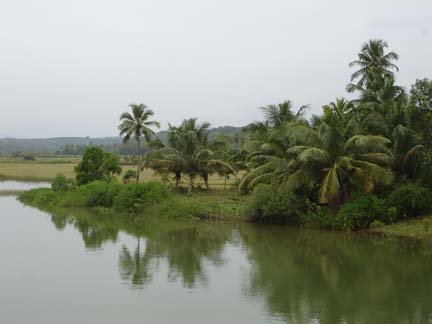
Holegadde near Honavar,Uttara Kannada dist, Karnataka
Copy? Right - but kindly remember to acknowledge!

" tulu-research.blogspot." ತುಳು ರಿಸರ್ಚ್. ಬ್ಲಾಗ್ಸ್ಪಾಟ್. ಇನ್

Have a nice day !