Mangalore has changed immensely during the last five millennia! The city of Mangalore initially evolved as a group of agricultural villages located on ancient river banks some 5000 years ago! The position (flow-paths) of the ancient rivers of Mangalore, have changed with passage of time, but the original agricultural signature villages have remained as fossil place names!
India was populated by early humans migrating since ca.120,000 years according to recent studies. Early pre-history of Mangalore is hazy but it was definitely home for numerous ancient tribal immigrants from Africa, northern India and Austro-Asiatics from Southeast Asia as found and immortalised in the numerous ethnonyms preserved to this date.
Kudla
The familiar Tulu name for Mangalore is ‘Kudla’. Often the name ‘Kudla’ has been confused with ‘Koodla’ (=confluence of rivers). However, the confluence of two rivers that bound the Mangalore city at present, namely Phalguni (Gurupur) and Netravathi, happened only in the year 1887. (Cf: Post 98 in this blog). Before that period the two rivers were flowing independently and not showing any features of confluence! Therfore, the ‘koodla’ or confluence definition for kudla ventured in older posts herein (No16, 17) or other inspired texts requires amendments.
The word ‘Kudla’ (kuD+la) should be understood as agricultural village on river bank. Let us look into this explanation in detail.
Ancient Agricultural phase :(ca.3000 BC-400 BC)
Tulu rural people have a special fascination for the humble horse-gram (‘kuDu’), do you know why? ‘KuDu’ (Tulu) or ‘Huruli’ (Kannada), or the horse gram was the earliest agricultural food crop preferentially grown by our ancestors some 4 to 5 millenia ago as found out by archeo-botanical studies in southern India!
Within Mangalore there are atleast four areas that were formerly (ancient, ca. 3000-1500BC) dedicated to the cultivation of earliest known crop, the horse gram (‘kudu’). Of these, the place names ‘Kudla’ and ‘Kudupu’ are well known.
Ancient Rivers of Mangalore: Phalguni
Geological studies (conducted by our team during the last two decades) evince interesting historical and paleo-geographic data on the rivers of Mangalore. The flow paths (channels) of the two rivers of Mangalore, namely Phalguni (Gurupur) and Netravathi, have continuously changed paths several times during the period of last 10,000 years or more.
One of the interesting aspects of geological and historical data correlation is that the River Phalguni was flowing along what is presently known as Kodialbail (recognisible as a paleo-valley paths), cutting across Mahatma Gandhi Road near TA Pai convention center and flowing across Alake and joined the Sea near Kuduroli. As far as geological evidences for the existence of river channel are concerned, you can see distinct presence of water worn quartz pebbles preserved in the soil zones all along the paleo- river path described above.
The ancient village names actually support the geological findings. The name Kudla suggests agricultural/farm area (kuD) beside a river (‘ala’). Similarly ’Alake’ (Ala+ke) is a village on river bank, ‘ke’ being a spatial suffix of south-east Asian Austro-asiatic origin. Thus we can correlate the time of flow of Phalguni along Kodialbail to the ancient agricultural Kudla phase estimated at ca.3000-2000 BC, based on archeo-botanical studies in southern India.
Further, Kuduroli represents a village (Oli= village) of ‘kuduru’s (=riverine islands). The ‘Kuduroli’ place name may be slightly later in time and coined after the period the river shifted its position northwards from Alake- Kuduroli area.
Kudu, horse gram
Kud (u) =meant agricultural land ( ‘kuDu’, pre-Dravidian word of Munda origin: ku+du, ku=good,prosperous; du=land).Kudu (=horse gram) represented one of the earliest grown and consumed cereal grain in southern India. According to paleo-botanical evidences, Rice, the major food crop of the south, was introduced in southern India probably during ca.800-400 BC period. (Kudugol, Kannada word, is an agricultural/farming, crop cutting sickle.).
Incidentally the equivalent Kannada word ‘huruli’ is a modification of ‘uruli’, where uru=land and uru+li means product of earth. Thus both the words ‘kudu as well as ‘uruli’ reflect the deep respect early farmers had toward the earth.
Kudla= A habitation formed during ‘kudu’ phase. (Kud+la, Kud=agricultural land, la= a habitation beside a flowing stream,river).The word ‘Kudla’ has been also interpreted as kooD+la or confluence of rivers, but the agricultural explanation appears more appropriate because in the original area identified as ‘Kudla’ (or Kodialbail) proper, there is no evidence of any sort of confluence of rivers!
Kudupu= An agricultural (Kudu) village.
Kudthadka (near Bajal) = A field (aDka) dedicated to farming. kuDuta +aDka
Kudpadi (Jeppu)= A shady zone (shrub or tree grown area=’pāDi’) dedicated to Kudu farming.
Almost all these places were originally on the banks of river, now with passage of time most of the rivers have changed their flow paths due to earth movements. KuDupa (=farmer) was one of the ancient proper names among Tulu people.
It can be seen that ‘koDipu’ (=to sprout) evolved from the original word ‘kuDu’. With this, ‘koDi’ and ‘koDa’ place names like Kodipadi, Kodavur etc evolved.
Pre-Dravidian signatures
Kudu place names are not exclusive to Tulunadu. Infact Tulu people have inherited this word from the pre-Dravidian culture of Munda civilization had dominated in southern India, before the advent of Dravidian speakers. Even though there were skirmishes between the Munda aborigines and Dravidian immigrants as testified in 'Devi Mahatme' and other epics of the period, Dravidian culture gradually absorbed essence of of the older Munda language and culture as testified by the presence of older Munda words as well as continuation of Munda place names in Tulunadu and other pats of southern India. As a proof you of pervasive Munda civilization in southern India, you can find kudu place names in other parts of Karnataka and Maharastra such as Kudle, Kudne, Kuditi, Kuditini etc. Besides, ‘Kudubi’ or ‘Kudumbi’ were an ancient agricultural tribes.
Associated Naga cult
One of the possibilities apparent in the analysis of Kudu village names is the growth and association of Naga worship cults along with the Munda agricultural phase. Prehistoric agricultural development in Tulunadu lead to destruction of natural forest areas and the wild serpents began to invade cultivated farm areas. The farming tribes were appalled at the sight of snakes that had magical powers to terminate people by their venomous stings. The early farmer had no other choice but to pray ardently to these serpents for the security of his family and livestock.
The Kudupu village was an ancient centre of Naga worship.(Later it was transformed to centre of Kumara/Skanda worship). The derived word ‘koDapu’ means to sting (like a serpent bite). And the word ‘koDa’ also represented a ‘Naga’ or serpent. A special word in this connection is ‘koDamaNi’ (as found in the name of the Tulu Spirit Kodamanittaya) which possibly represents the ‘Nagamani’ or the mythical gemstone found on the hood of cobra.
®

A heritage blog by: Ravindra Mundkur & Hosabettu Vishwanatha
Showing posts with label Kudupu. Show all posts
Showing posts with label Kudupu. Show all posts
Sunday, September 26, 2010


Sunday, June 27, 2010
246. Kudla : A controversy
The word ‘Kudla’ is an ancient name and refers to the city of Mangalore.What is the meaning of this word Kudla? If you answer me that ‘Kudla’ means ‘kooDla’ or a confluence of two rivers, you may not be precisely reflecting the original meaning of this word!
Let us analyse this controversy.
A Confluence of Rivers?


Fluvial Geography of Mangalore city at present
Yes! Most of us, including this blogger, were under the impression that ‘kuDla’ means a confluence region of two rivers, Gurpur and Nethravati. You can also find this explanation in some of the earlier posts filed in this blog or write-ups published in periodicals.This opinion is also shared by the mighty Tulu Nighantu.
The Tulu Nighantu lists three meanings for the word Kudla (p.823):
1. Mangalore town, a confluence of two rivers.
2. Again. [The Tulu usage ‘kuDala kuDala’ means to repeat again and again.]
3. (a) a confluence of two rivers, (b) a confluence of a stream and a river. [Latter, also known as ’KooTel’]
Thus the cited entries 1 and 3 above suggest emphatically that kuDla means a confluence.
The assertion that KuDla= confluence is based on the word koodla as in place names ‘KooDala Sangama’ (of Basaveshwara fame, Bagalkot district) or ‘KooDali’ (a confluence of Tunga and Bhadra rivers, Bhadravati Taluk).
Paleo-geography of Mangalore:
In Mangalore we have a confluence of Gurupur and Nethravati rivers between Bengare and southwestern corner of Mangalore city.However,the confluence of Gurpur with Nethravati River occurred relatively recently ie in the year 1887.That is to say that confluence as seen now did not exist in the historical past! Thus ancient word ‘kudla’ may not be referring to any recent confluence!
Secondly, the word ‘Kudla’ even though applied at present to Mangalore as a whole in general, was originally referring to apart of present Mangalore, especially the Kodialbail area.Kudla was the Kudla bail to begin with which with passage of time changed into Kodial-bail or simply Kodial. This Kudla bail or Kodial bail is a valley region once upon a time occupied by Phalguni River which changed its course (probably around 7th Century CE or earlier) further northwards in the course of time.
Thus the truth is that KuDla is not kooDla!
It was an fertile river plain in the antiquity that was amenable for good agricultural crops!
Let us explore the alternative explanation.
Agricultural settlement
Dr Gururaj Bhat (1963) in his work ‘Tulunadu’ passingly remarked that Kudla is not ‘kooDla’ or a confluence (p.29, 2009 edition). He pointed out that Kuduva tribes iniated agricultural practices in ancient Tulunadu.Kuduva tribes in different areas and times were also known as Kudi, Kudu, Kudubi, Kudumbi, Koda, Kunubi etc. The Munda word kuDa reffered to ‘good agricultural lands’ and those tribes associated with agriculture were known as KuDi or KuDubi.
Ku+ Da + ala. = An agricultural settlement on the river plains.
Ku=good, Da=land, earth. KuDa=good land, agricultural land. Ala= river plain or habitation on the river plain.
There are many villages in the Karavali having the prefix of KuDu.
KuDupu .(A village in eastern Mangalore on Nanthur -Vamanjur NH13 road).
KuDuma. (Old name for Dharmastala, Belthangadi taluk).
KuDumbi hittil ( A residential area near Falnir, Mangalore).
KuDipäDi .( A village near Vamadapadavu, Bantval taluk)
Kudne, Maharastra
Kudle beach, Gokarna, Uttar Kannada.
Note that in above place names suffixes –pu, Ne,-le etc are indicative of settlement or habitation areas.
According to Dr Padur Gururaja Bhat (ibid) ‘kuDu’ later transformed into ‘koDu’ as seen in place names KoDiala,KoDimbadi, KoDavur,KoDlaDi,KoDangala, KoDange etc.
KuDu
KuDu also represents horse gram which incidentally is the first agricultural food crop grown in southern India. Agriculture in southern Indian River plains was in vogue ca. 2000-2500 BC according to archeo-botanical studies. This takes the age of the place name Kudla to that period, ca 2000-2500BC. The word KuDäla is derived from ancient and pre-Dravidian Munda languages of southern India.
®
Sunday, May 31, 2009
188. Kudupu: layers of history
Our inadequacy in understanding the original historical and pre-historical environs and the socio-cultural settings, often introduces certain degree of ambiguity in the interpretation of place-names and the actual meanings originally intended by our forefathers. This aspect has been adequately emphasized in several of our previous posts.
Kudupu is one such village name that deserves attention of aficionados of evolution of our language and culture. Kudupu is a minor temple town located in the outskirt of present Mangalore city, known as abode of combined Subramanya and Naga worship. Many devout people consider this place on par with ‘Kukke Subramanya’ known for the atonement of what is described as ‘Naga-dosha’ in religious circles.
Three layers of history
At least three superposd layers of theologic history -with estimated periods of origin -can be delineated in the Kudupu area,which was a part of the Alupa domain of ancient Mangalore. The Kudupu is geographically located to the North of Kulashekar and Alape area of historical significance:
1.Early Kudupa/Koda (Naga) worship ca.400BC -400 CE
2.Kanda/Kumara (Subramanya) worship ca 400CE -800 CE
3.Ananta Padmanabha worship ca.800CE-1200CE
The three layers of history overalapped one after the other sequentially, wherein the chronologically earlier cults were absorbed and fused into the subsequent cults.
Naga worship
Let me draw your attention to the available evidences relating to the definite antiquity of this place before going to the analysis of the place name. The Naga worship is apparently quite ancient in Tulunadu possibly not younger than ca 600-400 BC. There are several villages in Tulunadu that carry place-names suggestive of Naga worship. Naguri, Nagur, Nagarbavi, Nagarkall, Uchila, Ujjodi, etc.
I prefer to add Kudupu and Kodavur to this list of Naga villages.
Kudupu is now famous for the temple built around ancient anthills representative of Naga worship cult and the worship of the popular Deity Anantha Padmanabha.
River that dried up
There are ’sthala - purana’ (site/village history) that describe the religious sanctity of the temple-town. In the cited theological ‘village history ‘ there is an interesting reference to a river “ Bhadra Saraswati Tirtha” flowing nearby the temple of Kudupu. The person who put together the village history was aware of the geographic fact that a river and later a lake (partial remains of a dried up river) existed in the area. It is interesting because presently there is no river near Kudupu. Since the village history is built around the devotion of Subramanya and Anantha Padmanabha ,possibly in that sequence, it can be predicted that it was originally compiled between the period of 4th to 7th Century CE. Thus it can be predicted that the river dried up somewhere during this period. The original Naga worship predates the phases of Subramanya and Anantha Padmanabha worships, and hence the initiation of Naga worship at Kudupu can be dated back to a period older than 4th Century CE.
However, the distinct valleys near Kudupu suggest that a river was flowing in the area once upon a time!
Etymology of Kudupu
Kudupu= to shrug off, to shiver (b) a variant of ‘kodapu’ (=to sting ) (c) ‘kudumpa’= a large stinging ant. (d) Kudupa/Kudpa= a male name (of tribal origin); possibly a stinging serpent or Serpent God, the usage derived from the one who stings. Therefore, the term ‘Kudupa’ originally represented a tribe who worshipped serpent God, a Naga worshipping tribe and Kudupu was their hamlet.
‘Kedu’= a boil or growth on the skin or infection. Earlier generation of Tulu people believed that skin boils, carbuncles etc were developed due to curse of Naga God and they prayed and offerings to Naga God for cure and relief from such scourges.
Later the food grain (horse gram) grown by the natives was also called Kudu. Kudu (=horse gram) one of the earliest food crops grown in south India, looks similar to ‘kedu’ outgrowths on the skin or vice versa.
‘Kudubi’= a tribal farmer, originally one who grows ‘kuDu’.
Kudubi, kudupa, kuduba, kuruba, kuduma, kodama, korama, kor, and koraga etc early tribal names might have been the variants applied to related or unrelated tribes spread in spatially different regions.
‘Kudpa’ or ‘Kudupa’ was a popular male name among the earlier generation of Tulu people. It is also true that many of the popular names were borrowed from actual tribal names, for example Koraga, Mudda, etc. Kuduma or Kodama was also a variant name of a former tribe, apart from being a personal name. There are villages in Tulunadu that bear the name ‘Kuduma’ or Kodamānu. Incidentally , renowned temple town Dharmasthala was formerly known as Kuduma.
Koda mani
The other variant ‘Kodama’ is also preserved in the village name ‘Kodaman’. There are several other ‘KoDa-‘ villages such as Kodavur,Kodanjikal,Kodange,Kodakal,Kodapadavu, Kodimbadi, etc.
There is one more proof for the above suggested derivation of ‘KoDa’=Naga. It is the name of a Tulu Spirit, namely the ‘Kodamanittaya’. The puzzling unexplained word ‘KoDa-mani’ should be the equivalent of the ‘naga-mani’ or the mythical gem on the hood of the Naga God.
Therefore, based on the foregoing analysis it may be tentatively concluded that the village ‘Kudupu’ was an early habitation of serpent worshipping tribes called ‘Kudupas’. And in their language, the word Kudupa, Kodapa or Koda represented the Naga, their God.
®
Kudupu is one such village name that deserves attention of aficionados of evolution of our language and culture. Kudupu is a minor temple town located in the outskirt of present Mangalore city, known as abode of combined Subramanya and Naga worship. Many devout people consider this place on par with ‘Kukke Subramanya’ known for the atonement of what is described as ‘Naga-dosha’ in religious circles.
Three layers of history
At least three superposd layers of theologic history -with estimated periods of origin -can be delineated in the Kudupu area,which was a part of the Alupa domain of ancient Mangalore. The Kudupu is geographically located to the North of Kulashekar and Alape area of historical significance:
1.Early Kudupa/Koda (Naga) worship ca.400BC -400 CE
2.Kanda/Kumara (Subramanya) worship ca 400CE -800 CE
3.Ananta Padmanabha worship ca.800CE-1200CE
The three layers of history overalapped one after the other sequentially, wherein the chronologically earlier cults were absorbed and fused into the subsequent cults.
Naga worship
Let me draw your attention to the available evidences relating to the definite antiquity of this place before going to the analysis of the place name. The Naga worship is apparently quite ancient in Tulunadu possibly not younger than ca 600-400 BC. There are several villages in Tulunadu that carry place-names suggestive of Naga worship. Naguri, Nagur, Nagarbavi, Nagarkall, Uchila, Ujjodi, etc.
I prefer to add Kudupu and Kodavur to this list of Naga villages.
Kudupu is now famous for the temple built around ancient anthills representative of Naga worship cult and the worship of the popular Deity Anantha Padmanabha.
River that dried up
There are ’sthala - purana’ (site/village history) that describe the religious sanctity of the temple-town. In the cited theological ‘village history ‘ there is an interesting reference to a river “ Bhadra Saraswati Tirtha” flowing nearby the temple of Kudupu. The person who put together the village history was aware of the geographic fact that a river and later a lake (partial remains of a dried up river) existed in the area. It is interesting because presently there is no river near Kudupu. Since the village history is built around the devotion of Subramanya and Anantha Padmanabha ,possibly in that sequence, it can be predicted that it was originally compiled between the period of 4th to 7th Century CE. Thus it can be predicted that the river dried up somewhere during this period. The original Naga worship predates the phases of Subramanya and Anantha Padmanabha worships, and hence the initiation of Naga worship at Kudupu can be dated back to a period older than 4th Century CE.
However, the distinct valleys near Kudupu suggest that a river was flowing in the area once upon a time!
Etymology of Kudupu
Kudupu= to shrug off, to shiver (b) a variant of ‘kodapu’ (=to sting ) (c) ‘kudumpa’= a large stinging ant. (d) Kudupa/Kudpa= a male name (of tribal origin); possibly a stinging serpent or Serpent God, the usage derived from the one who stings. Therefore, the term ‘Kudupa’ originally represented a tribe who worshipped serpent God, a Naga worshipping tribe and Kudupu was their hamlet.
‘Kedu’= a boil or growth on the skin or infection. Earlier generation of Tulu people believed that skin boils, carbuncles etc were developed due to curse of Naga God and they prayed and offerings to Naga God for cure and relief from such scourges.
Later the food grain (horse gram) grown by the natives was also called Kudu. Kudu (=horse gram) one of the earliest food crops grown in south India, looks similar to ‘kedu’ outgrowths on the skin or vice versa.
‘Kudubi’= a tribal farmer, originally one who grows ‘kuDu’.
Kudubi, kudupa, kuduba, kuruba, kuduma, kodama, korama, kor, and koraga etc early tribal names might have been the variants applied to related or unrelated tribes spread in spatially different regions.
‘Kudpa’ or ‘Kudupa’ was a popular male name among the earlier generation of Tulu people. It is also true that many of the popular names were borrowed from actual tribal names, for example Koraga, Mudda, etc. Kuduma or Kodama was also a variant name of a former tribe, apart from being a personal name. There are villages in Tulunadu that bear the name ‘Kuduma’ or Kodamānu. Incidentally , renowned temple town Dharmasthala was formerly known as Kuduma.
Koda mani
The other variant ‘Kodama’ is also preserved in the village name ‘Kodaman’. There are several other ‘KoDa-‘ villages such as Kodavur,Kodanjikal,Kodange,Kodakal,Kodapadavu, Kodimbadi, etc.
There is one more proof for the above suggested derivation of ‘KoDa’=Naga. It is the name of a Tulu Spirit, namely the ‘Kodamanittaya’. The puzzling unexplained word ‘KoDa-mani’ should be the equivalent of the ‘naga-mani’ or the mythical gem on the hood of the Naga God.
Therefore, based on the foregoing analysis it may be tentatively concluded that the village ‘Kudupu’ was an early habitation of serpent worshipping tribes called ‘Kudupas’. And in their language, the word Kudupa, Kodapa or Koda represented the Naga, their God.
®
Subscribe to:
Posts (Atom)
A Coastal estuary
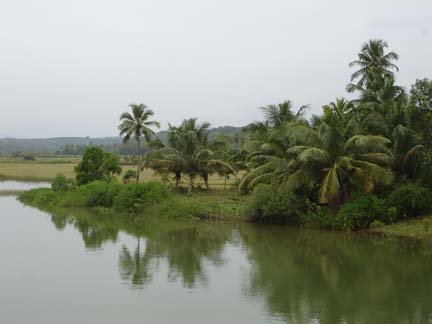
Holegadde near Honavar,Uttara Kannada dist, Karnataka
Copy? Right - but kindly remember to acknowledge!

" tulu-research.blogspot." ತುಳು ರಿಸರ್ಚ್. ಬ್ಲಾಗ್ಸ್ಪಾಟ್. ಇನ್

Have a nice day !