Showing posts with label Permanki. Show all posts

Friday, January 31, 2014

330. Manki: Village names in India

There is a place known as ‘Manki stand’ near Mangaladevi Temple in Mangalore. The place acquired the epithet of ‘stand’ since it was used as station for ‘Jataka’ (Horse carriage) during the British administration period in Mangalore. I used to think that the name was Monkey till I found that place names like Manki exist in other places for example near Honnavar in Uttara Kannada District, Karnataka. Similarly there is a village known as Permanki near Gurupur and Ulaibettu.

Etymology
Manki is a term connected with Munda tribes of Austro-Asiatic origin who were spread in diverse parts of India in the pre-Dravidian antiquity but presently restricted to parts of Bihar, Chattisgad, Orissa and Bengal. The term Manki represents a village or a habitation.
Thus the village name Permanki means a large village since pera means large in Dravidian languages also.

Manki Villages in India
Bihar: Manki, Mankidih, Mankiman
Chattisgarh: Manki
Jharkhand: Mankidih, Manki Bazar,
Karnataka:  Manki, Permanki,
Madhya Pradesh: Manki, Manki Salaiya, Mankiyai, Mankisar,Manki Ryt
Maharastra; Manki, Mankivalli
Meghalaya: Mankingiri
Orissa: Mankiria,Mankididihi, Mankidia, Mankidi
Punjab: Manki, Mankinvalli,
Rajastan: Manki, Mankiyas
Uttar Pradesh: Manki, Mankikhurd, Mankikalan, Mankiari.

Austro-Asiatic Munda tribes
The wide distribution of place names containing the term Manki and other place names containing Munda as prefix or suffix suggest that  habitations of Munda tribes were distributed all over India once upon a time probably before the advent and dominance of Dravidians in Southern India .


®

Saturday, April 10, 2010

236. Large villages

Size matters. Our ancestors had a special word for large villages. A number of villages have been named with prefix ‘peru’ or ‘peri’ (=large) indicating the expansive size of the area covered by the village.
Note some of the commonly known large villages around us:
Peradi= [pera+aDi]. A large settlement.
Perne= [peru+ Ne.] (Ne=area). Perne is a village near Uppinangadi on NH 48
Pernankila= [Per+Na+ank+ila.] (Na=area, ank=open field; ila= dwelling zone). Pernakila is a village near Udupi.
Perga =[Per+ga.] (ga=village area), The ‘ga’ appears to be the root word of later evolved word ‘gaon’(=village). The place name ‘Perga’ has become ‘Herga’ in the due course due to influence of Kannada.
Permanki= [per+ma+anki.] (‘manki’= elevated area; ‘ma’= elevated, raised; ‘anki’= open field/area)
Peramannur= [per+ maNN+oor]. (maNN=elevated flank of river, soil/sediment filled area
Peraje = [peri+aje]. Anje.>aje(=field). A large field.
Peraabe = [pera+be]. A large habitation. The spatial suffix '-be' apparently is an variant of -va or -ve, as in Belve.
Permude=[Peru+mude]. The word 'mude'('mu'=front, 'de'=area) appears to be a variant of 'munde'(=mogaru),a river flank area.
Perur= [Peru+ur].A large village.
Peruvaje = [Peru+va+aje]. A large field area of habitation.
Peruvayi = [Peru+ va + ayi]. A large area of habitation.
Periadka= [per+ia+adka].( ‘peria’=larger, large area; ‘adka’=aD+ka= field with trees; adka=ancient burial ground)
Peramogaru=[pera+mogaru].A large river plain. (‘mogaru’= a river plain or flank) . The village name has been distended to ‘Paēra mogaru’ (‘pEra’=milky) by inadvertent usage.
Perla =[peri+la]. A large settlement beside a river/stream. ‘ala’=stream, area beside stream.
Perlaguri==[peri+la+ guri]. A deep valley beside a large settlement beside a river/stream.
Perlampadi= [Peri+la+am+paadi].A large settlement beside a river with cattle grazing fields.
Perdala= [peri+Da+ala]. A large area beside a stream.( ‘Da’=area; ‘ala’=stream, area beside stream).
**
In Kannada areas, the 'peri' prefix has become 'hiri' or 'hirey'. For example:
Hiriadka described above under Periadka.
Hiregutti = A large hilly aaea (Uttara Kannada).
Hiriyur= A large village. Chitradurga district.
Hiremagalur= Elder daughter's village.

Antiquity
It is possible that some of the familiar words ,like peri /peru, we use in our language could be an ancient word shared by cultures in distant parts of the globe. One of the common explanation science provides is migration of early human tribes on continental scale.
Peru’ is name of a large country in South America. One of the meanings attributed to the country name Peru is ‘land of abundance’. The ‘abundance’ and the ‘large size’ seems related properties, suggesting a possible common ancestry for the word ‘Per’ or ‘Peru’.
®

Thursday, December 17, 2009

216. Permanki


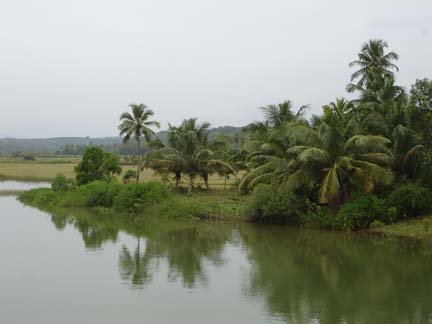
Some of the village names sound funny and do not have ready meanings even among the natives of those villages. One such hamlet name is Per(a)manki, located in Ulaibettu village on the banks of River Gurupur, near Neermarga and Mallur, in Mangalore Taluk.
The word ‘Permanki’ can be analyzed as follows:
In this place name, the Dravidian prefix ‘peru’ has been combined with ‘manki’. Peru or peri =large, big. Periya> hiriya= larger, bigger or elder. (There are several villages in Tulunadu carrying the prefix 'peru', like Pervaaje, Perankila, Perara, Perdur, Peramoger, Periadka, Peramannur etc.)
And we can attribute a meaning for the word ‘manki’ based on the line of analyses followed in earlier posts.
Manki= ma+anki= an elevated place.
Therefore, 'Permanki' stands for a large village located on a elevated ground or plateau.
Manki
The second word unit, namely Manki is an independent village name. We have a Manki village near Honnavar, Uttar Kannada district. The word ‘manki’  is a large settlement or a village in Munda cultural scenario and Munda language.
Suffix -ki
The word ‘manki’ emphasizes the existence of an ancient suffix -ki as a spatial attribute. It must be ancient one and discontinued later because it is not found in later or current Dravidian place names. However, it exists in some of the older place names like Neranki,Haleneranki,Parenki, Karenki(Dakshina Kannada),Karki, Valki (Uttara Kannada ), Bhalki (Bidar) etc.
Suffix –gi and –angi
Besides, we find another variant of suffix-ki in the form of –gi (or –angi) in Shimoga and surrounding regions. Ucchangi, Bhadrangi, Devangi, etc.Examples for places with suffix-'gi', are mostly found in Uttara Kannada and Uttar Karnataka: Balgi,Bargi,Biligi, Divgi, Byadagi, Nimbergi, Nesargi, Kalghatgi,Kushtagi, etc
Antiquity of words
The Karavali and contiguous parts of southern India have preserved many fossil words in the form of place names bearing testimony to numerous ancient tribes that sauntered and lived across this vast land. Although we find numerous fossil words as well as regional variants of some of these words, it is difficult task at this stage to pinpoint and classify the tribes and the words (languages) used by them.
Another possible way of establishing the antiquity of the words is to search for similar words (place names) in other parts of the world especially along known routes of human migration.
We find that  Manki as a place name exists even in Swat region (North West Frontier Province), Pakistan, in the islands of Papua New Guinea and in Poland. The Gandhar region (present Pakistan and Afghanistan) have been known as one of the ancient routes of immigration into India. Similarly the Papua New Guinea has been described as one of the early centers of human civilization outside Africa.
The strings of data discussed above establish that ancient words such as ‘manki’ have been carried to different places by the migrating human tribes.
Manki stand
There is one 'Manki' stand near Mangaladevi Temple, Mangalore.In the absence Of proper explanation, some people might have thought of this as 'monkey stand'! Now, the name 'Manki'(=elevated area) tallies with the other alternate names existing for the Old Mangalore area such as 'Mangaar'(ma+ang+ar=elevated open field). The old name 'Mangar' for the area, later became 'Mangal' and 'Mangala'probably between 6th to 8th Century CE. Yet it is interesting to note that both the ancient place names, 'Mangaar' (near Yemmekere)and 'Manki'(near Mangaladevi temple) have survived.

-With Hosabettu Vishwanath
®

Blog Archive

Books for Reference

  • A Comparative Study of Tulu Dialects By Dr. Padmanabha Kekunnaya. Govinda Pai Reserach Centre, UDupi. 1994
  • Koti Chennaya: Janapadiya Adhyayana. By Dr. Vamana Nandavar. Hemanshu Prakashana ,Mangalore.2001.
  • Male kudiyaru. Dr B. A.Viveka Rai and D.Yadupathi Gowda, Mangalore University,1996.
  • Mogaveera Samskriti By Venkataraja Punimchattaya. Karnataka Sahitya Academy.1993.
  • Mugeraru:Jananga Janapada Adhyayana. By Dr Abhaya Kumar Kaukradi.Kannada & Culture Directorate,Bangalore & Karnataka Tulu Academy, Mangalore,1997.
  • Puttubalakeya Pad-danagalu. Ed: Dr B.A.Viveka Rai,Yadupati Gowda and Rajashri, Sri Dharmasthala Manjunatheswara Tulu Peeta. Mangalore University.2004
  • Se'erige. Ed:Dr K.Chinnapa Gowda.Madipu Prakashana,Mangalagangotri,2000.
  • Studies in Tuluva History and Culture.by Dr P Gururaja Bhat (1975).Milagres College,Kallinapur,Udupi.
  • Taulava Sanskriti by Dr.B.A.Viveka Rai, Sahyadri Prakashana,Mysore 1977
  • TuLu naaDu-nuDi By Dr.PalthaDi Ramakrishna Achar, Puttur.
  • TuLu NighanTu. (Editor in Chief: Dr U.P.Upadhyaya, Govinda Pai Research Centre,Udupi. Six volumes. 1988 to 1997
  • Tulu Patero-A Philology & Grammar of Tulu Language by Budhananda Shivalli.2004.Mandira Prakashana Mangalore. p.317. (The book is in Tulu Language using Kannada script)
  • TuLunadina ShasanagaLa Sanskritika Adhyayana. By Shaila T. Verma (2002) Jnanodaya Prakashana,Bangalore, p.304.(Kannada)
  • Tuluvala Baliyendre. Compiled by N.A.Sheenappa Hegde,Polali,Sri Devi Prakashana,Parkala,1929/1999

A Coastal estuary

A Coastal estuary
Holegadde near Honavar,Uttara Kannada dist, Karnataka

Copy? Right - but kindly remember to acknowledge!

Creative Commons License
This work is licensed under a Creative Commons Attribution 3.0 License.

" tulu-research.blogspot." ತುಳು ರಿಸರ್ಚ್. ಬ್ಲಾಗ್‌ಸ್ಪಾಟ್‌. ಇನ್

" tulu-research.blogspot."  ತುಳು  ರಿಸರ್ಚ್.  ಬ್ಲಾಗ್‌ಸ್ಪಾಟ್‌. ಇನ್
Have a nice day !